
A Content Strategy Built on What Your Buyers Actually Ask
Updated
Most brands do not have a content problem. They have a “what should we post this week?” problem. We fix it with a plan that starts from real customer questions, search demand and what AI assistants already say about your industry, then tells your team exactly what to make, where to put it and how to know it worked.
- Website and blog
- Instagram and TikTok
- YouTube
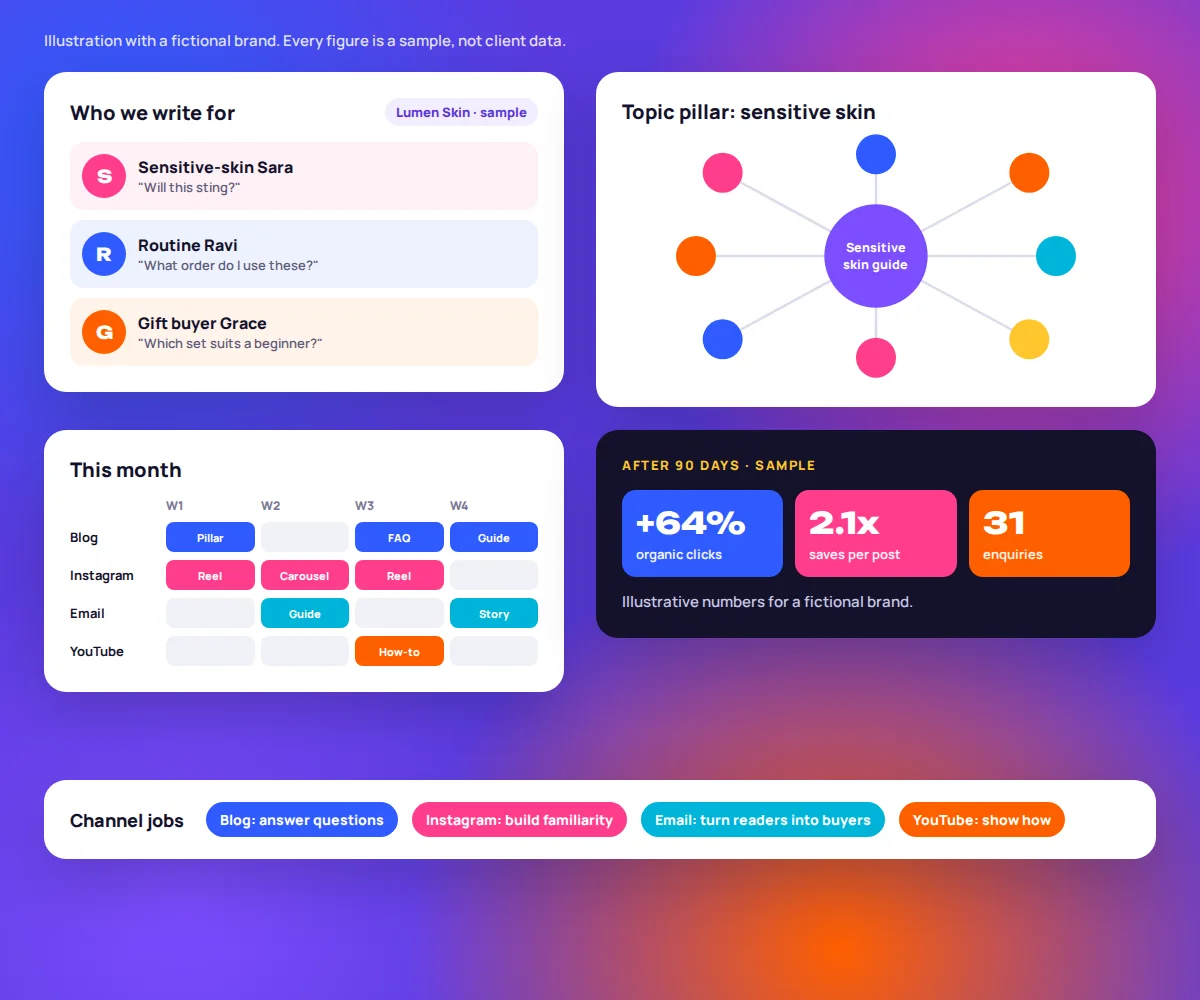 One plan your whole team can follow on a Monday morning
A written plan for who you are talking to, what you say, where you say it and how you measure it. Usually 10 to 15 pages, not a 90-slide deck.
Random posting, blog articles nobody reads, and a sales team that never uses anything marketing makes.
About four weeks to build. You see first results in search and social within two to three months of publishing.
What Is a Content Strategy?
A content strategy is the plan behind everything your brand publishes. It defines your audience, the questions they need answered before they buy, the topics you will own, the formats and channels you will use, and the numbers that prove it is working.
A content calendar tells you what goes out on Tuesday. A strategy tells you why that post exists at all. Without the second, the first fills up with holiday greetings and product photos that nobody saves.
The best strategies we have written are surprisingly short. They fit on a few pages because every decision traces back to one thing: what a real customer needs to hear, at that point in their decision, in the place they are already looking.
EmergingAds is a performance marketing agency founded in 2021, based in Gurugram, India, working with brands in the US, UK, UAE, India and Australia, with 85+ brands served. Content strategy sits inside our branding and content service and feeds our SEO and social media work.
Content Strategy vs Content Marketing vs a Content Calendar
Content strategy is the plan, content marketing is the work of making and distributing it, and a content calendar is the schedule. You need all three, in that order. Most businesses start with the calendar and wonder why nothing adds up.
Content strategy
Answers: why, for whom, about what?Audience, positioning, topic pillars, channel roles, success measures. Written once, reviewed every quarter.
Content marketing
Answers: how do we make and spread it?Writing, design, video, publishing, promotion and repurposing. The ongoing weekly work.
Content calendar
Answers: what goes out, when?Dates, owners, channels and status. Useful only when every slot comes from the strategy.
How Do You Decide What Content to Create?
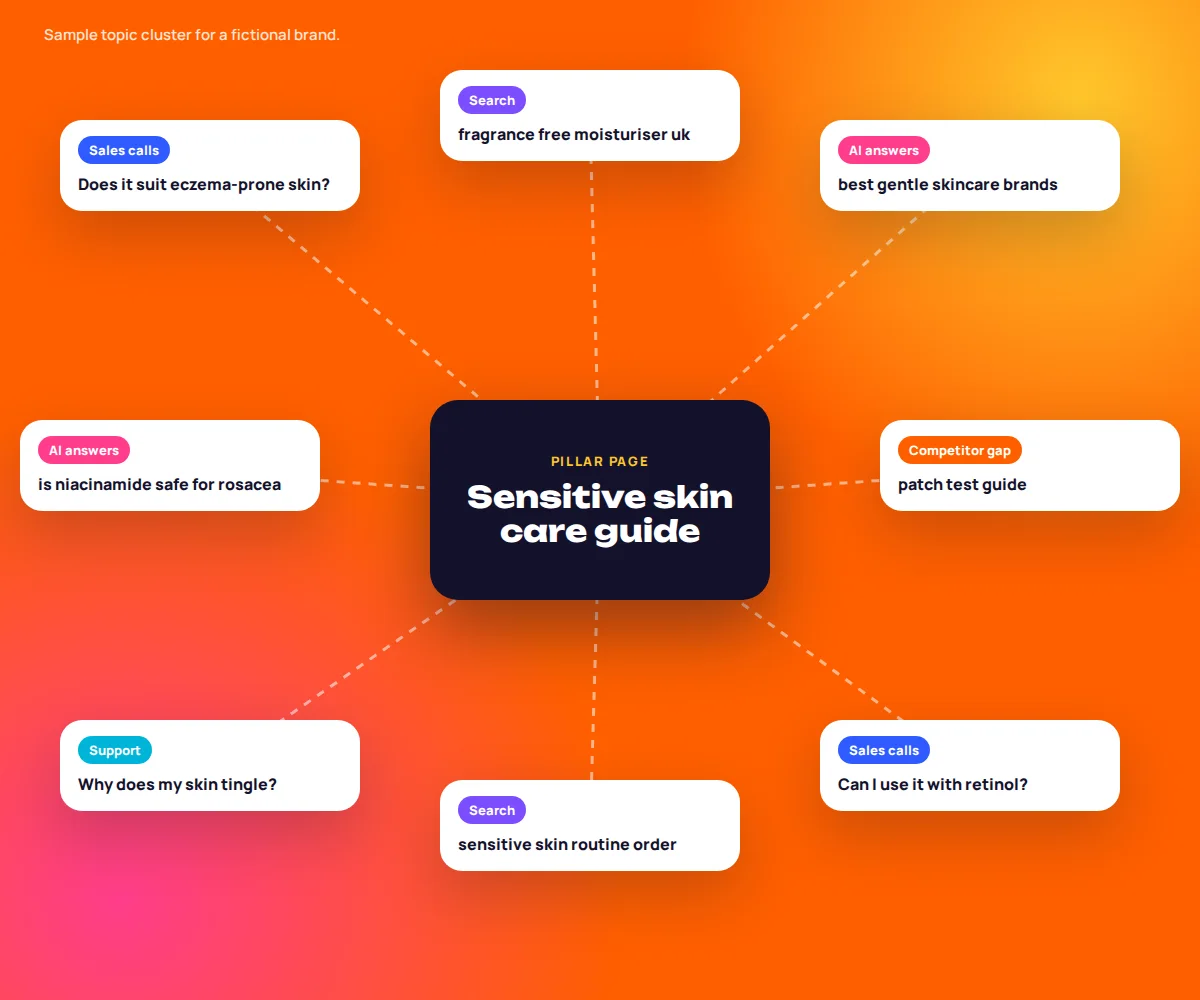
We use four sources and only commit to topics that show up in at least two of them: questions customers ask your sales and support team, what people search for, what AI assistants currently say about your industry, and the gaps in what competitors publish.
Sales calls and support tickets
The most valuable source and the most ignored. Twenty minutes with whoever answers the phone gives us better topics than any tool.
Search demand
Google Search Console first, then keyword tools. We look for questions with buying intent, not the biggest numbers. Our keyword research process sits behind this.
AI answers
We ask ChatGPT, Gemini and Perplexity the questions your buyers ask and note which brands get mentioned. If yours is missing, that shapes what we write.
Competitor gaps
Topics competitors rank for that you do not, and questions nobody in your market answers well. The second list is usually more interesting.
Content Mix Planner
Pick your main goal and how many hours a week your team can give content. The planner shows the mix we would usually start with, and roughly what that time buys each month. Treat it as a starting point for a conversation, not a rule.
What Does a 90-Day Content Plan Look Like?
A good 90-day plan builds one topic cluster properly instead of touching ten. The first month sets up the pillar page and the first supporting pieces, month two adds proof and video, and month three repurposes the best performers and fills the gaps the data shows.
Weeks 1 to 4: the pillar guide goes live first, because everything else links back to it. Social and email point people to it.
Weeks 5 to 8: proof arrives: a comparison page, a case study, customer content. This is where enquiries usually start to move.
Weeks 9 to 12: we look at what earned clicks, saves and leads, cut what did not, and refresh the pillar with what we learned.
How Do You Write Content That Ranks and Gets Quoted by AI?
Answer the question in the first two sentences, then prove it. Search engines and AI assistants both favour pages that state a clear answer, back it with specific facts, name who wrote it and keep it up to date. Vague, padded introductions lose on both.
“What does a content strategy cost?”
“In today’s fast-moving digital world, content is more important than ever. Every business is different, and many factors can affect pricing…”
- No answer until paragraph four
- No numbers, no ranges
- Nothing an AI assistant could quote
“What does a content strategy cost?”
“Most small and mid-sized businesses pay for a strategy once, then for monthly production. The price depends on how many channels and how much research is involved. Here is what changes it…”
- Direct answer first
- Clear factors a reader can apply
- Short, quotable sentences with a named author
What Should a Content Strategy Document Include?
At minimum: who the content is for, the three to five topics you will own, what each channel is for, how often you publish, who does what, and the numbers you will judge it by. If any of those are missing, the plan tends to fall apart within a month.
Audience profiles
Two or three real buyer types, written from interviews, with the questions each one asks before they buy.
Positioning and voice
What you say that competitors cannot, and how you sound saying it. Includes words to use and words to avoid.
Topic pillars
Three to five themes you will own, each with a pillar page and a list of supporting pieces.
Channel roles
One job per channel. Instagram builds familiarity, the website answers questions, email turns readers into buyers.
Formats and templates
The recurring formats you will use, with templates so they do not need designing from scratch each time.
Workflow
Who briefs, writes, designs, approves and publishes, and how long each step should take.
Distribution
How every new piece gets in front of people: email, social, internal links, sales team and paid boosts.
Measurement
The handful of numbers per channel that decide what to make more of and what to stop.
How Much Do Content Strategy Services Cost?
Most businesses pay once for the strategy and then monthly for production. The strategy price depends mainly on how many channels it covers, how much customer research is needed and how many markets or languages are involved. Production costs depend on volume and on how much video you want.
We would rather you spend less on the strategy and more on making things. A tight plan for two channels you can actually keep up beats a beautiful plan for six channels that stalls in week three.
If budget is limited, start with the website and one social channel. Add email once you have a steady flow of new subscribers, and video once you know which topics people care about.
What Changed When a Coaching Brand Got a Plan
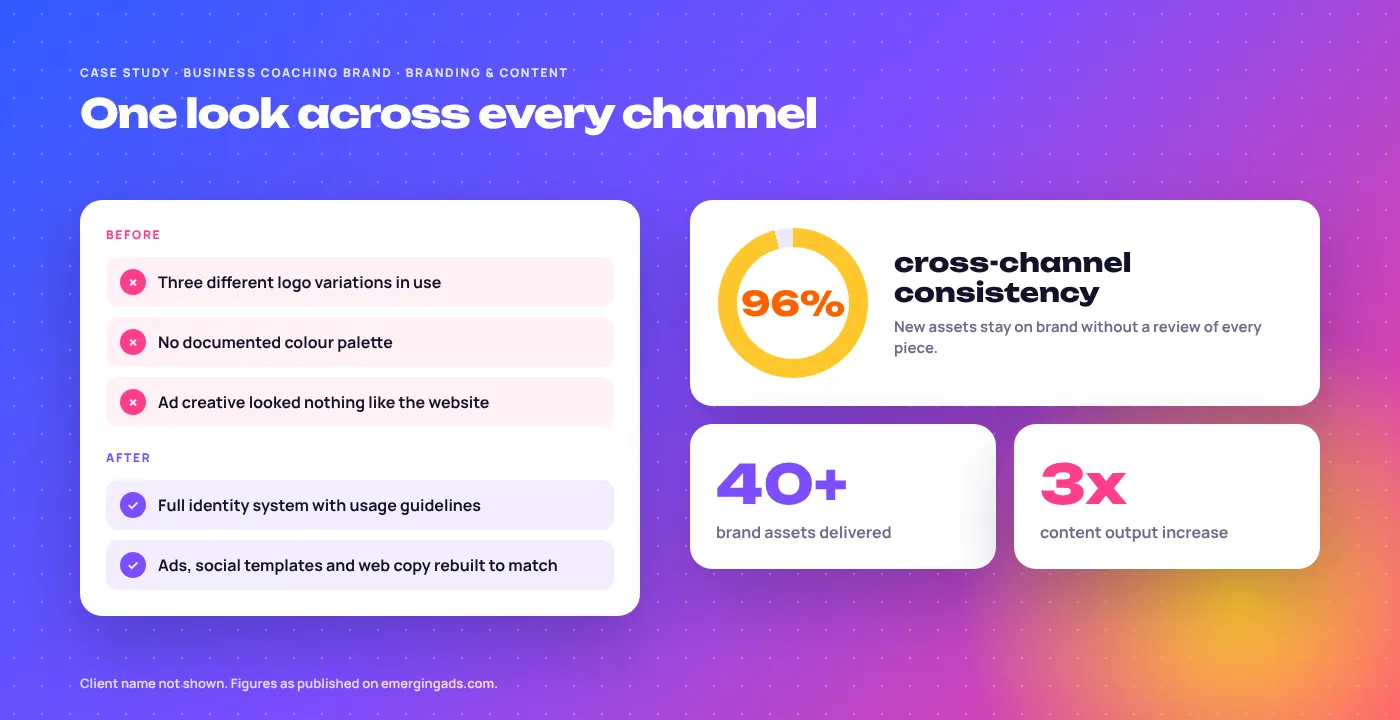
A business coaching brand, three logos, no plan
Ads, social posts and the website all looked like different companies, and content was made whenever someone had a spare hour. We wrote the brand and content rules first, then built templates and a publishing rhythm the team could keep up.
Same traffic, more enquiries
Content is not only blog posts. For a professional services firm, rewriting and restructuring the website so answers came first lifted conversions with no extra visitors.
conversion rate on the same traffic, page speed 94/100.
How Our Content Strategy Services Work
Four weeks to a finished strategy, then monthly production if you want us to make the content too.
Listen
Interviews with founders, sales and support. Six months of customer emails and call notes.
Week 1Research
Search Console, keyword gaps, competitor content and AI answer checks for your top questions.
Weeks 1 to 2Decide
Audience profiles, three to five topic pillars, the job of each channel and the numbers we will track.
Week 3Plan
A 90-day calendar, briefs for the first ten pieces and templates for recurring formats.
Week 4Make and review
Production by your team or ours, with a monthly report and a quarterly strategy review.
Ongoing
Services That Work Alongside Your Content Strategy
Content Strategy Questions
What is included in content strategy services?
Audience research, customer and search question research, topic pillars, the role of each channel, a 90-day calendar, briefs for the first pieces and a measurement plan. Production can be added monthly.
How long does it take to create a content strategy?
About four weeks for most small and mid-sized businesses. Larger companies with several products or markets usually need six to eight.
How is a content strategy different from an SEO strategy?
An SEO strategy focuses on search rankings. A content strategy covers every channel, including social, email and sales material, and uses search as one input among several.
How often should a content strategy be updated?
Review it every quarter against results and rewrite it once a year, or sooner if your products, audience or market change.
How do you measure whether content is working?
Each channel gets a job and a metric: organic clicks and enquiries for the website, saves and profile visits for social, clicks and revenue for email. Vanity numbers like impressions are tracked but not used to judge success.
Can content help my business appear in ChatGPT or Google AI Overviews?
It can improve your chances. Clear answers, specific facts, named authors, up-to-date pages and mentions on other trusted sites all make AI tools more likely to reference you. Nobody can guarantee it.
Do we need to make the content ourselves?
No. Some clients keep production in-house and use our strategy and briefs; others have us write, design and film. Most do a mix.
How many pieces of content should we publish each month?
Fewer than you think. Four strong pieces that answer real questions beat twenty filler posts. The planner above shows what different team sizes can realistically sustain.
Send Us Your Website and Three Competitors
We will tell you which questions your buyers ask that nobody in your market answers well, and the first three pieces we would make. Free, and yours to keep.