
Ecommerce Marketing That Scales Revenue, Not Just Traffic
We are an ecommerce marketing agency that runs Meta, Google Shopping, email and your store’s checkout as one system, judged on what lands in your bank account after product cost, shipping and returns.
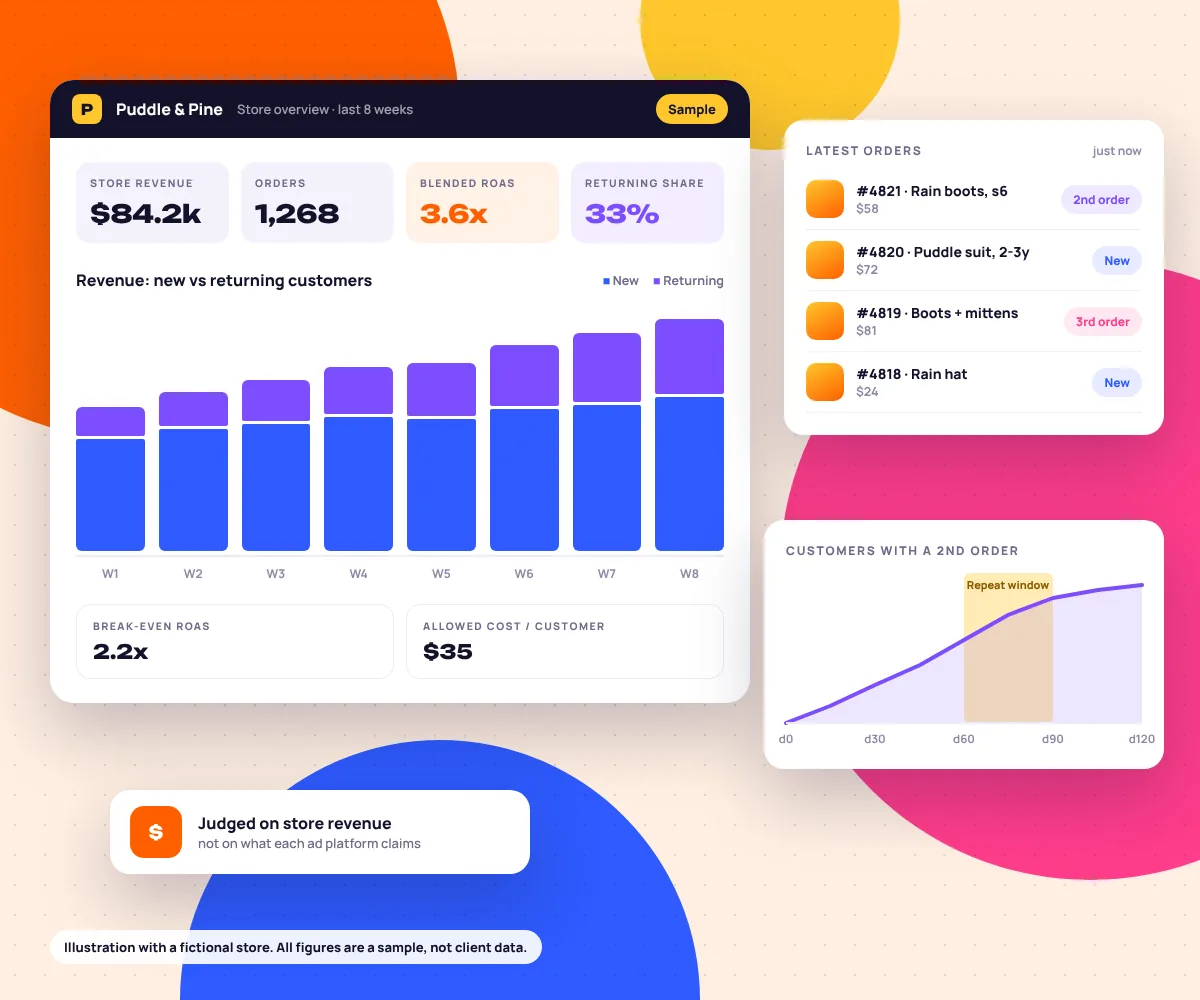
A Connected Ecommerce System: Acquisition, Retention and Conversion Working Together
Most stores run Meta here, Google there and email as an afterthought. The business gets busy but not more profitable, because nobody is doing the maths on the right.
A 3x ROAS sounds great until you take out product cost, shipping, payment fees and returns. On a lot of stores we audit, the ads are “working” and every first order still loses money. That can be fine, if second orders are coming. Often nobody has checked.
So before we touch a campaign we work out three numbers with you: what one order actually leaves you, how much you can pay to get a customer, and how much more you can pay once you count the second order. Every budget decision after that is measured against them.
Where a $60 order actually goes
Sample storeSample numbers for a fictional store, to show the method. Your audit uses your real costs and repeat rate.
Why D2C Brands Choose Us as Their Ecommerce Marketing Agency
We manage the full ecommerce stack, not just one ad account. Every channel has a different job, so we judge each one on a different number, and then judge all of them together on the last one.
Where most first orders start. Structured creative testing and weekly scaling decisions, optimised for purchases, with existing buyers kept out of prospecting so we only pay to find new ones.
Meta Ads management →Catches buyers already searching for your category. We rewrite feed titles for how people search and keep your brand name out of Performance Max, so it cannot take credit for sales you would get anyway.
Google Ads management →A second feed for your best creative, built native for TikTok rather than reposted from Meta. With TikTok Shop, creator affiliates and in-app checkout make it its own channel with its own pricing.
TikTok Ads management →Ad spend as a share of total Amazon sales, not just ad-attributed sales. If organic rank is climbing, TACoS falls even when ACoS looks flat. That is the number that tells you ads are building the listing.
Amazon Ads management →Welcome, browse, cart, checkout, post-purchase, replenishment and win-back flows, timed to your category’s repeat window. This is the channel that makes the $35 column on the left real.
Email marketing →In the UAE, India and Saudi Arabia, a chat often beats an email. Cart reminders, order updates and quick answers to “will this fit?” before someone gives up.
WhatsApp marketing →Product pages, cart and checkout, tested on the phone your buyers actually use. Better conversion improves the return of every channel above at once, however the visitor arrived.
Website design and CRO →Total store revenue divided by total ad spend. Platforms each claim the same sale, so their numbers add up to more than your store took. This one cannot be double counted, and it is the one we report first.
See results by brand →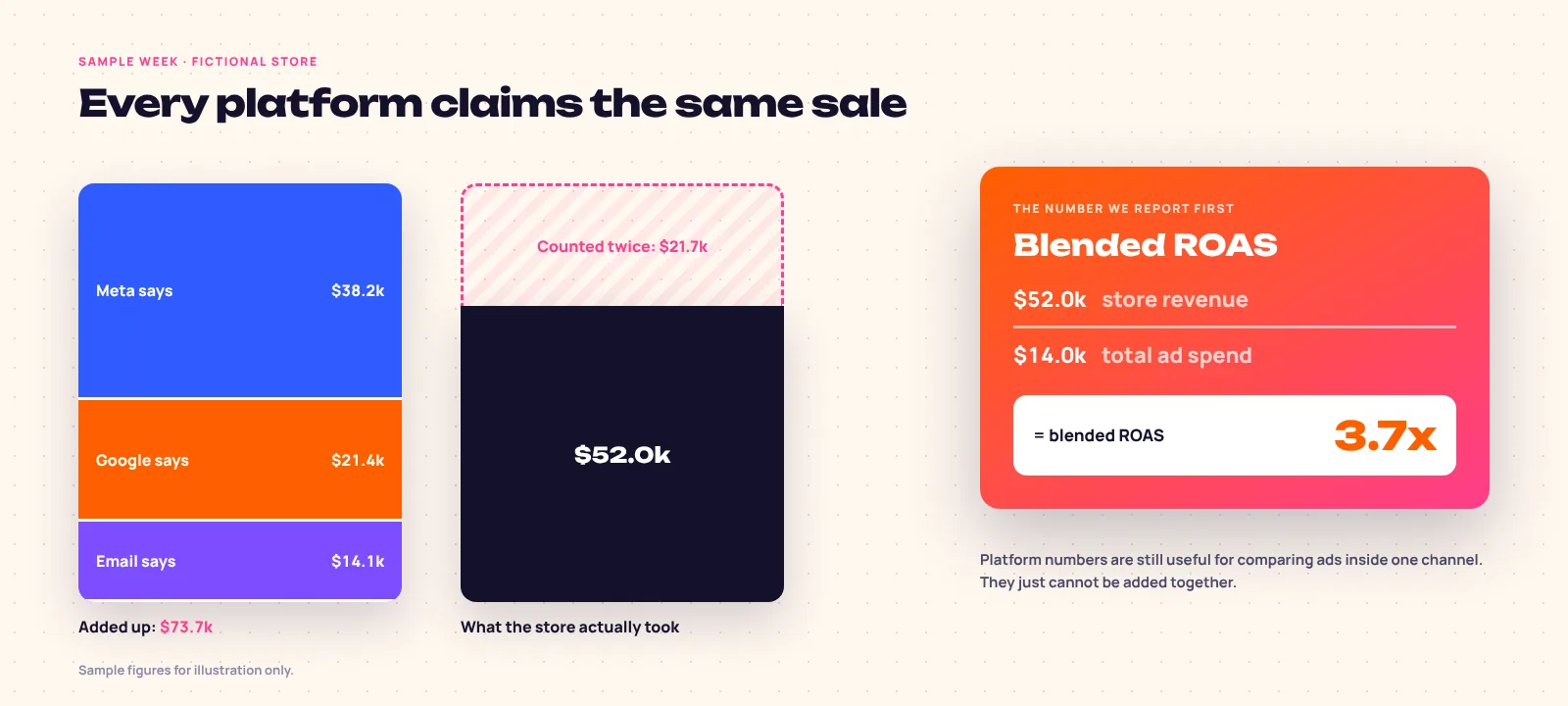
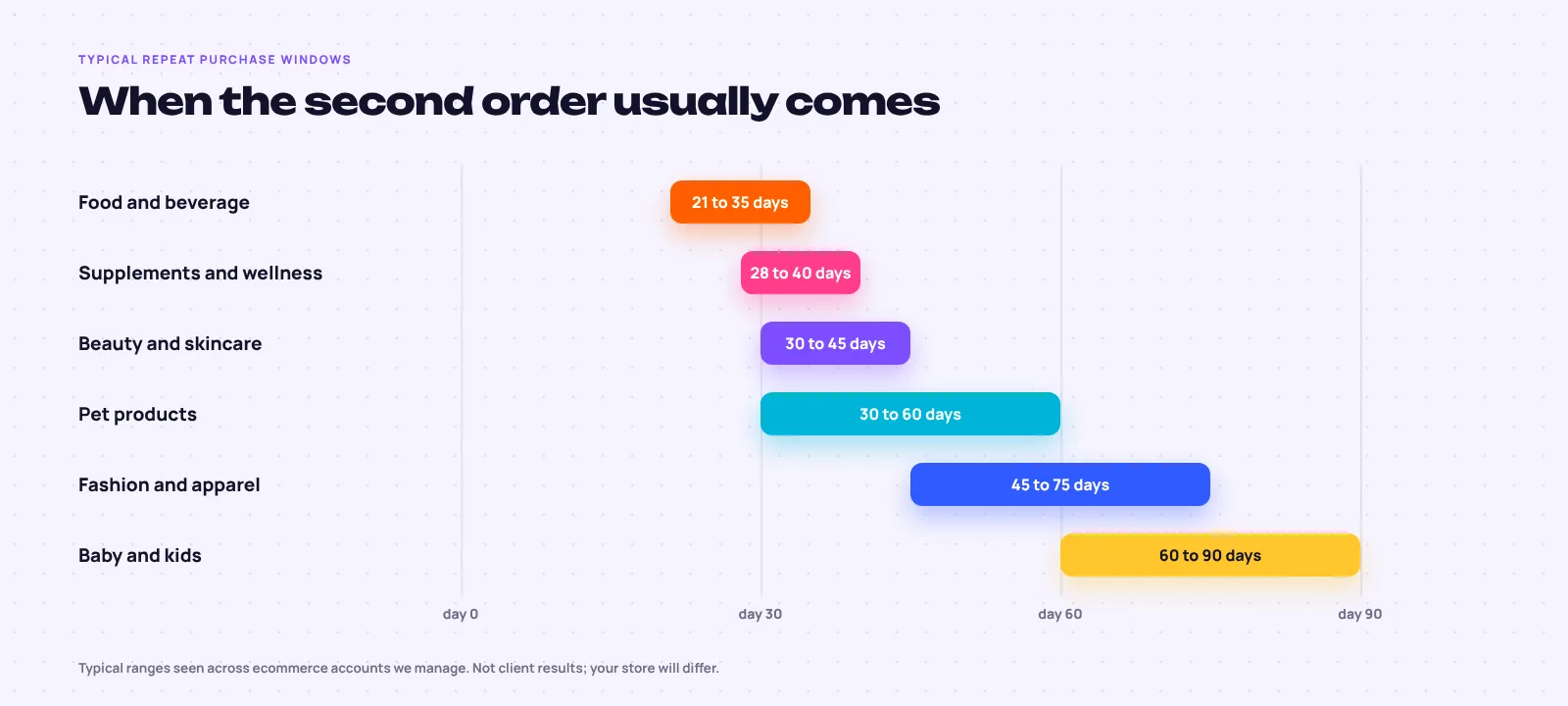
Ecommerce Benchmarks Differ by Category. Here’s What We See.
A baby clothing brand converts differently from a supplements brand. A “good” ROAS or repeat rate depends on what you sell, so pick your shelf.
Children grow out of the product. Plan around that.
What works
Creative that names the age or size range does the targeting for you. The repeat order is the next size up, so post-purchase emails are timed to growth, not to a generic 30-day reminder. Gift buyers (grandparents, baby showers) need their own angle and a gift-ready bundle.
Limits and seasons
Safety and material claims (“organic”, “hypoallergenic”) need proof on the product page or ads get rejected. Expect peaks around gifting seasons and Mother’s Day. See Simple Seed Baby and Baladi Baby.
Proof beats polish. Replenishment beats discounts.
What works
Real skin on camera, ingredient explainers and “I used it for 30 days” videos. A replenishment email a few days before the bottle runs out does more than a 20% code. Bundles (cleanser plus serum) lift AOV without training people to wait for sales.
Returns are a marketing number, not just an ops one.
What works
Occasion-led creative (a wedding, a trip, a first day at work) and new-drop urgency. We judge campaigns on revenue after returns, because a campaign that sells lots of the wrong size is not a winner. Size guides and fit notes on the product page pay for themselves.
Limits and seasons
Catalog ads only work as well as your product photos and feed titles. Peaks follow festive and wedding seasons, end-of-season sales and Black Friday. See Elan Store.
Low AOV means the first order rarely pays. The third one does.
What works
Taste is hard to sell through a screen, so we lean on reaction videos, unboxing and “pick your box” bundles that push AOV past the free-shipping line. Subscribe-and-save turns a short repeat window into the whole business model.
Limits and seasons
Perishables limit where you can ship, so campaigns target delivery zones, not whole countries. Gifting seasons and holidays dominate. See Thicc Cookies and Circuit Factory Food Box.
The strictest ad policies in ecommerce. Write for them from day one.
What works
Founder and customer stories about routine and how they feel, not what the product “cures”. A first-order offer that leads into a subscription, then a day-25 reminder for one-time buyers. Customer acquisition cost is the number to fight for here.
Limits and seasons
Meta and Google both reject health claims, weight-loss promises and copy that implies a personal condition. Google also restricts some ingredients outright. January and pre-summer peak. See A Life Plus and True Gut.
People buy for the pet, and they love showing it off.
What works
Pet-first creative and customer photos almost always beat studio shots. Ask for the pet’s name and size at checkout, then use it in every email. Food and treats run on refill cycles, toys and accessories on gifting and new arrivals.
Limits and seasons
Health and vet-style claims (“cures itching”) need the same care as human supplements. Pet birthdays, adoption anniversaries and Q4 all work. See HappyTails.
Typical ranges based on patterns across the ecommerce accounts we manage. They are not promises or client results, and your numbers will vary with price point, positioning and market.
Your Platform Shapes What’s Actually Possible
Marketing has to work inside your platform’s real limits, not around them. Pick yours to see what it lets us do, what it gets in the way of, and what we fix first.
Shopify and Shopify Plus
The best app ecosystem for Klaviyo, reviews and subscriptions, and clean checkout data. We lean on Shopify’s own order data for attribution and on fast product-page tests for CRO.
Most Shopify problems we find are self-inflicted: two pixels firing from the theme and an app, or the Meta and Google sales channel apps never set to share full customer data.
- Lets usSend server-side purchase events to Meta and Google through the native apps, sync the catalog daily, trigger Klaviyo flows on any store event.
- Watch outCheckout edits are limited unless you are on Plus, and every extra app slows the store on mobile.
- We fix firstDuplicate pixels, data-sharing settings, feed titles and the abandoned checkout flow.
WooCommerce
More flexible than Shopify, and more fragmented. Tracking depends on which plugins you installed and how they talk to each other, and default attribution is weaker.
We set up server-side GA4 and the Meta Conversions API early, because WooCommerce’s browser-only tracking misses a lot of purchases once ad blockers and privacy settings get involved.
- Lets usChange almost anything in checkout and product pages, and own the data on your own server.
- Watch outA plugin update can silently break the purchase event. Hosting and caching decide your page speed.
- We fix firstServer-side tracking, the product feed plugin, and a weekly check that purchases still fire.
Amazon
Marketplace selling needs a different creative and pricing strategy from your own store, so we treat it as a separate channel, not an add-on. Ranking runs on sales velocity, reviews and conversion rate.
You do not get the customer’s email, so there is no retention flow. The listing and ads have to do all the work, and your D2C prices need to make sense next to your Amazon price.
- Lets usRun Sponsored Products, Brands and Display, harvest search terms that convert, and send outside traffic with Amazon attribution links.
- Watch outAds can buy sales you would have had organically. Price gaps with your own site confuse buyers.
- We fix firstListing images and A+ content, campaign structure, and TACoS reporting.
TikTok Shop
People buy without leaving the app, which changes everything about the creative. Shop ads, creator affiliates and live selling sit side by side, and the video is the product page.
Like Amazon, it is marketplace-native selling, so we give it its own creative plan and pricing rather than pointing the same ads at it.
- Lets usRun Shop ads, pay creators on commission, and turn the best affiliate videos into ads.
- Watch outSample costs and commissions eat margin fast. Creators need clear briefs or the claims go off-script.
- We fix firstProduct listings, the affiliate commission plan and a first batch of native videos.
How We Scale Your Ecommerce Brand
We plan the work around a customer’s orders, not around our own departments. Campaigns go live in around 14 days, and the full system is running within 30.
Ecommerce audit
Paid channels, email programme, store conversion rate, tracking and creative, reviewed together to find the biggest leaks.
your real break-even ROAS and allowed cost per customerChannel strategy and launch
Channel priority and budget split set by your category, margins and growth stage. Tracking verified, then campaigns go live.
live campaigns and a dashboard on store revenueLaunch and integrate
Welcome, post-purchase and cart flows switched on, timed to your repeat window. First CRO fixes on product pages and checkout.
the connected system, runningScale for blended ROAS
Weekly cross-channel changes against one blended number. Budget moves behind what is profitable, and we stop what is not.
a weekly note and monthly cohort view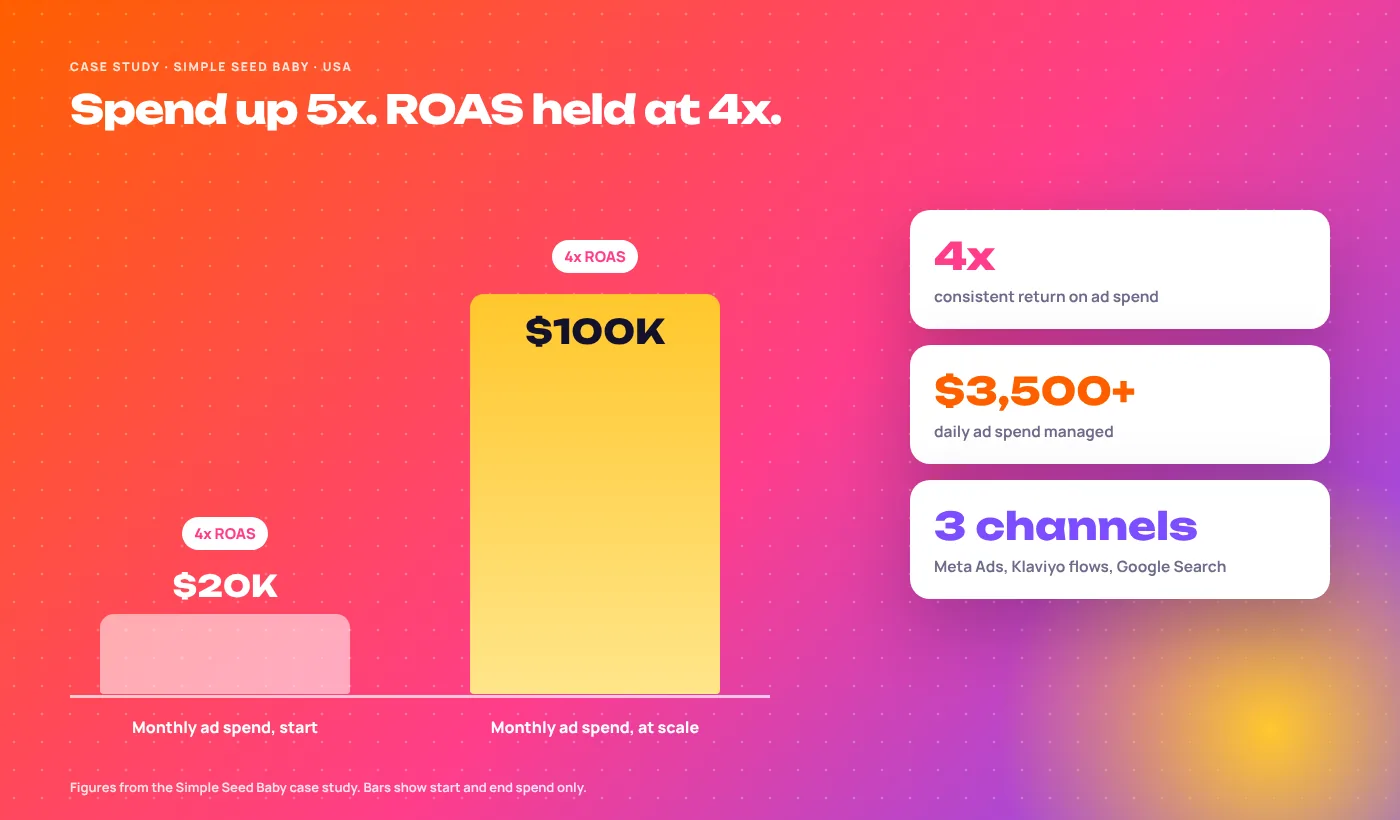
How Simple Seed Scaled to $100K/Month Ad Spend at a Consistent 4x ROAS
Simple Seed is a premium bamboo baby clothing brand. We took monthly ad spend from $20K to $100K and kept ROAS at 4x the whole way.
- Meta Ads, Klaviyo lifecycle flows and Google Search built as one system
- Email flows timed to baby clothing’s 60 to 90 day repeat window, because babies outgrow sizes, not on a beauty-style 30-day cycle
- Structured creative production, so new ads were ready before old ones tired as spend grew
Ecommerce Marketing Results
Real D2C and ecommerce brands we have worked with. Each card opens the full story.
Ecommerce Marketing: Frequently Asked Questions
What store owners ask us on the first call. If yours is not here, ask it on the audit.
What ecommerce platforms do you work with?
Mostly Shopify and Shopify Plus, but also WooCommerce, custom builds, Amazon and TikTok Shop. We work inside your existing setup. You do not need to migrate platforms to work with us.
What is a good ROAS for my store?
It depends on your margins. Divide your average order value by what one order leaves you after product cost, shipping, fees and returns. That is your break-even ROAS. A 2.5x can be very profitable for one store and a loss for another, which is why we work it out before setting targets.
Do you manage creative production?
Yes. Weekly static and video creative is part of full management. At higher spend, creative volume is the main thing that limits scaling, so we plan it as a weekly routine, not a one-off shoot.
How long until I see results?
Email automation can bring in revenue from the first week it is live. Paid campaigns usually show ROAS improvements within 30 days and meaningful scale within 60 to 90 days, once we have found a few creative winners.
Do different ecommerce categories really need different strategies?
Yes. Repeat windows, price sensitivity and the reasons people buy all differ by category. A subscription-first plan that works for supplements would underperform for fashion, where new-drop urgency matters more.
Why does Meta’s ROAS not match what Shopify shows?
Each platform counts differently and each one claims the same sale. Meta includes views and modelled conversions, Google tends to credit the last click, and Shopify only knows what was bought. We report all of them, but judge budget on blended ROAS: total store revenue divided by total ad spend.
Do you work with marketplace sellers as well as D2C stores?
Yes. We manage TikTok Shop and Amazon alongside your own store, treating each as a separate channel with its own creative, pricing and reporting.
Can you help us choose between subscription and one-time purchase?
We can advise using category patterns and your own repeat purchase data. The final call depends on things beyond marketing too, like margin structure and fulfilment, so we make the recommendation with you, not for you.
Can you work with brands selling in multiple countries?
Yes, multi-market ecommerce is something we do a lot. We build campaigns separated by market for the UK, USA, Europe, UAE, India and Australia, so each market gets its own budget and its own read on profit.
Is there a minimum contract?
Three months. That is how long it takes to fix tracking, get flows running and find creative winners, so you are judging stable numbers. After that it runs month to month.
What happens on the free ecommerce audit?
We look at your ad accounts, tracking, email flows, store conversion rate and margins, then walk you through where money is leaking and what we would fix first. You keep the fix list whether you hire us or not.
Ready to Scale Your Ecommerce Brand Profitably?
Book a free audit. We will work out your real break-even ROAS, show you where budget is leaking, and map how we would scale it.
Book My Free Ecommerce Audit