
CosIQ Grew to ₹33 Lakh+ in Sales and 4,530 Orders
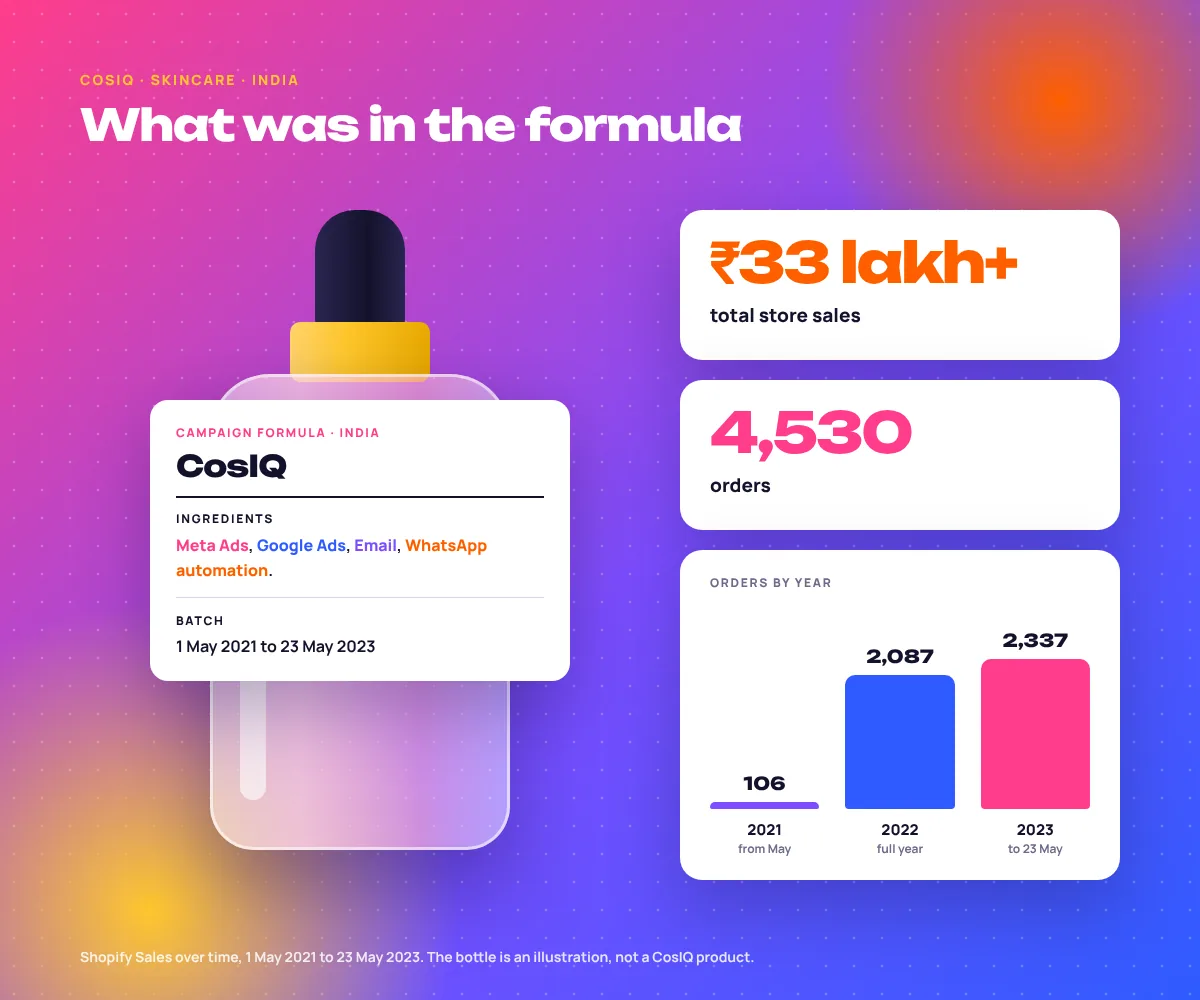
CosIQ is an Indian skincare brand making clean, effective formulations for the Indian beauty market. This skincare marketing case study covers the connected system we built across Meta, Google, email and WhatsApp automation. Its Shopify store went from 106 orders in 2021 to 2,087 in 2022, then 2,337 in 2023 up to 23 May: ₹33,21,534 in total sales across the period.
- ₹33L+total sales
- 4,530orders
- ₹27.9Lnet sales
- 2,337orders, Jan to 23 May 2023
The Brief
CosIQ needed sales momentum, and it needed it quickly, in one of the most crowded categories in Indian D2C. Dozens of skincare brands compete for the same beauty-conscious buyer on Meta and Google, often with similar products and similar promises.
Winning a first order was only half of the job. To make each customer worth the cost of finding them, the brand also needed retention: a reason and a route to buy again.
So the brief was two things at once: efficient paid acquisition, and the email and WhatsApp plumbing to get the most out of every customer it brought in.
- Client
- CosIQ
- Category
- Skincare, clean formulations
- Country
- India
- Channels
- Meta Ads, Google Ads, email, WhatsApp automation
- Services
- Paid ads, email marketing, WhatsApp automation
- Store
- Shopify
- Period on record
- 1 May 2021 to 23 May 2023
Results on this page come from CosIQ’s Shopify Sales over time report.
Three Concerns This Formula Had to Treat
A crowded shelf
Indian skincare buyers scroll past dozens of brands a day. On Meta and Google, the same audience is being bid on by many D2C brands at once, which pushes up the cost of every click.
No time for a slow build
The brand needed sales momentum quickly, not a year of gentle brand building. That rules out channels that only pay back much later.
One-time buyers
In a competitive category, paying to win a customer only works if they come back. Without retention, every sale has to pay for its own acquisition.
What Was in the Formula
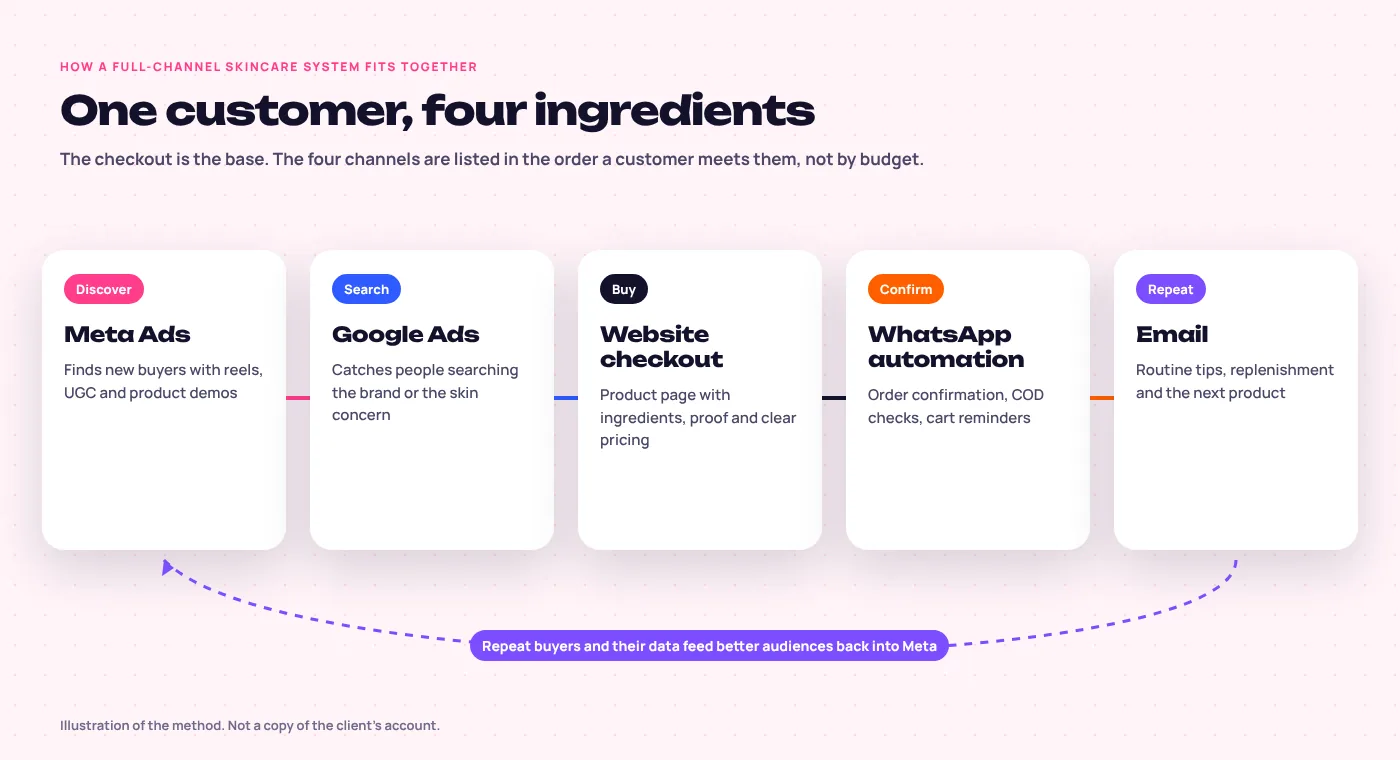
Every skincare label lists what is inside and what each part does. Here is the same thing for this campaign: four channels, each with a job. This describes how we build this kind of system, not a log of the account.
Ingredients: Meta Ads (prospecting, retargeting), Google Ads (search, shopping), email automation, WhatsApp automation, conversion tracking, creative testing.
| Active ingredient | Function | How it works in skincare |
|---|---|---|
| Meta Ads | Finds new buyers and brings back site visitors | Short videos showing texture, routine and real skin. Creator-style content usually beats polished studio shots in this category. |
| Google Ads | Catches people already searching | Brand terms, product terms and skin concern searches, plus Shopping so the product, price and rating show before the click. |
| WhatsApp automation | Confirms orders and recovers carts | Indian buyers answer WhatsApp far faster than email. Order confirmations, cash-on-delivery checks and cart reminders go here. |
| Turns a first order into a routine | How-to-use tips, a reminder when a bottle is likely running low, and the next product that fits the same routine. |
Listed in the order a customer usually meets them, not by share of budget. We do not publish the budget split.
How We Approached It, Step by Step
The order we apply things in, and why. The method is the same for most D2C skincare brands; the details change with the product and the price.
- Before use
Patch test the offer
Run small budgets on a few products, offers and angles before scaling anything. A skincare brand’s best seller online is not always the one the founder expects.
- Prep
Clean tracking first
Meta Pixel with the Conversions API, Google conversion tracking with enhanced conversions, and GA4 agreeing with the store. If the channels cannot see sales, they cannot find more.
- Apply
Capture the searchers
Start Google on brand and product terms, then the skin concerns your products answer. Search is the cheapest place to win someone who already wants what you sell.
- Layer
Build demand on Meta
Test several creative concepts at once: routine demos, ingredient explainers, honest reviews. Keep the winners, refresh the rest every few weeks before they tire.
- Seal
Close the loop on WhatsApp and email
Confirm orders on WhatsApp to cut fake and refused cash-on-delivery orders, recover carts, then use email for the second purchase. For most skincare the repeat window is roughly 45 to 75 days.
- Repeat
Review weekly, scale steadily
Look at cost per customer, not just clicks. Move budget to what brings buyers, in steps, and feed repeat buyer lists back into Meta as better audiences.
Skincare Marketing Case Study: Verified Results
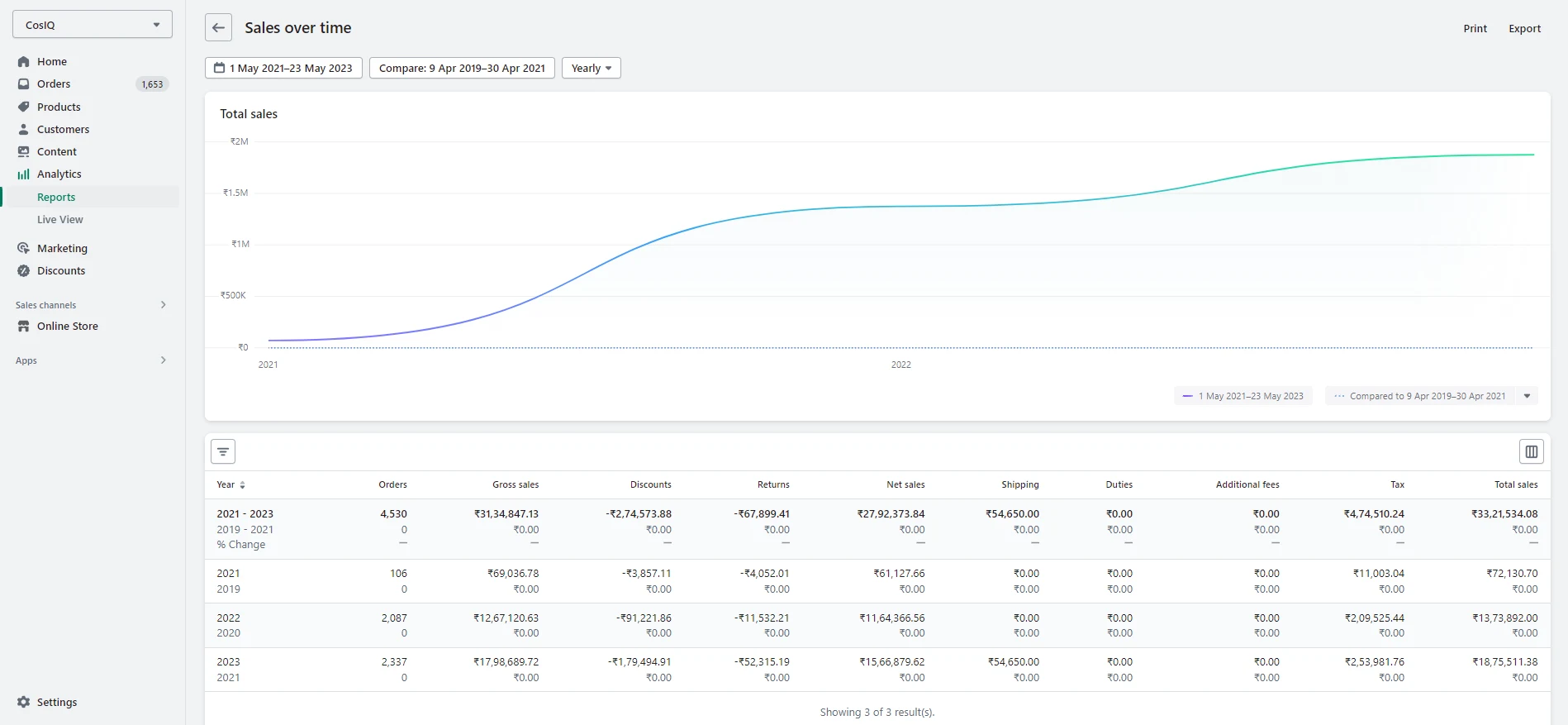
Ad platforms each report their own version of a sale. These numbers come from CosIQ’s Shopify admin instead: every order the store took from 1 May 2021 to 23 May 2023, counted once.
Batch log · year by year
OrdersTotal sales
In under five months, 2023 passed the whole of 2022 on both orders and sales.
1 May 2021 to 23 May 2023
Sales Facts- Orders
- 4,530
- Gross sales
- ₹31,34,847.13
- Discounts
- -₹2,74,573.88
- Returns
- -₹67,899.41
- Net sales
- ₹27,92,373.84
- Shipping
- ₹54,650.00
- Tax
- ₹4,74,510.24
- Total sales
- ₹33,21,534.08
Whole-store figures from Shopify, across every channel.
Read These Before You Scale a Skincare Brand
Meta is strict about skin
Before-and-after images and copy that implies a personal condition (“tired of your acne?”) get rejected. Show the routine and the texture, and let reviews do the talking.
Do not count orders that come back
In India, refused cash-on-delivery orders can quietly eat your margin. Judge campaigns on net sales, not placed orders. CosIQ’s report shows it plainly: ₹31,34,847 gross, ₹27,92,374 net after discounts and returns.
One channel is not a system
Meta alone pays full price for every sale. Google catches people already looking, and email and WhatsApp bring buyers back for close to nothing.
Avoid medical claims
Words like “cure” or “treat” can get ads rejected. Describe what the product does and how it feels, in plain language, and keep any claim you make backed up.
The Services and Stories Behind This Result
- Meta Ads managementDemand for D2C brands
- Google Ads managementSearch and Shopping
- WhatsApp automationOrder and cart flows
- Ecommerce marketingHow we grow online stores
- B2C marketingConsumer brands, beauty included
- Our clients85+ brands across several countries
- Success storiesMore case studies and results
Frequently Asked Questions
Which ad platforms work best for a skincare brand in India?
Usually Meta and Google together. Meta creates demand with video and creator content, and Google captures people already searching for a product or a skin concern. For CosIQ we combined both with email and WhatsApp automation. Its Shopify report for 1 May 2021 to 23 May 2023 shows 4,530 orders and ₹33,21,534 in total sales.
Why use WhatsApp automation for a D2C beauty brand?
In India, people open WhatsApp messages far more readily than email. It is the best place for order confirmations, cash-on-delivery checks and cart reminders, which protects margin and recovers sales that would otherwise be lost.
Can skincare brands run before-and-after ads on Meta?
Generally no. Meta restricts before-and-after imagery and copy that implies someone’s personal condition. Routine demos, texture shots, ingredient explainers and genuine reviews work within the rules and tend to perform well anyway.
What is a good customer acquisition cost for skincare?
It depends on your average order value, margin and how often people buy again. A brand with strong repeat purchase can afford a higher first-order CAC, which is why retention through email and WhatsApp matters as much as the ads.
How long does it take to see results like this?
Growth like CosIQ’s builds over time: 106 orders in 2021 (from May), 2,087 in 2022, then 2,337 between 1 January and 23 May 2023. Every brand is different, and the first weeks are spent on tracking and testing. We work on a 3-month minimum, then month to month, because that is roughly how long it takes to test, learn and settle.
Why does this case show Shopify numbers instead of ad platform numbers?
Meta, Google and email tools each count the sales they touched, so the same order can be claimed two or three times. The store report counts every order once, and it is the number that actually reaches the bank. That is why we lead with it.
Ready to Build Your Own Success Story?
Try a free ad audit. We will look at your Meta and Google accounts, your tracking and your retention flows, and show you what a connected system could do for your brand.