
Websites Built to Convert, Not Just Look Good
Most sites that “look great” still lose the visitor somewhere between the headline and the form. We are a website design agency run by performance marketers, so every page we build is planned around one job: turning the traffic you already pay for into enquiries and sales.
Why Businesses Choose Our Website Design Agency
We spend most of our week inside ad accounts. That changes how we build websites, because we see exactly what happens to a click after it lands.
Conversion Before Aesthetics
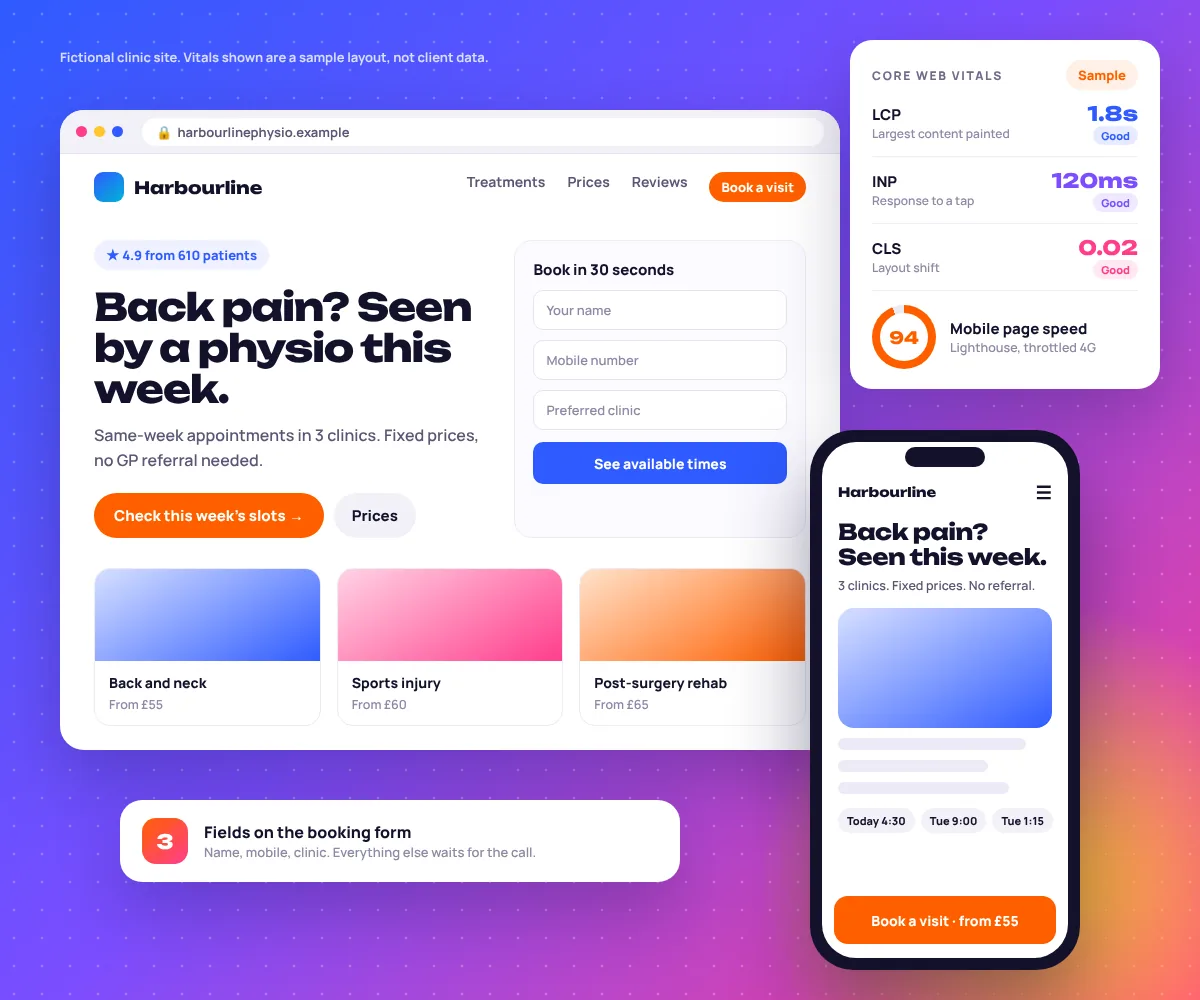
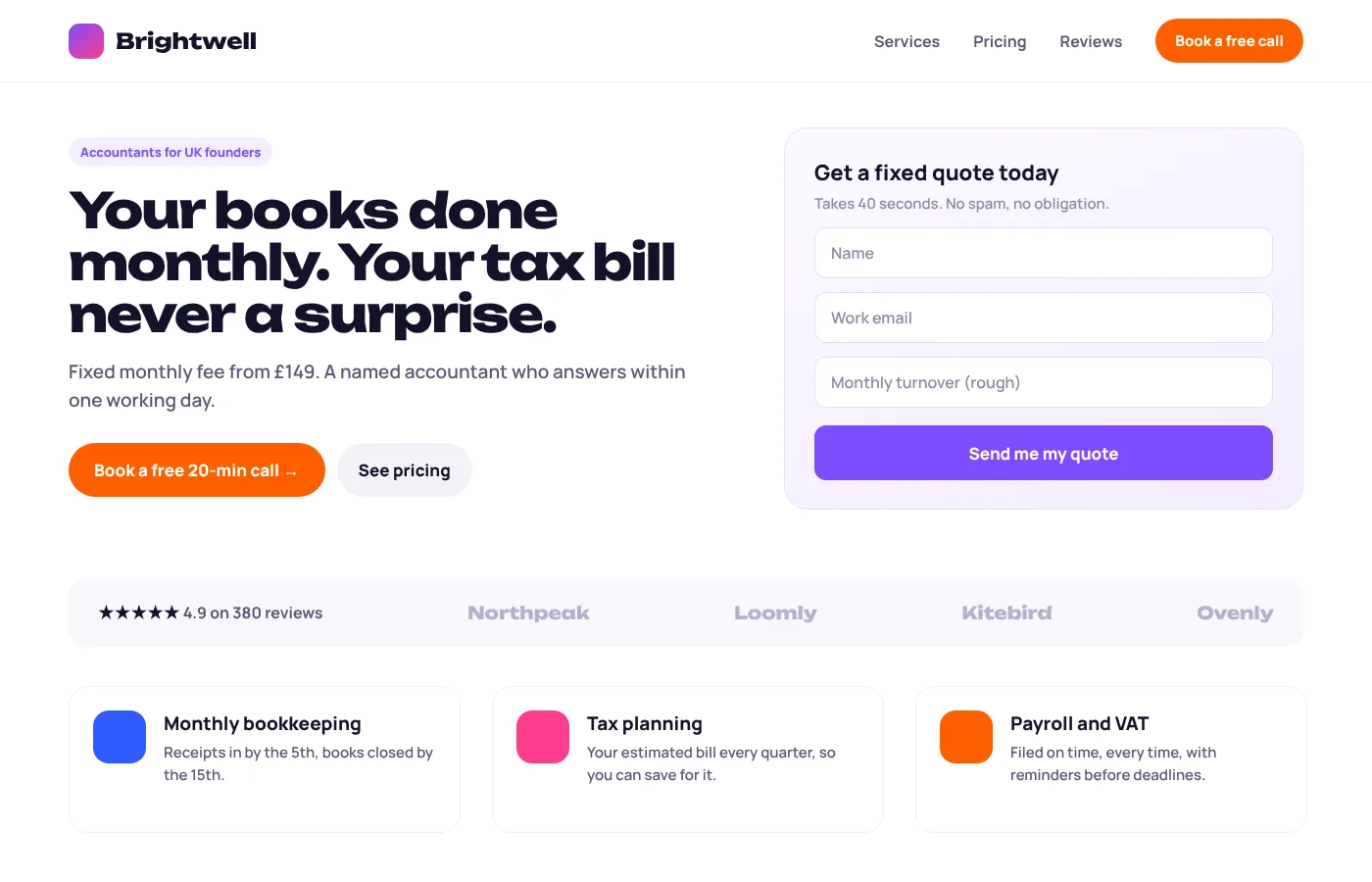
We decide what the page has to make someone do before anyone picks a colour. One primary action per page, proof near the top, and a form short enough to finish on a phone with one thumb.
Speed Isn’t an Afterthought
Every page gets a weight budget before design starts, and the build has to pass it. Slow pages make every ad click cost more, because fewer of those clicks ever see your offer.
SEO Foundation From Day One
Clean URLs, one H1 per page, titles written for search, schema, an XML sitemap and internal links are part of the build, not a bolt-on six months later when traffic disappoints.
Same Page, Two Layers
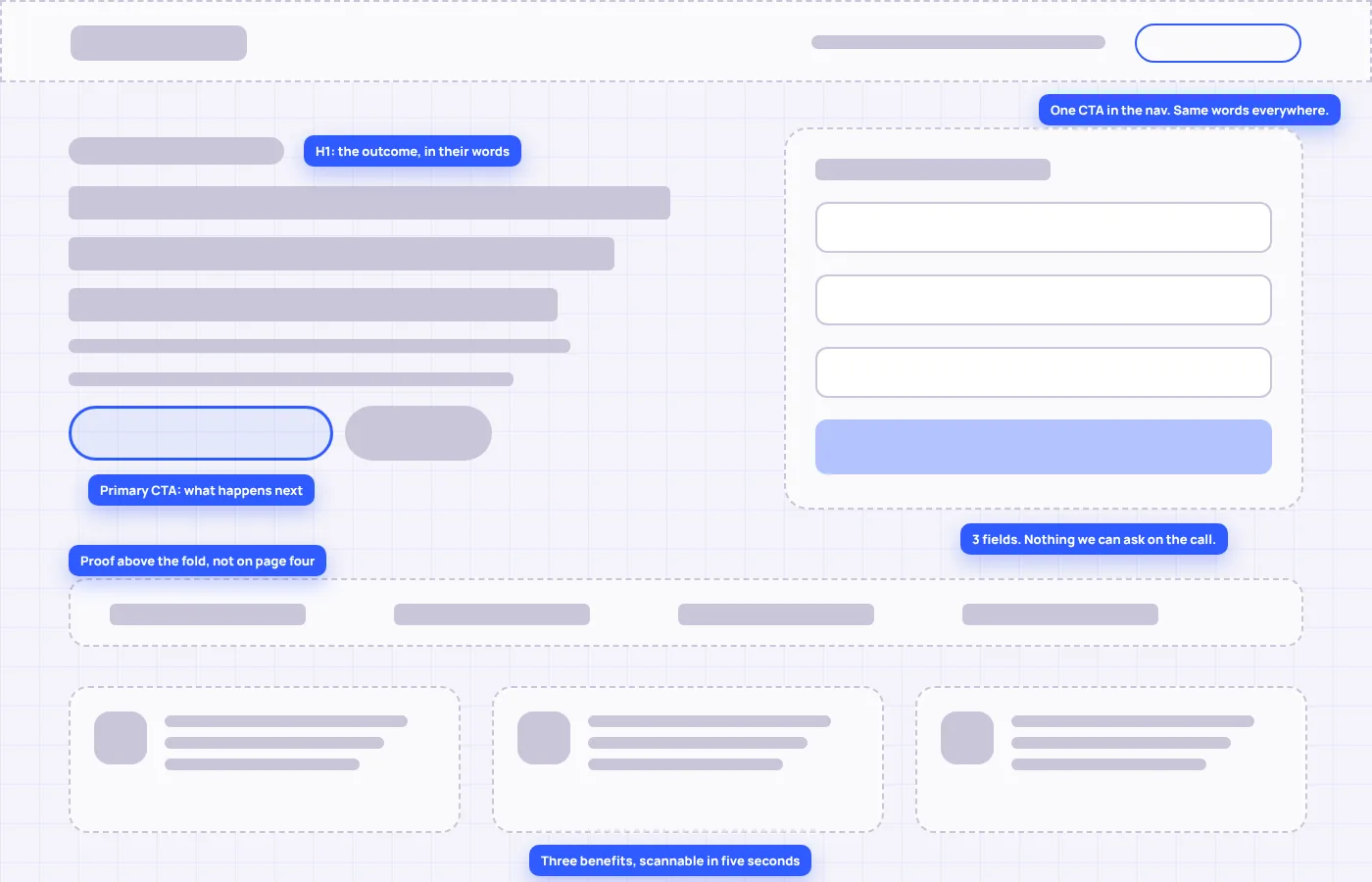
The finished design is the part you see. The wireframe underneath is the part that decides whether it converts.
We agree the wireframe with you before any visual design starts. It is quicker to move a form in grey boxes than in a finished page, and it keeps the conversation on what matters: what the visitor reads first, what they do next, and what might stop them.
H1The outcome, in the customer’s words. Not your company name or a slogan.CTASays what happens next. “Book a free 20-minute call” beats “Submit”.FORMThree or four fields. Anything else can be asked on the call.PROOFReviews or results near the top, where people decide whether to stay.
Full-Stack Website Design & Development
Laid out the way we would plan your site: three branches, each one owned by people who do that work every day.
Conversion-Focused Design
Page layouts planned around one action per page, written and designed for the people your ads send. Landing pages built to match each campaign’s promise.
Landing page design →CRO services →Shopify & WordPress Builds
Shopify for stores, WordPress for lead generation and content-heavy sites. Lightweight themes, no bloated page builders, and an editor your team can actually use.
WordPress design →Shopify setup →Performance Optimization
Images resized and served as WebP or AVIF, fonts trimmed, scripts deferred, unused apps and plugins removed. We test on a throttled mobile connection, not office Wi-Fi.
Shopify speed optimisation →Technical SEO Foundation
URL structure, titles and meta descriptions, heading order, schema markup, XML sitemap, canonical tags and redirects. Built in from the first template.
Ongoing SEO →Analytics & Tracking Setup
GA4 events for every form, call and booking, Google Tag Manager, ad platform pixels and heatmaps. You see which pages and channels produce leads, not just visits.
GA4 tracking →Tag Manager →Ongoing Site Management
Updates, backups, uptime monitoring, security patches, speed checks and small changes every month, so the site you launched does not slowly get heavier and slower.
Shopify management →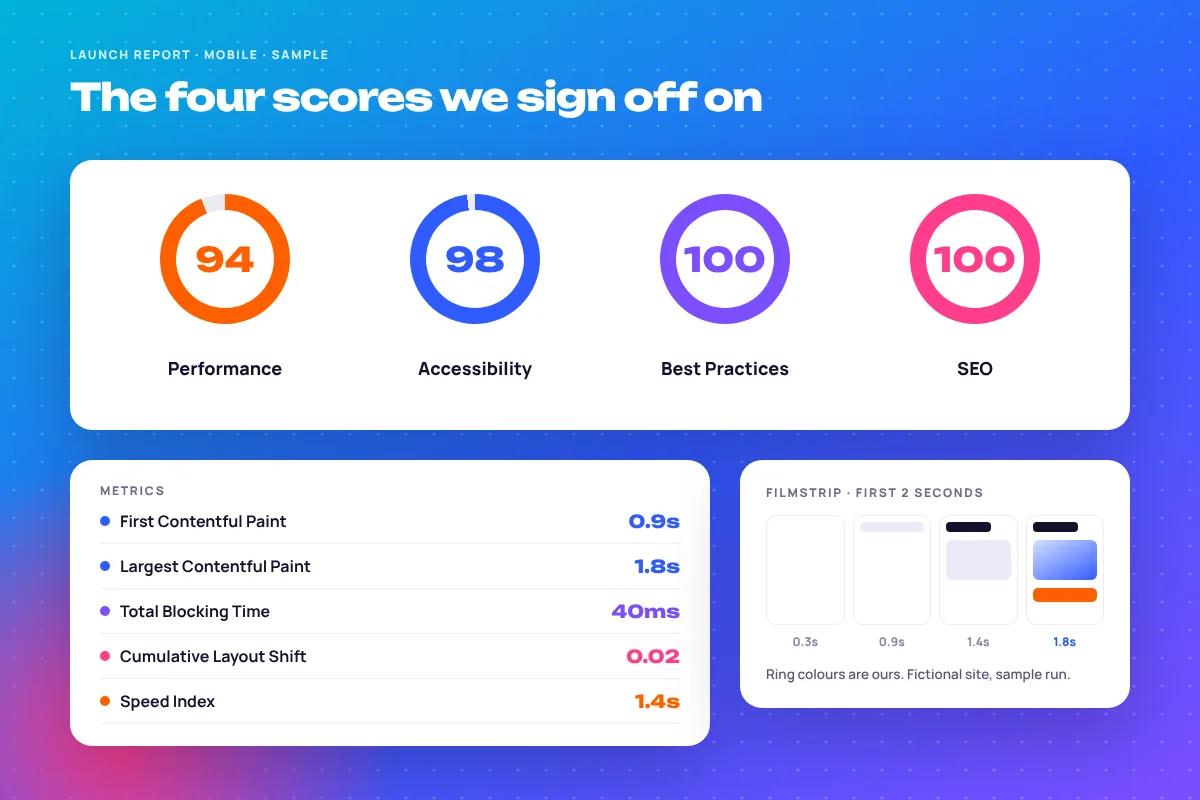
Four Scores Every Build Has to Hit
Google’s Lighthouse grades a page in four areas. We run it on mobile with a throttled connection, because that is how most of your ad traffic arrives.
Performance
Hero image preloaded and under budget, no layout shift from late fonts or banners, third-party scripts loaded after the page is usable.
Accessibility
Colour contrast that passes, labels on every form field, keyboard navigation, alt text and tap targets big enough for thumbs.
Best Practices
HTTPS everywhere, no console errors, no outdated libraries, images served at the size they are shown.
SEO
Crawlable links, unique titles and descriptions, valid structured data and a page that reads properly on a phone.
Every Page Gets a Weight Limit
Speed is easiest to protect before anything is built. These are the default budgets we design against for a typical landing or service page, measured compressed, on first load.
| Resource | Budget | Why it matters | How we stay under |
|---|---|---|---|
| HTML | ≤ 50 KB | The browser cannot start until it has the document. | Server-rendered pages, no giant inline data blobs. |
| CSS | ≤ 60 KB | CSS blocks the first paint. | One stylesheet per template, critical styles inlined, unused rules dropped. |
| JavaScript | ≤ 150 KB | Heavy scripts delay taps and hurt INP. | No sliders or animation libraries for things CSS can do. Everything deferred. |
| Hero image | ≤ 150 KB | Usually the Largest Contentful Paint element. | Sized per device, WebP or AVIF, preloaded, never lazy-loaded. |
| Other images | ≤ 400 KB | Below-the-fold images compete for bandwidth. | Lazy-loaded with width and height set, so nothing jumps. |
| Web fonts | ≤ 2 files | Late fonts cause invisible or jumping text. | Two weights, self-hosted woff2, font-display: swap. |
| 3rd-party tags | ≤ 5 | Chat widgets, pixels and review apps add up fast. | Loaded through Tag Manager, after consent and after the page is usable. |
| Total | < 1 MB | First load on mobile, before the visitor scrolls. | |
On Shopify the usual budget breaker is apps. Each one tends to add its own scripts to every page, even after you stop using it. Removing three or four forgotten apps is often the fastest speed win on an existing store.
Where Leads Leak Between the Click and Your CRM
A website is one link in a chain that starts with your ad and ends in your CRM. We check every handoff, because a lead lost at the fourth step looks exactly like bad traffic in your reports.
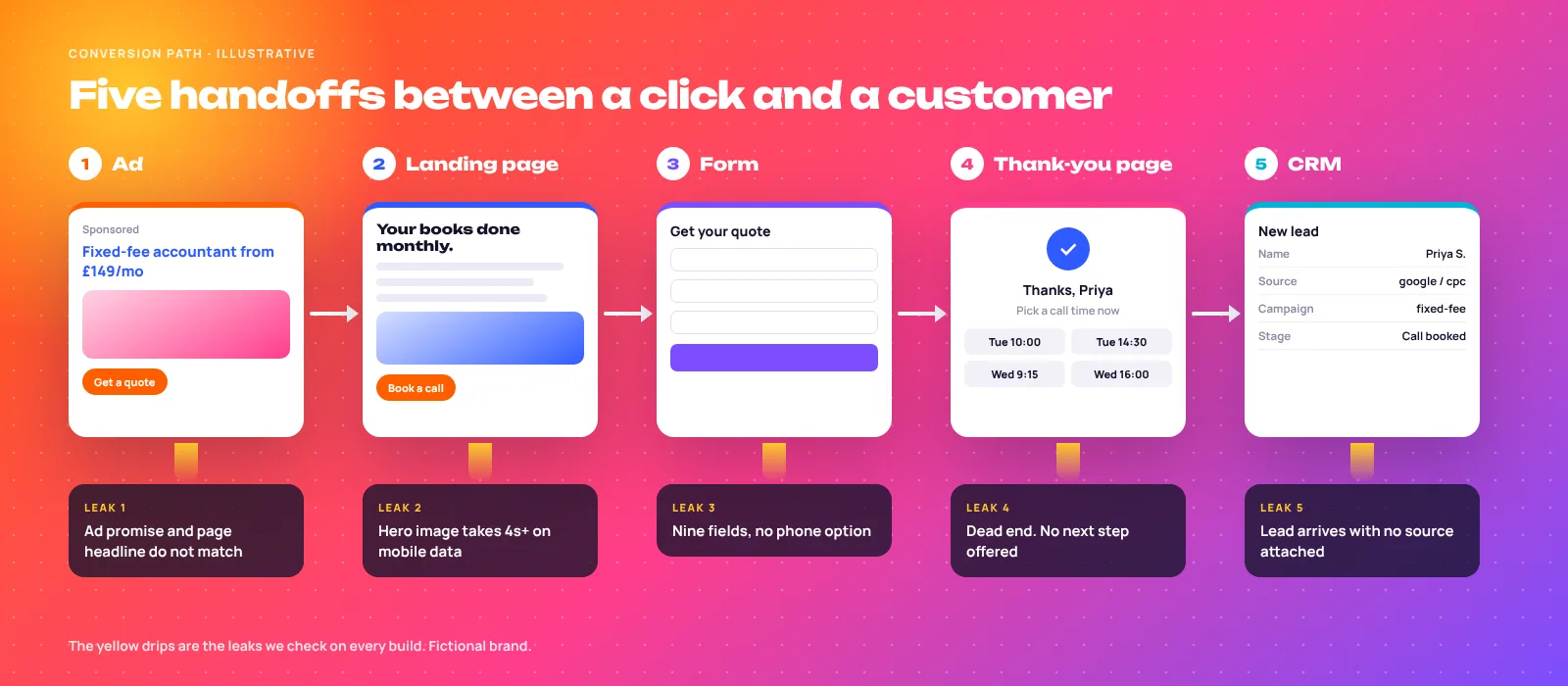
Lands from a Meta ad promising “fixed fees”. The headline says “Welcome”.
Fix: the H1 repeats the ad’s promise.Hero image still loading on 4G. Thumb hovers over the back button.
Fix: hero under 150 KB and preloaded.Scrolls past a slider looking for a price. Finds none.
Fix: a “from” price or price range above the fold.Taps the phone number twice. It is plain text, not a link.
Fix: click-to-call links, tracked as a conversion.Form rejects the “Company size” field. Visitor leaves.
Fix: four fields, inline errors, nothing that is not needed for the call.A composite of patterns we see in session recordings, not a single real visitor. We set up Hotjar heatmaps and recordings and advanced tracking so you can watch these too, and every form sends its UTM source into your CRM.
How a Professional Services Firm Lifted Conversions 28% Without More Traffic
The firm was paying for good traffic and losing it on the website. Pages loaded slowly, the contact form sat three clicks deep, and search engines had no structured data to understand what the firm did.
We did not redesign for the sake of a new look. We rebuilt the site around one clear conversion path, optimised every image and script, and added a full technical SEO foundation. Traffic stayed level. The share of visitors who got in touch went up.
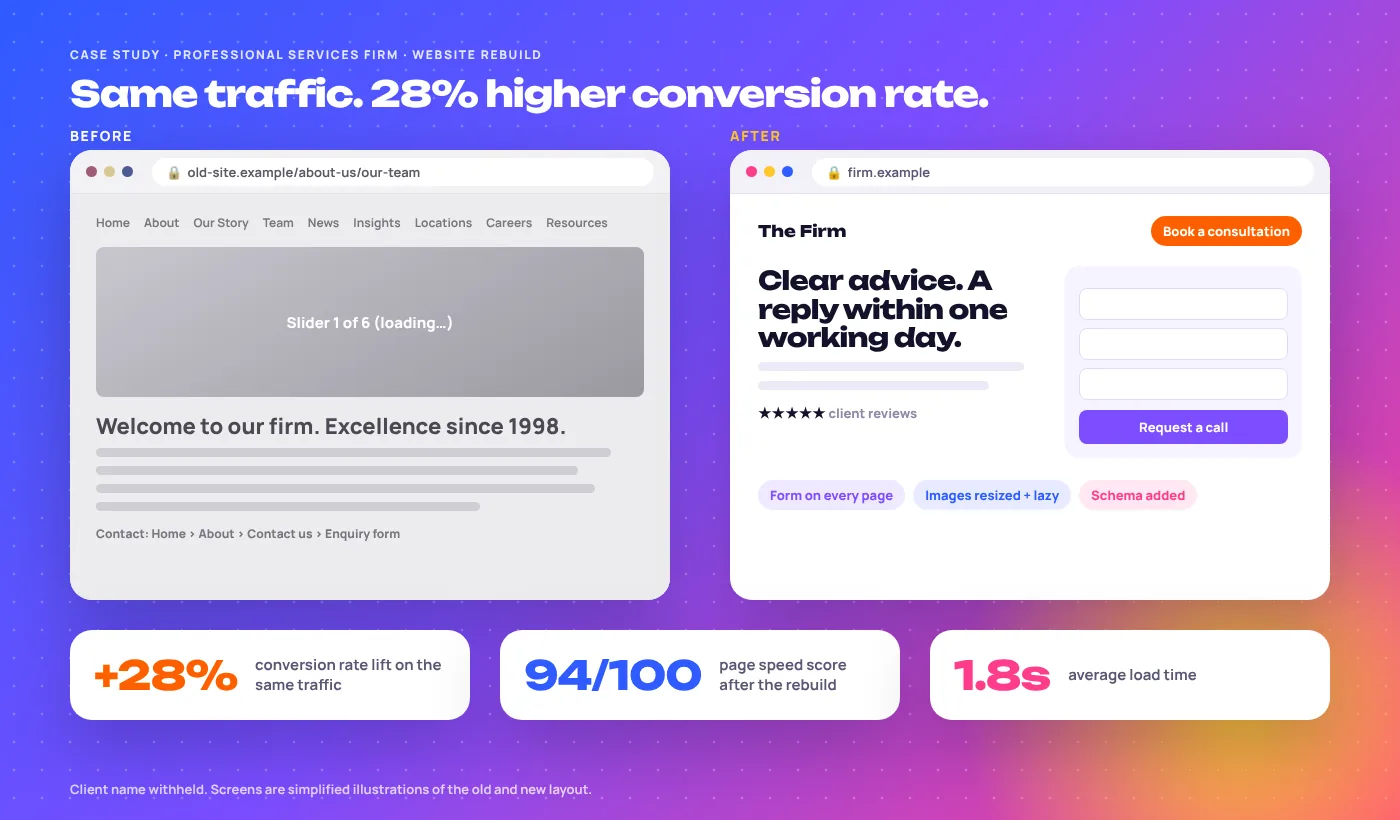
Rebuild site around one conversion path
✓ Mergedprofessional services firm, name withheld- Contact form three clicks deep: Home › About › Contact › Enquiry
- Short enquiry form on every service page, one click from anywhere
- Full-size images and stacked plugin scripts on every page
- Every image resized, compressed and lazy-loaded; scripts deferred or removed
- No schema, generic page titles
- Full technical SEO: schema, titles, sitemap, internal links
WordPress, Shopify or Custom? Answer Two Questions
Most businesses do not need a custom build. Here is the same fork we walk clients through on the first call.
Shopify
For stores of any size- Pick it if
- You sell products and want checkout, payments, stock and shipping handled for you.
- Watch out for
- App bloat. Every app is a monthly fee and usually extra script weight.
- Typical build
- 3 to 6 weeks after wireframes, more with big catalogue migrations.
Custom build
For real product features- Pick it if
- The site is part of the product: client portals, quote calculators, bookings with complex rules.
- Watch out for
- Every change needs a developer, long after launch, not just during the build.
- Typical build
- 8 weeks or more, scoped in detail first.
WordPress
For lead generation and content- Pick it if
- You sell services, need landing pages for ads and want to publish content your team can edit.
- Watch out for
- Heavy page builders and plugin pile-ups. We build lean, block-based themes instead.
- Typical build
- 3 to 5 weeks after wireframes for most lead sites.
How We Build Your Website
Four stages, each one adding detail to the last. You approve every stage before we move on, so nothing surprises you at launch.
Discovery & Wireframing
We look at your analytics, ads, competitors and sales process, then map the pages and wireframe the ones that matter most.
- Sitemap and URL plan
- Wireframes for key templates
- The 4-week clock starts at your approval
Design & Build
Visual design on top of the approved wireframes, then the build on a private staging site you can click through at any time.
- Copy, design and development together
- CRM, booking and payment integrations
- Weekly staging link to review
Testing & QA
Real iPhones and Android phones, every form submitted, every tracking event fired, speed tested against the budget.
- Cross-browser and device checks
- Redirect map tested line by line
- Pre-flight panel cleared
Launch & Monitor
We go live in your quietest hours, then watch Search Console, 404s, speed and conversions closely for the first month.
- Sitemap submitted, indexing checked
- Weekly report for 30 days
- Fixes shipped the same week
Four weeks is our average from wireframe approval to launch. Large stores, migrations and custom features take longer, and we will say so up front.
The Pre-Flight Panel Every Site Clears
Nothing goes live until every light on this panel is on. It is the same list on every build, whether it is a five-page lead site or a 2,000-product store.
Redesign Without Losing Your Rankings
Most traffic drops after a redesign come from one mistake: old URLs that suddenly return a 404. A redirect map prevents it.
- Crawl the old site and export every URL, plus the ones with traffic in Search Console and links from other sites.
- Map each old URL to its closest new page with a permanent 301 redirect. Not the homepage, the closest match.
- Keep URLs that already rank exactly as they are, where the new structure allows it.
- Update internal links so the site does not route through its own redirects.
- Watch Search Console for 4 to 6 weeks after launch and fix any 404s the same week.
| A | B | C | D | |
|---|---|---|---|---|
| 1 | Old URL | New URL | Code | Why |
| 2 | /services.php?id=4 | /services/tax-planning/ | 301 | Old query-string page that still has backlinks |
| 3 | /about-us/contact-us/enquiry/ | /contact/ | 301 | Was three clicks deep, now one |
| 4 | /blog/2019/05/vat-tips/ | /blog/vat-tips/ | 301 | Dates removed from blog URLs |
| 5 | /team-old/ | /about/ | 301 | Thin page merged into a stronger one |
| 6 | /summer-offer-2021/ | (none) | 410 | Expired offer, no traffic, no links |
| 7 | /services/ | /services/ | 200 | Already ranks, so the URL stays |
Example rows from a typical redirect map. A real one for a 50-page site often has 150 or more lines once old blog posts and image URLs are included.
Website services in detail
Build
Speed and conversion
Services we often pair with a new website
Website Design & Development FAQs
What founders ask us before they commit to a new site.
Do you build on WordPress or Shopify?
Both. Shopify for ecommerce, because checkout, payments and stock are handled for you. WordPress for service businesses, lead generation and content-heavy sites. If you need portals or app-like features, we will tell you when a custom build makes more sense and what it takes to maintain.
How long does a website build take?
Our average is four weeks from wireframe approval to launch. Discovery and wireframes usually take about a week before that. Large stores, content migrations and custom features take longer, and we give you a dated plan at the start.
Will my new site actually be faster than my old one?
We measure your current site first, so you have a baseline in writing. Then we design against a weight budget and test on a throttled mobile connection before launch. Across the sites we build, the average page speed score is 94/100 and the average load time is 1.8 seconds.
Do you handle SEO during the build, or is that separate?
The technical SEO foundation is part of every build: URL structure, titles and descriptions, heading order, schema, XML sitemap, internal links and redirects. Ongoing SEO, such as new content and link building, is a separate service you can add when you are ready.
Can you redesign my site without losing our current SEO rankings?
Yes. We crawl your current site, build a URL map that sends every old page with traffic or backlinks to its closest new page with a 301 redirect, keep URLs that already rank where we can, and watch Search Console for four to six weeks after launch. Small movements in the first weeks are normal; lasting drops usually come from missing redirects, which the map prevents.
Do you provide ongoing website management after launch?
Yes. Most clients keep us on a monthly plan after launch, so updates, security and speed are looked after and small changes get done without a new project each time.
Will the site be mobile-friendly?
We design mobile first, because that is where most ad traffic lands. Every build is tested on real iPhones and Android phones, and our average mobile score is 97/100.
Can you integrate our CRM or booking tools into the site?
Yes. We connect forms to CRMs such as HubSpot, Zoho and Salesforce, and embed booking tools such as Calendly. Every lead arrives with its source and campaign attached, so you can see which ads and pages produce customers.
Do you write the website copy too?
We can write all of it or edit what you have. At the very least we write the headlines, calls to action and form copy, because that is where most conversions are won or lost.
What is included in ongoing site management?
Core, theme, plugin or app updates, daily backups, uptime and security monitoring, a monthly speed check against the weight budget, small content and design changes, and a short monthly report. Bigger changes, like new templates or sections, are scoped as separate projects.
Who owns the website, domain and hosting?
You do. The domain, hosting, Shopify or WordPress admin, analytics and design files are set up in your name, with us added as users. If you ever leave, nothing needs to be handed back.
Do you build accessible websites?
Yes. We build to WCAG 2.2 AA as standard: readable contrast, labelled form fields, keyboard navigation, focus states and alt text. If you sell to consumers in the EU, the European Accessibility Act has applied since June 2025, so this is no longer optional for many online stores.
Ready for a Website That Actually Converts?
Send us your current site. We will run it through the same speed, tracking and conversion checks we use on our own builds, and show you where it is losing leads.