
SaaS Marketing That Generates Trials, Users, and Revenue
We are a SaaS marketing agency running paid acquisition for SaaS companies and apps, measured on activated users and paying customers, not clicks or raw signups. We set up the tracking first, then buy the trials, demos and installs that turn into subscriptions.
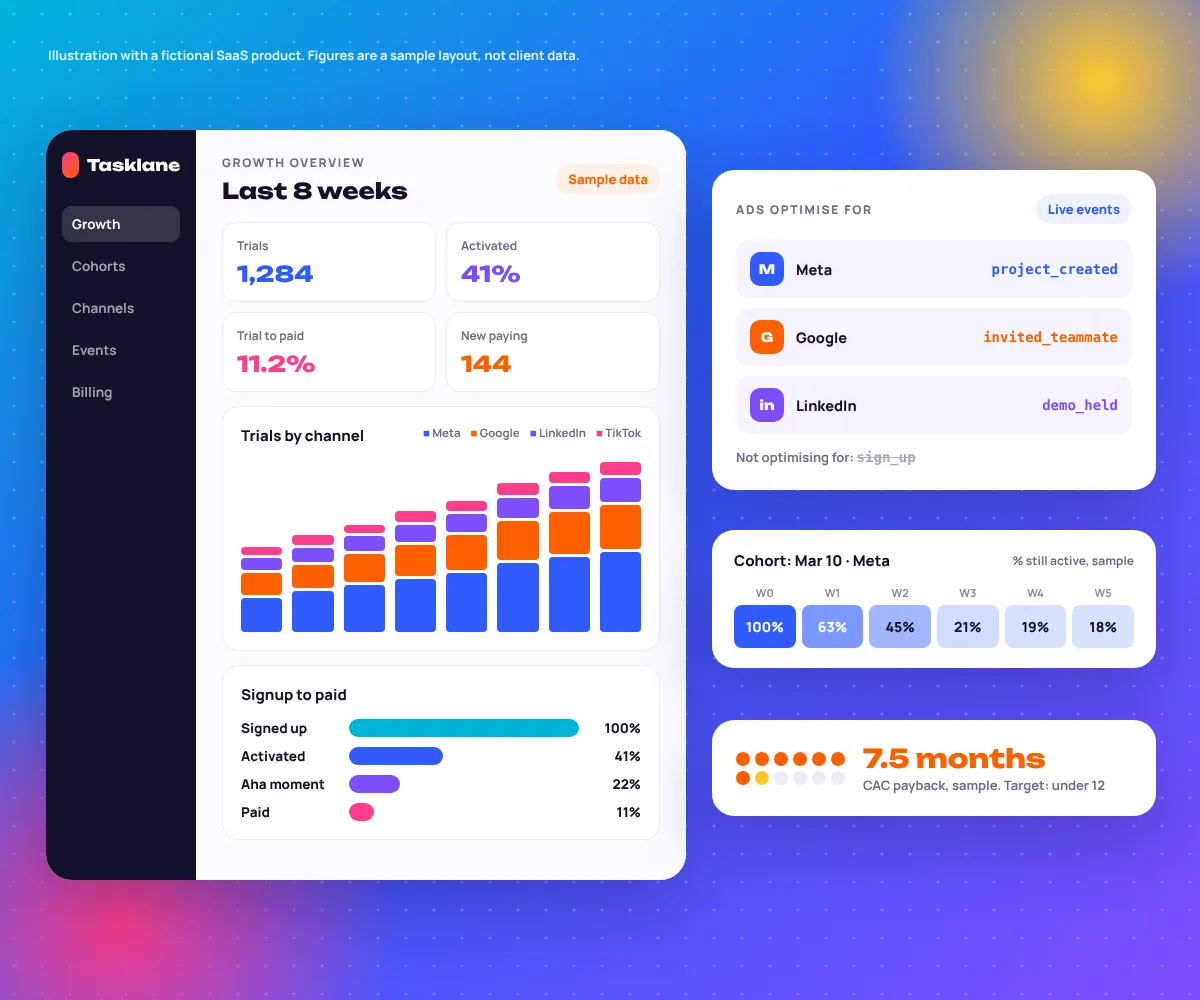
A SaaS Marketing Agency That Optimises for Activated Users, Not Vanity Metrics
SaaS ads are judged on activated users, trial starts and subscriptions, not installs or clicks. When we audit a SaaS account, these are the tickets we end up opening, roughly in this order.
Ads optimise for signups, and most signups never activate
Meta and Google are very good at finding people who sign up. Many of those people never create a project, connect an integration or come back on day two. The platforms are doing exactly what they were told.
The trial ends after the attribution window closes
A 14-day trial converts on day 14. Meta’s default window is 7 days after the click. So the ad platform never sees who paid, and cannot learn from them.
Free-email and junk signups inflate B2B numbers
For B2B SaaS, a signup from a personal email address with no company is rarely a buyer. Counted as a conversion, it teaches the algorithm to find more students and competitors.
iOS installs are a black box
Most iPhone users decline tracking, so app campaigns rely on Apple’s privacy postbacks with delayed, coarse data. Without a plan, you are flying blind on half your users.
Booked demos are counted, held demos are not
In sales-led funnels, a big share of booked demos never show. If the ad platforms only see the booking, they keep buying no-shows.
Branded search is taking credit
A Google campaign bidding on your own name looks brilliant. Most of those people would have found you anyway, and the blended CAC hides it.
Which Event Should Your Ads Optimise For?
Every SaaS product has four milestones between the ad and the invoice. The higher up the stairs you can optimise, the better the users. The catch is volume: platforms need roughly 50 events a week per campaign to learn.
Signup
sign_upCheap and plentiful. Tells the platform almost nothing about who will pay.
only at launch, to exit learning fastFirst key action
project_createdThe first thing a real user does: creates a project, connects a data source, uploads a file.
our default event once it hits volumeAha moment
invited_teammateThe action that predicts paying, found in your own data. Often a second session, a teammate invite or a third report.
bid on it when volume allows, else send as a value signalPaid
subscribeThe only event that pays the bills. Usually too rare and too late to bid on directly early on.
value-based bidding once paid events are frequent enough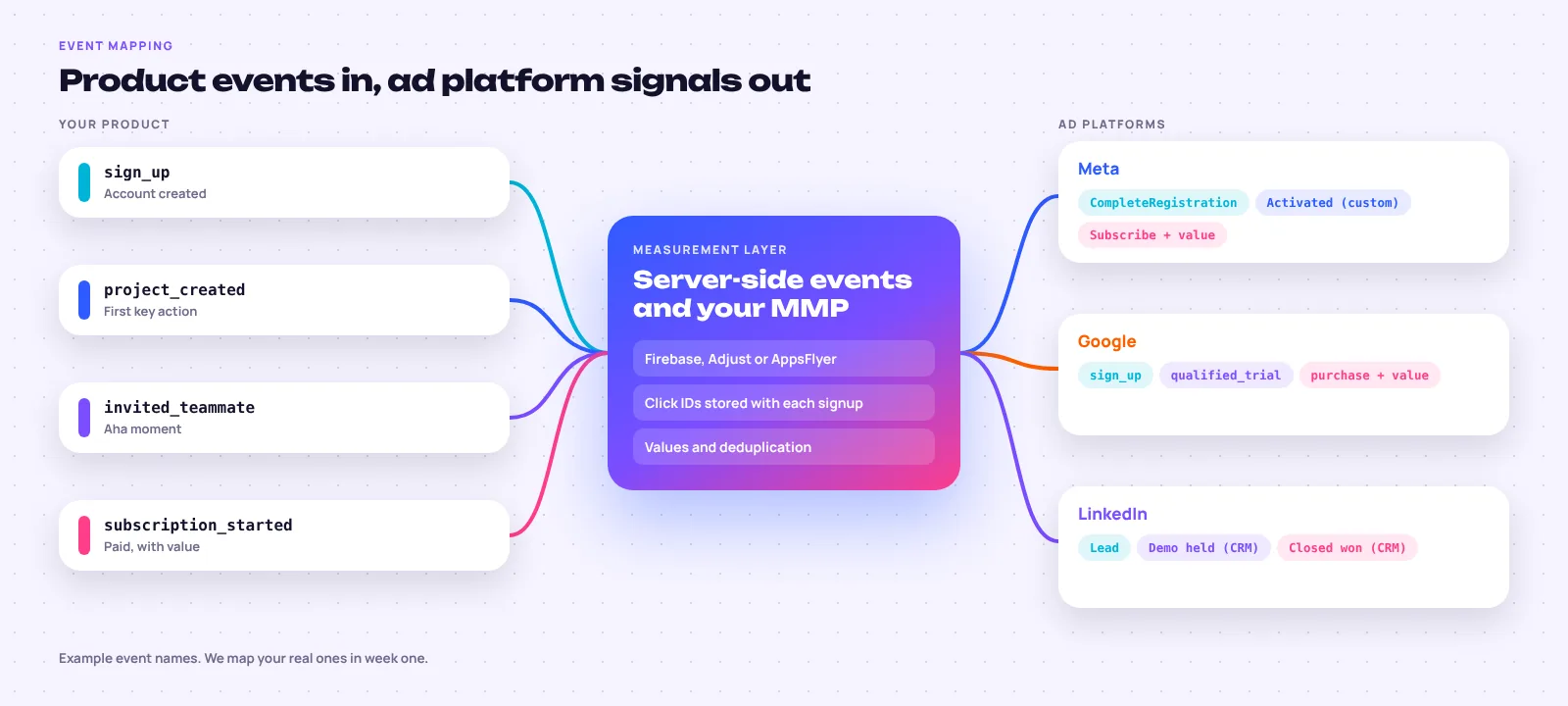
Trial-to-Paid, Read by Signup Cohort
Totals hide everything that matters in SaaS. We read every channel as a cohort: the people who signed up in one week, and how many are still active and paying in the weeks after.
| Signup cohort | W0 | W1 | W2 | W3 | W4 | W5 | W6 | W7 |
|---|---|---|---|---|---|---|---|---|
| Mar 03Meta, signup event | 100% | 38% | 21% | 9% | 7% | 6% | 6% | 6% |
| Mar 10Meta, first key action | 100% | 61% | 44% | 19% | 17% | 16% | 15% | |
| Mar 17Google, non-brand | 100% | 66% | 49% | 22% | 20% | 19% | ||
| Mar 24LinkedIn, demo | 100% | 57% | 46% | 24% | 23% | |||
| Mar 31TikTok, signup event | 100% | 33% | 17% | 6% | ||||
| Apr 07Meta, first key action | 100% | 63% | 45% |
The two Meta rows differ only in the optimisation event. In this sample, switching from signup to first key action leaves about two and a half times as many paying users from the same budget.
The drop after the pink line is the trial ending. That step is where most SaaS budgets are won or lost.
The TikTok row had the cheapest signups and the weakest paid rate. We move budget on cohort results, not cost per signup.
How Long Until a Customer Pays Back What You Spent?
CAC payback is the number of months of gross profit it takes to earn back the cost of acquiring one customer. It decides how fast you can afford to grow on paid. Here is a worked sample.
$30,000 / 50 customers = $600. Then $600 / $80 a month = 7.5 months.
Each punch is one month of $80 gross profit
- M1$80
- M2$160
- M3$240
- M4$320
- M5$400
- M6$480
- M7$560
- M8$600 at 7.5
- M9profit
- M10profit
- M11profit
- M12profit
As a rough guide, under 12 months is healthy for self-serve SaaS, and 12 to 24 months is common for sales-led, higher-ticket products. Typical ranges, not client data.
Same $30,000, but 13% of trials pay instead of 10%. That is 65 customers, CAC falls to about $462 and payback to 5.8 months.
An annual plan at $960 paid on day one brings $768 of gross profit straight away. Payback is instant for that customer.
Churn does not change payback, but a customer who leaves in month 5 never pays back at all. Cohort-based budgets cut those sources.
Which Channels We Use, and Where
Product-led and sales-led SaaS need different channel mixes. Switch between them to see how we usually set it up.
Discover 01
Meta video adsShow the product doing the job in ten seconds. Our main volume channel for self-serve tools. TikTokStrong for consumer apps and creator tools with a visual “before and after”. App install campaignsMeta, Google App campaigns, TikTok and Apple Search Ads, optimised to in-app events.Evaluate 02
Google non-brand search“Best [category] tool”, “[competitor] alternative”, “[job] software”. SEO comparison pagesAlternative and versus pages that keep paying after the ads stop. YouTube tutorialsShort how-to videos shown to people who searched the problem.Convert 03
Trial retargetingAds to trial users who have not activated, showing the one feature they skipped. Onboarding emailsBehaviour-based sequences, triggered by what the user did or did not do.Expand 04
Lifecycle automationUpgrade prompts at usage limits, win-back for lapsed accounts. Feature launch emailsBring existing users back for new features, which feeds the aha moment again.How We Grow SaaS Products
From MMP setup to optimised user acquisition in three weeks. Tracking always comes first, because every decision after it depends on the data being right.
Attribution and tracking setup
The data foundation. We map your product events, connect them to every ad platform and test them before any budget moves.
- MMP setup for apps: Firebase, Adjust or AppsFlyer
- Event map from signup to subscription, agreed with your product team
- Server-side events and click IDs, or Hyros where multi-touch matters
- iOS conversion values mapped to activation
A test signup and a test subscription show up in Meta, Google and your analytics with the right value, within minutes.
How Tarrakki Acquired 2,500+ New Mutual Fund Users With Meta App Install Campaigns
Tarrakki is an Indian fintech app that makes mutual fund investing simple. We ran Meta app install campaigns for first-time investors, with education-first creative.
app_installfirst_sip_setupThe point was never installs. Optimising for the first SIP set up meant the campaigns found people who actually invested, not people who downloaded and forgot.
Read the Tarrakki story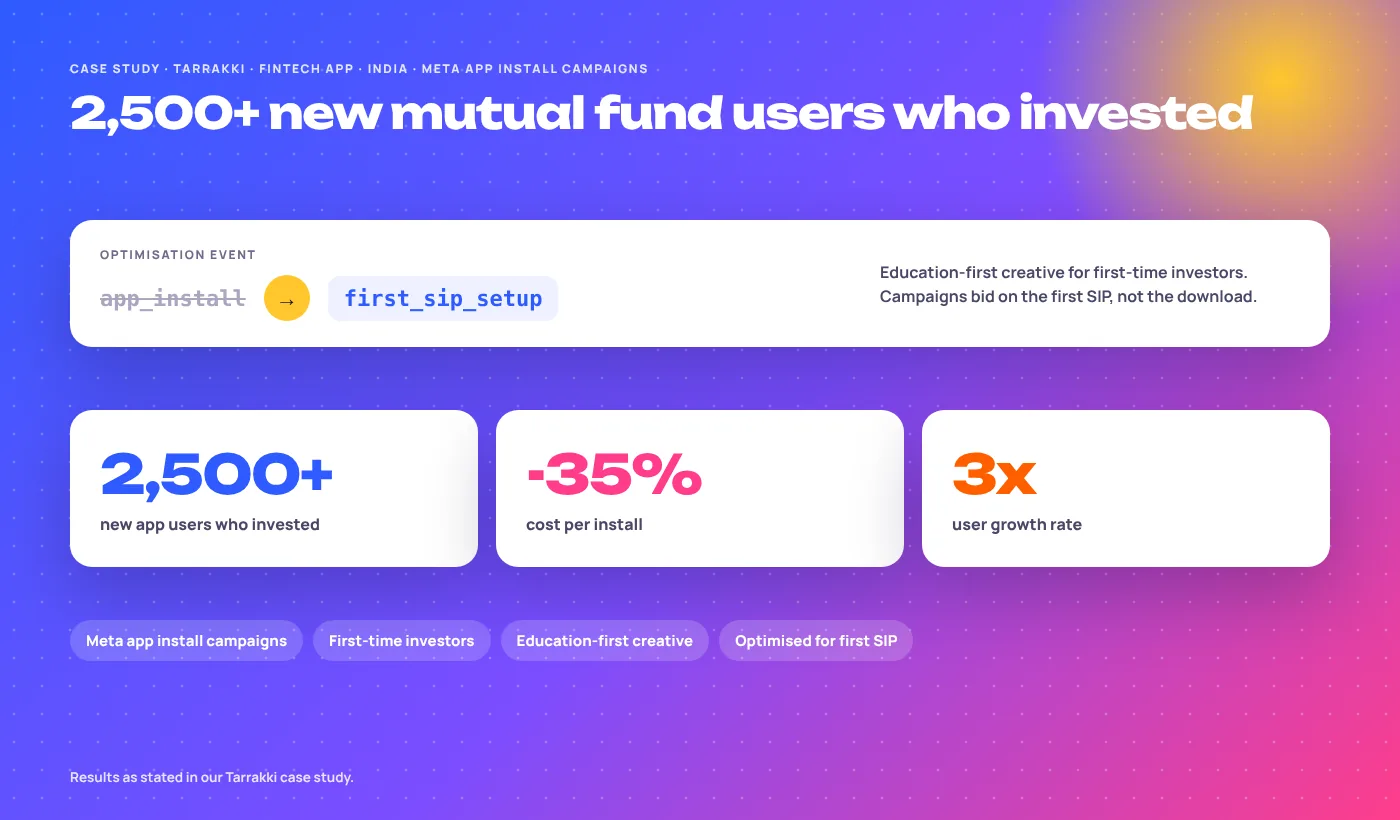
Caarisma
App install campaigns that cut the cost per install while the users who came in stayed longer.
Read the Caarisma case →Unorthodox Systems
Meta campaigns for an AI-first marketing business, measured with Hyros attribution so purchases trace back to the ads that drove them.
Read the Unorthodox Systems case →Tarrakki
Meta app install campaigns optimised for the first SIP, not the install.
Read the Tarrakki case →SaaS, fintech and app clients are part of our 85+ brand portfolio. See them all on our clients page or every success story.
Which MMP do you work with?
Firebase for startups and smaller budgets. Adjust or AppsFlyer for growth-stage companies that need deeper LTV and cohort reporting. We recommend one based on your stage and how complex your attribution is, and we work with whatever you already have if it is set up properly.
Do you run B2B SaaS campaigns as well as B2C apps?
Yes. B2B SaaS usually means LinkedIn and Google high-intent search with content-led funnels and demo campaigns. B2C apps focus on app install and in-app event campaigns on Meta, Google, TikTok and Apple Search Ads. The tracking and the channel mix are different, so the plans are too.
How is SaaS marketing different from standard D2C advertising?
The conversion is not a purchase. It is an activation event, a trial start or a subscription that can happen days or weeks after the click. That makes attribution and event optimisation much harder, and it is why we set tracking up before spending anything.
Can you help with App Store Optimisation alongside paid acquisition?
Yes, we give ASO guidance alongside paid campaigns. Your store page converts every paid visitor too, and better organic visibility for category searches makes each paid install cheaper.
Free trial, freemium or demo: which works best with paid ads?
It depends on price and complexity. Self-serve tools under a few hundred dollars a month usually do best with a free trial or freemium plan and paid social. Products that need setup, integrations or a procurement process usually need a demo, and LinkedIn plus search. Many products end up running both: trial for small teams, demo for larger ones.
How do you measure trial-to-paid when the trial is longer than the attribution window?
We send the subscription event server-side, matched to the original click ID, so Meta and Google see it even weeks later. We also send a predicted value at the activation milestone so the platforms get a signal inside their window. Then we check everything against cohort data in your own analytics.
How do you handle iOS tracking for app campaigns?
We map Apple’s privacy postback conversion values to your activation events through the MMP, so iOS campaigns optimise toward real usage rather than installs. We read iOS performance on blended numbers, because platform-reported iOS data is delayed and incomplete.
What CAC payback should we aim for?
As a rough guide, under 12 months for self-serve SaaS and 12 to 24 months for sales-led, higher-ticket products. The right number depends on your cash position and churn. We agree a target with you in the strategy week and report against it every month.
How long does SaaS marketing take to show results?
Setup takes around three weeks including tracking. Signups start the week campaigns launch. A trustworthy read on trial-to-paid takes at least one full trial length plus a couple of weeks, so judge us on the first two or three cohorts, not the first week.
Is there a minimum contract?
Yes, three months, then month to month. SaaS results only show up after trials end and cohorts mature, so a shorter window would mean judging on signups, which is exactly the metric we are trying to move you away from.
What happens on the free audit?
We look at your ad accounts, the events they optimise for, your tracking and your signup flow, then show you where the budget is buying users who never activate. It takes about 30 minutes and you keep the findings whether you hire us or not.
Connect the Rest of Your Growth Stack
Related industries, the services SaaS clients use most, and the proof behind them.
Ready to Grow Your SaaS Product With Quality Users?
We have acquired 2,500+ fintech app users, cut CPI by 48% and generated 1,500+ purchases with attribution you can check. Start with a free audit of your growth setup.
- Your ad accounts and optimisation events reviewed
- Tracking gaps from click to subscription listed
- A plan for which activation event to bid on
No card, no commitment. 30 minutes. Questions first? Contact us