
Landing Page Design That Converts Ad Traffic Into Leads and Sales
Our landing page design services start from the ad, not from a template. One page, one offer, one action, built for the phone most of your paid clicks arrive on, loading fast, and tracked in GA4, Meta and Google Ads before the first visitor lands.
- Live in about 14 days
- One page per audience
- Tracking tested before launch
Why a Landing Page Needs a Different Brief Than Your Homepage
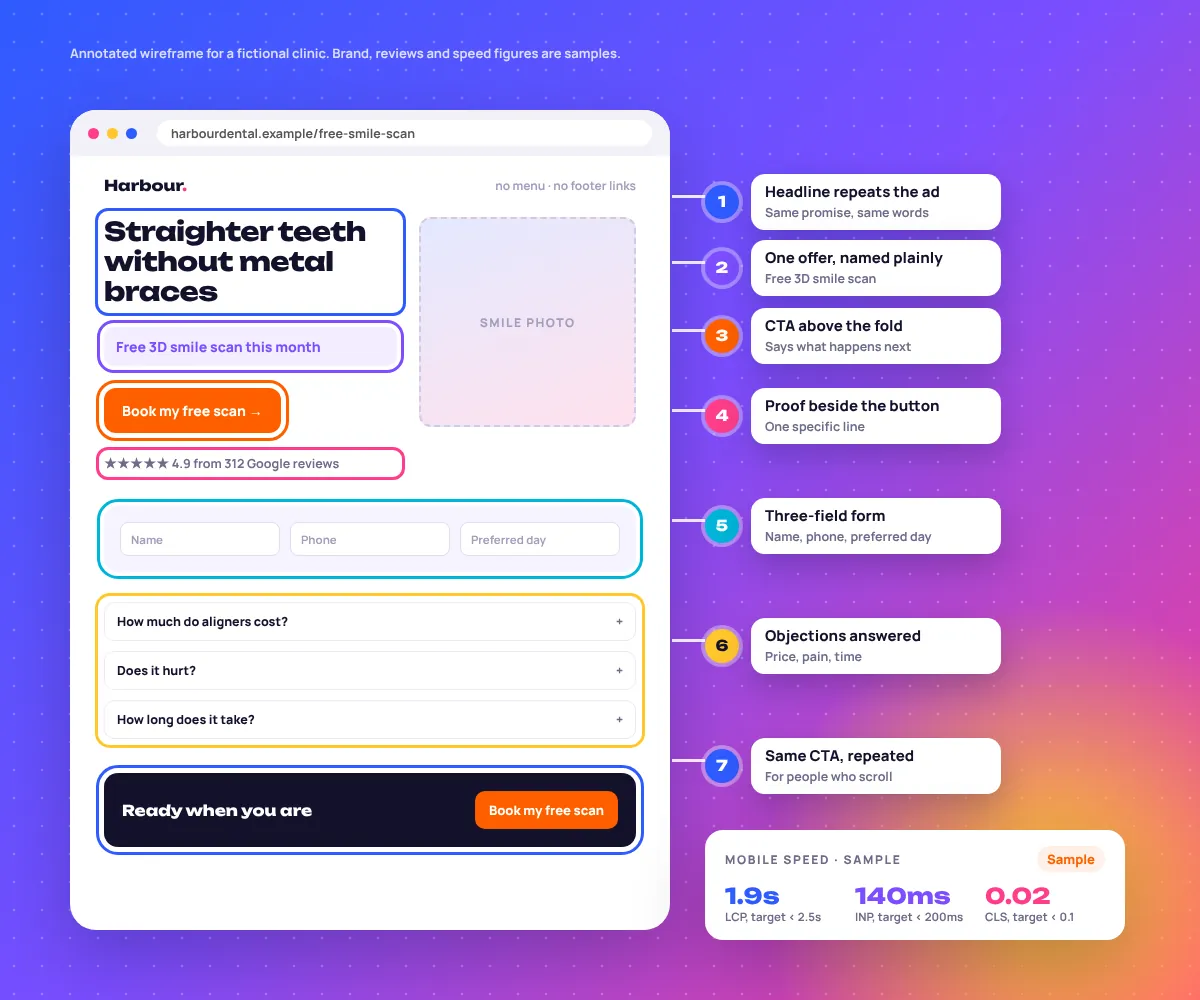
Your homepage talks to everyone: past customers, job seekers, people who typed your name into Google. A landing page talks to one person who clicked one ad a few seconds ago. That changes the brief.
On a landing page, every menu link is an exit you paid for, and a second offer splits attention so fewer people take the first.
So we write the brief backwards from the campaign: the ad set, the audience, the promise in the creative and the one action we want. If the ad sells a free trial class, the page sells the free trial class, not the membership tiers.
The most common problem we find when we audit an ad account is not the targeting. It is a good ad pointing at a page that answers a different question.
The first screen of your landing page
- Reports to
- The ad that sent the click.
- Has about five seconds to
- Confirm the promise the ad made, in the same words
- Name the offer and who it is for
- Show the button and say what happens after it
- Give one specific reason to trust you
- Not part of the job
- Your company history
- Every service you offer
- Links to the blog, careers or social profiles
- Measured on
- Conversion rate from that ad set, and lead quality.
Message Match: How Our Landing Page Design Services Start From the Ad
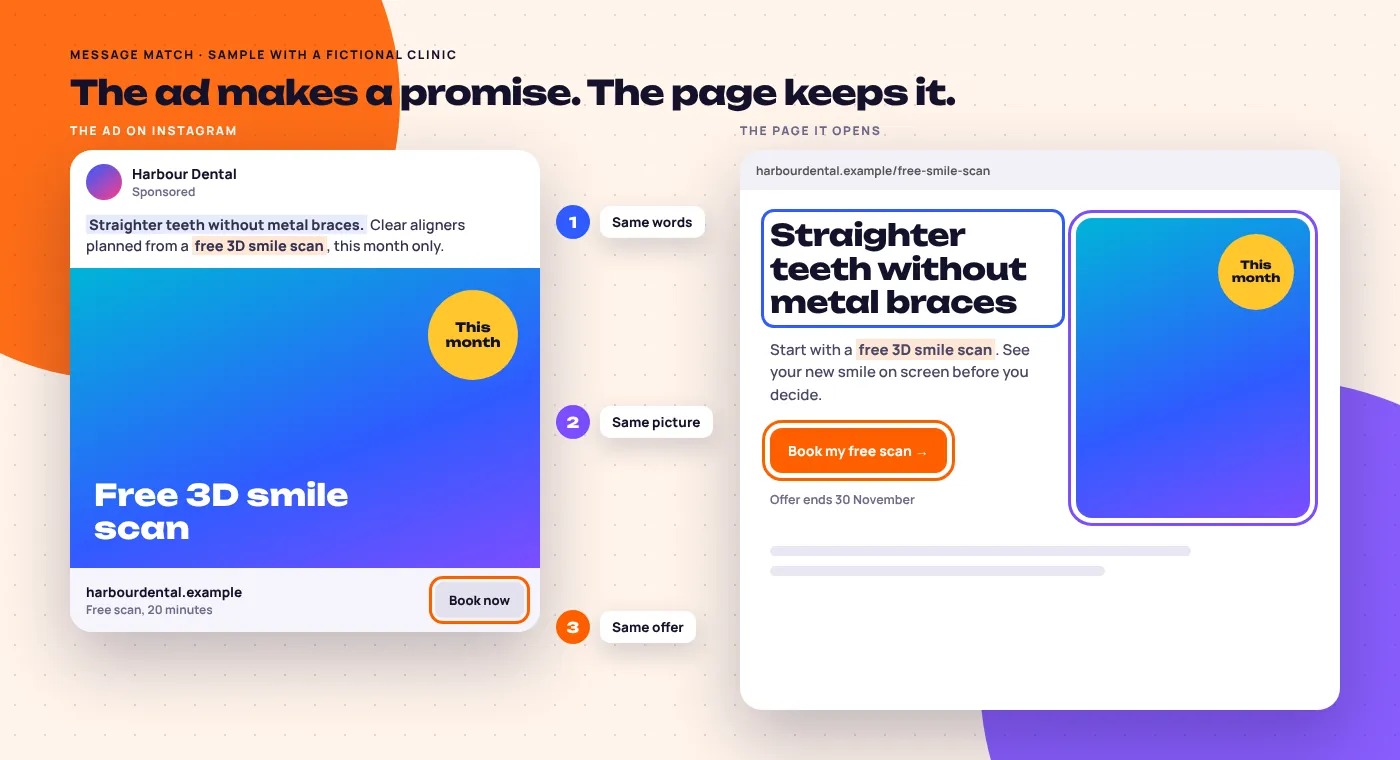
Before we draw anything, we put the ad and the page side by side. If a visitor can’t tell at a glance they are in the right place, nothing below gets read.
- 1
Same words
The page headline reuses the ad’s hook. If the ad says “without metal braces”, so does the page.
- 2
Same picture
Colours, product shot or face from the creative appear on the page.
- 3
Same offer, same button
Same price or deadline, and the button names the same action.
One page per audience or ad set, not one page for everything
Different ad sets make different promises, so they need different pages: one template, with a new headline, image and proof block per audience. A fictional clinic might split it like this:
| Ad set (sample) | Hook in the ad | Page headline |
|---|---|---|
| Meta, adults 30 to 50 interested in aligners | Straighter teeth without metal braces | Straighter teeth without metal braces. Start with a free 3D scan. |
| Meta, parents of teenagers | Braces your teen won’t hide from photos | Clear braces for teens, planned around school terms |
| Google Search, “invisalign cost” | Invisalign prices from a fixed monthly plan | What Invisalign costs here, with monthly plans and a free scan |
Search traffic arrives with a question, so the page answers it high up. Social traffic arrives curious, so the page earns the scroll.
The 12 Things We Fix First on a Landing Page That Isn’t Converting
When a founder sends us a page that “gets clicks but no leads”, these are the margin notes we write, roughly in the order they cost money.
- Message
The headline ignores the ad
We find: a brand slogan where the ad’s promise should be.
We change: the headline to the ad’s own hook.
- Offer
Two or three offers on one page
We find: “Book a call”, “Download the guide” and “Shop now” competing.
We change: one offer per page. The others get their own pages and their own ads.
- Exits
The full site menu is still there
We find: top navigation, footer links, social icons.
We change: remove them. The logo stays but does not leave the page.
- Above the fold
No button on the first mobile screen
We find: a tall hero image pushing the button below the fold.
We change: headline, offer, button and one proof line all visible before the first scroll.
- Button
The button says “Submit”
We find: generic labels that hide what happens next.
We change: “Get my quote by tomorrow”. The label is a small promise.
- Form
The form is the wrong length
We find: nine fields for a first enquiry, or two fields and a sales team drowning in junk.
We change: three or four fields, plus one qualifying question when lead quality is the problem. Shorter is not always better.
- Proof
Proof lives at the bottom
We find: reviews in a carousel nobody scrolls to.
We change: one specific proof line next to the button.
- Objections
Price and process go unanswered
We find: visitors leave to search “how much does it cost”.
We change: a short FAQ before the last button. No price? Show a range.
- Speed
The hero image is 2 MB
We find: Largest Contentful Paint at 4 seconds or more on mobile data.
We change: sized WebP, preloaded, fonts trimmed. Target LCP under 2.5 seconds.
- Interaction
The page feels sticky to tap
We find: chat widgets, popups and sliders loading first.
We change: delay or remove third-party scripts. Target INP under 200 ms.
- Tracking
Conversions are counted twice, or not at all
We find: a thank-you page firing on every reload.
We change: one conversion per real submission, browser and server, one event ID.
- Attribution
Leads arrive with no source
We find: CRM records that say “website” and nothing else.
We change: hidden fields saving UTMs and click IDs with every lead, so you see which ad set brings buyers.
Selling products rather than taking enquiries? The same thinking applies to product and collection pages, and we cover it in Shopify conversion optimisation.
Mobile First, Fast and Tracked Before Launch
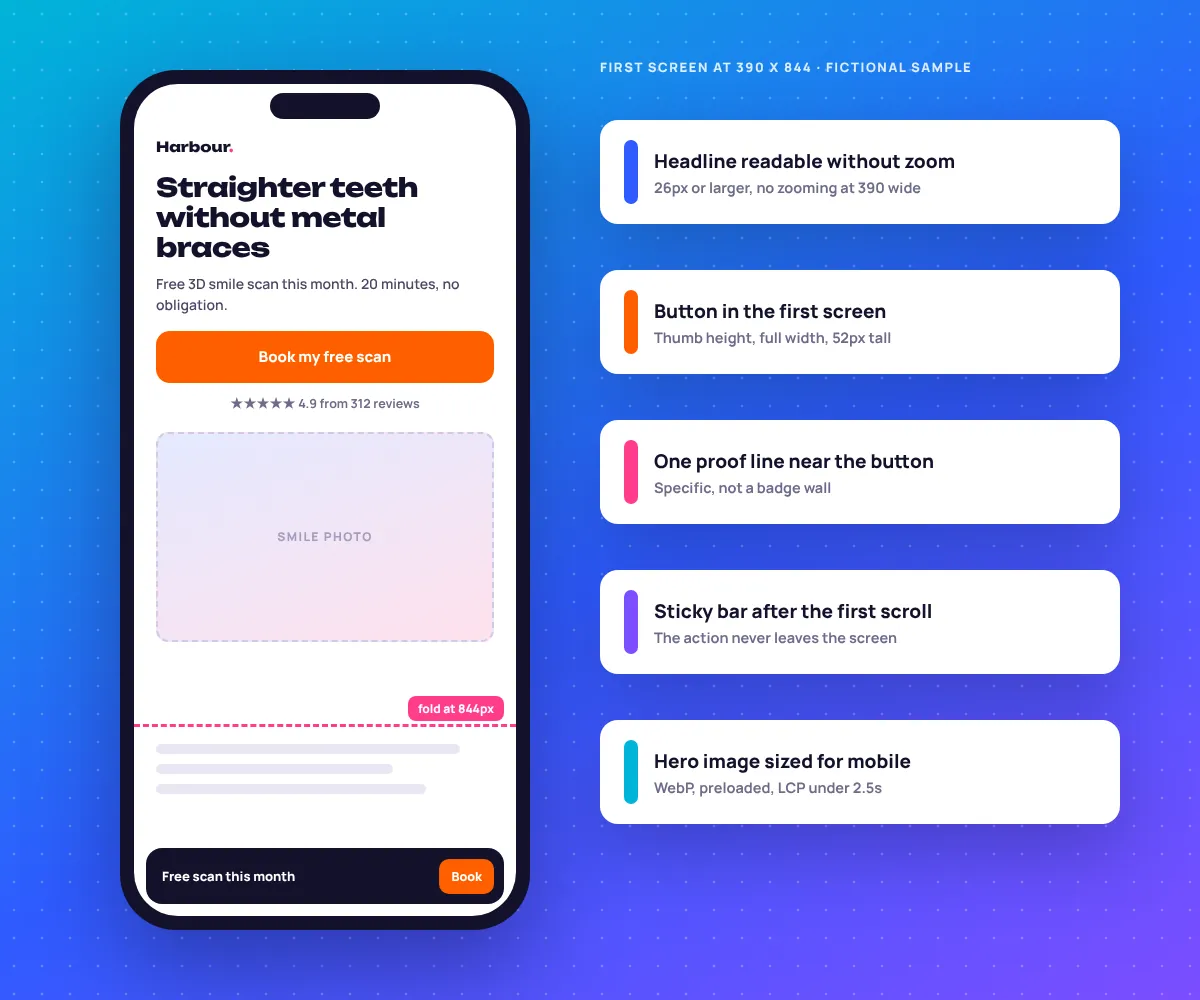
Most paid social traffic lands on a phone, often on mobile data, so we design the 390px version first. Every page we ship meets these standards.
Built for a thumb
Full-width buttons at least 48px tall, text readable without zooming, the number keyboard for phone fields and a sticky action bar after the first scroll.
Core Web Vitals
Google’s “good” thresholds, checked on a mid-range phone. Clicks lost to a blank screen still show up on your invoice.
GA4 events
One key event per real conversion, named by offer, so reports split by page and ad set.
Meta Pixel plus Conversions API
The same Lead or Purchase sent from browser and server, matched by event ID so Meta counts it once.
Google Ads enhanced conversions
So Google can match conversions it would otherwise lose to cookie limits. Our conversion tracking setup service covers the full wiring, including offline conversions from your CRM.
When A/B Testing a Landing Page Is Worth It, and When It Isn’t
A/B tests need volume. Split 40 leads a month between two versions and you will be reading noise for half a year. So the testing plan depends on how many conversions the page gets. These are rough rules of thumb, not laws.
Don’t split test yet
Make one big change at a time and compare equal periods with spend held steady. Session recordings tell you more than a test could.
Test big swings only
The offer, the headline angle, the form length. One test at a time, for three to four full weeks.
Run a testing cycle
A steady rhythm of tests, each with a written hypothesis, including smaller things like button copy.
Building a separate page for each audience is not an A/B test, and it doesn’t need the same volume. It is just good message match. When you are ready for a structured programme across the whole site, that is our website CRO service.
How We Build Your Landing Page: a 14-Day Sprint
The board for a typical lead-generation page with one offer. Cards tagged “You” are all we need from you.
Brief
Days 1 to 2Copy and wireframe
Days 3 to 5Design and build
Days 6 to 9Tracking and QA
Days 10 to 12Launch
Days 13 to 14After day 14: a first read after two full weeks of traffic, then fixes or test cycles depending on volume. Booking systems or multi-step quote forms take longer, and we say so on day one.
Results From Pages Built for Paid Traffic
Two published cases where the result depended on what happened after the click. Figures exactly as on each case page.
Mad Over Maldives, luxury travel, India
Meta ads by traveller type
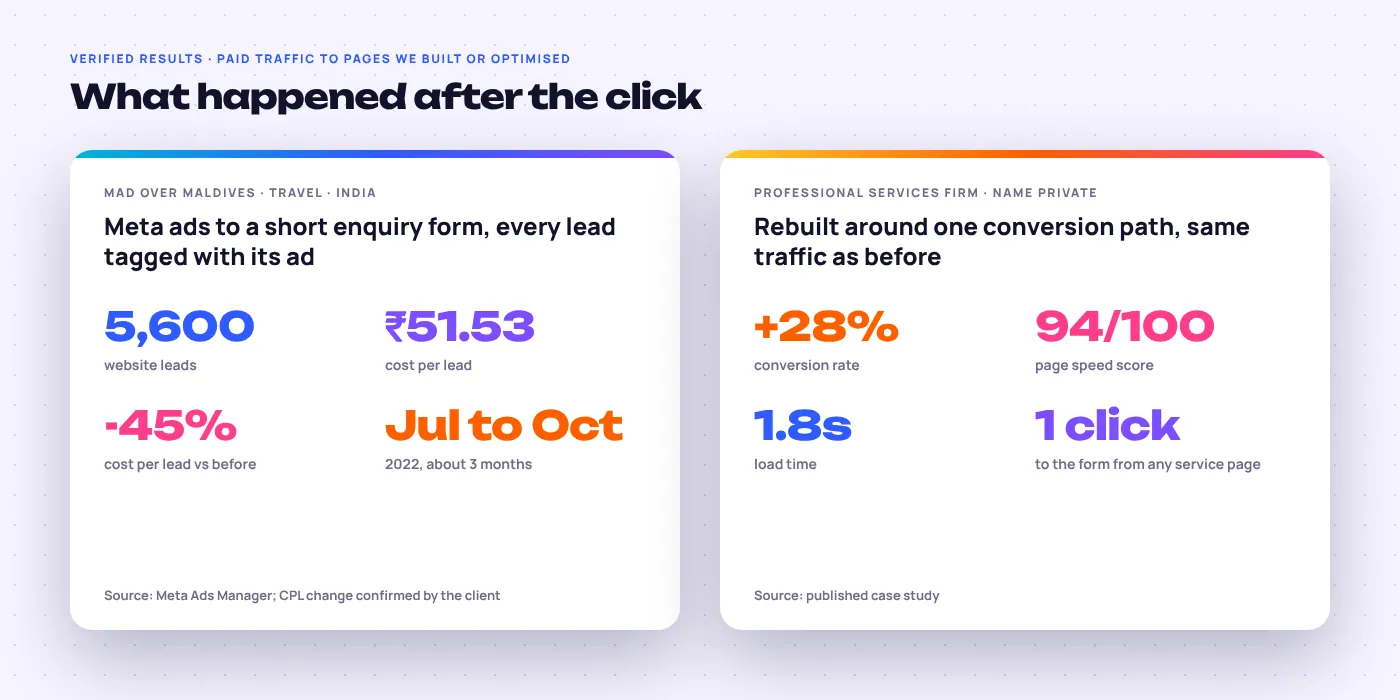
Separate ad sets for honeymooners, families and groups of friends, optimised for website leads.
A short form, tagged
Name, phone and package. Every enquiry tagged with its campaign, then followed up on WhatsApp within minutes.
From Meta Ads Manager, 1 Jul to 10 Oct 2022. Cost per lead 45% lower than the previous approach, confirmed by the client.
Read the Mad Over Maldives case study →Professional services firm, name kept private
Traffic they already paid for
Good visitors, lost to a slow site with the form three clicks deep.
One conversion path
A short enquiry form on every service page, images and scripts cut back.
On the same traffic, with a 94/100 page speed score and a 1.8 second load time.
Read the website rebuild case study →More results from lead generation and ecommerce accounts are on our success stories page, and the full list of brands is on our clients page.
Services That Work Alongside Landing Pages
Landing pages sit inside our website design and development service. These are the jobs that usually come before or after one.
Website and conversion
The ads that feed the page
Questions About Landing Page Design
What is a landing page?
A single page built for one campaign and one action, like booking a call or claiming an offer. No site menu, no competing links, and a headline that repeats the ad’s promise.
How long does it take to build a landing page?
About 14 days for a lead-generation page with one offer, if access and sales notes arrive in the first two days. Booking systems or multi-step forms take longer.
Is a dedicated landing page worth it if I already have a website?
If you run paid ads, usually yes. Your site serves everyone; a landing page serves one campaign, so more paid clicks become enquiries or sales. The bigger the spend, the faster it pays back.
How many landing pages do I need?
One per offer, and one version per audience where the ads make different promises. That rarely means starting from scratch: one template, new headline, image and proof.
How long should my landing page form be?
As short as the offer allows, and no shorter. Three or four fields suit most first enquiries. Lots of leads but few buyers? One qualifying question, like budget or timeline, often helps.
Which platform do you build landing pages on?
Usually your own WordPress or Shopify site, so the page sits on your domain. We also work in Unbounce, Webflow or other builders your team already uses.
What tracking do you set up on a landing page?
GA4 key events, Meta Pixel plus Conversions API with deduplicated event IDs, Google Ads enhanced conversions, and hidden fields saving UTMs and click IDs with each lead. All tested before launch.
Should I A/B test my landing page?
Only with enough conversions to read a result, roughly 100 or more a month as a rule of thumb. Below that, we make bigger single changes and compare equal periods.
Can you fix my existing landing page instead of building a new one?
Often, yes. We start with the 12-point teardown. If the problems are message, form and speed, we fix it. If the builder is slow or the structure fights the offer, a rebuild usually makes more sense.
Send Us the Ad and the Page It Opens
We will put them side by side, run the 12-point teardown on a phone and send back what we would change first. Free, and you keep the notes.
Everything important sits above this line. Including this button. Or go back to website design and development.