
Shopify Conversion Optimisation That Turns More Visitors Into Buyers
Our Shopify conversion rate optimization work starts with your own Shopify funnel, finds the step where buyers drop out, and fixes it with tests on the product page, cart drawer and checkout. No full redesign, no guesswork, just more orders from the traffic you already pay for.
- 1Product page
- 2Cart drawer
- 3Checkout
Shopify Conversion Rate Optimization: What It Is and How It Differs
What is Shopify CRO?
Shopify conversion rate optimization is the work of raising the share of store sessions that end in an order, by finding where shoppers leave the Shopify funnel and testing fixes to product pages, collections, cart and checkout.
It is narrower than general website CRO services, which cover lead forms and any platform. It is also different from Shopify speed optimisation, which fixes load time. Here we work with Shopify’s own pieces: themes, sections, apps, Shopify Bundles, Shopify Subscriptions, Shop Pay and the checkout.
| Question | Shopify CRO (this page) | Website CRO | Speed work |
|---|---|---|---|
| Main metric | Orders and revenue per session | Leads or sales on any site | Core Web Vitals |
| Where it works | Product, collection, cart drawer, checkout | Any page or form | Theme code, apps, images |
| Typical fix | Delivery date by the button, bundle offer, wallet order | Form length, page structure | Removing scripts, resizing images |
| Data source | Shopify Analytics funnel plus GA4 | GA4, heatmaps, recordings | Field data from real visits |
Where Shopify Stores Leak: Stage, Typical Leak, Fix
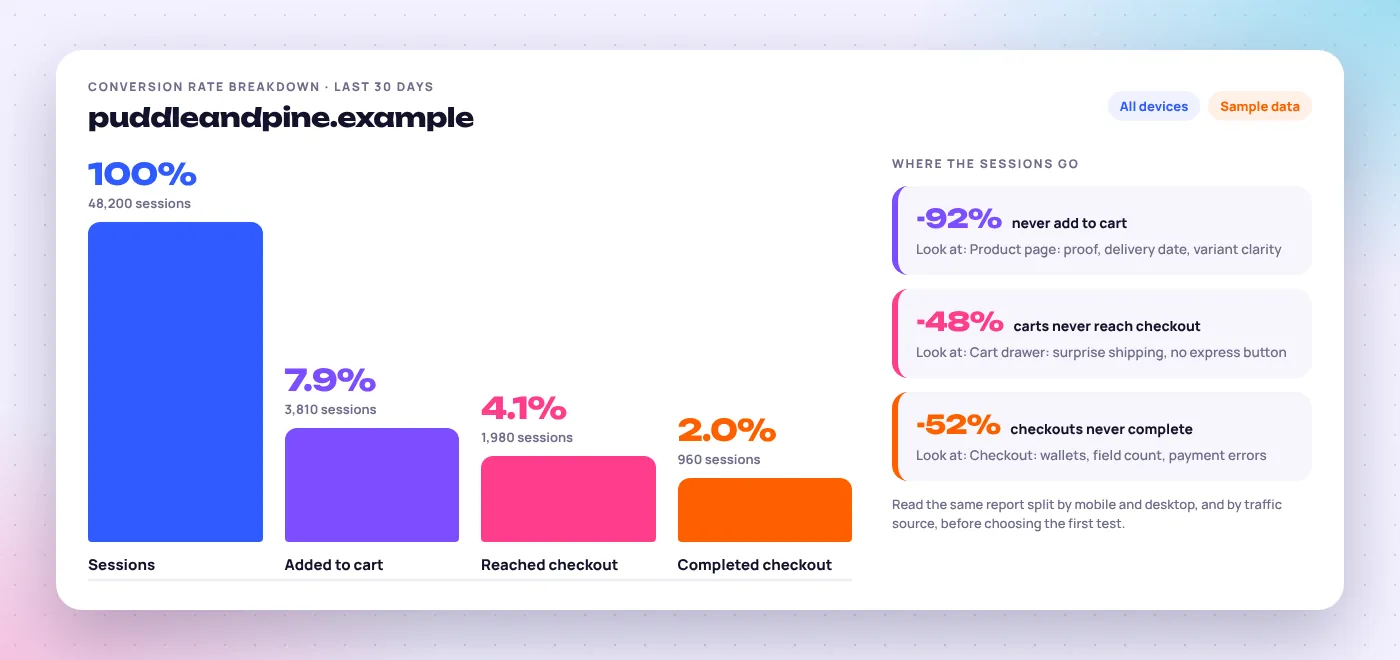
Every Shopify store has the same four-step report. The percentages differ; the leaks repeat.
| Stage | Typical leak | What we check | Usual fix |
|---|---|---|---|
| Collection pageSessions to product views | Twenty products, no filters, best sellers buried | Filter use, sort order, clicks on the first row | Shopify Search & Discovery filters, best sellers first, quick add on simple products |
| Product pageViews to added to cart | Reviews below the fold, no delivery date, confusing variants | Scroll depth, variant clicks, size guide opens | Rating beside the price, delivery promise under the variants, visible size guide |
| Cart drawerAdded to cart to reached checkout | Shipping cost unknown, popup on top of the cart | Cart opens versus checkout starts, by device | Free-shipping progress bar, one upsell, express buttons in the drawer |
| CheckoutReached checkout to completed | Surprise shipping, slow wallets, discount field hunting | Step-by-step drop, payment method mix, failed payments | Shop Pay and wallets first, shipping shown earlier, fewer custom fields |
How do you read the Shopify conversion funnel?
Compare the drop between each pair of steps, not the final conversion rate. A store with a low added-to-cart rate has a product page problem; a store where carts rarely reach checkout has a cart problem. Split the report by device and traffic source before deciding what to test.
What is a good conversion rate for Shopify?
There is no single good number. Rates often quoted as roughly 1% to 3% hide big differences by category, price and traffic mix. A store full of cold social traffic converts lower than one living on email and brand search, so we benchmark against your own funnel over time.
Shopify Product Page Optimization, Screen by Screen
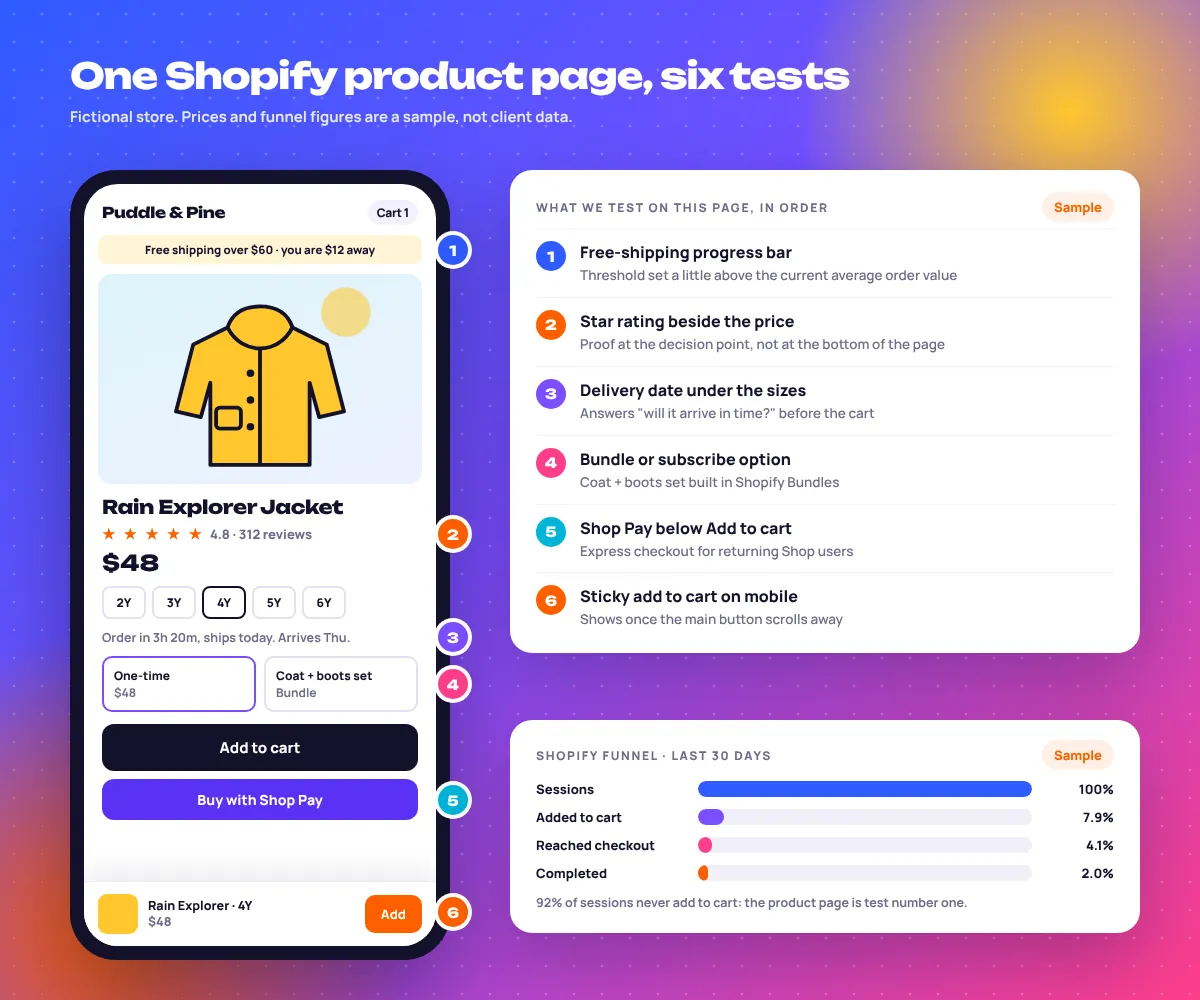
Most Shopify traffic is mobile, so we plan the product page as a stack of phone screens. Each screen has one job.
What should be above the fold on a Shopify product page?
The product image, name, price, star rating with review count, the variant picker and the Add to cart button. If the store offers free shipping above a threshold or a delivery date, that belongs on the first screen too. Everything else can sit lower.
- 01First screen
Decide in five seconds
Image, price, rating and the variant picker. Apparel shoppers stall at sizes, so the size guide sits next to the picker, not in a tab.
- Rating near the price
- Size guide inline
- Sold-out sizes greyed
- 02Second screen
Remove the last doubt
Delivery date, returns in one line and the bundle or subscription choice. Shopify Bundles handles fixed sets inside Shopify admin; Shopify Subscriptions adds a subscribe option for anything people reorder.
- Delivery promise
- Bundle or subscribe
- Shop Pay under Add to cart
- 03Scrolling
Keep the button in reach
A mobile sticky add-to-cart bar that appears once the main button scrolls away, keeping the chosen variant.
- Sticky add to cart
- Keeps selected variant
- 04Lower page
Proof and pairing
Photo reviews, a short FAQ and complementary products from Search & Discovery. Cross-sells belong here, not in a popup.
- Photo reviews
- Complementary products
- Three-question FAQ
Shopify Checkout Optimization and Shopify Cart Abandonment Fixes
After the product page, the money leaks at three stops. We take them in the order shoppers meet them.
Collection pages
Shoppers who cannot narrow down quickly leave.
- Filters by size, colour and price from Search & Discovery
- Best sellers and in-stock items first
- Quick add for products with one variant
Cart drawer
People add, see a total they did not expect, and go.
- Free-shipping threshold set a little above average order value, with a progress bar
- One relevant upsell, never three
- Shop Pay and wallet buttons inside the drawer
Checkout
Shopify’s checkout is strong; we remove what stores bolt on.
- Accelerated checkouts (Shop Pay, Apple Pay, Google Pay) visible early
- Shipping rates shown before the last step
- Checkout UI extensions only where they earn their place
How do you reduce Shopify cart abandonment?
Show the full cost before checkout, add express payment buttons to the cart drawer and stop popups covering the cart. Then check the abandoned checkout emails in Shopify are switched on and timed sensibly. Most abandonment comes from surprise costs and friction, not price alone.
Recovery emails help, but fixing the cause comes first. Our ecommerce email marketing team builds the flows after.
Does Shop Pay increase conversion rate?
Often, for stores with many returning Shop users, because saved details turn checkout into a couple of taps. We do not assume it. We check how many of your orders already come through Shop Pay, then test its position in the cart drawer and on the product page.
Checkout changes now go through Checkout Extensibility, per the Shopify Help Center. Checkout UI extensions on the information, shipping and payment steps need Shopify Plus; the thank you and order status pages can be customised on other plans.
The Shopify App Audit: Reviews, Upsells, Bundles, Subscriptions
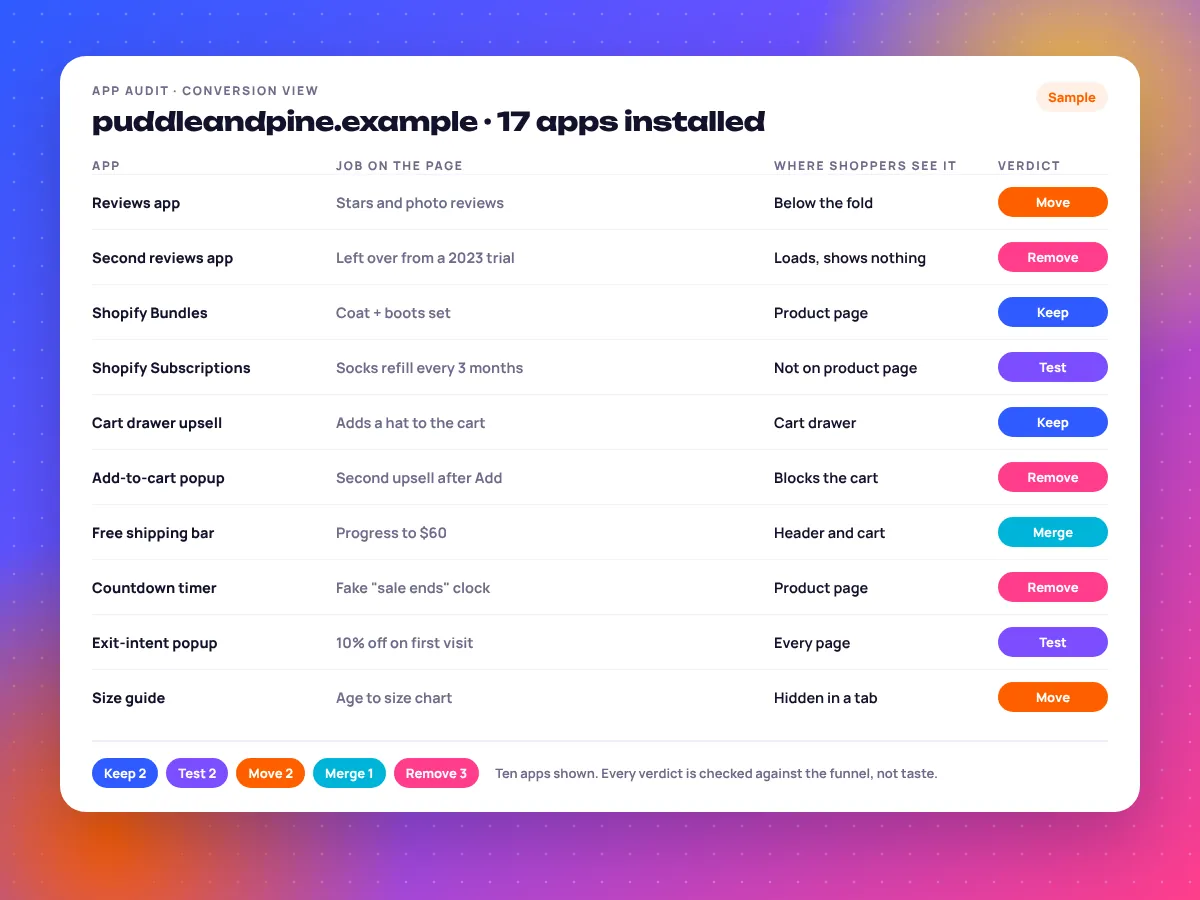
Two review widgets, a popup over the cart and a fake countdown clock all cost trust. We ask four questions of every app shoppers see:
- Does a shopper see it at the moment of decision?A rating beside the price beats reviews under the footer.
- Does it duplicate another app or a Shopify feature?Shopify Bundles and Search & Discovery often replace paid apps.
- Has it ever been tested?Upsell popups and exit offers get a test, then stay or go.
- Is it honest?Fake scarcity timers go. They cost repeat buyers.
Page weight from apps is a separate job, covered by our Shopify speed work.
Our Shopify A/B Testing Roadmap, Numbered
To increase Shopify conversion rate, the order of tests matters more than the ideas. This is our usual sequence, adjusted to your funnel.
Clean the data
Match Shopify orders with GA4 and ad platform purchases so results can be trusted.
Weeks 1-2 · Watch: order matchShip the obvious fixes
Broken variant images, hidden size guides, no delivery line. No test needed.
Weeks 1-2 · Watch: add to cartRating and delivery date by the button
The first real product page test, usually on the top ten products by sessions.
Weeks 3-5 · Watch: add to cart rateMobile sticky add to cart
Tested on mobile only, with the chosen variant carried into the bar.
Weeks 4-6 · Watch: mobile add to cartFree-shipping threshold and bar
Threshold set from your real order values, shown in header and cart drawer.
Weeks 6-8 · Watch: average order valueExpress buttons in the cart drawer
Shop Pay and wallets moved up, the cart popup removed.
Weeks 7-9 · Watch: reached checkoutBundle or subscription offer
Shopify Bundles for natural sets, Shopify Subscriptions for refills.
Weeks 9-11 · Watch: revenue per sessionCollection page filters and order
Filters, sort order and quick add on the collections ads land on.
Weeks 11-13 · Watch: product views per session
How much traffic do you need for Shopify A/B testing?
Enough to reach a few hundred conversions per variant, over at least two full weeks so weekdays and weekends both count. Smaller stores should test bigger changes on add to cart, which happens far more often than orders, and ship clear best-practice fixes without a formal test.
How long does Shopify CRO take?
The audit and first fixes take about two weeks. Each test runs two to four weeks, so a first round of product page, cart and checkout tests fills roughly three months. After that it becomes a monthly rhythm of new tests, built on what the last round taught us.
Results From Shopify Stores We Grow
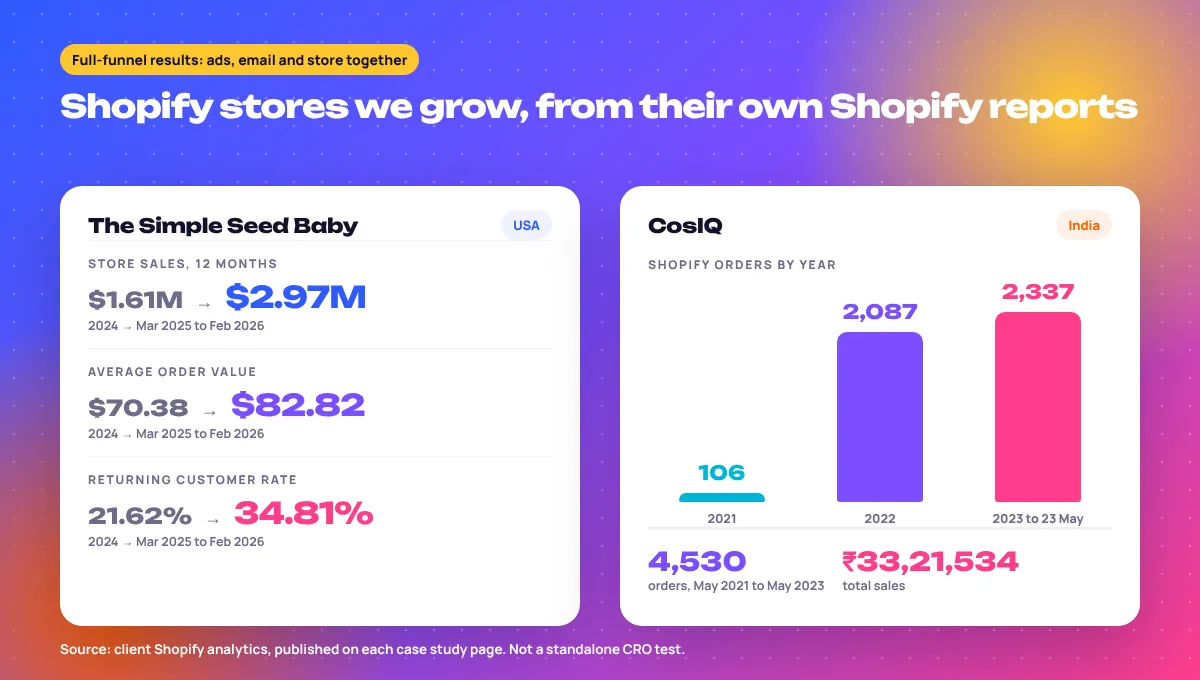
These are full-funnel results from ads, email and store work together, taken from each client’s Shopify reports. They are not the result of a single conversion test.
The Simple Seed Baby, US baby clothing
Store sales grew 84% year on year, from $1,611,792 in 2024 to $2,971,538 in the 12 months to February 2026. Average order value rose from $70.38 to $82.82 and the returning customer rate from 21.62% to 34.81%. We run Meta, Google and Klaviyo for the brand. Read the Simple Seed Baby case study.
CosIQ, Indian skincare
4,530 Shopify orders and ₹33,21,534 in total sales from May 2021 to May 2023, with orders rising from 106 in 2021 to 2,087 in 2022. Meta, Google, WhatsApp order confirmation and email worked as one system. See the CosIQ skincare case study.
EmergingAds is a performance marketing agency founded in 2021, based in Gurugram, India, working with brands in the US, UK, UAE, India and Australia, with 85+ brands served. More in our client success stories and on our clients page.
Shopify CRO Agency Work That Sits Next to This
A Shopify CRO agency should also fix what sits around the tests. Conversion work is one part of our website design and development services.
Build and run the store
Getting the basics right before testing.
Speed and wider CRO
Load time and conversion beyond Shopify.
By industry: ecommerce marketing for D2C brands and B2C marketing services. More on stores, ads and testing in our blog articles.
Questions About Shopify Conversion Optimisation
How do I increase my Shopify conversion rate quickly?
Fix the product page first. Put the star rating beside the price, a delivery date under the variants and Shop Pay under Add to cart, then show shipping costs in the cart drawer before checkout.
How long does Shopify CRO take to show results?
The first fixes usually ship within two weeks. Each A/B test needs two to four weeks, so a full first round across product page, cart and checkout takes about three months.
Is Shopify conversion optimisation worth it for a small store?
Yes, if you pay for traffic. Small stores may not have enough orders for formal split tests, so we ship clear fixes and test larger changes on add to cart, which happens far more often.
Do you redesign the whole store?
No. We change the specific pages and steps where the funnel shows a leak. A full redesign is a separate project through our website team, and only if the data says it is needed.
Can you customise the Shopify checkout?
Yes, within Checkout Extensibility. Branding and the thank you and order status pages can be changed on most plans, while checkout UI extensions on the information, shipping and payment steps need Shopify Plus.
Does Shop Pay really help conversion?
It often does, because returning Shop users can pay without typing details. We check your current Shop Pay share first and test where the button appears rather than assume a lift.
Should I use Shopify Bundles or a third-party bundle app?
Start with Shopify Bundles for fixed sets, because it is built into Shopify admin. A third-party app makes sense only when you need a bundle type or layout that Shopify Bundles does not offer, and it should earn its place in a test.
Do you run tests on the live store?
Yes. A Shopify A/B testing app splits live visitors between versions, after we preview each variant on a duplicate theme.
How is this different from Shopify speed optimisation?
Speed work fixes load time and responsiveness. Conversion work fixes what shoppers see and do once the page has loaded: proof, delivery, offers and checkout friction.
What do you need from us to start?
Staff access to Shopify admin with Analytics and Themes, read access to GA4, and a list of the apps you rely on. We take it from there.
Get More Orders From the Shoppers Already on Your Store
Send us your store URL. We will read your Shopify funnel, audit the apps on your product pages and send back the first three tests we would run.
Need a new store first? See Shopify store setup.
