
Ecommerce Email Marketing That Recovers Revenue at Every Stage
Updated
Email marketing for ecommerce is more than an abandoned cart flow. We plan the year of campaigns, grow the list with pop-ups and quizzes, segment buyers by how recently and how often they order, and pair email with SMS and WhatsApp, then prove what it added to store revenue.
What Is Ecommerce Email Marketing?
Ecommerce email marketing is the planned use of email, alongside SMS and WhatsApp, to turn store visitors into subscribers, first-time buyers into repeat customers and lapsed customers back into buyers, using order data to decide who gets what.
Flows react to what one shopper does; campaigns go to a segment on a date you choose. This page covers the strategy that ties both to your store’s numbers.
If you only need the automations, our email automation flows page covers each one trigger by trigger. If you are on Klaviyo and want the build itself, see Klaviyo email marketing.
How much revenue should email drive for an ecommerce store?
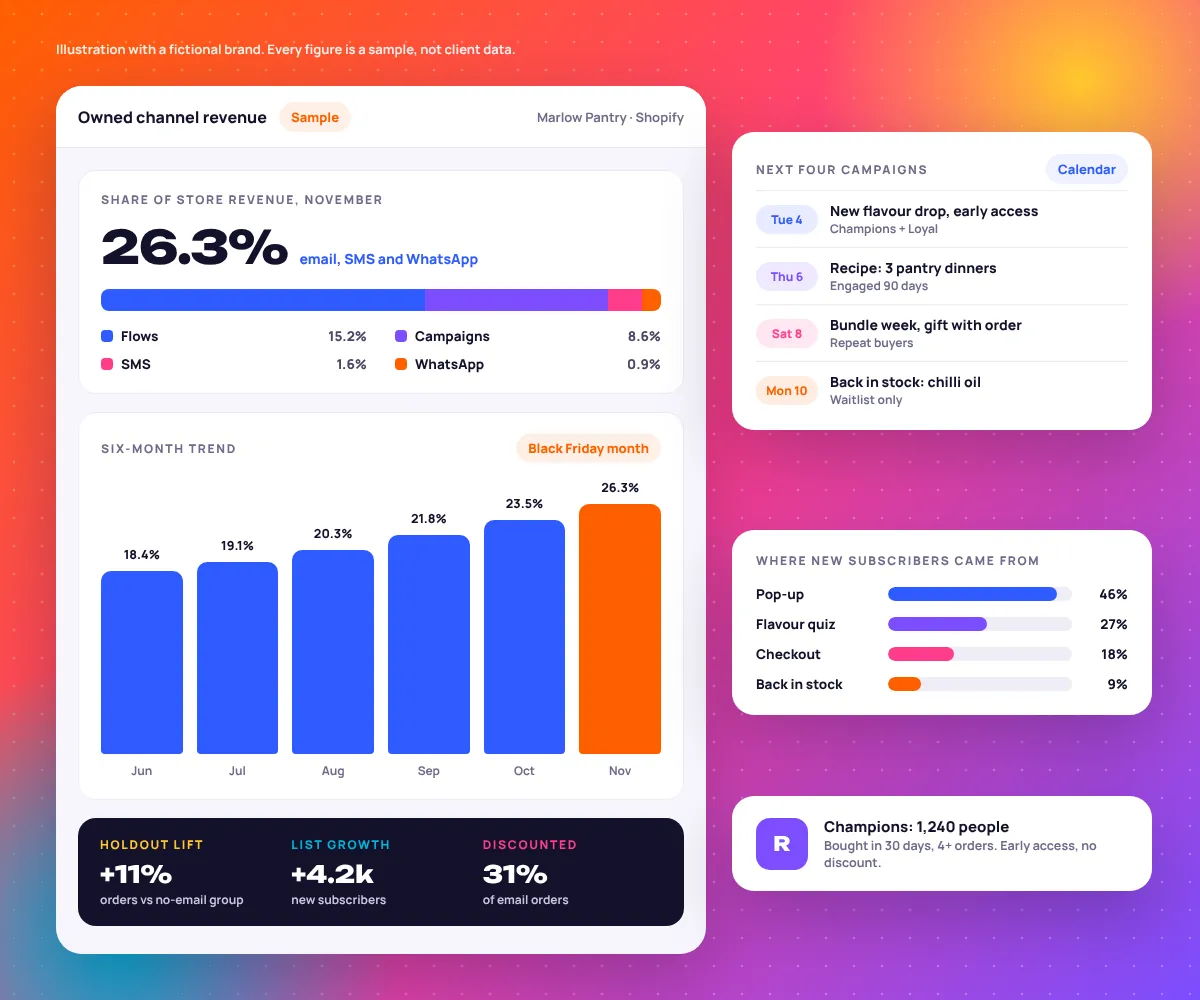
There is no single right number, but a commonly quoted healthy range for established stores is 20 to 30 percent of revenue from email and SMS, as the email platform reports it. Under 10 percent usually means missing flows or a weak list. Above 35 percent, check what email is claiming.
EmergingAds is a performance marketing agency founded in 2021, based in Gurugram, India, working with brands in the US, UK, UAE, India and Australia, with 85+ brands served. Email sits inside our wider email marketing management service.
Three numbers we pull first
From Shopify and your email platform, in the first week.
- %
- Email’s share of store revenueSplit by flows, campaigns and SMS. Campaign-heavy usually means under-automated.
- Off
- Email orders using a codeIf most carry a discount, the list has learned to wait for one.
- 2nd
- First to second order rateThe number email can move most.
How Do You Plan an Ecommerce Email Campaign Calendar?
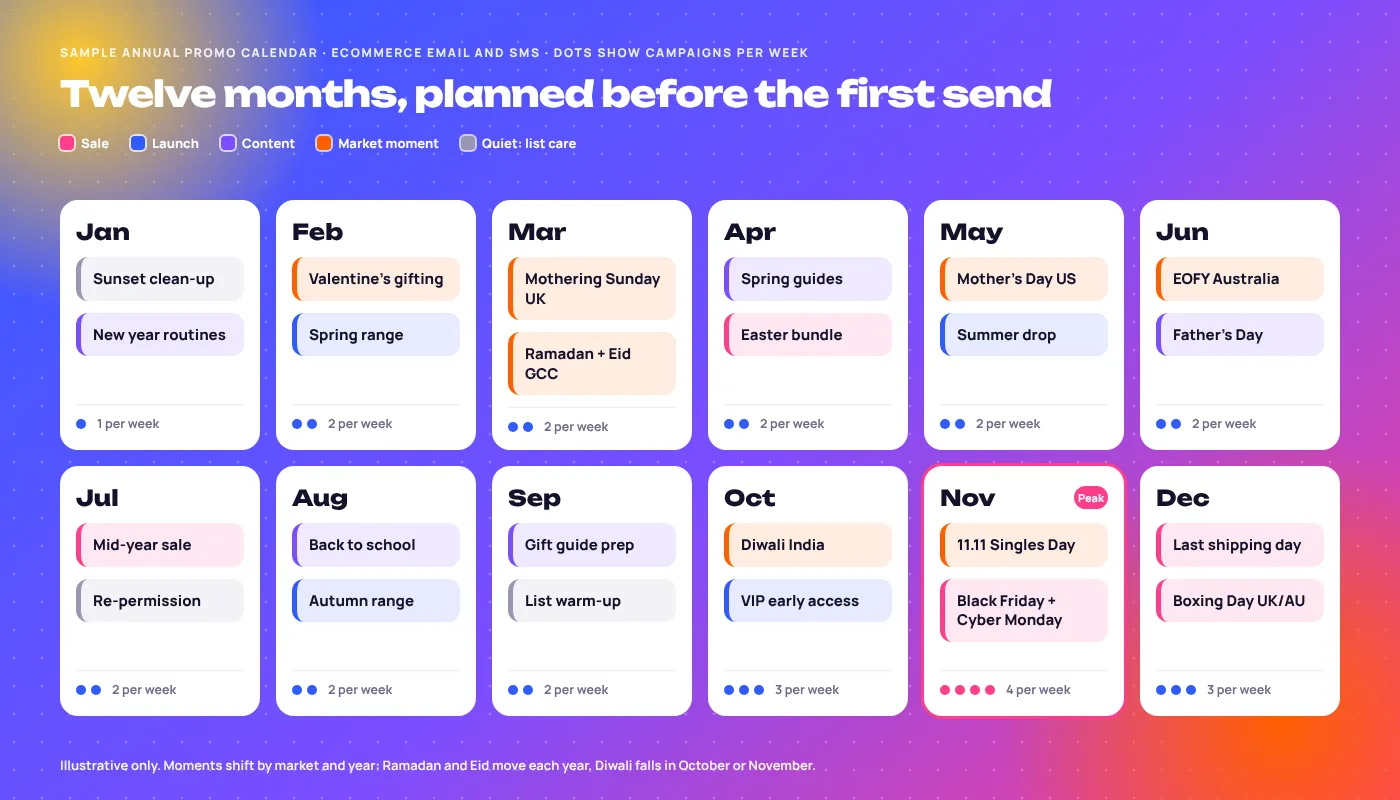
Start with a 12-month view: product launches, your biggest sale periods, the gifting and cultural moments in each market you sell to, and two quiet months for list care. Then set a weekly cadence per segment and fill each week about a month ahead.
How often should an ecommerce brand send emails?
Two to three campaigns a week to engaged buyers suits most stores; less-engaged subscribers get one.
Plan by market, not one calendar
Mother’s Day is March in the UK and May in the US. GCC stores plan around Ramadan and Eid, India around Diwali.
Not every send is a sale
Launches, guides and early access keep people opening between promotions.
Email List Growth for Ecommerce: Pop-Ups, Quizzes and Zero-Party Data
Email list growth for ecommerce comes from the traffic you already pay for. Each method brings a different kind of subscriber, so we track first orders by source, not list size.
| Tactic | What you collect | Where it works | Watch for |
|---|---|---|---|
| Timed or exit pop-up | Email, then SMS on a second step | Most stores, first visit | Google’s guidance on intrusive interstitials warns against full-screen mobile pop-ups. Delay it and keep it easy to close. |
| Product or routine quiz | Needs, preferences, product fit | Skincare, supplements, food, pets | Use every answer in follow-ups. |
| Back in stock and waitlist | Exact product interest | Drops, sizes, limited runs | Send the alert fast. |
| Checkout opt-in | Email and SMS consent from buyers | Every store | Separate, unticked boxes where the law requires it. |
| Post-purchase preference survey | Birthdays, who it was for, frequency wanted | Gifting and repeat categories | Three questions at most. |
| Giveaways | Volume | Launches only | Prize hunters rarely buy. |
What is zero-party data?
Zero-party data is information a customer tells you on purpose, such as skin type, a child’s age or how often they want to hear from you. It is more reliable than guessing from clicks, and it lets one campaign show different products to different people.
Consent rules differ by market: UK and EU subscribers need clear opt-in, and US marketing texts need prior express written consent. Forms also convert better on a fast store; see Shopify conversion optimisation.
Ecommerce Email Segmentation by RFM and Lifecycle
RFM segmentation for email scores every buyer on recency (how long since the last order), frequency (how many orders) and monetary value (how much they spend). Crossing recency with frequency gives nine groups, and each one gets a different message and offer, instead of one blast to everyone.
New buyers
How-to content, a cross-sell and a review ask. No code yet.
Promising
Bundles and replenishment reminders timed to usage.
Champions
Early access and referral asks. Never a sitewide code.
One-and-done risk
Best-sellers and reviews, a threshold offer if margin allows.
Steady
The normal calendar plus product education.
Loyal, cooling
A VIP perk and a short note asking what changed.
Lapsed one-timers
Two win-back emails, then sunset.
At risk
Best non-discount offer first, a code only if that fails.
Can’t lose
Most valuable lapse. A personal message and your strongest offer.
Monetary value sits on top: the top-spending third of each cell gets VIP treatment. The 30 and 90 day cut-offs suit products bought every month or two; for furniture we stretch them. Good ecommerce email segmentation also uses lifecycle stage and engagement, covered on our email segmentation strategy page.
How Do You Run Ecommerce Email Offers Without Killing Margin?
Use the cheapest offer that still moves the segment, and save percentage discounts for the few moments that need them. Early access, gifts with purchase, bundles and free shipping thresholds usually protect margin better than a sitewide code, because they reward a bigger basket rather than discounting it.
Early access
Champions shop a day early. No margin lost.
Gift with purchase
A sample above a basket size.
Free shipping threshold
Set it just above your average order to lift basket size.
Bundles
A best-seller with a slow mover.
Spend and save tiers
Money off only above set basket sizes.
Sitewide % off
Black Friday and clearance. Rarely anywhere else.
The maths behind the order: a product with a 60 percent gross margin keeps 40 points after 20 percent off, so you need 50 percent more orders to earn the same gross profit. Every planned offer is checked against your margins.
SMS and WhatsApp Marketing for Ecommerce, Alongside Email
In SMS and WhatsApp marketing for ecommerce, fewer messages win. Email carries the volume; texts carry the urgent or personal ones, and we suppress the email when a text has already done the job.
- Best for
- Stories, launches, guides, flows, anything with images or several products.
- Rules
- Gmail and Yahoo require authentication and one-click unsubscribe, set up in email deliverability setup.
SMS
- Best for
- Sale start, last shipping day and back in stock, two to four a month.
- Rules
- Separate SMS consent, sender ID and quiet hours. US marketing texts need written consent.
- Best for
- UAE, Saudi Arabia and India, where shoppers expect it. VIP drops and win-backs, on approved templates.
- Rules
- Opt-in first, per the WhatsApp Business Messaging Policy. More on our WhatsApp marketing service.
How Do You Measure Email Marketing Incrementality?
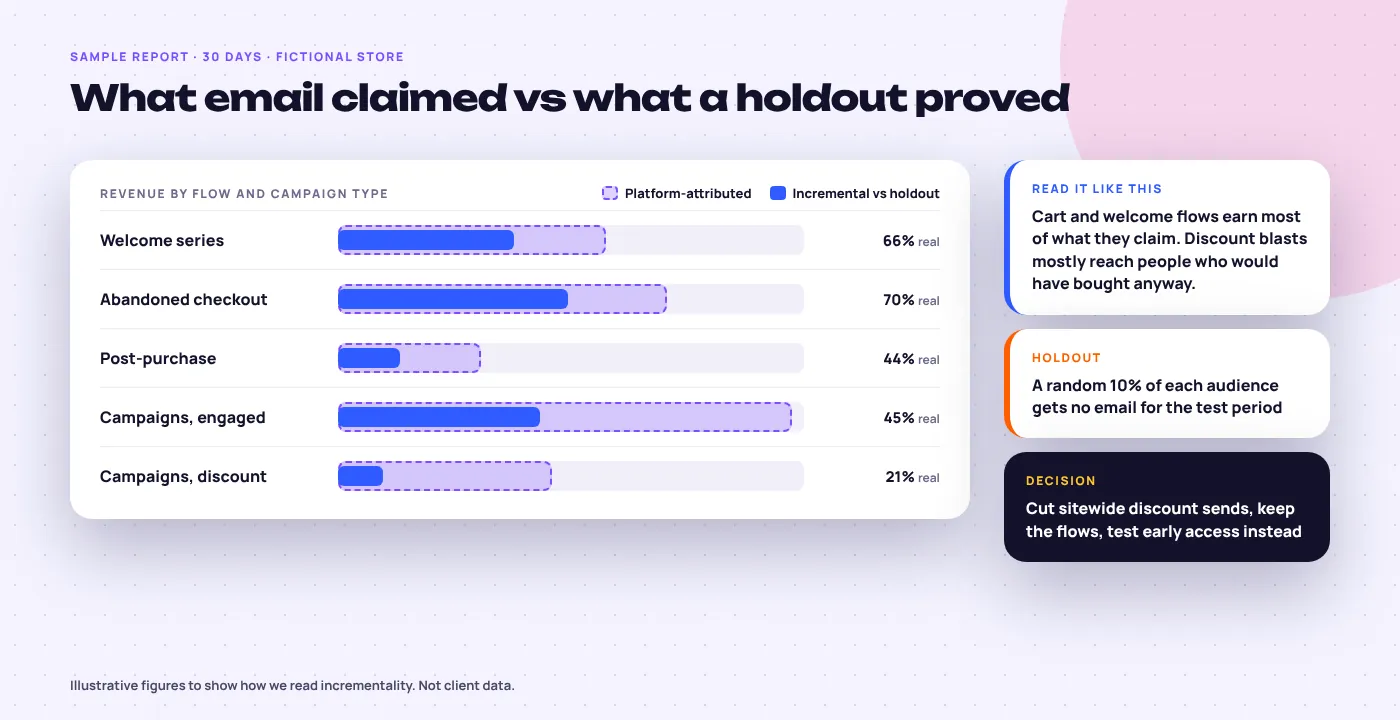
Hold back a random 5 to 10 percent of a segment from a flow or a campaign for a set period, then compare orders per person against the people who got the email. The difference is the revenue email actually added. Platform-attributed revenue counts any order after an open or click, so it always reads higher.
What the monthly report shows
- Email’s share of store revenue, split by flows, campaigns, SMS and WhatsApp.
- Revenue per recipient and holdout results, not open rates, which Apple Mail Privacy Protection inflates.
- Discount share and first to second order rate, checked against Shopify and GA4.
Our 90-Day Plan for Ecommerce Email
Most setup is live in about 14 days. The rest of the quarter grows the list and proves what works.
- Days 1 to 10A baseline and ranked fixes
Audit and baseline
Revenue share, flows, list sources, discount use and deliverability.
- Days 7 to 21Segments that update daily
Fix the foundations
Sending domain, consent fields and the first RFM segments.
- Days 14 to 30The flows that earn most, running
Core flows live
Welcome, abandoned checkout and post-purchase, each with a holdout.
- Days 31 to 45First orders tracked by source
List growth
Pop-up with a quiz step, back in stock alerts, checkout opt-in.
- Days 31 to 60Every send has a segment and a goal
Calendar and segmented campaigns
The 12-month calendar signed off, then sends by segment.
- Days 61 to 75An offer ladder that protects margin
Offer tests
Early access against a code, gift with purchase against free shipping.
- Days 61 to 80No customer gets the same message twice
SMS and WhatsApp layer
Launch, last-chance and win-back texts for opted-in subscribers.
- Days 76 to 90The next 90 days, built on proof
Incrementality read and next quarter
Holdout results, what to cut, what to scale.
Ecommerce Email Results From Our Clients
Fit Kit Bodycare, UK bodycare
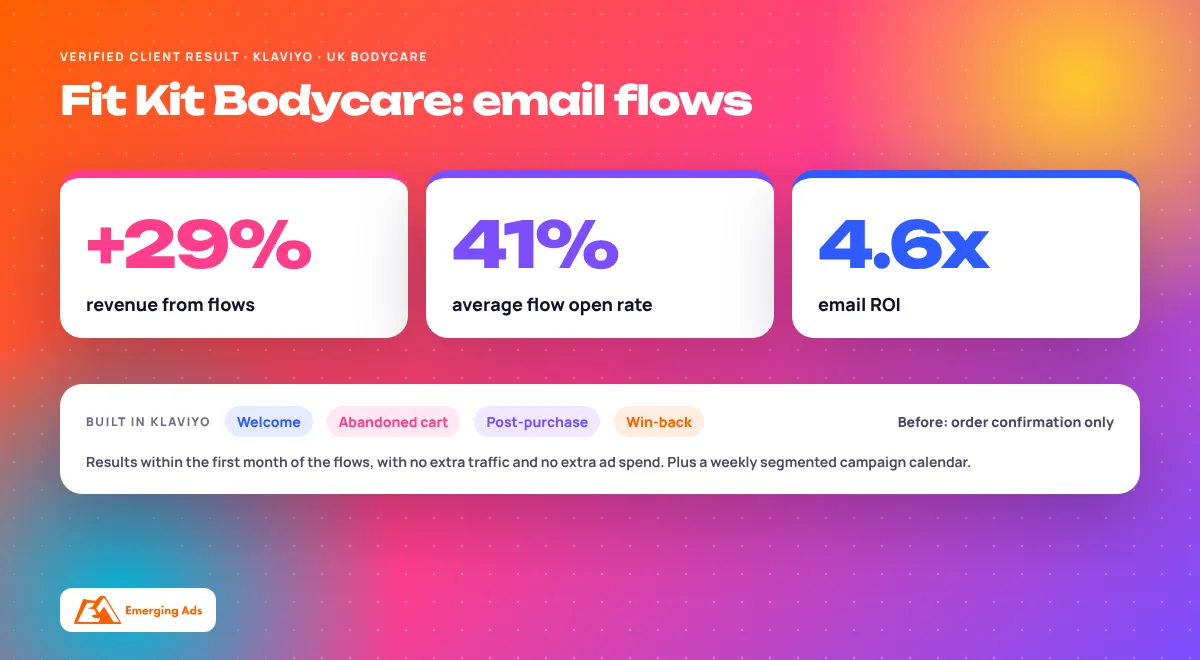
Before we started, the only automated email was an order confirmation. We built welcome, abandoned cart, post-purchase and win-back flows in Klaviyo and a weekly segmented campaign calendar. Within the first month: +29% revenue from flows, a 41% average flow open rate and 4.6x email ROI, with no extra traffic or ad spend.
The Simple Seed Baby, USA
A bamboo baby clothing brand we run Meta, Google and Klaviyo for. The case study credits the rise in returning customers to the email side.
Returning customer rate, from Shopify. Read the Simple Seed Baby case study →
More results on our success stories page, and the brands we work with on our clients page.
More Email Services for Online Stores
Industries:Ecommerce marketingB2C marketing servicesPaid traffic that feeds the list:Meta ads for ecommerceReading:Marketing blog
Email Marketing for Ecommerce: Common Questions
What email flows do online stores need?
Welcome, browse abandonment, abandoned checkout, post-purchase, replenishment and win-back. Start with the first three; they usually earn the most.
Is ecommerce email marketing worth it for a small store?
Yes, once you have steady traffic. Flows run on visitors you already paid for, so even a small list brings back lost orders.
How long does it take to see results from email marketing?
Flows usually show revenue within the first month. List growth and offer tests take a full quarter to read.
How often should an online store send marketing emails?
Two to three campaigns a week to engaged buyers is a good starting point. Less engaged subscribers get one.
What is RFM segmentation in email marketing?
It groups customers by recency, frequency and monetary value of their orders. Each group gets different messages and offers.
How do I grow my email list without discounts?
Use a quiz, back in stock alerts and early access as the reason to sign up.
How do you stop email discounts from hurting margin?
By using the cheapest offer that still moves each segment. Sitewide codes are kept for a few planned moments.
Should I use SMS or WhatsApp as well as email?
Yes, for a few urgent or personal messages. WhatsApp works best in the UAE, Saudi Arabia and India. Both need opt-in.
How do I know email is really adding sales and not taking credit?
Run a holdout test: a random group gets no email for a set period, and the difference in orders is what email added.
Which email platform is best for an online store?
Klaviyo for most Shopify stores, for its order data and segments. Omnisend or Shopify Email can suit simpler setups.
Do you design and write the emails too?
Yes. We write and design on-brand templates and test them on mobile before anything goes out.
Grow Ecommerce Revenue With Email That Works at Every Stage
Share your store and email platform. You get email’s real share of revenue, the flows and segments you are missing, and a first draft of your 90 days.