
Scale Your Ecommerce Revenue with Meta Ads
We run Meta ads for ecommerce brands on Shopify and WooCommerce, and we start with your margins, not your ROAS. Clean catalogue, a simple account, new creative every week, and every decision judged against the break-even number your store actually needs.
Why Ecommerce Meta Ads Fail at Break-Even
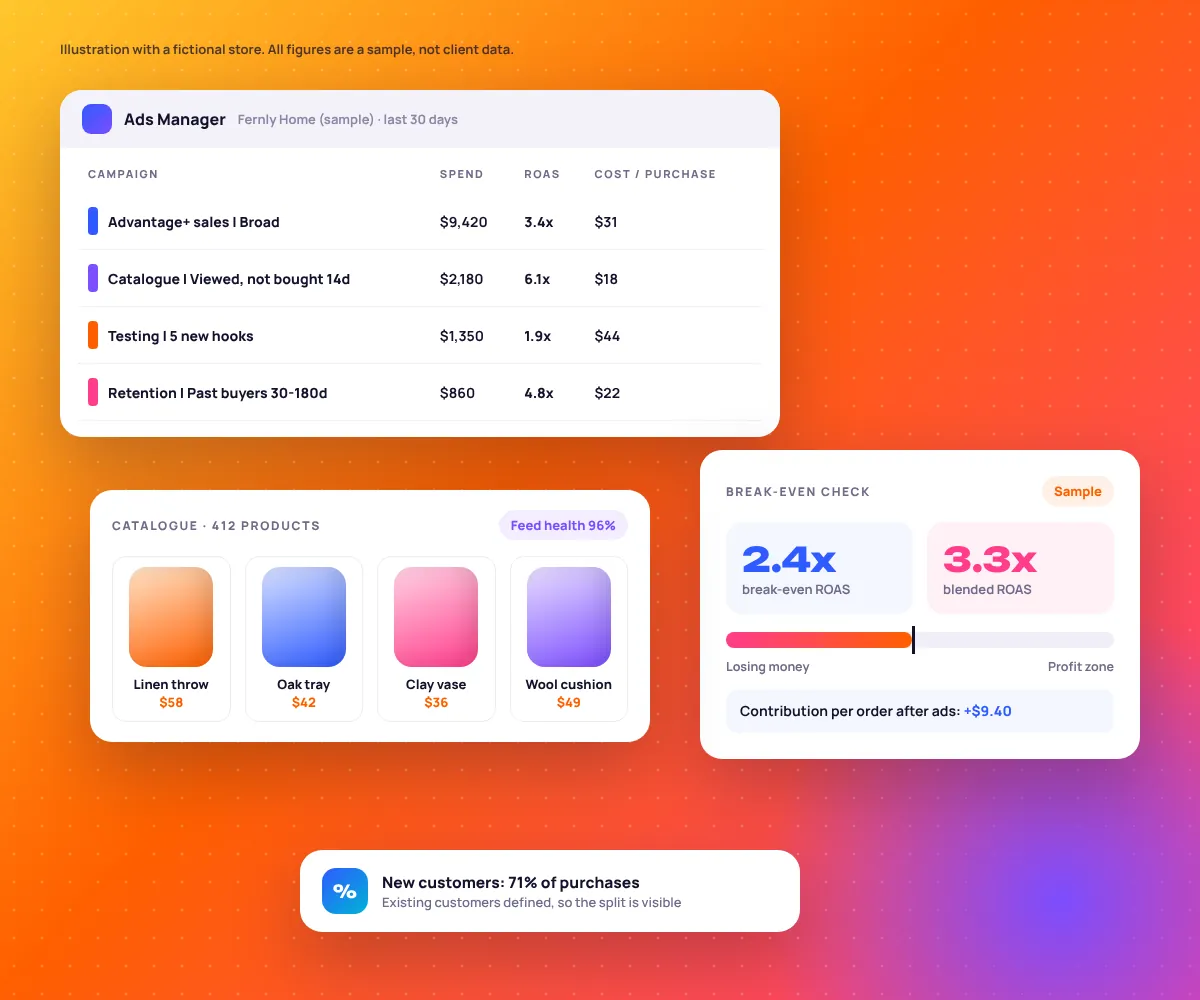
Plenty of stores report a healthy ROAS and still lose money. Meta sees revenue. It does not see your product cost, the courier, the payment fee or the parcel that comes back. All of that sits between the number on screen and the money in your account.
Contribution margin, not ROAS, decides if you can scale
Contribution margin is what one order leaves you after the variable costs of that order, before any advertising. Divide your order value by it and you get break-even ROAS: the point where ads pay for themselves and nothing more. A store with a 40% contribution margin breaks even at 2.5x. At 25% it needs 4x just to stand still.
So the first thing we agree with a founder is that line. Every campaign, creative and budget move is then judged against it, using blended revenue from Shopify against total ad spend, not only what Ads Manager claims.
Break-even ROAS calculator
How We Structure Meta Ads for Ecommerce Stores
Think of the ad account as a shop. Each room has one job, and customers move through it in one direction. Fewer rooms, bigger budgets, faster learning.
Prospecting
Broad audiences with strong creative. In most stores this is folded into the Advantage+ campaign; we split it out only when a new market or product line needs its own budget.
Advantage+ sales campaign
The main scaling campaign (Meta’s Advantage+ shopping campaigns now sit under Advantage+ sales). Broad targeting, 10 to 30 live ads, existing customers defined so you can see new versus returning revenue. This is where most of the money goes and most of the learning happens.
Creative testing
A separate, capped campaign where new hooks prove themselves before they reach the shop floor.
Catalogue retargeting
Advantage+ catalogue ads (once called dynamic product ads) for people who viewed or carted and did not buy. They see the exact product, with a reason to come back.
Retention
Past buyers, new launches, replenishment timing. Capped hard, because Meta loves spending on people who would buy anyway.
Budget shares are typical starting points, not fixed rules. More on the shop floor itself in our Advantage+ campaign management notes.
A catalogue Meta can actually sell from
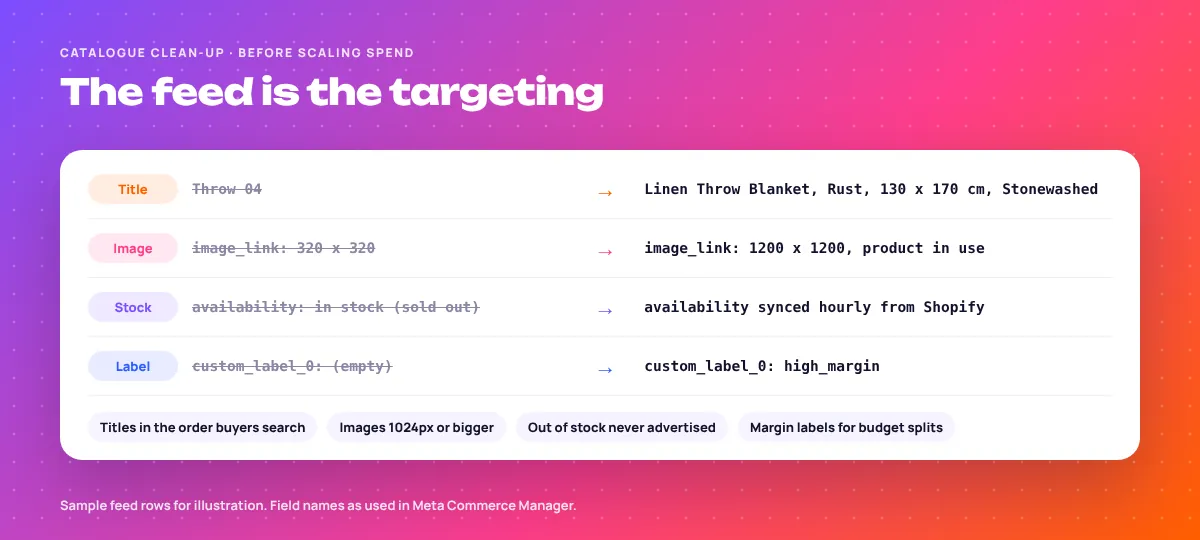
Catalogue ads are only as good as the feed behind them. We fix titles so they read the way people shop (product, colour, size, material), replace images below 500 x 500 pixels with 1024 pixels or bigger, stop sold-out products being advertised, and add custom labels for margin so the high-margin products get the budget. If purchases are under-reported, we sort that first with Meta Pixel and Conversions API tracking, because a catalogue campaign optimising on half the data is guessing.
A Creative Production Line, Not a Launch
In ecommerce on Meta, creative is the targeting. Ads tire in weeks, so we run creative like a production line: something new goes onto the belt every week.
Brief
Angles from reviews, support tickets and returns reasons. What do buyers say in their own words?
MondayMake
3 to 5 new hooks: creator video, product in use, a static offer, a carousel of bestsellers.
Mid-weekTest
Into the testing campaign for about 7 days, judged on cost per purchase against break-even.
7 daysGraduate
Winners move into the Advantage+ campaign as new ads. Losers are cut, not tweaked forever.
Friday reviewWatch
Frequency, click-through and cost per purchase tracked weekly for signs of fatigue.
WeeklyRemix
Tired winners get a new hook or format rather than retiring a proven message.
As neededCustomer-style video and simple demos usually beat polished studio shots for cold audiences.
Free shipping thresholds, bundles and a clear returns promise often move conversion more than a new background.
Budget rises of about 20% at a time, a few days apart, keep delivery stable while you grow.
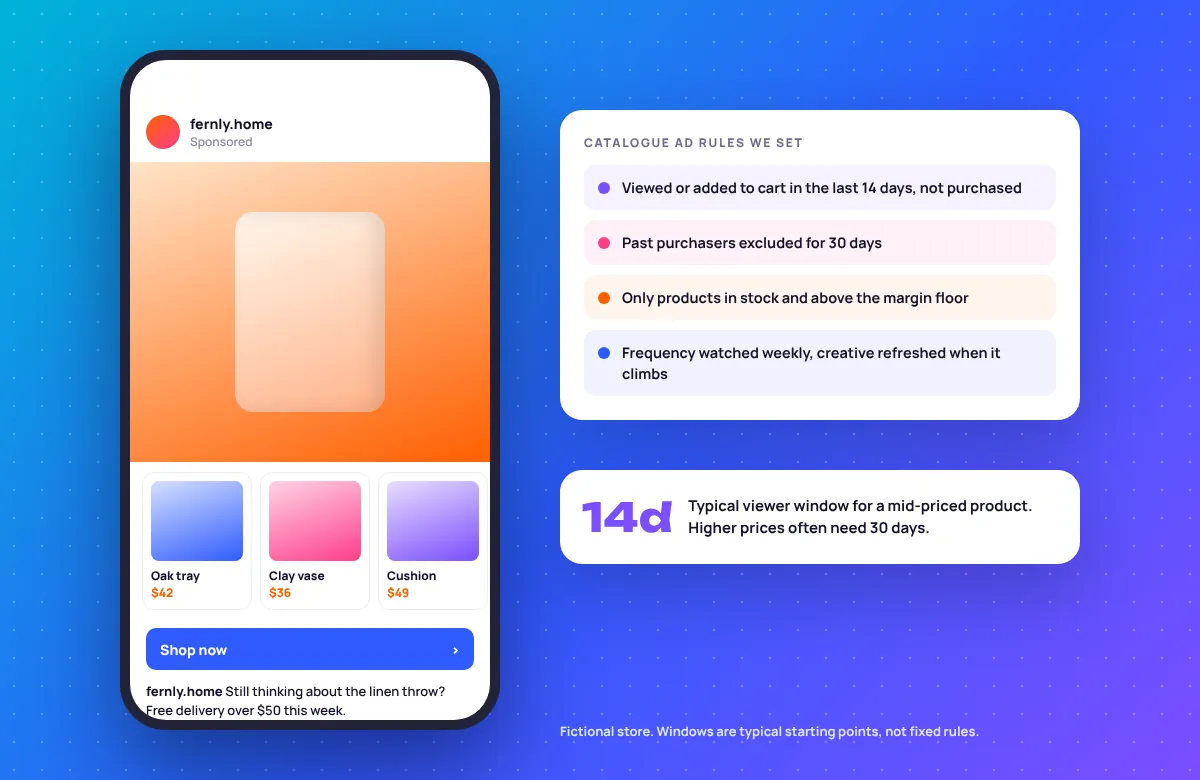
Cart abandoners and product viewers get their own windows and exclusions. The full setup is in our guide to Meta retargeting ads.
Facebook Ads for Ecommerce Through the Big Seasons
Peaks are won in the weeks before them. Costs per thousand impressions climb as everyone piles in, so the audiences, creative and offers need to be ready before the auction gets expensive.
Ramadan and Eid
GCC, plus Muslim audiences in India and the UK. Moves about 11 days earlier each year.
Diwali
India and the diaspora. Gifting and occasion wear peak in the final 2 weeks.
Black Friday and Cyber Monday
The most expensive week of the year in most Western markets.
Christmas and Q4
Ends at your last delivery date, not 25 December.
Bar lengths are relative weeks for planning, not exact dates. Email and SMS carry a lot of the peak for warm customers; we plan both together with our email marketing for ecommerce team.
From Audit to Live Campaigns in About 14 Days
Profit check
- Break-even and target ROAS agreed
- Shopify revenue vs Meta reporting
- New vs returning customer split
Tracking
- Pixel and Conversions API deduplicated
- Purchase value and product IDs correct
- Event match quality checked
Catalogue and creative
- Feed cleaned, margin labels added
- First batch of 8 to 12 ads produced
- You approve the plan
Launch, then weekly
- Advantage+, catalogue and testing live
- Weekly read against break-even
- Monthly report in plain language
Real Brands. Real Numbers.
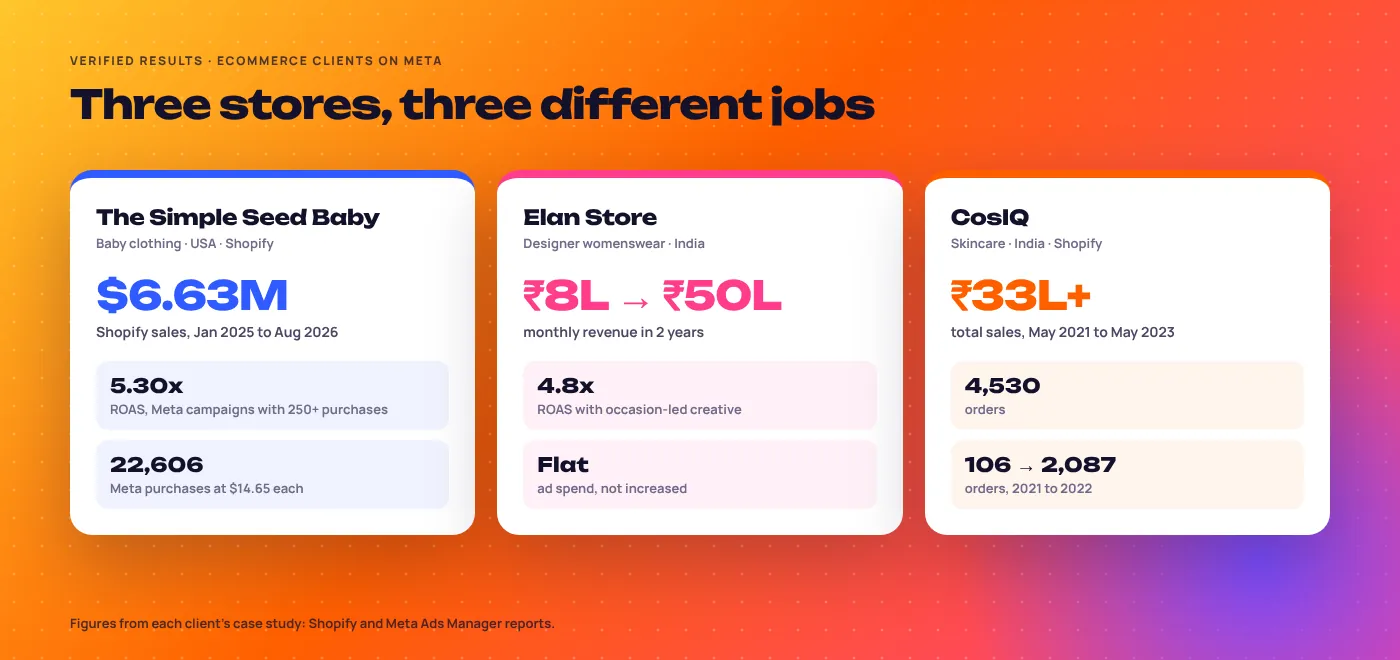
- The Simple Seed Baby, USA. Premium bamboo baby clothing. $6.63M in Shopify sales from January 2025 to August 2026, with the Meta campaigns that drove 250+ purchases each returning 5.30x. Read the Simple Seed Baby case study.
- Elan Store, India. Designer womenswear grew from ₹8 lakh to ₹50 lakh a month over two years at 4.8x ROAS, with occasion-led creative and flat ad spend. See the Elan fashion case study.
- CosIQ, India. Skincare on Shopify: ₹33 lakh+ in sales and 4,530 orders, with Meta paired with email and WhatsApp for repeat orders. See the CosIQ skincare case study.
Complete Your Meta Ads Strategy
- Meta Advantage+ campaigns
- Meta retargeting ads
- Meta Pixel and CAPI tracking setup
- Facebook and Instagram ads management
- Meta lead generation ads
Most ecommerce clients also use our wider ecommerce marketing services; consumer brands outside retail should see B2C marketing. Browse our clients, more success stories or the EmergingAds blog.
Common Questions Answered
What is a good ROAS for ecommerce on Meta?
There is no universal number. A good ROAS is one comfortably above your break-even ROAS, which comes from your margins, shipping, fees and returns. A 2.5x can be very profitable for one store and a loss for another.
What is break-even ROAS and how do I calculate it?
Break-even ROAS is order value divided by contribution margin per order, before advertising. If an average order is 60 and leaves 25 after product, shipping, fees and returns, break-even ROAS is 2.4x. The calculator on this page does the maths for you.
How long does it take to see results from Meta ads for a store?
The first 2 to 3 weeks are learning and testing. Repeatable improvement usually shows between weeks 4 and 8, once winning creative and a stable structure are in place.
Are Advantage+ campaigns worth it for ecommerce?
For most stores, yes, as the main scaling campaign. We still keep a separate testing campaign, catalogue retargeting and a capped retention campaign so we can see what is really driving new customers.
Do you set up the product catalogue and feed?
Yes. We connect your store to Commerce Manager, fix titles, images and availability, add margin labels and resolve the errors that stop products showing in catalogue ads.
Which store platforms do you work with?
Shopify, WooCommerce, Magento, BigCommerce and custom stores. Shopify is the most common, and its Meta integration is usually the quickest to get right.
Can you fix purchases that are under-reported in Ads Manager?
Yes. We set up the Conversions API alongside the pixel, deduplicate events and check purchase values and product IDs, so Meta optimises on complete data.
Do you make the creative as well as run the ads?
Yes. We brief and produce static, carousel and short video creative, and work with your creators or UGC where you have them. Winners are decided by cost per purchase, not by taste.
How is ecommerce on Meta different from lead generation?
Ecommerce depends on catalogue health, purchase tracking and margins. Lead generation depends on lead quality and follow-up speed. The structure, creative and reporting are different, which is why we treat them as separate services.
Is there a minimum contract?
Yes, three months, then month to month. That is roughly how long it takes to fix tracking, clean the catalogue and find creative that keeps working.
Ready to Scale Your Ecommerce Store?
Book a free audit. We check your break-even ROAS, tracking, catalogue and creative, and show you where the next profitable sale comes from.