
Turn Warm Traffic Into Paying Customers.
Most visitors leave without buying. We run Meta retargeting ads that bring them back with the right product, the right message for how warm they are, and a frequency that reminds rather than nags.
Meta Retargeting Ads Built Around How Warm Each Visitor Is
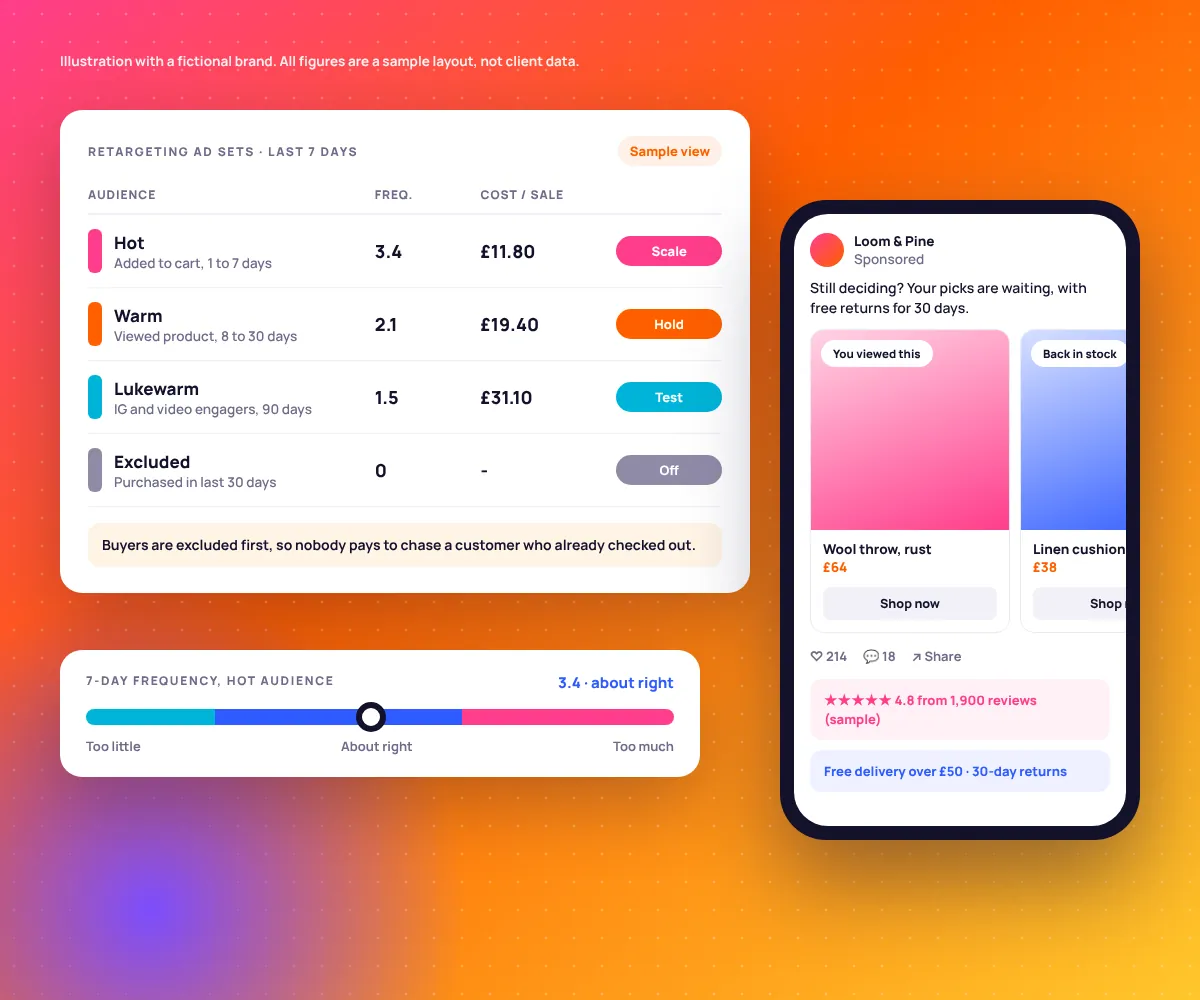
One “all visitors, 180 days” ad set is the most common setup we find, and the most wasteful. Someone who abandoned a cart yesterday and someone who watched a Reel two months ago need different ads, different budgets and different patience.
Cart and checkout abandoners
Window: 1 to 7 days- Message
- The exact product, plus whatever blocked the sale: delivery time, returns, sizing. No discount on day one.
- Budget share
- Small audience, highest return per pound. Usually the first ad set we fund fully.
Product and pricing page viewers
Window: 8 to 30 days- Message
- Proof. Reviews, UGC, comparisons, “why this one”. They liked it, they are not sure yet.
- Budget share
- The bulk of retargeting spend for most stores with steady traffic.
Video viewers and social engagers
Window: 30 to 90 days- Message
- The reason to care: the bestseller, the founder story, the problem you solve. Treat it as soft prospecting.
- Budget share
- Only after hot and warm are covered. It is cheap reach, not cheap sales.
Recent customers
Excluded 14 to 30 days- Message
- Nothing at first. Later, a cross-sell or refill timed to how long the product lasts.
- Budget share
- A separate campaign, or handed to email and SMS flows that cost far less.
For lead businesses the same logic applies with different signals: people who opened your Instant Form but did not submit, landing page visitors who did not book, and 50 percent video viewers. A form opener from three days ago is the hottest audience you will ever pay to reach. If you sell on forms, our Meta lead generation ads page covers the prospecting side of that funnel.
With Meta retargeting ads, windows are a starting point, not a rule. A £30 impulse buy goes cold in a week. A £3,000 sofa or a holiday package stays warm for a month or more, so we stretch the hot window and slow the message sequence. That is why travel brands and high-ticket stores get longer sequences than fast fashion.
Your Catalogue Is the Creative
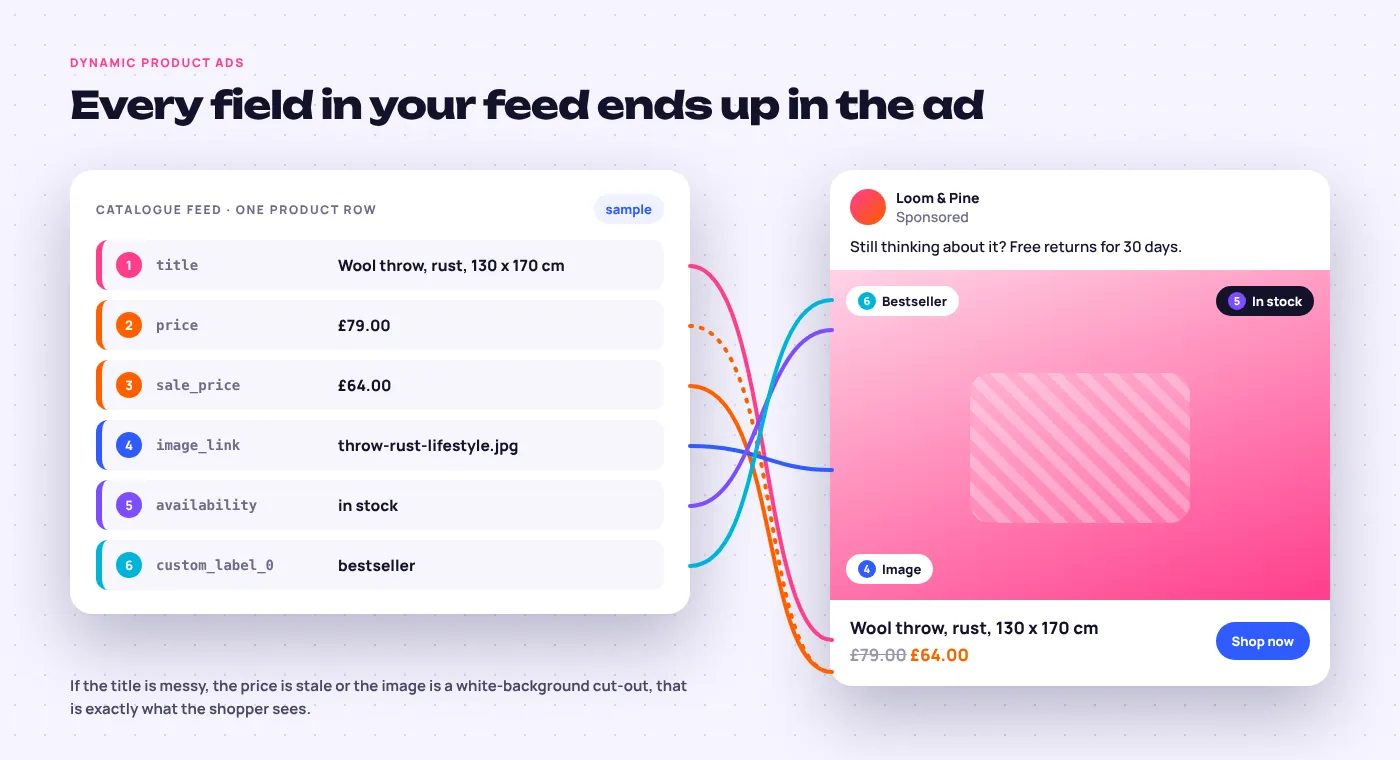
Dynamic product ads (Meta calls them Advantage+ catalogue ads now) pull every visual and every word from your product feed. So when a retargeting campaign underperforms, the fix is often in the feed, not in Ads Manager. These are the fields we fix first.
titleReadable on a phoneProduct, key variant, size. Not “SKU-4471 RUST WOOL NEW 2026”.sale_priceUpdated at least dailyA stale price in the ad and a different one at checkout kills trust and gets items rejected.image_linkLifestyle shots for retargetingThey have seen the cut-out already. We add additional images or catalogue overlays so the ad looks like an ad.availabilityOut of stock means out of the adPaying to retarget someone to a sold-out size is pure waste.custom_labelMargin and bestseller tagsSo we can build product sets that push high-margin items and keep loss leaders out.
One more check that is easy to miss: the product IDs your pixel sends must match the IDs in the catalogue. Events Manager shows a catalogue match rate. Under about 90 percent, people see the wrong products or none at all. Running a Shopify or WooCommerce store? Our Meta Ads for ecommerce service covers the catalogue and prospecting side together.
How Often Should a Warm Visitor See Your Ad?
Retargeting pools are small, so frequency climbs fast. Pick a setting below to see what each zone looks like inside Ads Manager, and what we do about it. Numbers are typical ranges for a hot audience over 7 days.
What you see
- 7-day frequency under about 1.5 on cart abandoners
- Most of the pool never sees an ad before the window closes
- Ad set stuck at a tiny daily spend
What we do
- Raise budget on the hot ad set until frequency reaches 2 to 3
- Merge thin ad sets so each one gets enough delivery
- Check the pool is actually filling: a broken add-to-cart event looks exactly like this
What you see
- Hot audience at roughly 2 to 5 a week, warm lower
- CTR steady week to week, CPM not climbing
- Comments are questions, not “stop following me”
What we do
- Keep budget in line with how fast the pool refills
- Swap one creative a fortnight so the ad does not go stale
- Leave it alone. Most damage in retargeting comes from fiddling.
What you see
- Frequency above 6 to 8 a week and still rising
- CTR falling, CPM rising, cost per sale creeping up
- Hide-ad and negative feedback in the comments
What we do
- Cut budget to match pool size, or widen the window
- Exclude buyers faster and rotate in new angles
- For awareness-style retargeting, use a Reach campaign, which is where Meta lets you set a hard frequency cap
Worth knowing: sales and lead campaigns do not have a frequency cap setting. Frequency there is controlled by two things only, budget and audience size. That is why we size retargeting budgets from the pool, not from a percentage someone read in a blog post.
The Privacy Reality Check, in Plain Words
Retargeting still works in 2026. It just works on less data than it did, and anyone selling you “retargeting like 2019” has not opened an ad account in a while.
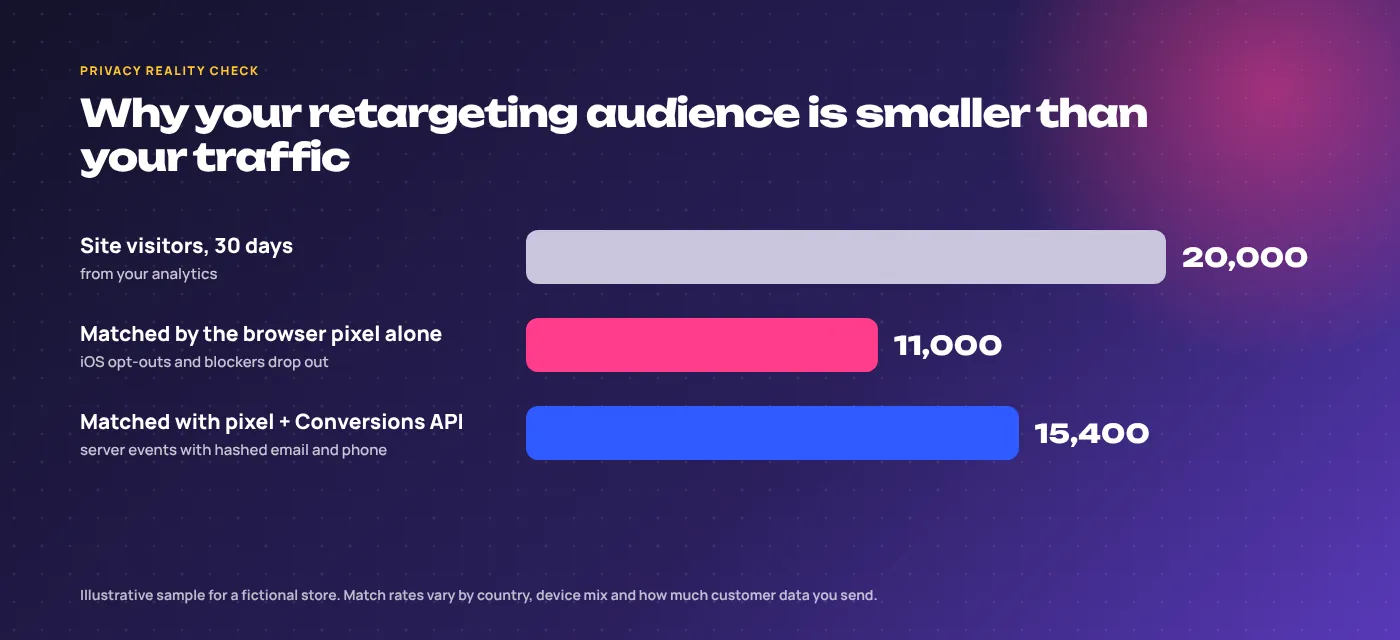
Many iPhone users said no to tracking
When someone opts out on iOS or uses a blocker, the browser pixel often cannot tie their visit to a Meta profile. Your analytics says 20,000 visitors; your custom audience is much smaller. That is normal. It also means a “7-day cart” audience can be too small to deliver, so we merge windows on lower-traffic stores.
The Conversions API wins some of it back
CAPI sends events from your server with hashed email and phone, so Meta can match more visits and purchases. Pixel and server events must share an event ID or they double count. We check Event Match Quality in Events Manager and aim for the top of the scale on purchase events. Full setup lives on our Meta Pixel and CAPI tracking page.
Meta now blends retargeting into prospecting
Advantage+ sales campaigns serve new and returning people in one campaign. Great for scale, but they can quietly spend on people who would have bought anyway. We set audience segments so reporting splits new, engaged and existing customers, and use the controls the account offers to limit spend on existing customers. More on that in our Advantage+ campaigns guide.
Reported results look worse, real ones may not
Modelled conversions fill some gaps, but Ads Manager will under-report on some days and over-claim on others. We judge retargeting on blended revenue and a simple holdout once spend allows: switch it off for one region or one audience and see what sales do. It is the only honest way to know what it adds.
From Audit to Revenue in 30 Days
Retargeting is quicker to build than prospecting, but only if tracking is clean. Here is the first month, stub by stub.
Account audit and audience map
What we check before touching a budget:
- Pixel and CAPI deduplication
- Event Match Quality on purchase or lead
- Catalogue match rate
- Buyer exclusions on every ad set
- Overlap with prospecting campaigns
Fix tracking, build audiences
Signal gaps fixed first. Then hot, warm and lukewarm audiences, product sets and the first creative batch per temperature.
- Feed cleaned and labelled
- Sequence written
- Dashboard live
Launch and first read
Campaigns go live around day 14, earlier if tracking was already sound. We watch frequency daily for the first two weeks.
- Budgets sized to pool
- First creative swap planned
- Holdout plan agreed
Weekly optimisation
Frequency, fatigue and overlap reviewed weekly. Winners scaled, tired ads retired, and a short written note on what changed.
- Clean report every Monday
- Monthly look at blended revenue
Real Brands. Real Numbers.
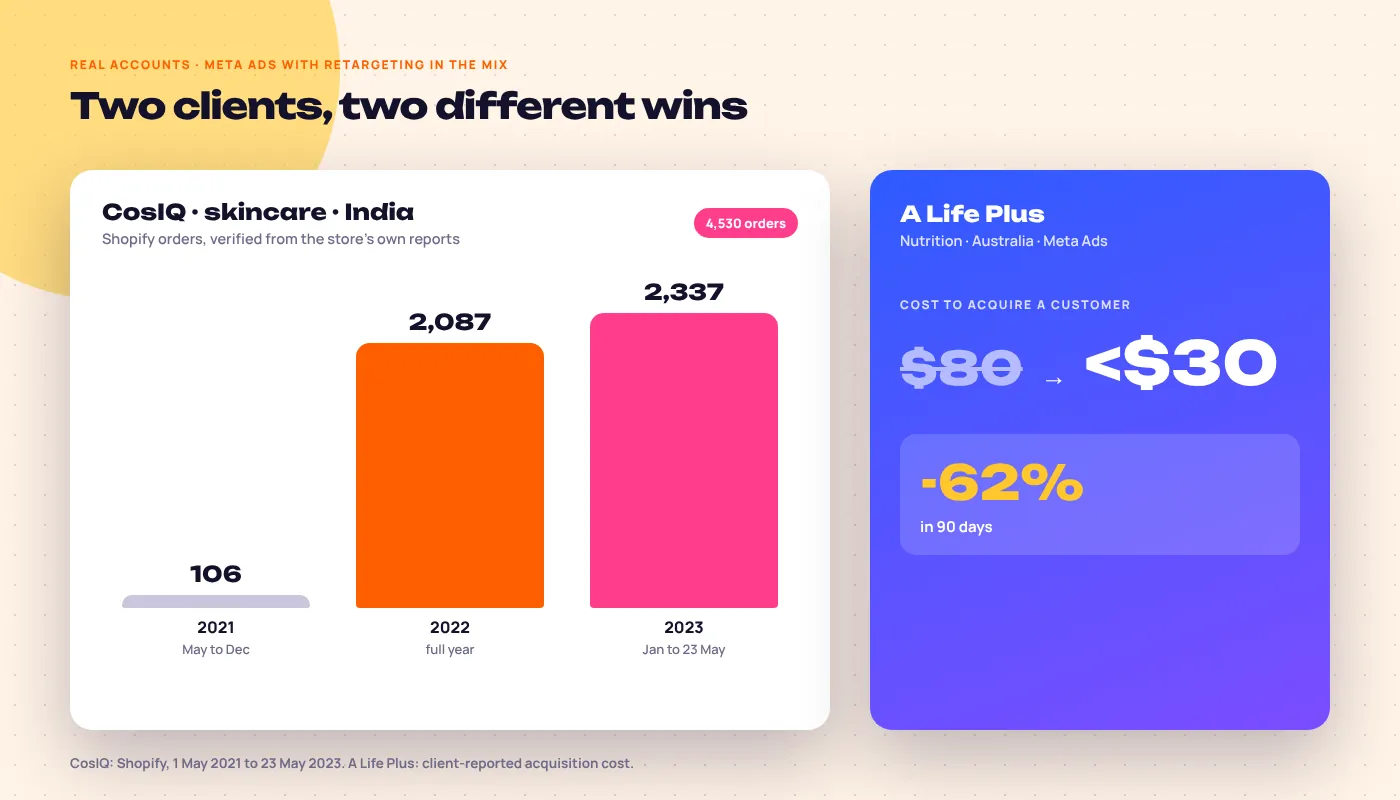
Two Meta accounts where retargeting ran alongside prospecting. Neither number is retargeting alone, and we will not pretend it is: the win came from the whole account working together.
More in our client success stories and the full list of brands we work with.
Complete Your Meta Ads Strategy.
Retargeting only has something to work with when the rest of the account fills the pool. These are the pieces it leans on. For the whole picture, start with our Meta Ads management service.
Industry guides: ecommerce marketing and travel industry marketing, where long consideration windows make retargeting do the heavy lifting. Practical write-ups land on our marketing blog.
Meta Ads Retargeting FAQs.
What founders ask us about Facebook and Instagram retargeting before they hand over an account.
What is Meta Ads retargeting?
It is showing Facebook and Instagram ads to people who already know you: website visitors, cart abandoners, video viewers, Instagram engagers, form openers or customers. Because they have already shown interest, the cost per sale is usually lower than reaching strangers, as long as the audience is set up by recency and buyers are excluded.
How long does it take to set up retargeting campaigns?
Around 14 days from kickoff to live campaigns. If your pixel, Conversions API and catalogue are already clean, it can be quicker. If tracking is broken, we fix that first, because retargeting built on a broken add-to-cart event targets nobody.
What is a good retargeting window?
For most stores: 1 to 7 days for cart and checkout abandoners, 8 to 30 days for product viewers and up to 90 days for video viewers and social engagers. High-ticket products and travel stay warm longer, so we stretch the windows. Low-traffic stores often need one combined 30-day audience so it is big enough to deliver.
What are dynamic product ads?
Ads that pull products from your catalogue and show each person the items they viewed or added to cart, with live prices and stock. Meta now calls them Advantage+ catalogue ads. They are only as good as your feed, so we clean titles, images, prices and labels before launch.
What frequency is too high for retargeting?
As a typical range, a hot audience seeing your ads 2 to 5 times a week is healthy. Above 6 to 8 a week with falling click-through and rising CPM, people are tired of you. Sales campaigns have no frequency cap setting, so we control it through budget and audience size.
Does retargeting still work after the iOS privacy changes?
Yes, on smaller audiences than before. Opted-out iPhone users and blockers shrink the pool the browser pixel can build. The Conversions API wins part of that back by matching server events with hashed customer details. Expect smaller pools and plan budgets around them.
Do I still need retargeting if I run Advantage+ sales campaigns?
Often less than before, because Advantage+ already serves people who know you. We usually keep a small dedicated retargeting campaign for cart abandoners and a sequence that Advantage+ cannot run, then check with audience segment reporting that the two are not paying for the same people.
Can retargeting work for lead generation?
Yes. Some of the best audiences are people who opened an Instant Form and did not submit, landing page visitors who did not book and people who watched most of a video. A reminder with a reason to act now, like limited slots or a short case story, works well here.
Should retargeting ads offer a discount?
Not straight away. If every abandoner gets 15 percent off, customers learn to abandon carts. We start with reassurance and proof, and only bring in an offer late in the sequence or for specific product sets with room in the margin.
Is Meta retargeting worth it for a small store?
Usually yes, but keep it simple: one 30-day warm audience, buyers excluded, a dynamic product ad and one proof-led creative. Below a few thousand visitors a month the pool is too small for anything clever, and the bigger job is getting more people to the site.
How do I get started with EmergingAds retargeting?
Book a free ad audit. We review your Meta account, pixel, Conversions API and catalogue, show you which warm audiences you are missing or overspending on, and give you the fix list whether you hire us or not.
Stop Losing Warm Traffic to Competitors.
You left something behind: the audiences you are not retargeting yet. Book a free audit and we will show you which ones, and roughly what they are worth.