
Facebook Ads Audit: Find Out Exactly Where Your Meta Budget Is Leaking
We grade your Meta account on 30 checks across tracking, structure, audiences, creative and landing pages. Within 48 hours you get the grades, the evidence and a fix list in the order we would work through it ourselves.
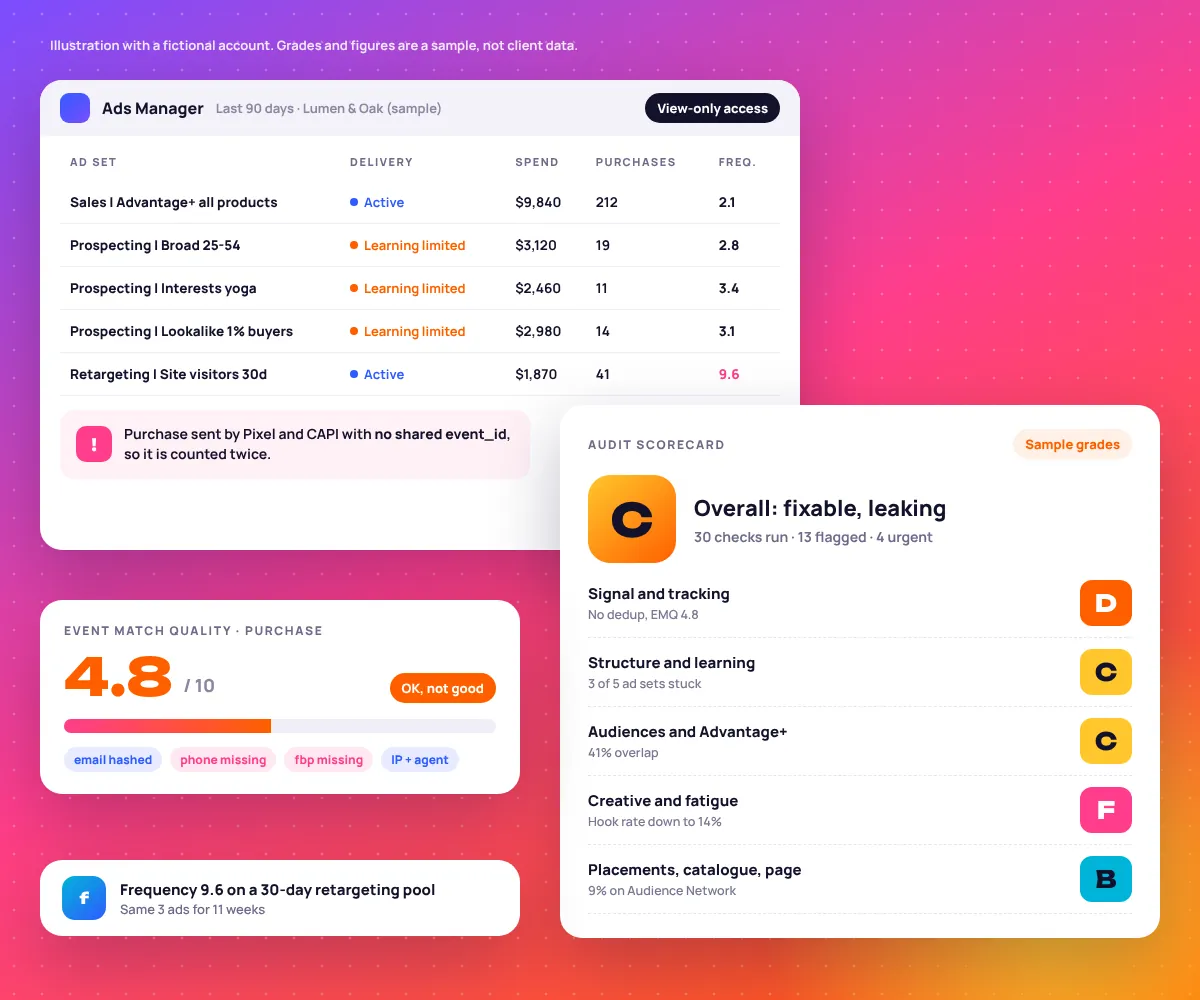
- ALeave it alone
- BMinor tidy
- CCosting you
- DFix this month
- FFix today
Free. View-only access. 90 days of data.
Why Most Meta Accounts Leak Budget Quietly
Meta accounts rarely fail loudly. They drift. A sale campaign runs months after the sale, a lookalike built on 300 buyers never gets rebuilt, and three ad sets bid against each other for the same people. Nothing triggers an alert, so cost per result creeps up and nobody can say why.
A proper Meta ads audit asks a narrow question: where is spend going that produces nothing measurable, and what stops the algorithm finding better customers? We start with signal, not creative, because Meta optimises towards whatever data you feed it. Then structure, audiences, creative and the page. How we run an account after that is on our Meta Ads management service page.
- Learning limitedFive ad sets, 9 purchases a week eachNone will exit learning. Merged into two, they might.
- Active, 14 weeksRetargeting with the same three adsFrequency near 10, paying for the same people.
- Counted twicePurchase from Pixel and CAPINo shared event_id, so ROAS looks better than the bank account.
- Out of stockCatalogue ads still showing sold-out productsClicks land on a page with nothing to buy.
- Typical findings, not one client account.
Our Meta Ads Audit Checklist, in Five Drawers
The order we work in. Open a drawer to see its six checks and what healthy looks like. Auditing your own Facebook ad account? Start at drawer one.
Drawer1Signal and measurement
Pixel, Conversions API, match quality, attribution
6 checks
Signal and measurement
Pixel, Conversions API, match quality, attribution
Nothing else can be judged until this is right. Gaps here usually make our Meta Pixel and Conversions API setup the first job.
- 01One pixel, firing onceNo second pixel from an old plugin or stray GTM tag. One event per action.
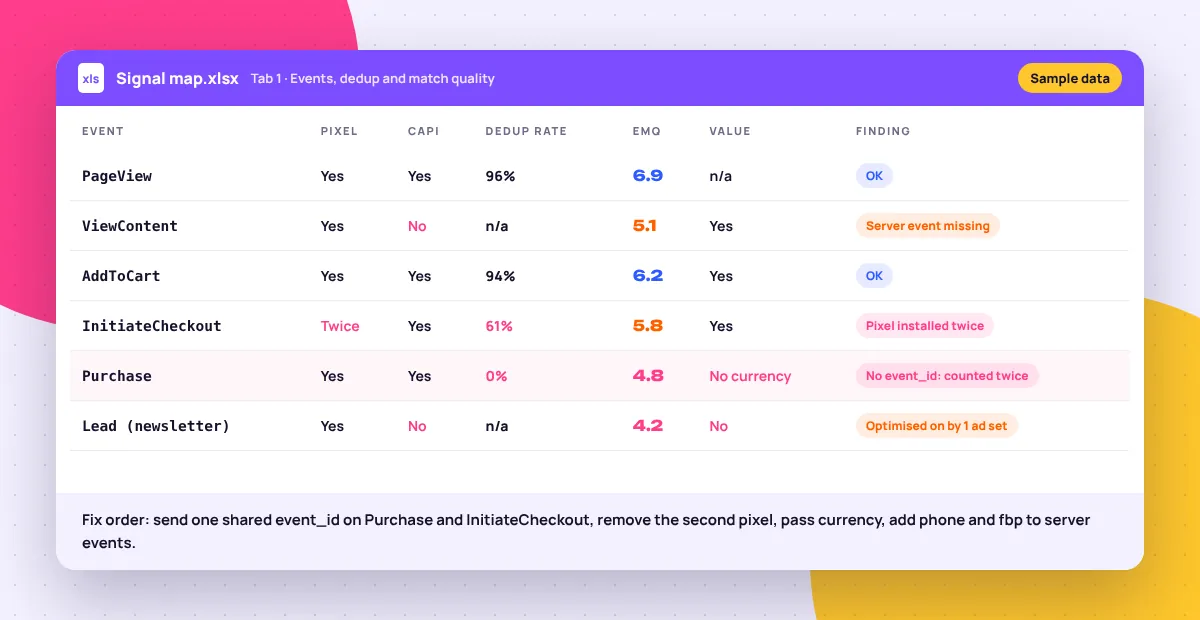
- 02Pixel and CAPI deduplicatedBrowser and server events share event name and event_id, so one purchase counts once.
- 03Event Match QualityScored out of 10 per event. We want Purchase or Lead at 6 or above, with email, phone, fbp and fbc sent server side.
- 04Value and currencyReal order value and currency on every purchase, or ROAS is guesswork.
- 05Attribution settings7-day click, 1-day view or 1-day click, and whether reports compare like with like against Shopify or your CRM.
- 06The right optimisation eventPurchases or qualified leads, not landing page views or newsletter sign-ups.
Drawer2Structure and learning phase
Fragmentation, budgets, bid strategy, edits
6 checks
Structure and learning phase
Fragmentation, budgets, bid strategy, edits
Meta’s long-standing guide is roughly 50 optimisation events a week to leave learning. Most accounts split conversions so thin that nothing gets there.
- 07Account fragmentationAd sets sharing one goal and conversions per ad set. Ten small ones usually lose to two healthy ones.
- 08Learning limitedShare of spend stuck in Learning limited, and whether merging would fix it.
- 09Campaign objectiveSales for sales, leads for leads. Traffic objectives buy traffic, rarely revenue.
- 10Budget level and splitCampaign or ad set budgets, and the split between new customers and retargeting.
- 11Bid strategy fitHighest volume, cost per result goal or ROAS goal, matched to real conversion volume.
- 12Edit historyBig budget jumps and daily tinkering restart learning. Activity history shows how often.
Drawer3Audiences and Advantage+
Overlap, exclusions, existing customers, automation
6 checks
Audiences and Advantage+
Overlap, exclusions, existing customers, automation
In 2026 creative and automation do most of the targeting. We check it is not spending on people who would buy anyway. Our Advantage+ campaign setup page goes deeper.
- 13Audience overlapAd sets sharing more than about a fifth of their audience bid against each other.
- 14ExclusionsRecent buyers out of prospecting, and leads out of forms they already filled in.
- 15Existing customer shareHow existing customers are defined and what share of Advantage+ spend reaches them.
- 16Creative enhancementsMusic, text variations, image expansion. Some help, some put off-brand ads live.
- 17Retargeting poolsWindow, size and frequency. Small pools with old ads are where fatigue starts.
- 18Seed listsLookalikes on stale or tiny lists, and whether they still beat broad.
Drawer4Creative and fatigue
Frequency, hook rate, variety, spend spread
6 checks
Creative and fatigue
Frequency, hook rate, variety, spend spread
Since Meta’s 2025 ad retrieval changes, different concepts beat ten near-copies of one ad.
- 19Frequency by audienceCold above roughly 3 a week, or retargeting past about 8, usually means fatigue.
- 20Hook rate3-second plays divided by impressions. Under about 20% on cold traffic, the opening is not working.
- 21Hold rateWho keeps watching. A good hook with a weak middle means the offer comes too late.
- 22Concept varietyTruly different angles, formats and faces, not headline swaps of one idea.
- 23Spend concentrationOne ad taking most of the spend for weeks, with nothing queued behind it.
- 24Decay over timeCTR falling while CPM and cost per result rise, week after week.
Drawer5Placements, catalogue, offer and page
Where ads run, product feed, what happens after the click
6 checks
Placements, catalogue, offer and page
Where ads run, product feed, what happens after the click
A weak offer or slow page makes every ad leak.
- 25Placement spendAdvantage+ placements are a fine default, unless Audience Network eats spend for nothing.
- 26Catalogue healthRejected items, sold-out products in sets, and pixel content IDs matching catalogue IDs.
- 27Product setsSplit by margin, bestsellers or category, not one set of everything.
- 28Offer strengthHow your offer reads next to competitors in the Meta Ad Library.
- 29Landing page match and speedSays what the ad promised and loads fast on a mid-range phone.
- 30Form and checkout frictionEvery extra form field or checkout step costs leads or orders.
The Pack You Receive After a Facebook Ad Account Audit
Working files, not screenshots. Your team, your agency or we can act on them the same afternoon.
- PDF01
Scorecard and audit report
A grade per drawer, then each finding with evidence and the fix, in plain English.
- XLSX02
Signal map
Every event: Pixel, CAPI, dedup rate, match quality and value, with the fix order.
- XLSX03
Spend leak sheet
Spend with no results over 90 days, totalled, plus the overlap and exclusion map.
- XLSX04
Creative fatigue table
Every live ad marked keep, refresh or switch off.
- CALL05
Walkthrough with the auditor
The fix list in order, with the person who did the work.
Findings go into three lanes, as in our Google Ads audit, so the report reads as a to-do list.
What Bad Looks Like: Red Flags From Sample Audits
Six findings as they appear in the report. Fictional accounts, real patterns we see every month.
Every sale reported 1.8 times
Saw: no event_id on Purchase. 1,640 Meta purchases against 910 Shopify orders.
Fix: order ID as event_id on both. No budget calls until they agree.
Seven ad sets, none out of learning
Saw: 6 to 14 purchases a week each, 68% of spend Learning limited.
Fix: two broad ad sets; let the creative do the targeting.
Paying to compete with yourself
Saw: interest, lookalike and broad ad sets overlap by 41%.
Fix: merge, keep one clean test ad set.
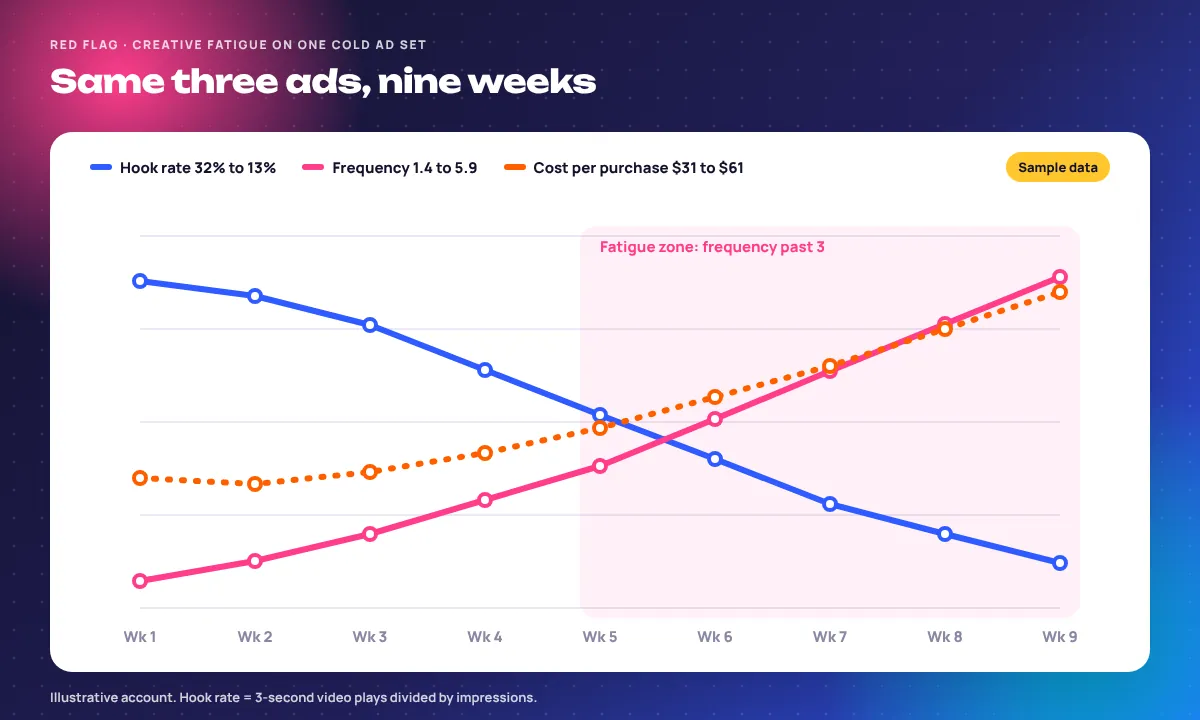
Hook rate halved in nine weeks
Saw: 32% to 13% while cold frequency hit 5.9.
Fix: three new concepts, not three new colours.
212 sold-out products still advertised
Saw: weekly feed, daily stock changes.
Fix: daily feed and an in-stock filter on every set.
Cheap leads nobody can reach
Saw: no intent question; sales reach fewer than one in four.
Fix: a qualifying question, and qualified leads sent back to Meta.
How to audit Facebook ads for fatigue yourself
Break top ads down by week in Ads Manager with frequency, link CTR, cost per result and a custom hook rate metric. Frequency up while hook rate and CTR fall means people have seen the ad. Refresh it before cost per result doubles.
How Your Free Audit Works
Your part takes five minutes. With view-only access, nothing in your account can change.
- You · 5 minutes
Share view-only access
Add us as a partner in Business Settings with view access to the ad account, Events Manager and catalogue.
- Us · hours 0 to 10
Check the signal
Events, dedup, match quality and attribution, against your store or CRM.
- Us · hours 10 to 24
Structure and audiences
Fragmentation, learning, overlap and Advantage+, on 90 days of data.
- Us · hours 24 to 36
Creative, catalogue, page
Fatigue, placements, feed health and the page on a phone.
- Us · hours 36 to 48
Grade, price and send
Grades, lanes, a second-person check, then the pack lands.
When the Same Checks Are Fixed on Real Accounts
These clients hired us for full management, not a one-off audit, but each case shows what fixing these drawers does. Approach notes come from each case study; numbers are verified from the clients’ own Shopify or Ads Manager reports.
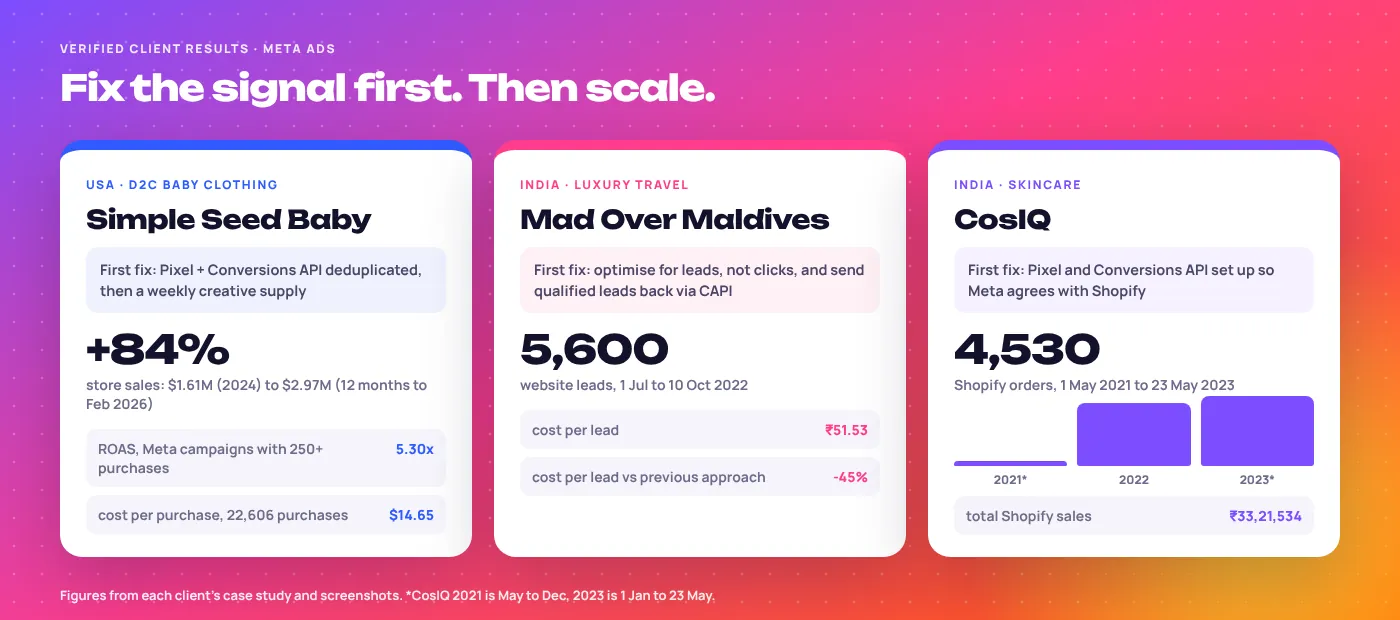
ROAS slid as spend rose. Pixel and Conversions API were deduplicated so Meta matched the store.
New creative every week, budgets raised in steady steps. Campaigns with 250+ purchases returned 5.30x on $331K.
store sales, $1.61M to $2.97M
Simple Seed case studyContact forms brought slow, poor leads. Campaigns now optimise for leads, not clicks.
WhatsApp replies within minutes; qualified and booked leads sent back via the Conversions API.
at ₹51.53 each, cost per lead down 45%
Mad Over Maldives case studyA crowded category needing fast sales. Tracking first: Pixel and Conversions API agreeing with the store.
Several concepts tested at once, winners kept, the rest refreshed before they tired.
₹33,21,534 in Shopify sales, May 2021 to May 2023
CosIQ case studyIs a Meta ads audit worth it for your account?
Yes, if cost per result has crept up for months or Ads Manager ROAS does not match your store. Online stores gain most from drawers 1, 4 and 5, so the audit is often step one of our ecommerce marketing work. Enquiry-led businesses lose most on lead quality, a pattern we see constantly in travel marketing. Warm audience leaking? Look at Meta retargeting ads. Poor form quality? See our Meta lead generation ads. Healthy account? We will say so.
Complete Your Meta Ads Strategy
Works well with
See the 85+ brands we work with, read every client success story, or browse practical notes on our marketing blog.
Common Questions About the Meta Ads Audit
What is a Facebook ads audit?
A structured review of your Meta account that traces each problem to its cause. Ours runs 30 checks, grades five areas and ends with a ranked fix list.
How long does the audit take?
48 hours from view-only access, for accounts with around 90 days of history. Newer accounts get a short call first.
What access do you need to my ad account?
View-only access to the ad account, Events Manager and, for catalogue ads, Commerce Manager. No admin or billing rights. We change nothing.
Is the audit really free?
Yes, with no obligation. The pack is yours to keep and hand to any team.
How does the Meta ads audit work with Advantage+ campaigns?
We check existing customer settings, creative enhancements and whether Advantage+ gets clean purchase data. Automation is only as good as its signal.
What is Event Match Quality and why does it matter?
Meta’s score out of 10 for how well event data matches real people. Higher scores mean better credit and faster learning. Hashed email and phone sent via CAPI usually lift it.
Do you check creative, or only settings?
Both. Drawer 4 covers frequency, hook rate, hold rate and concept variety, and every live ad is marked keep, refresh or switch off.
Can you audit lead generation accounts as well as ecommerce?
Yes. Lead gen audits focus on form questions, lead quality and CRM feedback to Meta. Ecommerce adds catalogue and purchase value checks.
My account is small. Is an audit still worth it?
Usually. Small accounts feel every wasted dollar more, and structure is easier to fix before you scale.
What happens after I receive the audit?
Fix it yourself, hand it to your agency, or ask us. If we take it on, urgent fixes go live in around 14 days, then management runs on a 3-month minimum, then month to month.
Will you need to see our Shopify or CRM data?
It helps. Comparing Meta’s numbers with your store or CRM is the fastest way to spot double counting. A 90-day export is enough.
Do you audit Instagram ads too?
Yes. Both run from one Meta account, so we cover both, including Feed, Reels and Stories spend.
Label: your ad account. Status: not audited yet.
Get Your Free Facebook Ads Audit
Share view-only access. In two days you will know each grade and what to fix first.
- 30 checks
- Graded scorecard
- Signal map
- Fix list in 3 lanes
- Walkthrough call