
Updated
YouTube Demand Gen Campaigns That Create Demand Across Every Google Surface
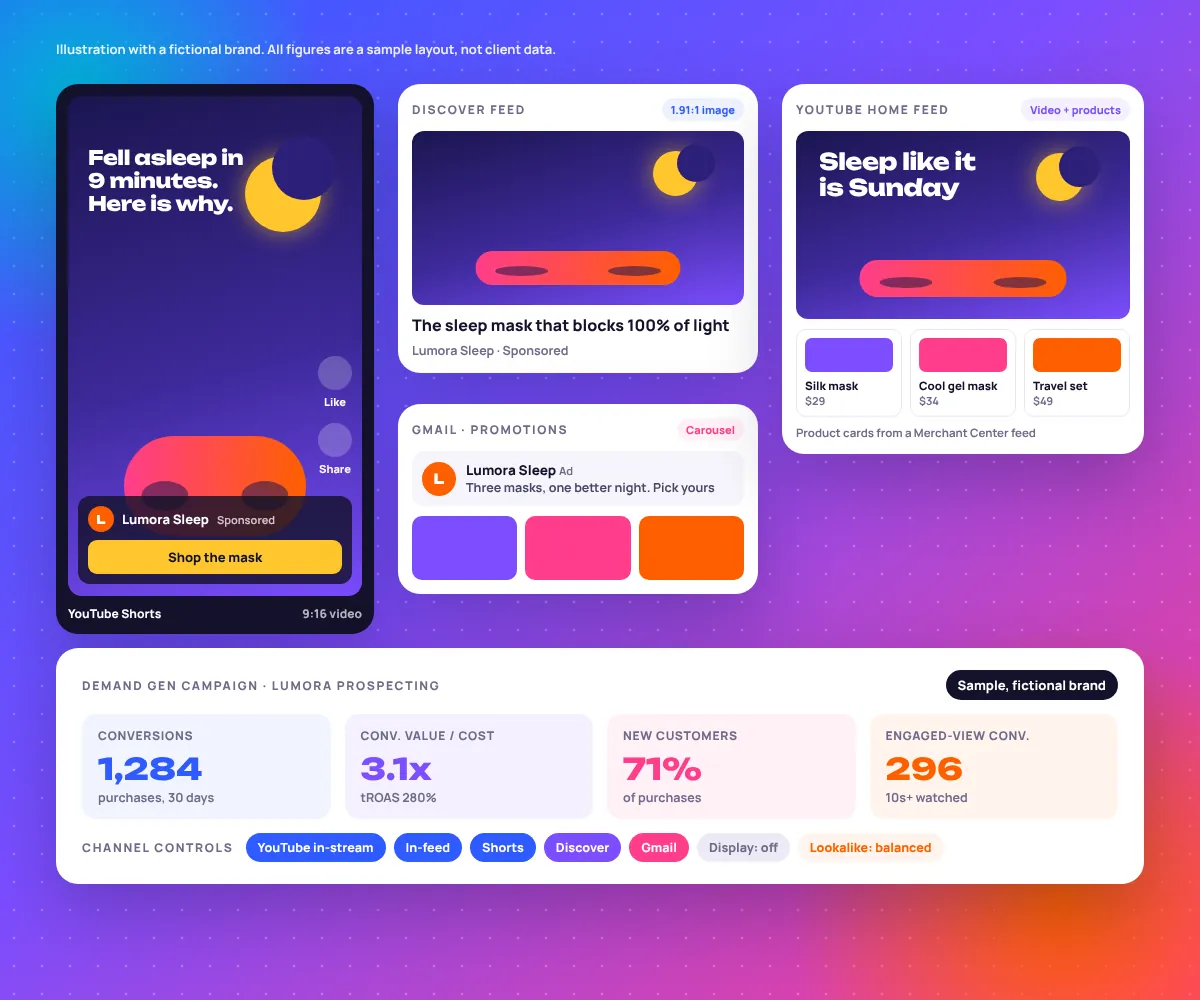
We plan and run Google Demand Gen campaigns for brands that need new buyers, not just the ones already searching. Video, image, carousel and product ads reach people on YouTube, Shorts, Discover and Gmail, with creative made for feeds that scroll.
- YouTube in-stream
- In-feed
- Shorts
- Discover
- Gmail
- Display Network, optional
What Demand Gen Campaigns Do Differently From Other Google Formats
What is a Google Demand Gen campaign?
Demand Gen is a Google Ads campaign type that shows video, image, carousel and product ads to people browsing YouTube, Shorts, Discover, Gmail and, if you allow it, the Display Network. It bids for conversions or value, and it finds people by who they are rather than what they just searched.
Search catches demand that already exists. Demand Gen works the step before: the person who would buy if they saw your product, but has never typed its name. With Video action campaigns folded in during 2025, youtube demand gen campaigns are where conversion-focused YouTube buying lives. New to the channel? Start with our YouTube advertising services overview.
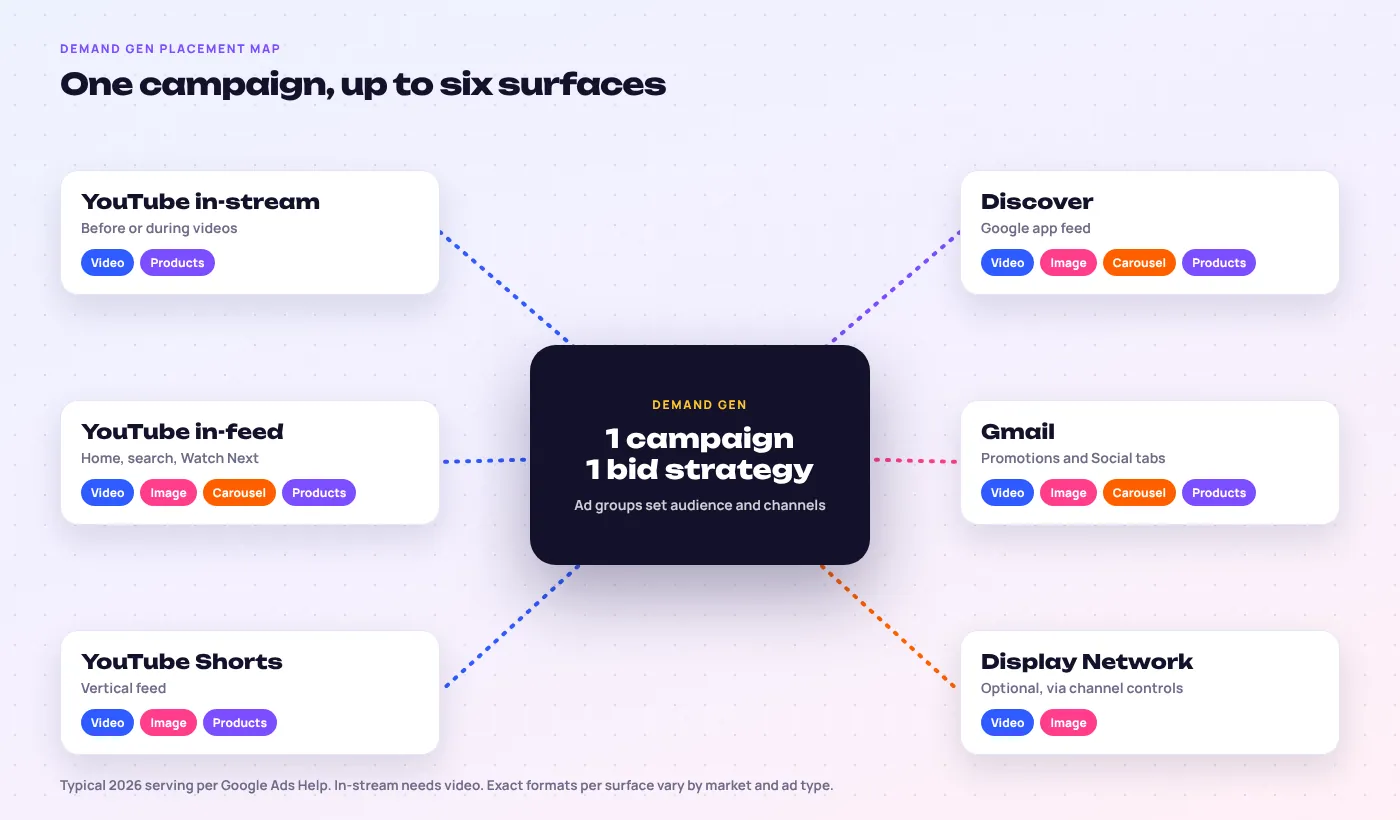
YouTube in-stream
Video only, before or during a chosen video. Our YouTube in-stream ads page covers that format in depth.
YouTube in-feed
Home, search results and Watch Next. The thumbnail is the hook.
YouTube Shorts
Full-screen vertical. Native 9:16 cuts only; cropped landscape gets swiped.
Discover
The Google app feed. Strong for image and carousel ads with an editorial headline.
Gmail
Promotions and Social tabs. The sender name and first line carry the click.
Display Network
An option in channel controls, tested once feed placements prove out. For banner-led work see Google Display ads management.
Image vs Video vs Carousel: Demand Gen Formats and Asset Specs
What assets does a Demand Gen campaign need?
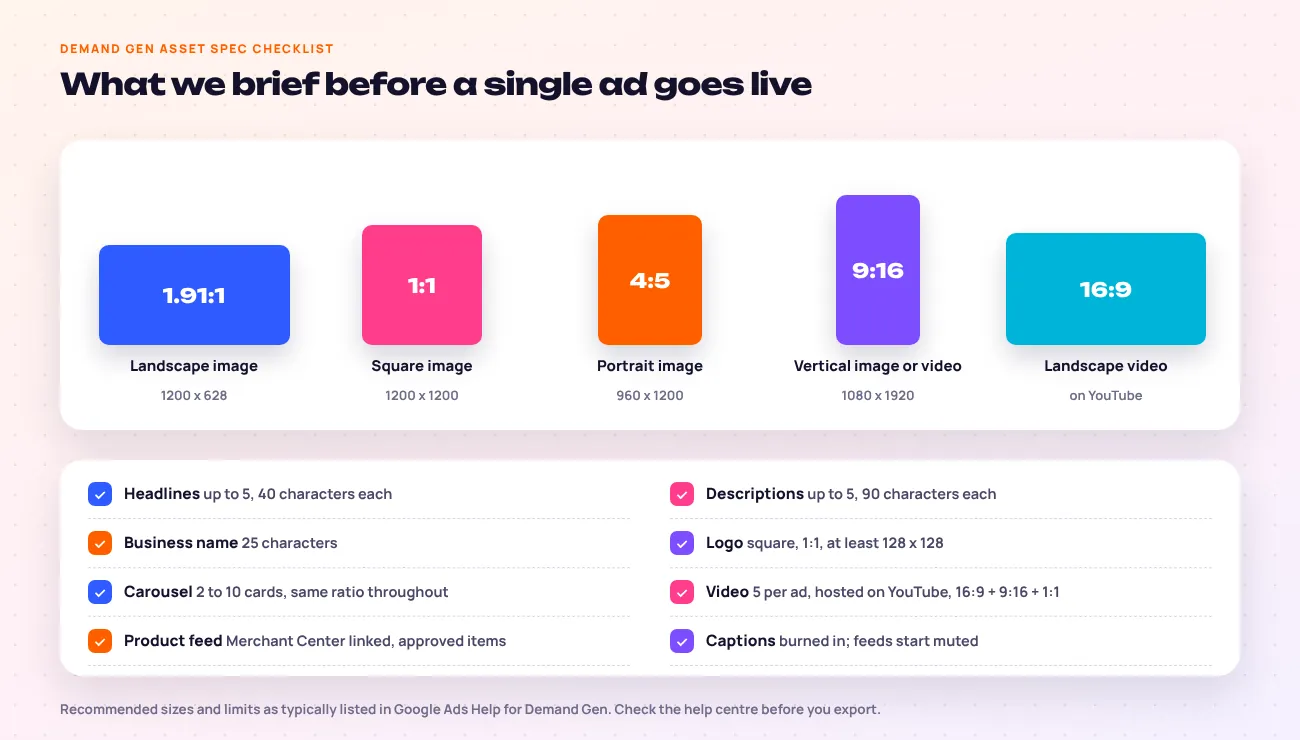
Each ad needs a full set for its format. Image ads want landscape, square and portrait images, a square logo, headlines and descriptions. Video ads need at least one YouTube-hosted video, ideally in 16:9, 9:16 and 1:1. Carousels take 2 to 10 cards. A Merchant Center product feed is optional but strong for ecommerce.
Video ads
Earns its place: the only format for in-stream; strongest on Shorts.
Watch out: one landscape file starves Shorts.
Single image ads
Earns its place: Discover and Gmail, where a sharp still often beats video.
Watch out: text-heavy banners.
Carousel ads
Earns its place: ranges, bundles and step-by-step stories.
Watch out: card one must stand alone.
Product feed
Earns its place: shoppable product cards under video.
Watch out: disapproved listings do not show.
How do product feeds work in Demand Gen?
You link Google Merchant Center to the campaign and choose which products may show, by feed label or product filters. Google then adds product cards under your video ads and builds product-led image and carousel ads from the feed. The feed’s titles, images and approval status decide how well it works.
A weak feed makes a weak campaign, so we fix it first, the same work as our Google Shopping ads management:
- Lifestyle images on hero products.
- Titles that say what the item is first.
- A filter that keeps out-of-stock lines from cold audiences.
Selling across several channels? See our ecommerce marketing services.
Demand Gen Lookalike Segments and Audience Signals
How do lookalike segments work in Demand Gen?
You give Google a seed list, usually a Customer Match list of buyers, and it finds people who behave like them in the countries you target. You choose a reach level: narrow is roughly the most similar 2.5%, balanced about 5% and broad about 10%. Narrower means closer matches and less scale.
The seed matters more than the setting: top buyers by lifetime value beat your whole email list. In 2026 accounts, optimised targeting is often on, so lookalikes may act as a starting signal rather than a hard fence. We check that on every ad group.
Alongside lookalikes we add custom segments from your buyers’ Google searches. People who watch or click feed YouTube remarketing, where the offer can be more direct.
The seed card we fill in before building lookalikes
- Seed source
- Top buyers by value or repeat rate
- Size we aim for
- 1,000+ matched people where possible
- Refresh
- Monthly upload, or synced from the CRM
- Exclude
- All existing customers from prospecting
Demand Gen Bidding Strategy and Channel Controls
Which bid strategy should a Demand Gen campaign start on?
Start on Maximise conversions with no target while the campaign learns, because a target set too early throttles delivery. Once conversions arrive steadily, usually after two to four weeks, add a target CPA near what it already achieves. If purchase values are tracked, move to Maximise conversion value, then target ROAS.
- Step 1 · learning
Maximise conversions
No target while it learns.
- Step 2 · steady volume
Target CPA
Near the CPA already achieved.
- Step 3 · values tracked
Maximise conversion value
When basket sizes vary.
- Step 4 · proven
Target ROAS
With consistent value data.
What channel controls change
Channel controls let each ad group choose its surfaces. Google’s guidance favours leaving all channels on, and usually we agree. We narrow them when creative fits only one place, or a surface takes spend without converting.
Settings we set on day one
- Conversion goal: the purchase or qualified lead.
- New customer acquisition: on where Customer Match lists exist.
- Shorts-only ad group: when vertical creative is strong.
- Display: off at first, tested later.
Demand Gen vs Performance Max vs Video Campaigns
What’s the difference between Demand Gen and Performance Max?
Performance Max buys every Google channel, Search and Shopping included, and decides placement itself. Demand Gen stays on visual feeds (YouTube, Discover, Gmail and optional Display) and lets you choose audiences, lookalikes, channels and the exact creative per ad. Use Performance Max to capture intent and Demand Gen to create it.
| Compared on | Demand Gen | Performance Max | Video campaigns |
|---|---|---|---|
| Where it runs | YouTube in-stream, in-feed, Shorts, Discover, Gmail, optional Display | All Google channels, including Search, Shopping and Maps | YouTube and Google video partners |
| Creative | Video, image, carousel, product feed | Text, image and video in asset groups, plus feed | Video only |
| Targeting | Chosen audiences, lookalikes, custom segments | Audience signals only; Google decides | Audiences, topics, placements |
| Lookalike segments | Yes | No | No |
| Bidding | Conversions, CPA, value, ROAS, clicks | Conversions or conversion value | CPM or CPV, by subtype |
| Best job | Finding new buyers with visual ads | Capturing existing intent at scale | Reach, frequency and views |
Demand Gen vs Performance Max is rarely either-or. Most ecommerce accounts we run use Performance Max on the core range and Google Demand Gen campaigns for people new to the brand. See our Performance Max management.
Creative That Stops the Scroll in Feeds, Shorts and Gmail
Why does Demand Gen creative differ from TV-style video?
Because most Demand Gen placements are feeds people scroll past, not videos they sat down to watch. The first frame works like a thumbnail, sound is usually off, and the viewer gives you a second, not five. Creative has to show the product and the reason to care before anyone decides to stop.
YouTube Shorts ads look like Shorts
The best YouTube Shorts ads are vertical, phone-shot, with a face or the product in frame one. Keep text clear of the side buttons and caption bar.
Design the thumbnail on purpose
One subject, high contrast, three words at most. It competes with real video thumbnails.
Write like a headline, not an ad
Discover sits beside news. A specific, useful headline earns the tap a slogan does not.
Treat it as an email subject line
Name the offer plainly in the first line; the expanded ad tells the story. For the funnel behind it, see YouTube ads for ecommerce.
How Do You Measure Demand Gen? Conversions, Engaged Views and Lift
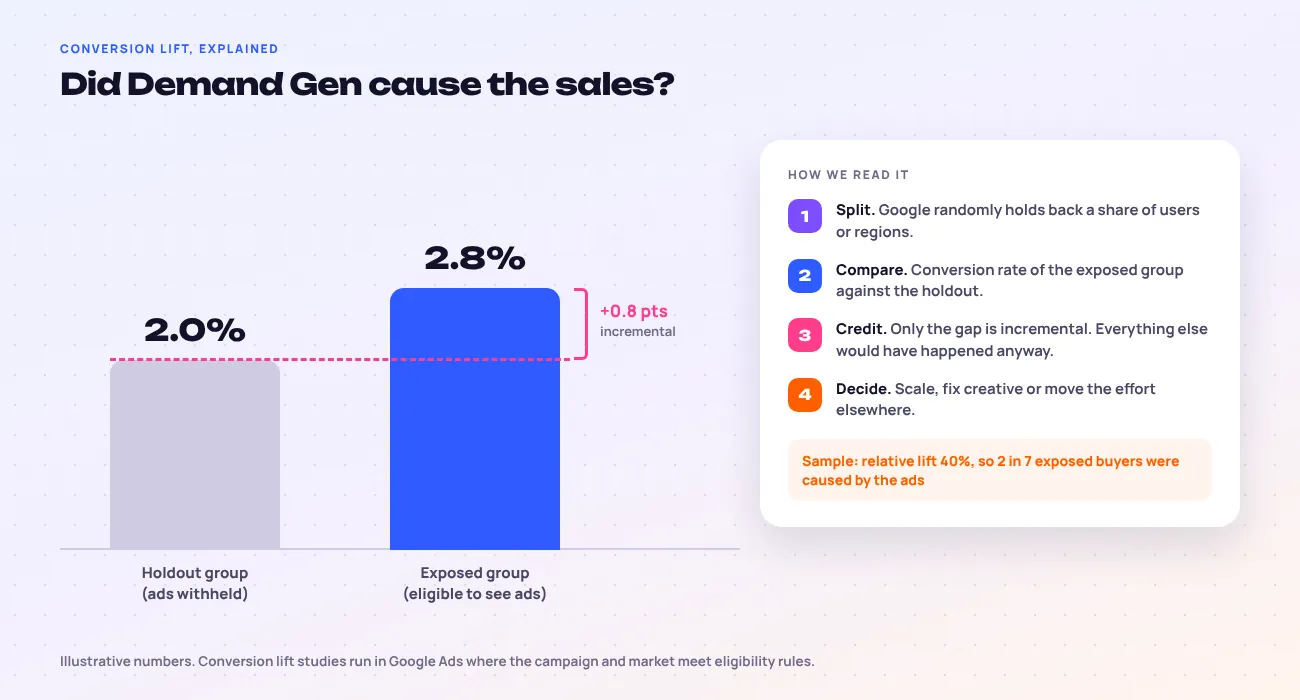
Read three layers. Click and engaged-view conversions in Google Ads show what the campaign touched. GA4 shows how those visitors behave on site and where Demand Gen sits in conversion paths. A conversion lift study, with a randomised holdout of users or regions, shows what the campaign actually caused. Only that last layer settles whether to scale.
Engaged-view conversions
Conversions from people who watched 10 seconds or more without clicking, within a 3-day default window per Google Ads Help. We report them apart from clicks.
New customer share
For prospecting, the share of first-time buyers matters more than blended ROAS.
Conversion lift studies
Run in Google Ads, by user or geography, where the campaign qualifies. Our conversion tracking setup makes sure the events are right first.
How We Launch Google Demand Gen Campaigns in About 14 Days
How long does it take to launch a Demand Gen campaign?
About 14 days from kickoff to live ads when creative exists, longer if we are shooting new video. Then the campaign needs a learning period: Google’s guidance is to let it gather roughly 50 conversions before judging bids or creative, which in most accounts takes two to six weeks.
- Days 1 to 3
Check tracking and goals
Conversion actions, values, GA4 links and consent mode, tested with real orders.
- Days 2 to 5
Build seed lists and exclusions
Customer Match by value, customer exclusions, custom segments.
- Days 3 to 6
Audit the product feed
Approvals, titles, images and a product filter for cold traffic.
- Days 4 to 10
Brief and cut the assets
Video in three ratios, image sets, carousels, headlines per surface.
- Days 8 to 12
Structure the campaign
Ad groups by audience, channel controls set.
- Around day 14
Launch on Maximise conversions
No targets yet, and no big edits that reset learning.
- Weeks 3 to 8
Tighten and test
Add bid targets, test lookalike levels, refresh creative, run a lift study.
Our Demand Gen Campaign Management Approach and Google Proof
EmergingAds is a performance marketing agency founded in 2021 and based in Gurugram, India, working with brands in the US, UK, UAE, India and Australia. We have served 85+ brands and managed $10M+ in ad spend.
We do not yet have a published Demand Gen or YouTube case study, so we will not invent one. Our Demand Gen campaign management follows the approach above: clean tracking, value-based seeds, native creative per surface and a lift test where Google allows.
What we can show is our Google Ads work for ecommerce, labelled honestly on the right. See more client success stories, the brands we work with, or our B2C marketing services.
Artsy Packaging, UK packaging brand
- £12k to £85k
- monthly revenue
- 9.2x
- ROAS
- -71%
- CPA
NetNutri, US supplement store
- 10,271
- purchases
- $794,281
- conversion value
- 2.21x
- value on $359,908 spend
More YouTube and Google Ads Services
Also useful:Google Ads managementPerformance Max agencyPaid ads guides on our blog
Common Questions About Demand Gen Answered
What is a Google Demand Gen campaign used for?
It is used to find new customers with visual ads before they search for you, across YouTube, Shorts, Discover, Gmail and optional Display.
How does Demand Gen work with YouTube Shorts?
Shorts is one of the surfaces Demand Gen serves on, and channel controls let you give it its own ad group. Native 9:16 video performs best.
Is Demand Gen worth it for an ecommerce brand?
Yes, when tracking is reliable and you have creative for feeds. If Search and Shopping are not yet profitable, fix those first.
What’s the difference between Demand Gen and Discovery campaigns?
Demand Gen replaced Discovery campaigns. It kept Discover and Gmail and added YouTube placements, video ads, lookalikes and channel controls.
Can I use lookalike audiences in Performance Max?
No. Lookalike segments are a Demand Gen feature; Performance Max takes audience signals, which guide targeting rather than define it.
How long does a Demand Gen campaign take to learn?
Usually two to six weeks, or roughly 50 conversions. Avoid large edits in that time because they restart learning.
Should Demand Gen and Performance Max run at the same time?
Often, yes. Performance Max captures existing intent while Demand Gen reaches people not searching yet; clear goals and customer exclusions keep them apart.
Can Demand Gen campaigns run on the Google Display Network?
Yes, as an option in channel controls. We usually test it in its own ad group once feed placements are proven.
How do you know if Demand Gen ads are actually working?
A conversion lift study is the clearest answer: it compares people who could see the ads with a randomised holdout.
Do you make the Demand Gen creative?
Yes. We brief and edit video cuts in every ratio, image sets and carousels, and plan new shoots around the hooks we want to test.
Build Demand at Scale With YouTube Demand Gen Campaigns
We check your tracking, seed lists, feed and creative coverage, then tell you what we would build first. Or start with our YouTube Ads service.