LinkedIn Lead Generation Ads That Reach the Buyers Who Sign Off Budgets.
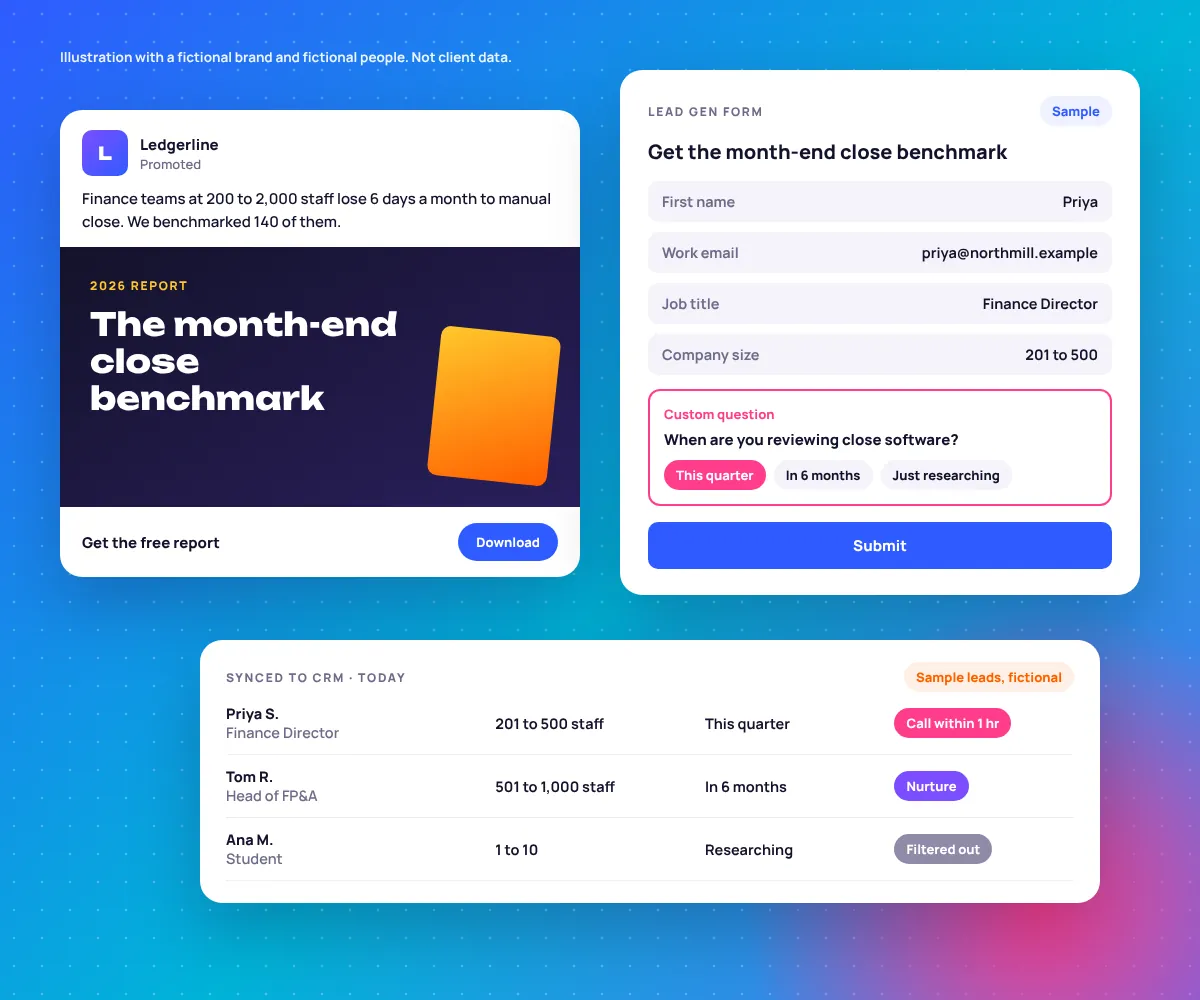
Lead Gen Forms prefill name, email, title and company from the profile, so the right people actually finish the form. We pair them with tight professional targeting, one or two qualifying questions and a handover that gets every good lead to a rep within the hour.
Build the Audience Before You Write the Ad
LinkedIn targeting runs on what people say about their own job. That is its whole advantage, and the easiest place to waste it. Here is how we stack the four layers that matter for lead generation.
Function and seniority beat job titles for scale. Titles are written a hundred ways (“FD”, “Finance Director”, “Director of Finance”). Function plus seniority catches all of them. We use titles only for small, precise lists.
Exclusions do as much work as inclusions. Students, job seekers, your own staff, competitors and existing customers come out first.
Two defaults get switched off. Audience expansion and the LinkedIn Audience Network are on for new campaigns. For lead gen they usually add cheap clicks from the wrong people, so we turn both off and test them later on purpose.
LinkedIn retired lookalike audiences in 2024. The replacement, predictive audiences, is built from your own lead or customer list and works well once you have a few hundred real leads to seed it.
Job function
What they doSeniority
Who signsCompany size
Who can afford youIndustry
Where the problem livesHow big should one audience be?
Typical ranges for a Lead Gen Form campaign on a modest budget.
Lead Quality Versus Lead Volume: Finding the Right Balance
Every field you add costs submissions and buys context. Move the scale to see what each form length tends to give your sales team.
Most volume, least context. Good for a content download feeding a nurture sequence. Bad if sales calls every lead, because they will spend afternoons on students and tiny firms.
Where we start most accounts. Prefilled basics plus company size and one question about timing or the problem. Each extra question typically costs 10 to 20 percent of submissions, and here it pays for itself.
Fewest leads, sharpest ones. Right for demo and pricing requests where a rep calls every lead. Phone number and budget questions cut volume hard, so we only ask when sales will actually use the answer.
What the form asks
- First and last name prefilled
- Work email prefilled
- Company name prefilled
- Company size prefilled
- When are you reviewing this? custom
- Phone number typed
- Rough budget band custom
Hidden fields carry campaign, audience and offer into the CRM on every lead, at zero cost to the person filling it in.
The offer matters more than the form length. “Contact us” converts badly on LinkedIn. A specific report, benchmark, calculator or a short audit converts well, because it gives the buyer something before asking for a call. We usually run two offers against each other in the first month and let cost per qualified lead decide.
LinkedIn Lead Generation Ads: From Form to Booked Call
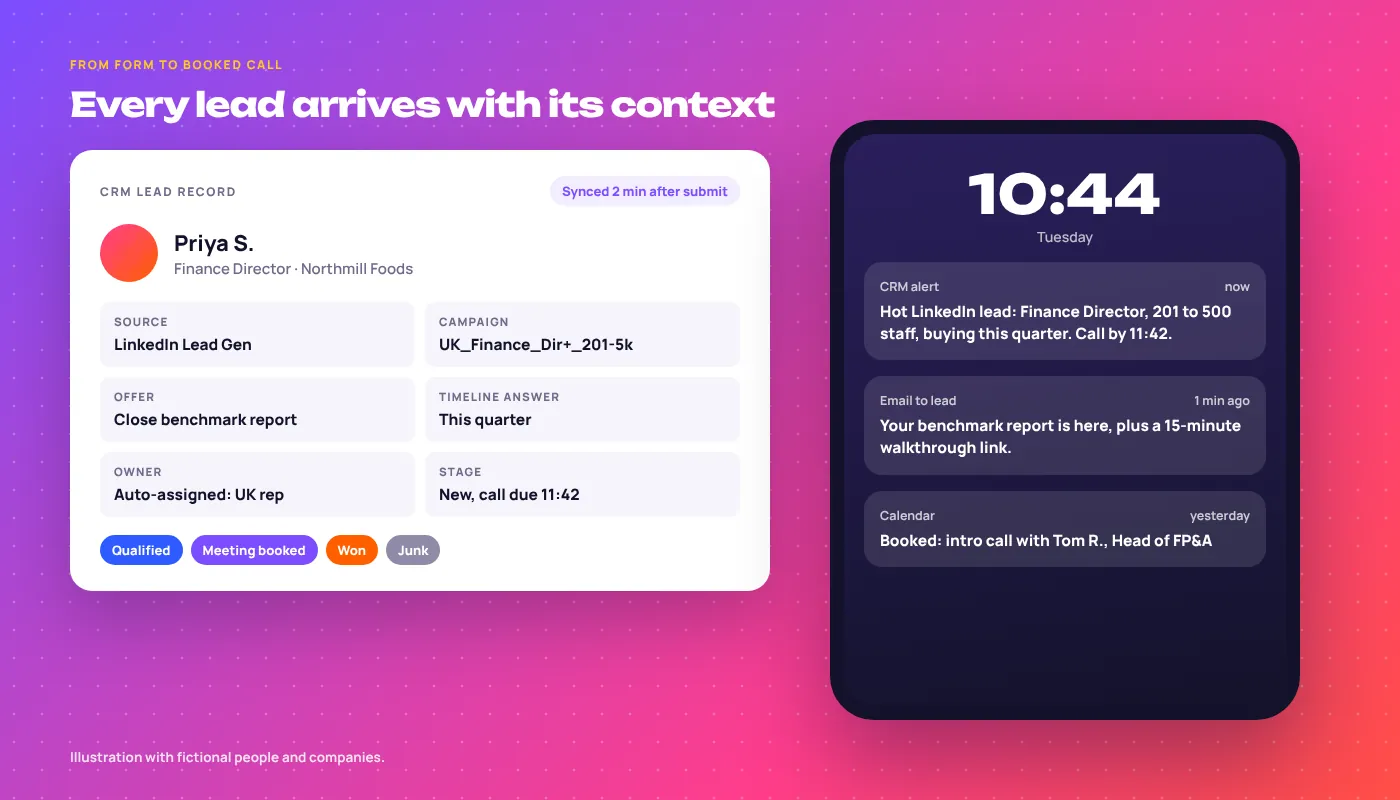
B2B leads cool off in hours, not days. This is the lane every lead travels on, and who is responsible at each point.
Prefilled profile data plus your questions and hidden fields.
Native sync for HubSpot and Salesforce, Zapier or Make for Zoho and others. Routed to an owner by country and size.
Email with the report and a booking link, plus a WhatsApp message where the market prefers it.
Alert to the rep with the lead’s answers, so the first call opens with their problem, not “did you download our guide?”
Leads answering “just researching” get a short email sequence instead of a call.
Qualified, meeting, opportunity, won or junk. Two clicks.
Qualified and won leads go back through LinkedIn’s Conversions API, so bidding learns which leads turn into pipeline.
Cost per qualified lead and per meeting by audience and offer, not just cost per form.
One practical warning: LinkedIn only keeps form leads available to download for 90 days. If nothing syncs them out, they quietly disappear. The sync is the first thing we build, before a single ad goes live.
How We Deliver Consistent Results.
Six steps, run in this order every time, because skipping step one is how most LinkedIn accounts end up paying for students.
Persona and audience build
We interview sales about recent wins and losses, then build the targeting stack and exclusions.
Offer and form
Two offers, a form with qualifying questions, hidden fields and the thank-you screen.
CRM sync and routing
Leads into your CRM, owners assigned, rep alerts and nurture emails tested end to end.
Creative for the feed
Single image, document and Thought Leader ads written for people scrolling between meetings.
Weekly optimisation
Bids, audiences and creative reviewed weekly. Fresh ads every two to three weeks.
Monthly pipeline review
Sales feedback, cost per meeting and what to change in targeting or offer next month.
No LinkedIn Case Study Yet. Here Is What Your First 90 Days Would Look Like.
We would rather show you a plan than borrow someone else’s numbers. For a B2B lead generation account on LinkedIn, the first three months usually run like this.
Different channel, same discipline: qualifying questions, fast follow-up and judging cost per consult, not cost per form. More in our success stories and client list.
- Days 1 to 14: buildICP and exclusions, two offers, forms with one timing question, CRM sync and alerts, Insight Tag and Conversions API.
- Weeks 3 to 6: learnOne tight audience and one retargeting audience. We read cost per lead and, more importantly, how many leads sales accepts.
- Weeks 7 to 10: cut and keepWeak offer paused, best audience split by seniority or industry, first document or Thought Leader ad in rotation.
- Weeks 11 to 13: decideCost per meeting and early pipeline against your deal size. Scale, change offer, or tell you honestly that LinkedIn is not your channel.
More LinkedIn Ads Services
Lead gen is one job in a LinkedIn account. These pages cover the others, and our LinkedIn Ads management service ties them together.
B2B lead generation on LinkedIn works best for considered purchases. See how we run it for SaaS companies and finance brands, or read our latest marketing articles. If you already run Instagram and Facebook forms, our Sponsored Content work pairs well with LinkedIn lead generation ads by warming people up before they see the form.
Common Questions Answered.
What B2B founders and marketing leads ask before running LinkedIn Lead Gen Forms.
What are LinkedIn Lead Gen Forms?
Forms that open inside LinkedIn when someone clicks your ad, with name, email, job title and company prefilled from their profile. Because nobody has to type much or load a landing page, they usually convert at several times the rate of a landing page form. You can add custom questions and hidden fields.
What is a good cost per lead on LinkedIn?
One your deal size can carry. A $100 lead is cheap if one in ten becomes a $15,000 customer, and expensive if your product costs $50 a month. We set targets from your close rate and deal value, then judge on cost per qualified lead and cost per meeting.
How long does it take to see results from LinkedIn lead gen ads?
First leads in the first week or two after launch. Reliable cost per lead data usually takes four to six weeks, and a clear view of pipeline takes 60 to 90 days, because B2B deals take time to close.
How many fields should a LinkedIn Lead Gen Form have?
Usually five or fewer, mostly prefilled, with one custom qualifying question. Add more only when sales will use the answer. Each extra question typically costs 10 to 20 percent of submissions.
How big should my LinkedIn audience be?
For one persona on a modest budget, roughly 15,000 to 80,000 members is a good starting range. LinkedIn will not serve under 300. Account-based lists can be smaller, but expect higher costs per click.
Can LinkedIn leads sync to my CRM automatically?
Yes. HubSpot and Salesforce have native integrations, and Zoho and most other CRMs connect through Zapier or Make. We set it up before launch, because LinkedIn only keeps leads downloadable for 90 days.
Are LinkedIn lead gen leads lower quality than landing page leads?
Intent can be a little lower, because the form is so easy to submit. A qualifying question, a specific offer and fast follow-up close most of that gap. We report on leads sales accepts, not raw form fills.
What offers work best with Lead Gen Forms?
Specific ones: an industry benchmark, a calculator, a short audit, a webinar with a named speaker. Generic “contact us” or “request a demo” offers to cold audiences usually cost far more per lead.
Is LinkedIn advertising worth it for small B2B companies?
It can be, if your deal size is large enough and you start with one tightly defined audience. If your average sale is small, Google or Meta usually gets you customers cheaper, and we will say so on the audit.
Do you write the ads and the forms?
Yes. We write the copy, design single image and document ads, build the forms, questions and thank-you screens, and set up the follow-up emails. Your team approves before anything goes live.
What happens on the free audit?
We look at your LinkedIn account if you have one, your offer, your CRM setup and your deal size, then tell you whether LinkedIn makes sense for you and what we would do first. You keep the notes either way.
Get More Qualified B2B Leads From LinkedIn Ads.
Pick a time that suits you. Thirty minutes, with the people who would run your account, and an honest answer on whether LinkedIn fits your deal size.