
The short answer
YouTube ads are video and image ads that run on YouTube and Google’s video partners, bought through Google Ads. Formats include skippable and non-skippable in-stream ads, 6-second bumpers, in-feed ads and Shorts ads. They matter more in 2026 because YouTube now reaches people on phones and TV screens at a scale few channels match, Shorts offers low-cost reach, Demand Gen campaigns make YouTube a performance channel as well as a brand one, and video increasingly feeds AI search answers.
For years, many performance marketers treated YouTube as a brand channel: something big advertisers used for awareness while everyone else focused on search and social. That view is out of date. YouTube is now one of the most-watched platforms on television screens as well as phones, its ad formats cover everything from six-second reminders to direct-response campaigns, and Google’s campaign types let advertisers optimize for conversions, not just views.
It is also a channel where a lot of budget is wasted. Default targeting settings send ads to places they should not go, creative made for TV gets skipped in seconds, and campaigns are judged on metrics that do not reflect their real effect. This guide explains what YouTube ads are, how each format works, why they matter more now than a few years ago, and how to run a first campaign without the usual mistakes.

What YouTube ads actually are
YouTube ads are bought through Google Ads, not a separate platform. You upload your video to YouTube, often as an unlisted video, then create a campaign in Google Ads that tells Google who to show it to, where, how much to spend and what you want to achieve.
Ads can appear before, during or after other videos, in YouTube search results and the home feed, between Shorts, on YouTube’s connected TV apps, and on Google video partner sites and apps outside YouTube. Some campaign types, such as Performance Max and Demand Gen, also include YouTube alongside other Google placements like Discover and Gmail.
Because it runs inside Google Ads, YouTube can use Google’s audience data, including what people have searched for on Google, which is one of its biggest advantages over other video platforms.
The ad formats and when to use each
Skippable in-stream ads
These play before, during or after other videos, and viewers can skip after five seconds. On view-based bidding you generally pay only when someone watches 30 seconds (or the whole ad if shorter) or interacts. On conversion-focused campaigns, Google charges differently depending on the bidding strategy. They are the workhorse format for most advertisers, flexible enough for awareness and performance, and the first five seconds decide almost everything.
Non-skippable in-stream ads
Short ads, typically up to 15 seconds, that viewers must watch. They are bought on impressions and suit messages you need everyone to see in full, such as a launch or event. They cost more per impression and can irritate viewers if overused.
Bumper ads
Six-second, non-skippable ads bought on impressions. They are cheap per impression and very effective for reminders, reinforcing a longer ad or keeping a brand front of mind during a campaign. Six seconds is enough for one idea, not a story.
In-feed video ads
Previously called discovery ads, these appear in YouTube search results, alongside related videos and on the home feed as a thumbnail and headline. The viewer chooses to click and watch, which usually means higher intent. They suit longer content such as product demonstrations, tutorials and reviews.
Shorts ads
Vertical video ads that appear between Shorts, YouTube’s short-form feed. Shorts inventory has become one of the lowest-cost ways to buy reach on the platform, and it suits the same native, fast-paced creative that works on TikTok and Instagram Reels.
Masthead
The large placement at the top of the YouTube home feed, usually bought on a reservation basis for major launches. It delivers huge reach in a short window and is mainly relevant for large brands.
Campaign types in Google Ads
Formats are what viewers see. Campaign types are how you buy them. The main options in 2026 are:
- Video campaigns with goals such as awareness, consideration or reach, using formats like skippable, non-skippable, bumper and in-feed ads. Best for building audiences and brand awareness.
- Demand Gen campaigns, which Google has positioned as the main way to run YouTube for conversions. They span YouTube in-stream, in-feed and Shorts, plus Discover and Gmail, and support video and image ads. Google moved its older video action campaigns into Demand Gen.
- Performance Max, which includes YouTube among all Google placements. You have less control over where video runs, but it can work well for advertisers with strong conversion data. Our page on Performance Max covers how we manage it.

Why YouTube matters more in 2026 than a few years ago
YouTube is now television
A large and growing share of YouTube watch time happens on TV screens through smart TVs and streaming devices. Nielsen’s measurements of US TV viewing have placed YouTube at or near the top of streaming platforms. For advertisers, that means YouTube can deliver something close to TV reach, with digital targeting and measurement, at budgets far below traditional TV.
Shorts opened cheap reach
Short-form vertical video is where much attention has moved. Shorts ads let advertisers reach those viewers on YouTube, often at low cost per view, and the same vertical creative can be reused across Shorts, Reels and TikTok.
It became a performance channel
With Demand Gen and Performance Max, YouTube can be optimized for conversions and conversion value using Google’s data, not just views. Many ecommerce and lead generation advertisers now run YouTube as part of their direct-response mix.
Search intent targeting is a real edge
Custom segments let you reach people based on what they have recently searched for on Google. Someone who searched for “best standing desk” last week can see your standing desk video on YouTube today. No other video platform has that signal.
Video increasingly feeds AI answers
Google’s AI Overviews and other answer engines sometimes cite YouTube videos, especially for how-to and product questions. A video that answers a common question clearly within its first 15 seconds, with an accurate title, description and chapters, has a real chance of being referenced. That is a reason to invest in useful organic video content as well as ads. Our guide to ChatGPT SEO covers how AI answers choose sources.
Targeting: where most budget gets wasted
The biggest waste we find in YouTube accounts comes from where ads appear, not who they target. Without exclusions, ads can run on children’s content, mobile game apps where people tap accidentally, and low-quality channels that produce cheap views and nothing else.
Audience targeting options
- Your data: website visitors, past customers, YouTube channel viewers and uploaded customer lists. Usually the highest-performing audiences.
- Custom segments: people who searched for specific terms on Google, or are interested in specific websites or apps. Often the best prospecting option for performance campaigns.
- In-market and life events: people Google believes are actively researching a category or going through events such as moving or getting married.
- Affinity: broad interest groups, best for awareness.
- Demographics: age, gender, parental status and household income in some markets.
Content and placement controls
- Set content suitability to the level that fits your brand, and exclude sensitive content categories.
- Exclude content made for kids if your product is not for children, both because it rarely converts and because of the restrictions that apply to that content.
- Review where ads actually ran regularly, and exclude channels, videos and apps that spend without results.
- Consider whether Google video partners help your campaign, and test with and without them.
Creative that works on YouTube
The single most common reason YouTube campaigns fail is creative made for a different context. A 60-second brand film that builds slowly to a reveal will be skipped by most people before the brand appears.
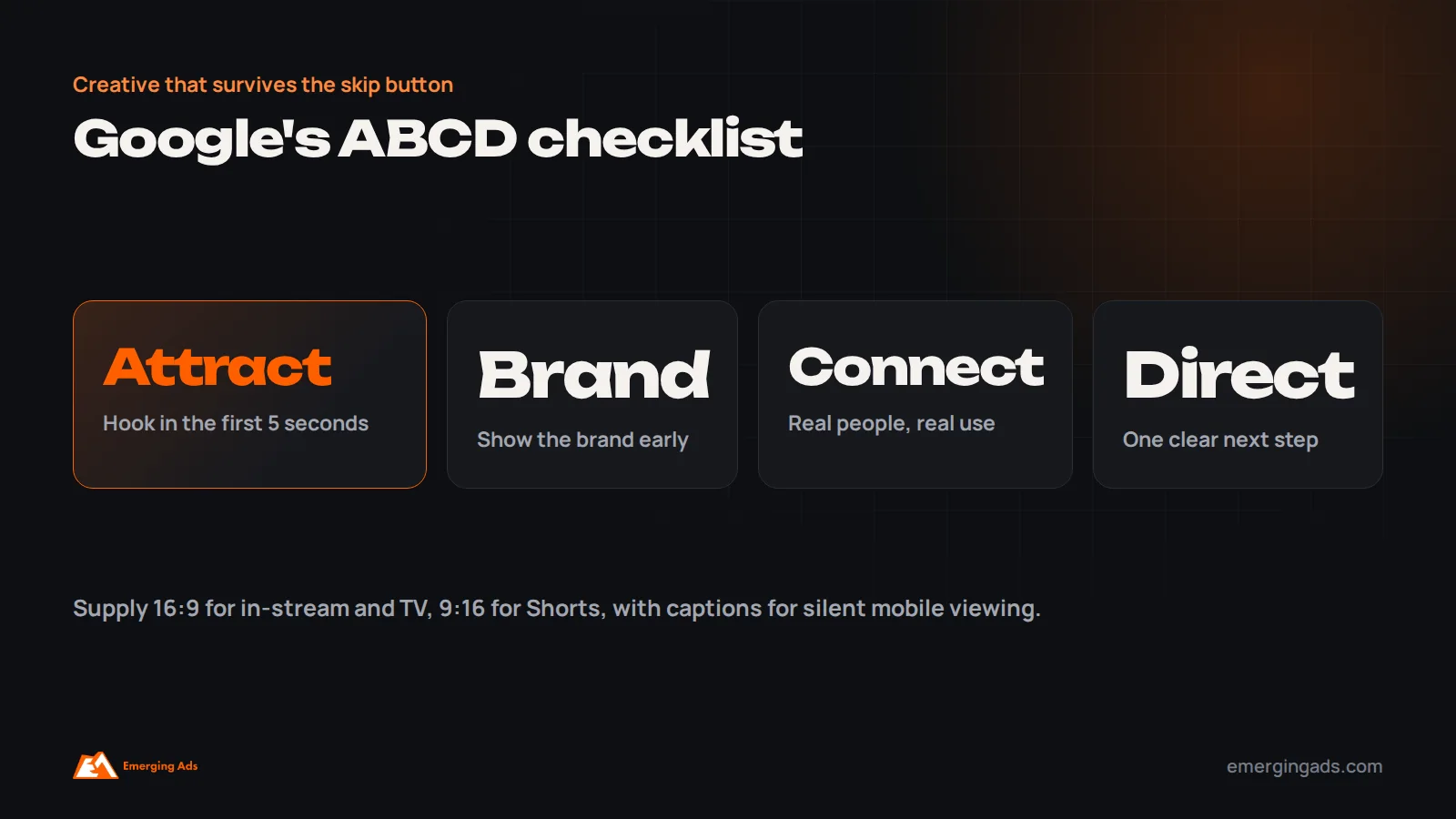
Google’s own research-based guidance, often summarized as ABCD, is a useful checklist:
- Attract: hook attention in the first five seconds with movement, a person, a question or a surprising visual.
- Brand: show or say your brand early and naturally, not only at the end.
- Connect: make people feel something or learn something, using real people, demonstrations and clear benefits.
- Direct: tell viewers exactly what to do next, and make it easy.
Format matters too. Supply horizontal 16:9 videos for in-stream and TV, vertical 9:16 for Shorts, and square for some in-feed placements. Add captions for silent viewing on mobile, but remember that many TV viewers watch with sound on. For performance campaigns, product demonstrations, creator-style reviews and problem-and-solution stories usually outperform polished brand spots.
Bidding strategies in plain terms
The bidding strategy tells Google what you are paying for, and it should match the job the campaign is doing.
- Target CPM and viewable CPM pay per thousand impressions. Suited to reach and awareness, and to bumper and non-skippable ads.
- Maximum CPV pays per view on skippable ads. Suited to consideration, when you want people to actually watch.
- Maximize conversions, target CPA and target ROAS optimize towards conversions using Google’s data. Suited to Demand Gen and performance-focused campaigns, provided conversion tracking is reliable.
- Maximize clicks in some Demand Gen setups, useful early on when conversion volume is too low for conversion bidding.
A common mistake is optimizing for cheap views when the business needs sales. Cheap views are easy to buy and tell you very little about whether anyone will buy.
How paid YouTube and your own channel work together
Ads and organic content on YouTube support each other more than on most platforms. Ads can be run from videos already on your channel, so a useful tutorial or review that performs well organically can become an ad with little extra work. People who watch your ads can be added to remarketing lists, and viewers of your organic videos can be targeted with ads later. And a channel with genuinely useful content gives people somewhere to go after seeing an ad, which builds trust before they buy.
You do not need a large channel to advertise. But brands that publish a few genuinely helpful videos, such as how to choose, how to use, and answers to common questions, usually find their ads perform better, and those videos keep earning views, and potentially AI citations, long after a campaign ends.
YouTube in different markets
YouTube’s reach is broad, but how people use it varies by market. In India, YouTube is one of the largest platforms of any kind, with heavy mobile viewing and strong demand for content in regional languages, which makes local-language creative important. In the Gulf, viewing is high on both mobile and TV, and Arabic creative typically outperforms English-only ads for local audiences. In the UK and US, connected TV viewing has grown fastest, which raises the value of horizontal, sound-on creative alongside mobile-first edits. Plan creative and targeting for the market, not just the platform.
Getting your first campaign off the ground
- Decide the job. Awareness for a launch, consideration for a complex product, or conversions for a store or lead generation business. The job determines campaign type, bidding and how you measure.
- Set up tracking. Make sure Google Ads conversion tracking works, ideally with enhanced conversions, and link your YouTube channel to Google Ads.
- Build audiences. Create remarketing lists of site visitors and customers, and custom segments based on the search terms your best customers use.
- Prepare creative. At least two or three different videos, in the formats your campaign type uses, built around a strong first five seconds.
- Set exclusions for content suitability, kids content and any placements you know you do not want.
- Start with a focused budget on one or two audiences, run it for at least two to three weeks, then review where ads ran and how each audience performed.
How much to spend on YouTube ads
YouTube has no large minimum spend, which makes it easy to start small. The practical question is whether the budget is enough to learn. Awareness campaigns can show results at modest budgets because they are judged on reach and views. Conversion campaigns need enough spend to generate conversions, so the budget should be set relative to your expected cost per conversion, just as on search or Meta.
A sensible approach is to treat YouTube as a test with a defined budget and a defined period, often six to eight weeks, measured on the outcomes described below. If it works, scale gradually. If it does not, the lessons about creative and audiences are still useful elsewhere.
How to measure YouTube ads properly
YouTube is often undervalued because last-click reporting rarely gives video credit. Most people do not click a YouTube ad and buy immediately. They watch, remember, and later search for the brand or come back directly.
Measure at several levels:
- Attention: view rate, average watch time and how many people watched to the end. These tell you whether creative works.
- Conversions: click and engaged-view conversions in Google Ads. Engaged-view conversions count people who watched a meaningful portion of a skippable ad and then converted within a set window.
- Search lift: whether branded searches rise while YouTube is running. Watch branded search volume in Google Ads and Search Console.
- Brand and conversion lift studies: Google offers lift studies for eligible budgets, which compare exposed and unexposed groups to measure real effect.
- Blended results: total revenue or leads across all channels before, during and after YouTube spend.

Using YouTube for remarketing
YouTube is also excellent for bringing back people who already know you: site visitors, cart abandoners, past customers and people who watched your videos. A short testimonial or product demonstration shown to someone who visited your pricing page last week is often far more persuasive than another static banner. Our guide on YouTube remarketing goes through how to set this up and which audiences to start with.
Who should use YouTube ads?
YouTube suits brands with products that benefit from being shown in use, services that need explaining, launches that need broad reach quickly, and any business already succeeding on search that wants to create more demand for search to capture. It is also a natural next channel for brands whose short-form video works on Meta or TikTok, because the same creative style transfers well to Shorts.
It is also worth comparing with the other short-form video platforms. TikTok and Meta Reels often reach younger audiences at low cost and reward the same native style, while YouTube adds search intent signals, longer viewing sessions and TV screens. Many brands we work with test creative on TikTok or Meta first, then bring proven concepts to YouTube Shorts and in-stream.
It is less suitable if you have no capacity to produce video at all, though simple product demonstrations and talking-head videos shot on a phone often work better than people expect, or if your budget is so small that search campaigns on high-intent keywords have not yet been fully funded. In most cases, high-intent search should come first, and YouTube should be added to grow the pool of people searching for you. Our guide to lowering Google Ads CPA covers getting search right first.
Common YouTube ads mistakes
- Running TV-style creative that hides the brand and the point until the end.
- Leaving content and placement exclusions at defaults, so budget goes to kids content and accidental app clicks.
- Judging conversion campaigns on last-click results only, and switching them off before their effect on search and direct traffic shows.
- Using one video in one format for every placement, including Shorts and TV.
- Spreading a small budget across too many audiences to learn anything.
- Optimizing for cheap views when the goal is sales or leads.
If you would like help planning or running YouTube campaigns, our YouTube ads team works alongside our Google Ads specialists so video and search are planned together, and our branding and content team can help produce creative built for each format. For how YouTube fits with your other channels, see our performance marketing guide for 2026.
Frequently asked questions
What are YouTube ads?
YouTube ads are video and image ads shown on YouTube and Google video partners, bought through Google Ads. They include skippable and non-skippable in-stream ads, bumper ads, in-feed ads, Shorts ads and the masthead.
How much do YouTube ads cost?
There is no fixed price. Costs depend on audience, format, bidding strategy, competition and creative quality. You set your own budget, and many advertisers start with a defined test budget over six to eight weeks.
Do you pay if someone skips a YouTube ad?
With view-based bidding on skippable in-stream ads, you generally pay only when someone watches 30 seconds, the whole ad if it is shorter, or interacts with it. Other bidding strategies and formats are charged differently, such as by impressions.
What is the best length for a YouTube ad?
Bumper ads are fixed at 6 seconds and non-skippable ads are typically up to 15 seconds. Skippable ads can be longer, but the first 5 seconds must earn attention. Shorts ads generally work best when short and fast-paced.
Are YouTube ads good for small businesses?
They can be, especially with tight targeting such as remarketing and custom segments based on search terms, and simple, authentic videos. Most small businesses should make sure high-intent search campaigns are working first.
What are Demand Gen campaigns?
Demand Gen is a Google Ads campaign type that runs video and image ads across YouTube in-stream, in-feed and Shorts, plus Discover and Gmail, optimized for conversions or clicks. It replaced Google’s older video action campaigns.
How do I measure whether YouTube ads are working?
Look at view rate and watch time for creative quality, click and engaged-view conversions, rises in branded search, lift studies where available, and total business results before and during the campaign.
Are Shorts ads worth it?
For many advertisers, yes. Shorts inventory is often a low-cost way to build reach, and vertical creative made for Reels or TikTok can usually be reused with small adjustments.