The short answer
Start with Google Ads if people already search for what you sell, because search captures existing demand from buyers who are ready now. Start with Meta ads if your product is visual, new, impulse-friendly or something people do not yet know to search for, because Meta creates demand by putting the product in front of likely buyers. Most growing businesses end up using both: Meta to create demand and Google to capture it. The right first channel depends on search volume, product type, margin and how much creative you can produce.
“Should we spend on Google or Meta first?” is one of the questions we are asked most often by founders and marketing managers. It is a fair question. Budgets are limited, both platforms are huge, and both have advocates who will tell you the other one is a waste of money.
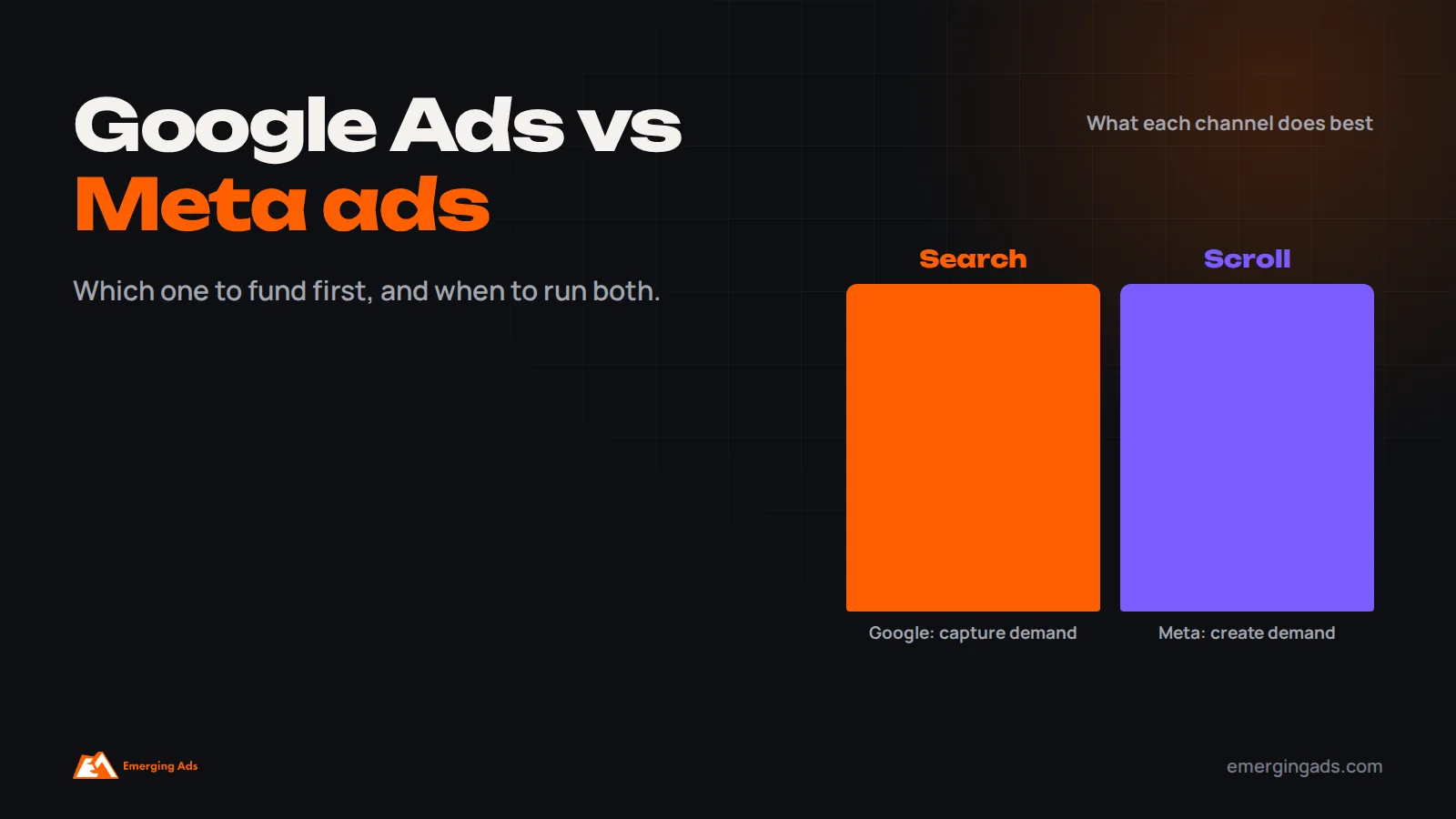
The honest answer is that neither is better in general. They do different jobs. Google Ads mostly reaches people who are already looking for something. Meta mostly reaches people who were not looking, and persuades some of them that they want what you sell. Which job matters more for your business right now decides where your first dollar should go.
This guide explains how each platform works, the questions we ask to decide which comes first, how results typically differ, and how to split budget once you are ready to run both. Where we use numbers, they come from accounts we manage or are clearly marked as examples.
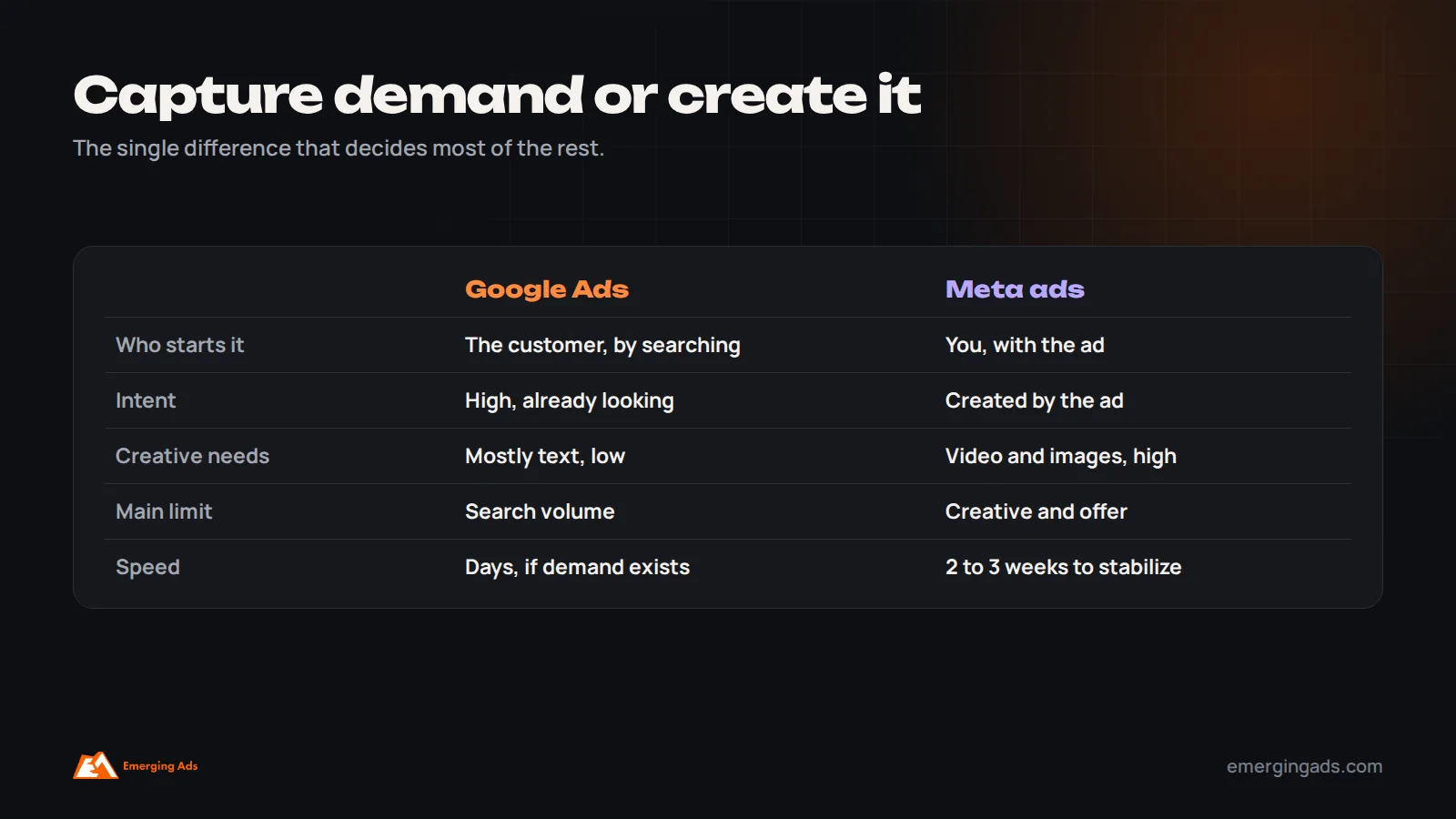
The core difference: capturing demand versus creating it
On Google, the customer starts the conversation. Someone types “emergency plumber near me” or “running shoes for flat feet”, and your ad appears because of what they asked for. The intent is already there. Your job is to be the most relevant, credible answer at that moment.
On Meta, you start the conversation. Someone scrolling Instagram was not looking for bamboo baby clothes, but your ad shows them a sleepsuit that solves a problem they recognize, and some of them buy. The intent did not exist until the ad created it. Your job is to stop the scroll and make a convincing case in a few seconds.
That difference shapes everything else: targeting, creative, costs, conversion rates, how quickly results show up and how you should measure them. It also explains why the two channels work so well together. Meta makes people aware of you. Some of those people later search for you or your category on Google, where search ads and organic results capture them.
How Google Ads works for a growing business
Google Ads covers several networks, but for most businesses starting out, the core is search: text ads on Google results pages, plus Shopping ads with product images and prices for online stores. You choose keywords that describe what customers search for, write ads that match, and bid in an auction where Google considers your bid, ad relevance and landing page quality.
Beyond search and Shopping, Google Ads also includes Performance Max, which runs across search, Shopping, YouTube, Display, Discover, Gmail and Maps from one campaign, and Demand Gen, which focuses on YouTube and Google’s feeds. These can create some demand of their own, but for most businesses starting out, search and Shopping remain the core.
Its strengths are clear. Intent is high, because people are actively looking. Results can arrive quickly, sometimes within days, if the search volume exists. And it works for almost any business with something people search for, from emergency services to software to specialist products.
Its limits are just as clear. You can only reach as many people as are searching. If few people search for your category, Google can only spend so much before it runs out of relevant searches. Competitive categories can have high costs per click. And Google rarely creates new demand on its own; it captures demand that already exists.
On our NetNutri supplements account, Google Shopping and Performance Max work precisely because supplement shoppers search for exactly what they want, often with brand, size and capsule count in the query. Across the reporting period, the account recorded 10,271 purchases at an average cost per click of $0.46.
How Meta ads work for a growing business
Meta ads run across Facebook, Instagram, Messenger and partner apps. Rather than targeting what people search for, you supply creative and conversion data, and Meta’s system finds people likely to respond, increasingly with broad targeting where the creative itself does much of the targeting work.
Its strengths are reach and persuasion. Meta can put a new product in front of millions of potential customers who would never have searched for it. Visual formats such as short video, carousels and creator content can explain and demonstrate a product. And for ecommerce with good creative and clean tracking, it can scale very far.
Its limits come from the same place. Because people are not actively looking, conversion rates per click are usually lower than on search, so you need a strong offer, a quick-to-understand product and enough creative to avoid fatigue. Results take some time to stabilize while the algorithm learns. And it depends heavily on accurate conversion tracking through the pixel and Conversions API.
For The Simple Seed Baby, a US baby clothing brand, Meta is the main growth engine. Its high-volume campaigns produced 22,606 purchases at a 5.30x ROAS, because baby clothing is visual, emotionally driven and easy to understand in a short video, exactly the kind of product Meta suits.
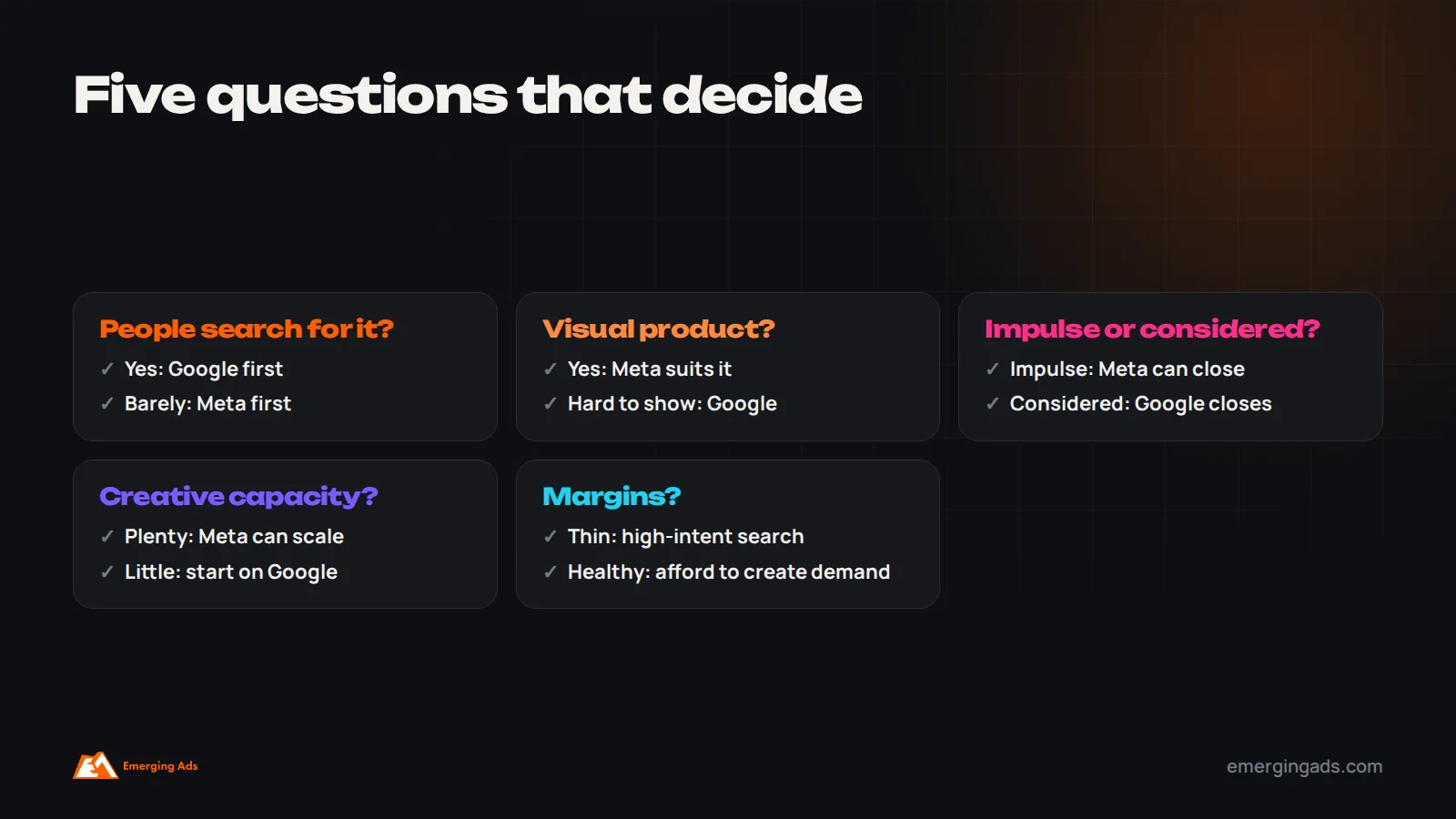
Five questions that decide which channel comes first
When we plan a new account, we work through the same five questions. Answer them honestly and the right first channel is usually obvious.
1. Do people already search for what you sell?
Check Google’s Keyword Planner or a keyword tool for the terms your customers would use. If there is meaningful search volume for high-intent terms, such as “buy”, “near me”, “price”, specific product names or problem-plus-solution phrases, Google can produce sales quickly. If search volume is tiny because the product is new or the category is unfamiliar, Google has little to capture, and Meta is the better starting point. Our guide on doing keyword research yourself walks through how to check this properly.
2. Is the product visual or easy to demonstrate?
Products that look good, solve a visible problem or can be demonstrated in a few seconds, such as fashion, beauty, home, food, fitness, gadgets and baby products, tend to suit Meta. Services that are hard to show, such as accounting, legal advice or B2B software, usually find search a more natural fit, at least to begin with.
3. Is it an impulse purchase or a considered one?
Lower-priced, emotionally driven purchases can happen straight from a social ad. High-ticket or complex purchases usually involve research, comparison and often a search. That does not rule Meta out for considered purchases, but its role becomes building awareness and retargeting rather than closing the sale directly.
4. How much creative can you produce?
Meta runs on creative. If you can only produce one or two ads a month, it will struggle once those ads fatigue. Google search ads are text-based and much less demanding creatively. If your creative capacity is limited, starting with Google is often more realistic.
5. What are your margins and order values?
Both channels cost money to acquire a customer. If your margin or customer value is thin, you need the most efficient possible acquisition, which often means high-intent search terms. If customers are worth a lot over time, you can afford the higher upfront cost of creating demand on Meta.
Which comes first for common business types
| Business type | Usually start with | Why |
|---|---|---|
| Local services (plumbers, clinics, lawyers) | People search when they need help, often urgently | |
| DTC fashion, beauty, baby, home | Meta | Visual, emotional products that create demand |
| Ecommerce selling known brands or products | Google (Shopping) | Shoppers search for specific products and compare prices |
| New product category or invention | Meta | Little search volume until people know it exists |
| B2B software and services | Google, then LinkedIn | Buyers research solutions; Meta works mostly for retargeting |
| High-ticket ecommerce | Google, with Meta retargeting | Purchases involve research and comparison |
| Events, courses, local experiences | Meta | Interest-led, visual, time-sensitive |
These are starting points, not rules. A DTC skincare brand with strong search demand for its ingredient might start on Google. A local gym might find Meta fills classes faster than search. Test your assumptions with real data.
How costs and results typically compare
Comparing the two platforms on cost per click is misleading. Google clicks are often more expensive, but each click carries more intent. Meta clicks are often cheaper, but fewer of them convert immediately. What matters is cost per customer and how valuable those customers turn out to be.
In practice, we see a few consistent patterns:
- Google search usually converts at a higher rate per click, especially for branded and high-intent terms. See our breakdown of average Google Ads conversion rates by industry.
- Meta usually reaches more new people per dollar and has much more room to scale once creative and tracking are in place.
- Google is capped by search volume. Once you cover the relevant searches, extra budget buys increasingly marginal traffic.
- Meta is capped by creative and offer. When ads fatigue or the offer stops resonating, costs rise until something new arrives.
- Branded search gets cheaper as Meta grows, because more people search for you by name after seeing your ads.
How quickly each one shows results
Google search can produce sales within the first week if search demand exists and the landing page converts, although campaigns using Smart Bidding still need several weeks to optimize fully. Meta usually takes two to three weeks of learning and creative testing before results stabilize, and often longer to find the angles that scale.
That matters for cash flow. If you need sales quickly to fund growth, high-intent Google search is usually the safer first step. If you have runway to invest in learning, Meta can open up a far larger audience.
Why most businesses end up running both
The businesses that grow fastest rarely choose one platform forever. They use each for what it does best, and the two reinforce each other.
Meta introduces the brand to people who were not looking. Some of them buy straight away. Many more remember, and later search for the brand or category on Google. Google captures those searches, along with everyone else already in the market. Retargeting on both platforms brings back people who visited but did not buy. And email collects everyone who shows interest, so neither ad platform has to pay to win the same customer twice.
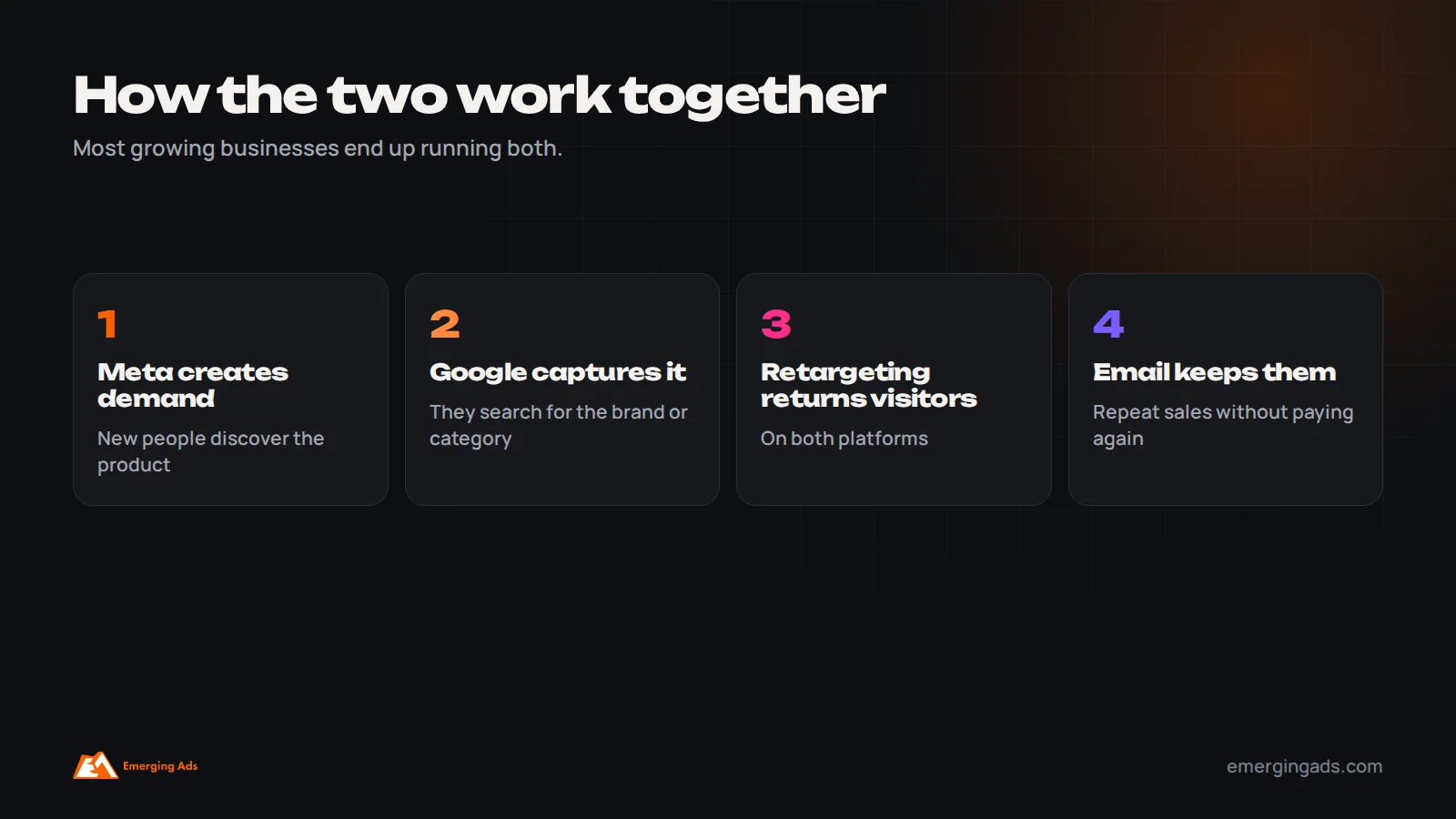
This is also why judging each platform only on its own reported results can mislead. Meta may get little last-click credit for sales that started with one of its ads and finished with a Google search. Turning off Meta because its reported ROAS looks weaker can quietly shrink Google’s branded search volume a few weeks later.
How to split budget when you run both
There is no universal split, but these starting points work for most of the businesses we plan with. Treat them as a first hypothesis to test, not a formula.
- Search-led businesses, such as local services and B2B: most of the budget on Google search, with a smaller share on Meta for retargeting and local awareness.
- Visual DTC brands: most of the budget on Meta, with Google covering branded search, Shopping and high-intent category terms.
- Ecommerce stores selling products people search for: a more even split, with Google Shopping and Performance Max capturing product searches and Meta growing new customers.
Revisit the split monthly. If Google is capturing all available high-intent searches at a good return, extra budget there buys less and less, and it may be time to grow Meta to create more demand. If Meta is fatiguing and costs are rising, shift budget towards proven search terms while new creative is produced.
What to do with a small budget
With a genuinely small budget, splitting across two platforms usually means neither gets enough data to work well. Pick one, run it properly for at least six to eight weeks, and add the second once the first is producing a reliable return.
For most service businesses and stores with real search demand, that one is Google search, starting with the highest-intent terms and tight negative keywords. For visual DTC brands with little search volume, it is Meta, starting with one well-structured campaign and several different creative angles. In both cases, fix tracking first, so the platform optimizes towards real sales or leads rather than guesses.
Tracking: the foundation for both
Whichever platform comes first, results depend on accurate conversion data. For Google, that means Google Ads conversion tracking with enhanced conversions, and for many accounts a properly configured GA4. For Meta, it means the pixel plus the Conversions API with deduplication. Both platforms optimize towards whatever you tell them is a conversion, so tracking the wrong action, or the right one inaccurately, wastes budget from day one.
Our guides on Meta pixel tracking setup and lowering Google Ads CPA both start with tracking for this reason.
How to measure the two fairly
Each platform reports conversions using its own attribution rules, and both will claim some of the same sales. Adding up platform-reported revenue usually gives a number larger than your actual sales. To compare fairly:
- Track blended results: total revenue or leads divided by total ad spend across all channels.
- Watch new customer numbers, not just total conversions, so retargeting existing customers does not flatter either platform.
- Monitor branded search volume as Meta spend changes.
- Use holdout tests for larger budgets, pausing one channel in a region or period to see what really changes.
Our performance marketing guide covers blended measurement in more detail.
What about TikTok, YouTube and LinkedIn?
Google and Meta are the usual first two because of their reach and maturity, but they are not the only options. TikTok can reach younger audiences at low cost with native creative, and YouTube combines video with Google’s search intent signals. LinkedIn is the strongest option for reaching specific job roles in B2B, at a premium. These usually make sense as a third channel, once Google and Meta are working, unless your audience is unusually concentrated on one of them. Our article on YouTube ads in 2026 explains where video fits.
Mistakes we see when choosing between them
- Choosing based on cost per click. The cheaper click is rarely the cheaper customer.
- Running Meta with one or two ads. It needs creative variety to work.
- Running Google on broad keywords with no negatives. Budget leaks into irrelevant searches.
- Splitting a small budget across both from day one. Neither learns.
- Judging each platform only on its own dashboard. Their effects overlap.
- Giving up after two weeks. Both need time to learn, Meta especially.
Two example launch plans
A local physiotherapy clinic
Month one: Google search campaigns for high-intent terms such as “physiotherapist near me” and specific conditions, with call tracking and a booking page. Month two: add a small Meta campaign targeting a few kilometers around the clinic, retargeting website visitors and promoting a first-visit offer. Month three onwards: shift budget based on cost per booked appointment from each.
A new DTC skincare brand
Month one: Meta sales campaign with five to eight genuinely different creative angles, clean pixel and Conversions API tracking, and a welcome email flow. Month two: add Google branded search and Shopping as brand searches begin to appear, and expand winning Meta angles. Month three onwards: grow Meta budget in steps while Google captures rising branded and category demand.
If you would like a plan built around your own numbers, our Google Ads and Meta ads teams work together on channel planning, and a free ad audit is a good place to start if you already run either.
Frequently asked questions
Is Google Ads or Meta ads better for a small business?
It depends on whether people already search for what you sell. Businesses with clear search demand, such as local services, usually do best starting with Google. Visual or new products that people do not yet search for usually do better starting with Meta.
Which is cheaper, Google Ads or Facebook ads?
Meta often has cheaper clicks, but Google clicks typically convert at a higher rate because of search intent. Compare cost per customer and customer value, not cost per click.
Should I run Google and Meta ads at the same time?
Most growing businesses benefit from both, because Meta creates demand and Google captures it. With a small budget, start with one, prove it works, then add the other.
How should I split budget between Google and Meta?
Search-led businesses usually put most budget on Google, visual DTC brands on Meta, and ecommerce stores selling searched-for products often split more evenly. Review the split monthly based on blended results.
Which shows results faster?
Google search usually produces sales sooner when search demand exists. Meta typically needs two to three weeks of learning and creative testing before results stabilize.
Is Google Ads better for ecommerce than Meta?
For stores selling products people search for by name, Google Shopping is often the best first channel. For visual, new or impulse products, Meta often scales further. Many stores need both.
Why does Meta show lower ROAS than Google in my reports?
Meta often starts the journey and Google finishes it, so Google gets more last-click credit. Look at blended results and branded search trends before judging Meta on its own reported ROAS.
Do B2B companies need Meta ads?
Usually not as a first channel. B2B companies typically start with Google search and LinkedIn, then use Meta for retargeting and sometimes for reaching small business owners.