How to Get Started With ChatGPT SEO
Key Takeaways
- ChatGPT SEO, more accurately called generative engine optimization, is about getting cited inside an AI-generated answer, not ranking a blue link on a results page.
- AI answer engines pull from sources they judge trustworthy and clearly structured, so the same content that ranks poorly in Google often gets ignored by ChatGPT too.
- Clear, direct answers near the top of a page get quoted far more often than content that buries the point under three paragraphs of preamble.
- Structured data, FAQ schema especially, doesn’t guarantee an AI citation, but it makes a page far easier for a model to parse and extract cleanly.
- This is additive to traditional SEO, not a replacement for it, brands that ignore classic on-page fundamentals rarely get cited well regardless of how AI-friendly the formatting looks.
What ChatGPT SEO Actually Means
ChatGPT SEO is the informal name for a real and fast-growing discipline more accurately called generative engine optimization, or GEO. Instead of optimizing to rank a blue link on a search results page, the goal is to get a brand mentioned, quoted, or cited inside the answer an AI model generates directly, whether that’s ChatGPT, Perplexity, Google’s AI Overviews, or a similar assistant. The traffic pattern looks different too: fewer clicks overall, but the clicks that do happen tend to come from someone who already trusts the brand enough to follow up, since an AI already vouched for it.
This matters more every quarter because a growing share of research-stage queries, especially the comparison and recommendation kind, ‘best CRM for a small business,’ ‘how much should X cost,’ now get answered inside a chat interface before the user ever opens a search engine tab. A brand that’s invisible to these models is invisible for an entire category of buyer intent, regardless of how well it ranks in classic organic results.
How AI Answer Engines Choose What to Cite
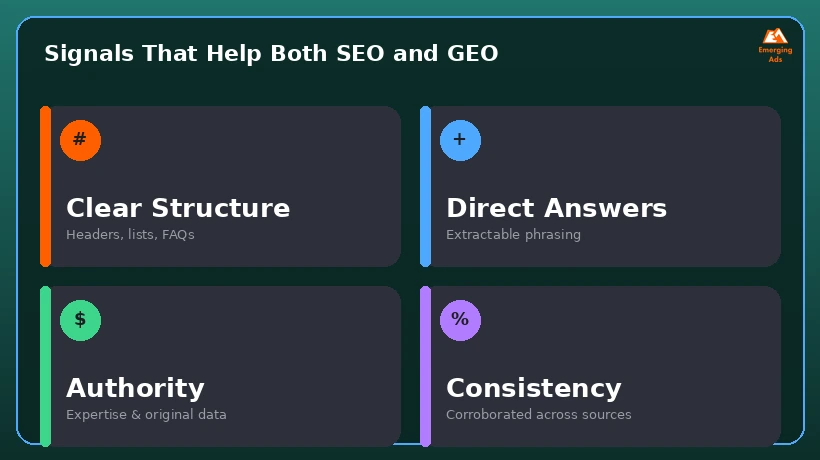
Large language models don’t rank pages the way a search engine does, but they still lean heavily on signals that overlap with traditional SEO: how clearly a page answers a specific question, how consistent that answer is across multiple sources, and how authoritative the domain appears based on its broader footprint. A page that states a clear, direct answer in the first two sentences is far easier for a model to extract cleanly than a page that opens with three paragraphs of scene-setting before getting to the point.
- Consistency across sources matters, an answer repeated similarly across several credible sites gets more confidently cited than a lone outlier claim
- Direct, extractable phrasing beats clever, indirect phrasing every time a model is choosing what to quote
- Recency signals matter for time-sensitive topics, a page with a visible, accurate publish or update date is safer for a model to trust
- Structured formatting, headers, lists, FAQ blocks, gives a model clean chunks to pull from instead of forcing it to parse dense prose
None of this is truly separate from good on-page SEO fundamentals, it’s an intensified version of the same discipline, applied with an eye toward how a model reads a page rather than only how a human skims it.
Step 1: Audit What ChatGPT Already Says About Your Brand
Before changing anything, run a handful of realistic prompts a prospective customer might actually type, category recommendations, comparison questions, pricing questions, and see whether the brand shows up at all, and if it does, whether the description is accurate. This single exercise often surfaces the real starting problem: it’s not that the brand is being described unfavorably, it’s that it’s simply not mentioned, because there’s nothing on the web structured clearly enough for a model to pull from confidently.
Document the gap honestly. If competitors show up and the brand doesn’t, that’s a content and authority gap to close. If the brand shows up but with outdated or wrong information, that’s usually a signal that the source content itself is unclear or that a stale third-party mention is outranking the brand’s own current pages in whatever the model was trained or retrieved on.
Step 2: Restructure Content to Answer, Not Just Discuss
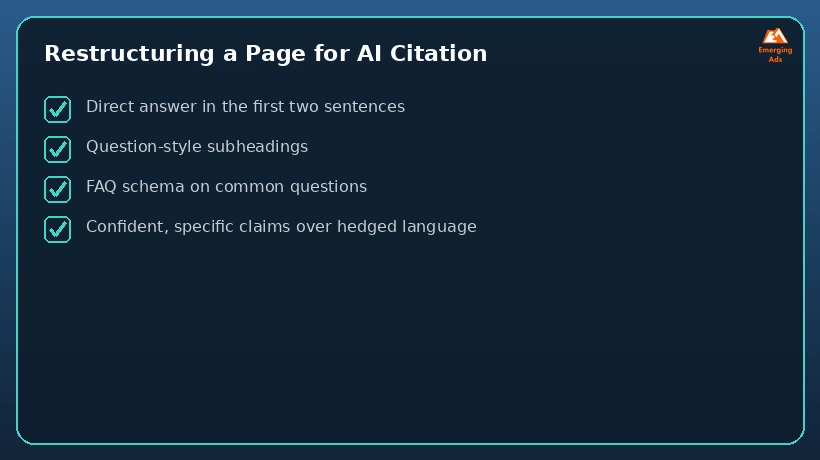
Most existing website copy is written to persuade, not to answer, which is exactly backwards for GEO. A page about pricing that spends four paragraphs building up to a number before finally stating it is much less useful to an AI model than a page that states the number plainly in the first sentence, then explains the reasoning afterward for the human reader who wants more context.
- Lead each key section with a direct, quotable answer sentence before any supporting explanation
- Use question-style subheadings that mirror how people actually phrase prompts to an AI assistant
- Keep the answer itself short enough to lift cleanly, one to three sentences, even if the surrounding section goes deeper
- Avoid vague hedging language, models tend to favor confident, specific claims over qualified, non-committal ones when choosing what to cite
This is also where working with a content strategy partner who understands both classic SEO and this newer discipline pays off, since restructuring an entire content library for extractability while keeping it genuinely useful for human readers is a real editorial skill, not just a formatting checklist.
Step 3: Strengthen the Signals AI Models Actually Trust
Authority still matters, arguably more than ever, because a model weighing conflicting claims across sources needs some way to decide which one to trust. Original data, named expertise, and a consistent publishing history all contribute to that trust signal, the same way they’ve always mattered for classic SEO, just applied with a slightly different emphasis on how visibly the content demonstrates first-hand knowledge rather than aggregating what’s already been said elsewhere.
Third-party mentions matter too. A brand that only talks about itself on its own site is a much weaker citation candidate than a brand that’s also mentioned accurately across industry directories, press coverage, and case studies with real client outcomes, because that external corroboration is part of what makes a model comfortable repeating a claim confidently rather than hedging it.
Step 4: Add Structured Data That Makes Extraction Easy
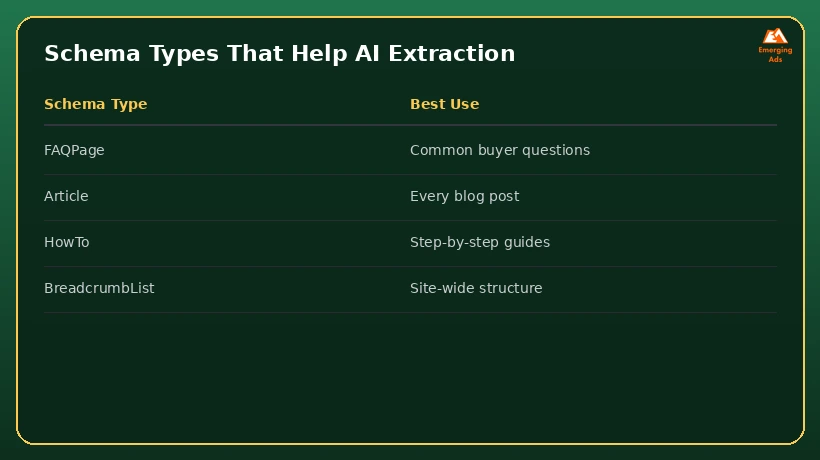
| Schema Type | Why It Helps AI Extraction | Where to Use It |
|---|---|---|
| FAQPage | Gives a model pre-formatted question-answer pairs to lift directly | Any page answering common buyer questions |
| Article/BlogPosting | Signals authorship, publish date, and topical focus clearly | Every blog post and guide |
| HowTo | Breaks a process into clean, numbered, extractable steps | Step-by-step guides and tutorials |
| BreadcrumbList | Helps establish topical hierarchy and site structure | Every page on the site |
Structured data doesn’t guarantee a citation on its own, no responsible SEO practitioner would promise that, but it removes friction for a model trying to parse a page accurately, and it costs nothing extra to implement correctly once a page is already well-organized. It’s a low-effort, low-risk addition layered on top of genuinely clear writing, not a substitute for it.
Where GEO and Traditional SEO Overlap and Where They Diverge
The overlap is larger than most brands assume: fast page speed, clear structure, genuine expertise, and strong keyword and topic research all help both disciplines equally. Nothing about optimizing for AI citations requires abandoning classic SEO fundamentals, and treating them as two separate workstreams usually just means duplicating effort that could be shared.
Where they diverge is mostly about format and directness. A page can rank respectably in classic search while still reading as too indirect or too promotional to get quoted by a model, which is why a content audit through this specific lens, extractability, not just keyword coverage, tends to surface gaps a standard SEO audit alone would miss entirely.
How to Track Whether It’s Working
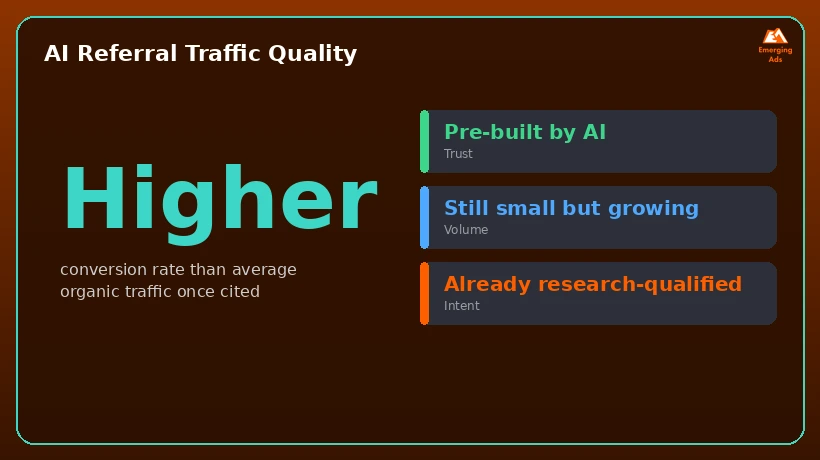
Tracking GEO performance is still maturing as a discipline, there’s no single dashboard yet that plays the role Google Search Console plays for classic search, but a few practical methods work today. Running the same set of prompts monthly and logging whether and how the brand appears is a simple, repeatable baseline. Watching for referral traffic from AI platforms in analytics, even if the volume is still small relative to organic search, shows whether citations are actually converting into visits.
Referral traffic from AI assistants tends to convert at a meaningfully higher rate than average organic traffic, because a user arriving after an AI recommendation has already had a chunk of the trust-building work done for them before they ever land on the page. Watching that conversion rate specifically, not just the raw visit count, is often the clearest signal that the effort is paying off.
Common Mistakes Brands Make Chasing AI Citations
- Stuffing FAQ schema onto thin, low-value content and expecting the markup alone to earn a citation
- Writing answers so hedged and qualified that a model has nothing confident to quote
- Ignoring the third-party corroboration signal entirely and only optimizing the brand’s own pages
- Treating GEO as a one-time project instead of an ongoing practice as models and their training data keep shifting
- Abandoning classic SEO fundamentals to chase AI citations, when in reality the two reinforce each other far more than they compete
The brands seeing early results tend to be the ones treating this as a refinement of good content practice, not a completely separate discipline requiring a different team or a different playbook from scratch.
GEO for Local and Multi-Location Service Businesses
Local and service-area businesses shouldn’t assume this only matters for large national brands. A growing share of ‘best X near me’ and ‘who should I hire for Y’ questions now get partly answered inside an AI assistant before a user ever opens a maps listing, which means the same fundamentals that support local SEO, consistent business information, clear service-area pages, genuine local reviews and mentions, also feed directly into whether a model feels confident recommending that business by name. A local business with thin, generic service pages is just as invisible to an AI assistant as it would be buried on page three of a search results page.
Multi-location and multi-country brands face a related challenge: a model needs to be able to tell which location or market a given page or claim actually applies to, since a confidently written but geographically ambiguous page can lead to a citation that’s technically accurate but practically useless for the person asking. Clear location and market signals, the kind covered under international SEO for brands operating across several countries, help a model avoid recommending the wrong branch, currency, or service area entirely.
- Keep NAP (name, address, phone) and service-area details consistent across the website and every third-party directory listing
- Write location-specific pages with genuinely distinct content, not a single template swapped by city name
- Make pricing and availability claims specific enough to a market that a model isn’t guessing which location they apply to
- Keep review profiles active and current, since recency of third-party feedback is itself a trust signal models weigh
A Realistic First 90 Days
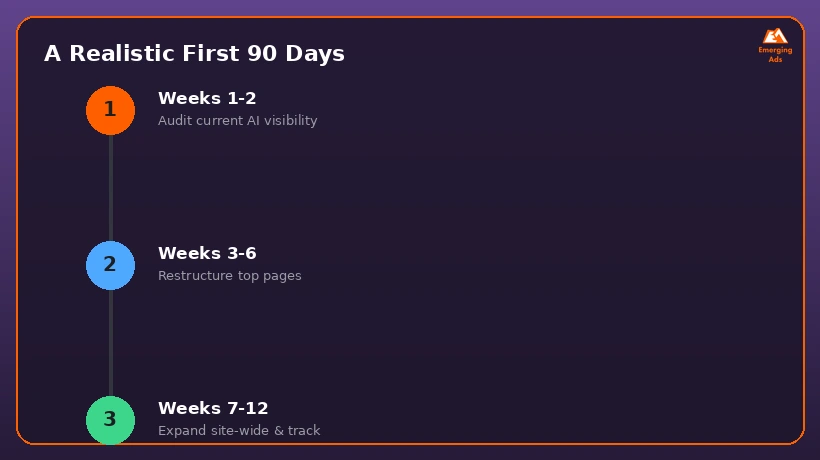
A sensible first quarter starts with the audit, running real prompts and documenting the current state honestly, then moves into restructuring the handful of highest-intent pages, pricing, comparison, and core service pages, before expanding the practice site-wide. Trying to overhaul an entire content library at once usually produces rushed, shallow edits, while a focused first pass on the pages most likely to get cited produces a much stronger proof of concept to build from. For a deeper walkthrough of the broader concept behind this practice, our earlier piece on what generative engine optimization actually is is a useful companion read alongside this getting-started guide.
Budget realistically for this as ongoing work rather than a one-time project. Models retrain, retrieval sources shift, and competitors are increasingly running the same playbook, so a brand that gets cited well in month three but stops maintaining the practice by month six typically sees that visibility fade as fresher, better-structured competitor content takes its place. Treating it with the same ongoing discipline as ordinary search engine optimization work, rather than a single sprint, is what keeps the results compounding instead of decaying.
If it’s unclear which pages are worth prioritizing first, or whether the current content is even structured in a way that gives AI models a fair shot at citing it accurately, a free audit is a practical way to get a second set of eyes on where the biggest gaps actually sit before committing a quarter of effort to the wrong starting point.
Frequently Asked Questions
Is ChatGPT SEO the same thing as generative engine optimization?
Yes, ChatGPT SEO is the informal, commonly searched term for the same discipline SEO practitioners call generative engine optimization or GEO, optimizing content to be cited inside AI-generated answers rather than only ranking as a traditional search result.
Do I need to abandon traditional SEO to focus on this?
No, the two overlap heavily. Strong on-page fundamentals, clear structure, genuine expertise, and solid technical health all help both traditional rankings and AI citation chances, so this is additive work layered on top of existing SEO, not a replacement for it.
How long does it take to start showing up in AI answers?
It varies by how frequently the underlying models retrain or refresh their retrieval sources, but most brands doing this consistently start seeing early movement within two to four months, with more meaningful, repeatable citations building over six months or longer.
Does FAQ schema guarantee an AI will cite my page?
No single tactic guarantees a citation. Structured data like FAQ schema makes a page easier to parse and extract from, which helps the odds, but the underlying content still has to be clear, accurate, and genuinely useful for a model to choose it over competing sources.
Can a small business realistically compete with larger brands for AI citations?
Yes, more so than in some areas of traditional SEO, because AI models often favor the clearest, most direct answer over the biggest domain authority alone. A small business that writes precise, well-structured, genuinely expert content can out-cite a much larger competitor whose content is vaguer or more promotional in tone.
How is AI referral traffic different from regular organic traffic?
It tends to be smaller in volume today but converts at a noticeably higher rate, since a visitor arriving after an AI recommendation has usually already had part of the trust-building work done before landing on the page, which shortens the path to a conversion.
Should every page on my site be optimized for AI citations?
Not necessarily every page, but every page that answers a genuine buyer question, pricing, comparisons, how-to content, and core service explanations, benefits the most and should be prioritized first before a broader site-wide pass.
What tools exist to track AI search visibility?
The tooling is still maturing industry-wide, but practical methods available today include running a consistent set of test prompts monthly and manually logging results, alongside watching AI-platform referral traffic and its conversion rate inside standard web analytics, and comparing those numbers quarter over quarter to spot real trends rather than noise, ideally with more than one person contributing prompt results.