Use up and down arrow keys to resize the meta box pane.
Use up and down arrow keys to resize the meta box pane.
Use up and down arrow keys to resize the meta box pane.
What Is GEO (Generative Engine Optimization)
Key Takeaways
- GEO optimizes content to be cited and summarized by AI answer engines, not just ranked in a list of blue links.
- Clear, direct-answer structure near the top of a page matters more for GEO than it ever did for classic SEO.
- Structured data and factual clarity make content easier for AI systems to extract and trust.
- GEO doesn’t replace SEO, the two overlap heavily and mostly reinforce the same fundamentals a solid search engine optimization program already builds on.
- Citation tracking in AI tools is still immature, so measurement requires a mix of direct checking and referral traffic signals.
GEO, Defined Simply
Generative Engine Optimization is the practice of structuring and writing content so that AI answer systems, AI Overviews, chat-based assistants, and similar tools, can accurately extract, summarize, and cite it when generating a response. Where classic SEO optimizes for ranking in a list of links, GEO optimizes for being the source an AI system pulls from when it writes its own answer. It’s best thought of as an extension of search engine optimization, not a replacement for it.
How GEO Differs From Traditional SEO
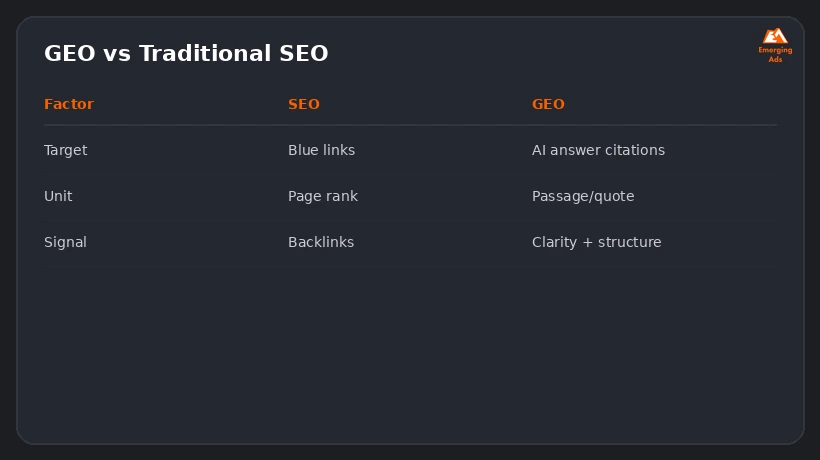
Traditional SEO earns a click by ranking well and writing a compelling meta description. GEO earns a citation by giving an AI system a clear, confidently-stated, well-structured answer it can lift directly. That means clarity and factual precision near the top of a page matter more, and keyword density matters less, than in classic SEO practice. If your search engine optimization foundation is already solid, most of the heavy lifting for GEO is already done.
What Makes Content Citable by AI Engines
- A direct, clearly-stated answer to the core question within the first few sentences of a section
- Structured data (Article, FAQPage, HowTo schema) that makes the content’s structure machine-readable
- Specific, checkable facts and figures rather than vague generalities
- Clear headers that match the actual questions people ask, close to natural language
- Content that reads as genuinely authoritative on the topic, not thin or templated
A Practical GEO Readiness Checklist
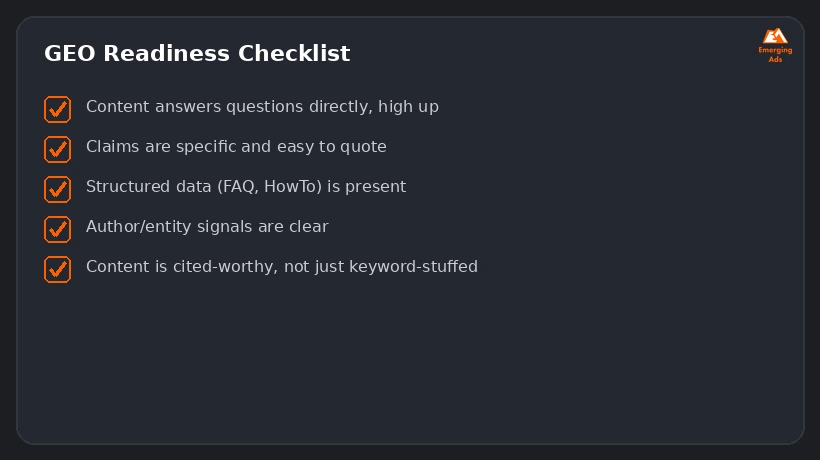
- Every key page has a clear, quotable answer near the top, not buried after paragraphs of preamble
- FAQ schema is implemented and matches real questions your audience actually asks
- Claims and statistics are specific and sourced, not vague marketing language
- Page structure uses genuine H2/H3 hierarchy that mirrors how someone would naturally break down the topic
- Content is kept current, stale statistics and outdated claims reduce an AI system’s confidence in citing the page
How to Measure GEO Performance Today


Measurement tooling for AI citations is still catching up to where analytics tools are for classic search. In the meantime, a practical approach combines manually checking how your brand and content show up in AI Overviews and chat assistants for target queries, watching referral traffic from AI platforms in your analytics, and tracking whether branded search volume rises as AI-driven awareness grows. This sits alongside, not instead of, the standard rankings and traffic reporting from your existing search engine optimization work.
Want us to look at your account?
We’ll audit your setup and tell you exactly where the budget is leaking, free.
Get Your Free Ad AuditFrequently Asked Questions
Is GEO replacing SEO?
No, GEO builds on the same foundation of clear, well-structured, authoritative content that good SEO has always required, it adds a layer focused specifically on AI extraction and citation.
Do I need separate content for GEO versus SEO?
Generally no, content written with genuine clarity, direct answers, and solid structure tends to serve both goals simultaneously, GEO is more about emphasis than an entirely separate content type.
Does schema markup actually help with AI citations?
It helps AI systems parse content structure and facts more reliably, though the exact weight it carries in citation decisions varies by platform and isn’t fully transparent.
How do I check if my content is being cited by AI Overviews?
Manually search target queries and review what’s being cited, alongside monitoring referral traffic from AI platforms in your website analytics.
Does GEO require different keyword research than SEO?
The research process overlaps significantly, though GEO also benefits from thinking in natural-language questions people would actually type into a chat assistant, not just short search queries.
Can small businesses realistically compete in GEO?
Yes, since GEO rewards clarity and genuine authority on a specific topic more than raw domain authority, a focused small business can be cited for its specific niche.
How often should GEO-optimized content be updated?
Regularly, especially content with statistics or time-sensitive claims, stale facts reduce an AI system’s confidence in using the content as a source.
Does AI Overview traffic count in standard analytics?
It’s still an evolving area, some referral traffic from AI platforms is trackable in standard analytics tools, though not all AI-driven awareness translates into a trackable click.
What’s the biggest content mistake for GEO?
Burying the direct answer under long preamble, AI systems extract more reliably from content that states the answer clearly and early, then elaborates.
Should FAQ sections be written differently for GEO?
Write FAQ answers as direct, self-contained responses to the question asked, since these are exactly the format AI systems tend to lift most readily.
Ready to fix what’s costing you conversions?
Book a free, no-pressure audit of your ad account or website.
Get Your Free Ad Audit