The short answer
TikTok ads for ecommerce work by showing native, short-form video to people likely to buy, optimized with conversion data from the TikTok pixel and Events API. The brands that succeed treat creative as the main lever: videos that look like TikTok content rather than adverts, hooks in the first two seconds, frequent testing and Spark Ads that boost real posts from the brand or creators. TikTok suits visual, demonstrable products and younger audiences, and works best alongside Meta and Google rather than instead of them.
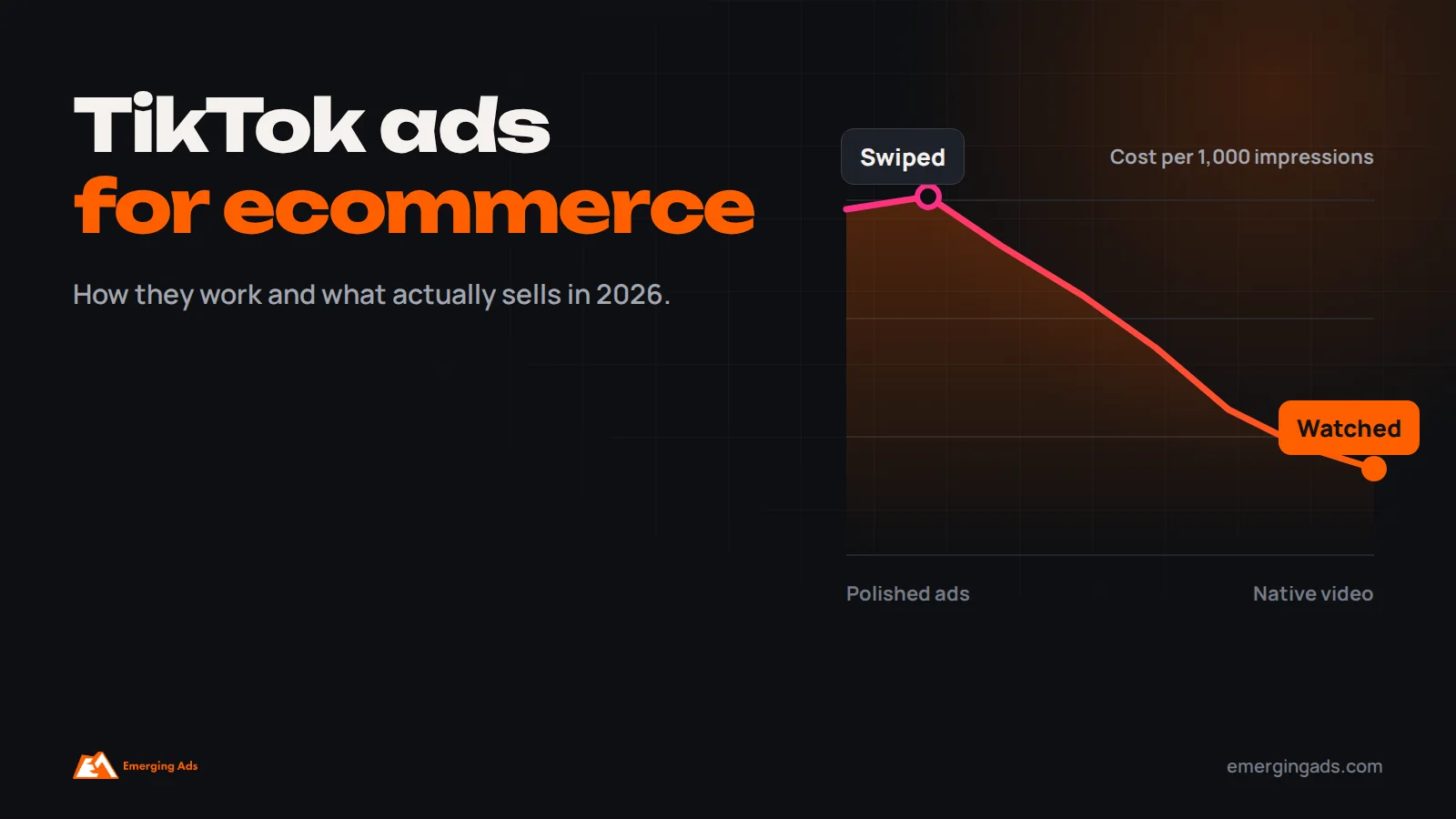
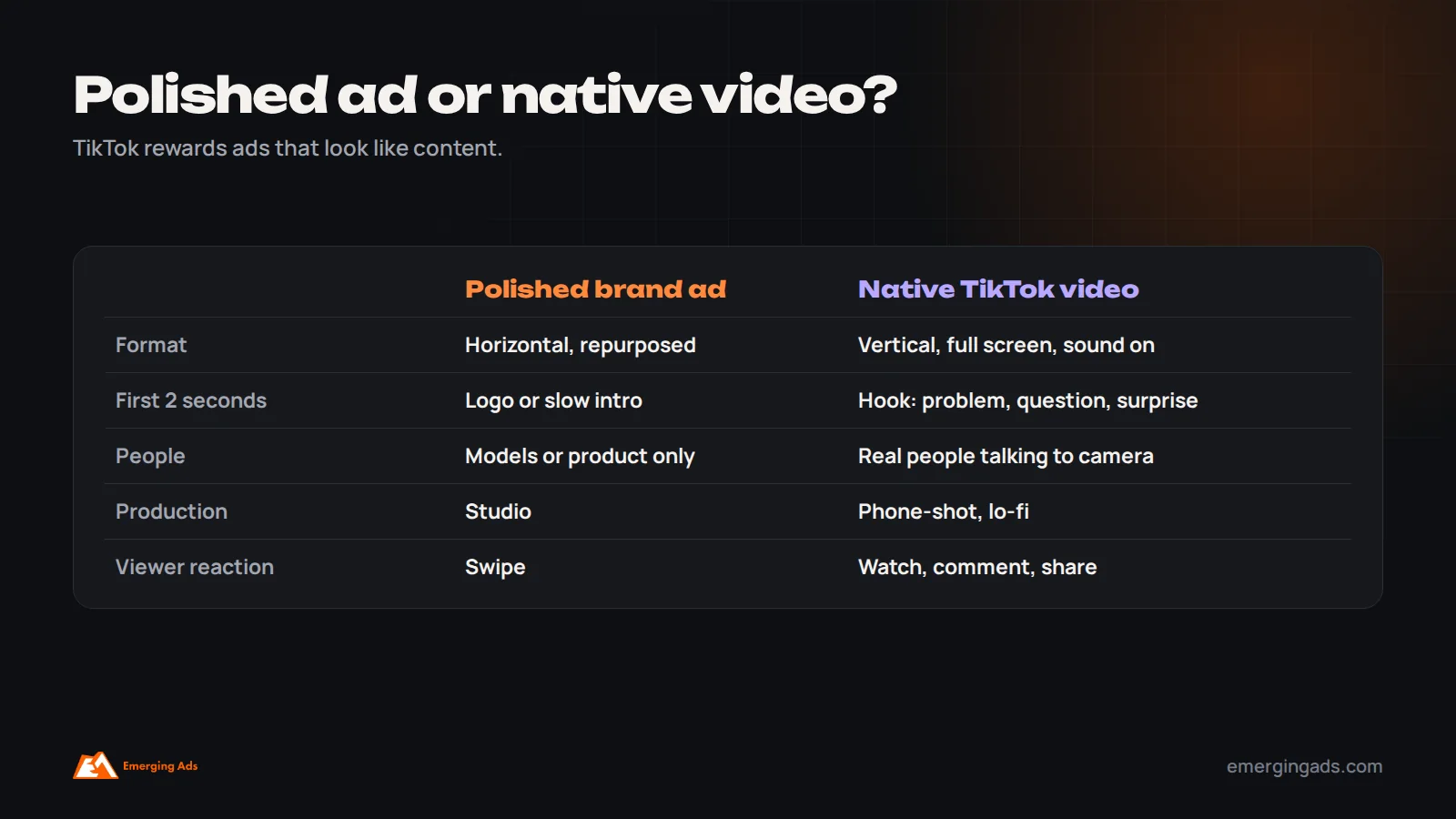
TikTok changed what advertising on social media looks like. Polished brand videos that perform reasonably on Facebook often get swiped away on TikTok within a second. What works instead are videos that look like they belong on the platform: a person talking to camera, a product demonstrated in a real kitchen, a quick before-and-after, a creator reacting to something they bought.
For ecommerce brands that adapt to that, TikTok can open up a large audience at a lower cost per thousand impressions than many other platforms. For brands that do not, it can burn budget quickly. We manage TikTok campaigns for consumer brands in several markets, and the difference between those two outcomes almost always comes down to creative, tracking and patience rather than targeting tricks.
One note before we start: TikTok is not available in every market. It has been banned in India since 2020, and TikTok Shop is available only in certain countries. Check availability in the markets you sell into before planning budget.
How TikTok ads work for an online store
TikTok ads are managed in TikTok Ads Manager. Ads appear mainly in the For You feed, between organic videos, and look and behave like regular posts: viewers can like, comment, share and follow. For ecommerce, campaigns usually optimize for purchases, using conversion data sent from your store.
Like Meta, TikTok’s delivery system learns from the conversion events you send and finds people similar to those who bought. Unlike Meta, the creative has to fit a very specific environment. TikTok users are watching full-screen, vertical, sound-on video, scrolling quickly, and they are highly sensitive to anything that feels like an interruption.
That makes TikTok as much a creative channel as a media channel. Targeting settings matter, but much less than whether the first two seconds of the video stop someone from scrolling.
Campaign types for ecommerce
Website conversion campaigns
The standard option for driving purchases on your own store. You choose the optimization event, ideally purchase, set a budget and supply creative. TikTok finds people likely to convert.
Smart+ campaigns
TikTok’s automated campaign type, which handles targeting, bidding and creative combinations with less manual setup, similar in spirit to Meta’s Advantage+ and Google’s Performance Max. It tends to work well for accounts with steady conversion volume and plenty of creative.
Catalog and shopping ads
Ads that use a product catalog to show relevant products, including dynamic retargeting of products people viewed. They require a catalog connected to TikTok and accurate product IDs in pixel events.
TikTok Shop campaigns
In markets where TikTok Shop is available, brands can sell directly inside TikTok. Shop ads, including TikTok’s GMV Max campaign type, are designed to drive sales through the in-app shop rather than an external website. This can work very well for impulse products, but it is a different operation, with its own fulfillment, fees, customer service and creator affiliate program.
Spark Ads
Spark Ads promote existing organic TikTok posts, either from your own account or from creators who authorize you to use their posts. Because the ad is a real post, views, likes and follows build on the original, and it looks fully native. In our experience, Spark Ads from genuine creators or the brand’s best organic posts are often the strongest performers in an ecommerce account.
Setting up tracking properly
TikTok needs accurate conversion data to optimize. Install the TikTok pixel on your store, and add the Events API to send events from your server as well, with deduplication so each purchase is counted once. Shopify has an official TikTok app that handles much of this setup.
Check that the standard ecommerce events fire correctly, including view content, add to cart, initiate checkout and complete payment, with value, currency and content IDs that match your catalog. Use TikTok’s Events Manager diagnostics to catch errors. As with Meta, the stronger the match between the data you send and TikTok’s users, the better the optimization.
If you already run Meta, the principles are the same as those in our guide to Meta pixel and tracking setup.
Creative: the part that decides everything
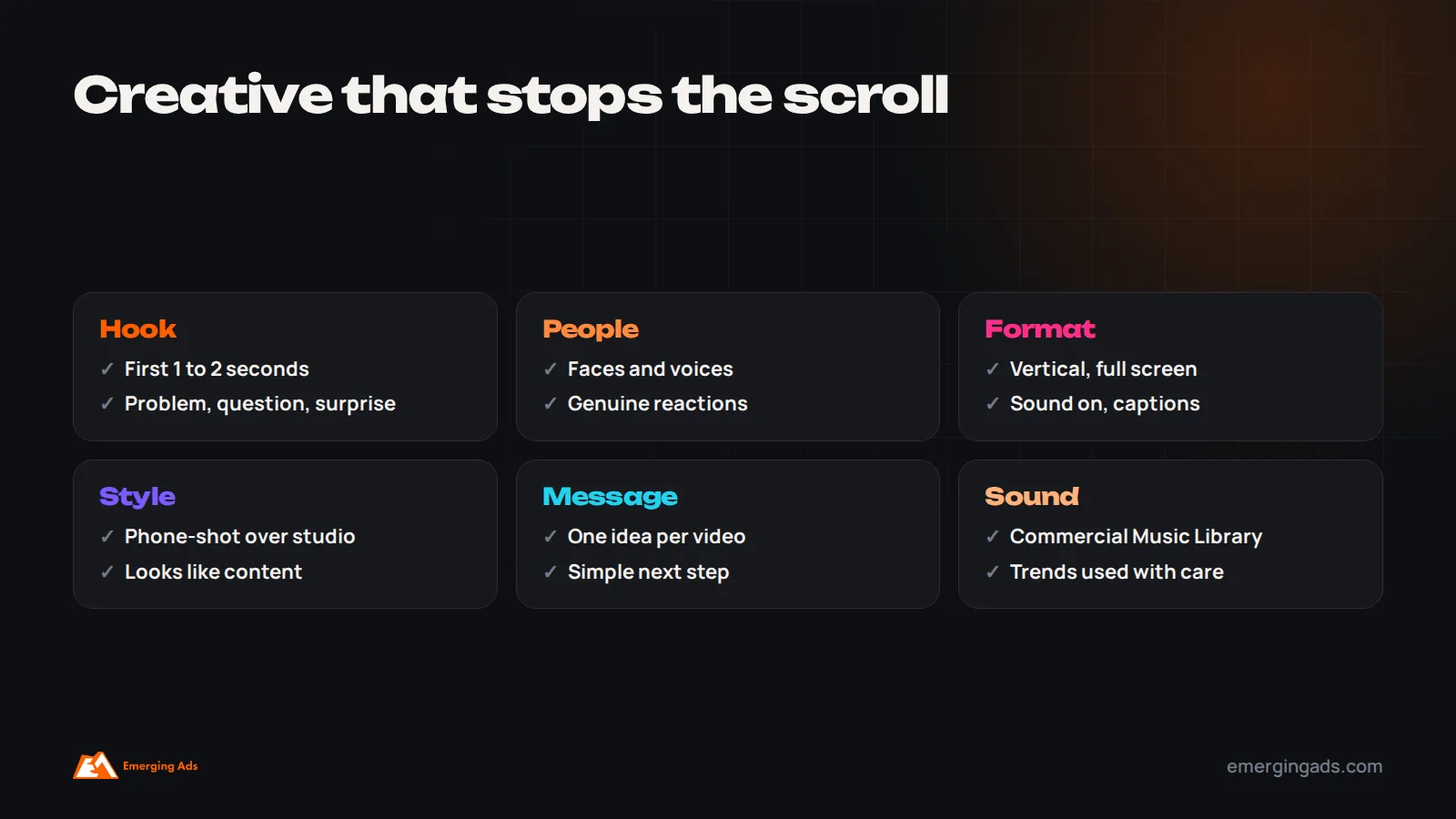
The single biggest predictor of TikTok results is whether the creative looks native. In practice, that means:
- Vertical, full-screen, sound-on video. Repurposed horizontal ads with black bars rarely work.
- A hook in the first one to two seconds. A bold statement, a question, a surprising visual, a problem the viewer recognizes, or the product doing something unexpected.
- Real people. Faces, voices and genuine reactions outperform product-only footage for most categories.
- Lo-fi production. Phone-shot videos often outperform studio productions because they look like content, not ads.
- Trending formats and sounds, used with care. Commercial accounts have licensing restrictions on music, so use TikTok’s Commercial Music Library.
- Captions and on-screen text that repeat the key point for people watching with sound off.
- One clear idea per video and a simple call to action.
When a DTC wellness brand came to us, it was running three polished videos that looked great on a laptop and got swiped on a phone. We swapped them for native, sound-on content, tested new videos every week and turned the brand’s best organic posts into Spark Ads. Cost per thousand impressions came down, because TikTok’s system rewards ads that people actually watch.
Creative formats that work for ecommerce
- Problem and solution: show a common frustration, then the product fixing it.
- Demonstration: the product in use, ideally doing something that is hard to believe without seeing it.
- Unboxing and first impressions: creators opening and reacting to the product.
- Before and after: where the category allows it and claims are accurate.
- Founder story: why the product exists, told to camera.
- Reviews and testimonials: real customers explaining what changed for them.
- Comparisons: your product against the usual alternative, done fairly.
- Answering comments: replying to real viewer questions with a video, which TikTok supports natively.
Working with creators
Creators are central to TikTok ecommerce. They know how to make content that works on the platform, and their audiences trust them. There are several ways to work with them: paying creators to make videos you run as ads, using Spark Ads to boost creators’ own posts, partnering through TikTok’s creator marketplace, or, in TikTok Shop markets, running an affiliate program where creators earn commission on sales.
Brief creators on the product, the key benefit, any claims they must avoid and the call to action, but leave the execution to them. Over-scripted creator videos lose the authenticity that makes them work. Our guide to influencer collaborations for small businesses covers briefs, rates and contracts.
How much creative you need, and how to test it
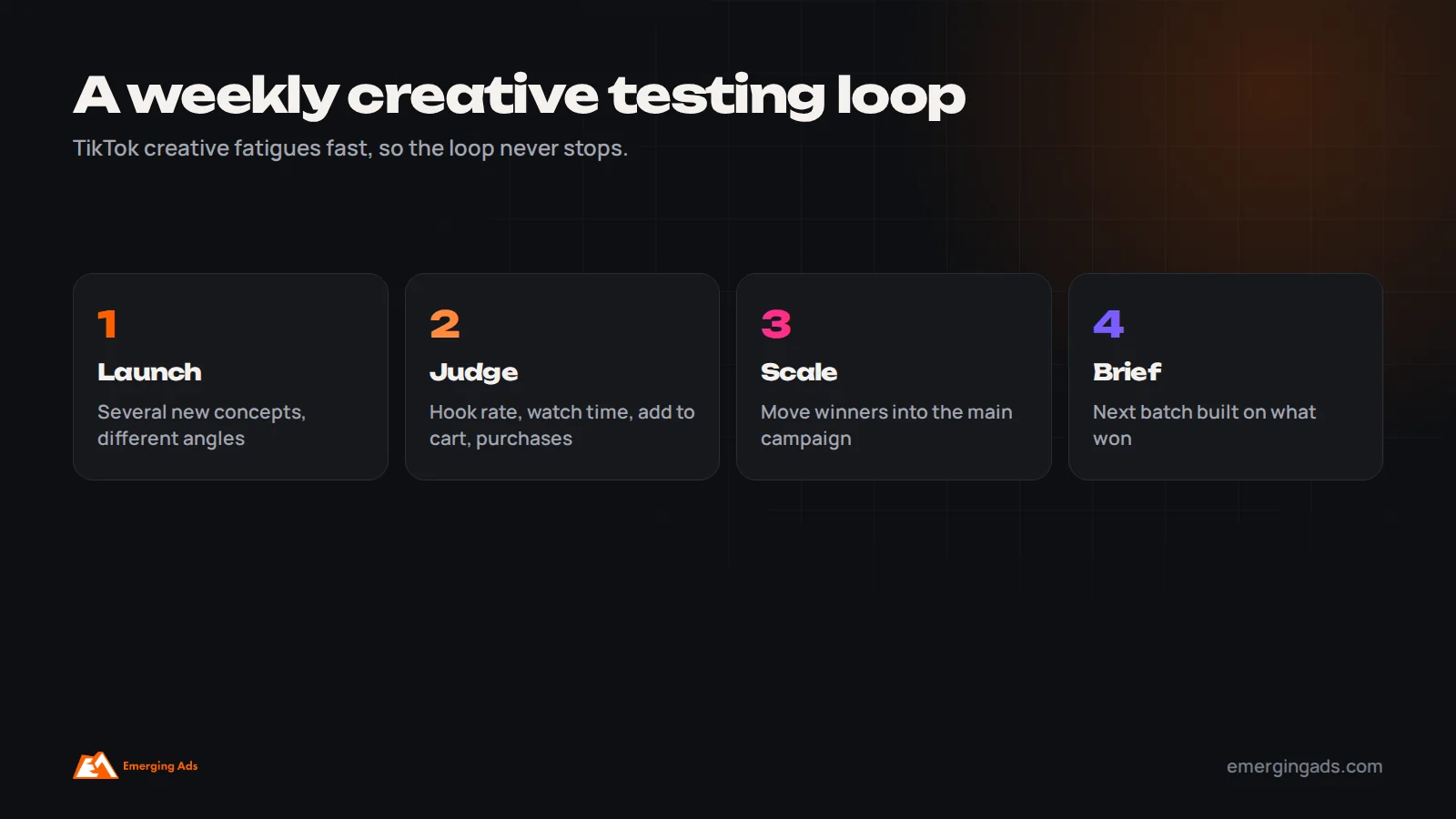
TikTok creative fatigues faster than on most platforms, often within a few weeks, sometimes days for small audiences. Plan for a steady flow of new videos rather than a single launch batch.
A practical testing rhythm for most ecommerce brands is to launch several new concepts every week or two, each a genuinely different angle or hook rather than small edits of the same video. Give each test enough spend to judge on cost per purchase or at least add-to-cart rate, then move winners into the main campaign and pause losers. Track hook rate (the share of viewers who watch past the first two to three seconds) and average watch time alongside purchases, because they show why a video worked or failed.
Keep a simple log of every concept you test, its hook, angle, format and result. After a couple of months, patterns appear, such as which opening lines, people or product moments consistently win, and briefing new videos becomes much faster and more reliable.
TikTok’s Creative Center is a free resource showing top-performing ads, trending hashtags and sounds by region and industry. It is useful for spotting formats that work in your category, not for copying individual ads.
Targeting and bidding
For most ecommerce accounts, broad targeting with strong creative works better than narrow interest targeting, because TikTok’s system can find buyers more efficiently when it has room to explore. Set location, language and age appropriately, exclude existing customers from prospecting where your data allows, and let the conversion data do the rest.
For bidding, start with lowest cost or maximum delivery to gather data, then consider cost cap once you know a realistic cost per purchase. TikTok sets minimum daily budgets at campaign and ad group level, and like other platforms it needs a reasonable volume of conversions to learn, so avoid spreading a small budget across many ad groups.
Retargeting on TikTok
Most TikTok budgets go to prospecting, but retargeting can be very efficient once there is enough traffic. TikTok lets you build audiences from website visitors and specific events such as add to cart, from people who watched a share of your videos, from people who engaged with your profile or ads, and from customer lists. Use different messages for each: a reminder of the exact product for cart abandoners, a review or demonstration for video viewers, and a new product or bundle for past buyers. Keep retargeting windows sensible and watch frequency, because warm audiences on TikTok are often small and see the same ads quickly. Dynamic catalog ads are the simplest way to show each visitor the products they actually looked at.
What budget to start with
TikTok can be tested on a modest budget, but very small tests rarely produce reliable conclusions because conversion volume is too low. A sensible first test runs for four to six weeks with enough daily budget for at least one ad group to collect a steady stream of conversions, and with enough new creative to give the account a fair chance. Treat the first month as learning: the main output is knowing which angles, hooks and products work, not immediate profitability.
Landing pages for TikTok traffic
TikTok traffic behaves differently from search traffic. Visitors arrive mid-scroll, on a phone, often after a few seconds of video, and they leave quickly if the page does not continue the story the ad started. Send them to a page that matches the video: if the ad shows one product solving one problem, land them on that product, not the homepage. Load fast, show the product and price immediately, put reviews and user-generated content near the add-to-cart button, and offer express mobile payments. Pages that reuse visual elements or phrases from the video tend to convert better, because the visitor instantly knows they are in the right place.
TikTok Shop or your own website?
In markets where TikTok Shop is available, brands face a choice: sell inside TikTok, send traffic to their own store, or do both. Each has tradeoffs.
TikTok Shop removes friction. Shoppers buy without leaving the app, which suits impulse purchases and live shopping, and creators can earn affiliate commission on sales, which motivates them to promote products. The downsides are platform fees and commission, less control over the customer relationship and data, and the need to manage TikTok’s fulfillment and service standards.
Your own website gives you the customer data, the email address for future marketing, full control of the brand experience and higher margins per order. The downside is that every extra click loses some shoppers. Many brands use TikTok Shop for discovery and impulse products, and their website for full ranges, bundles and repeat purchases, then work to bring Shop customers into their own email list over time.
Comments are part of the ad
Every TikTok ad has a public comment section, and viewers read it. Questions left unanswered, complaints left visible or spam left in place all affect how the next viewer sees the brand. Monitor comments on active ads daily, answer product questions quickly, and consider replying to good questions with a short video, which often becomes strong creative in its own right. Positive comments from real customers are social proof you could not write yourself. You can also limit or filter comments in Ads Manager if a campaign attracts abuse, but active, honest replies usually do more good than switching comments off.
Measuring TikTok fairly
TikTok often influences purchases that it does not get last-click credit for. Someone sees a product on TikTok, remembers it, and later searches on Google or comes back directly. As with Meta and YouTube, judge TikTok at more than one level:
- In-platform cost per purchase and ROAS for comparing ads and campaigns.
- Branded search volume and direct traffic trends while TikTok is running.
- Blended revenue across all channels relative to total ad spend.
- Post-purchase surveys asking “where did you first hear about us?”, which often credit TikTok more than any dashboard does.
TikTok vs Meta for ecommerce
TikTok and Meta are often compared, and they share a lot: both are visual, both optimize from conversion data, both reward creative variety. The differences matter, though.
- Audience: TikTok skews younger in most markets, though its audience has broadened. Meta reaches almost every age group.
- Creative style: TikTok punishes anything that looks like an ad more harshly. Meta tolerates more polished creative, especially in the feed.
- Fatigue: TikTok creative usually burns out faster.
- Maturity: Meta’s ecommerce tools, attribution and scale are more mature in most markets.
- Cost: TikTok often offers lower costs per thousand impressions, though conversion rates can be lower too.
Most brands we work with start on Meta, then add TikTok once they have proven offers and a creative process. The same native-style video can often run across TikTok, Instagram Reels and YouTube Shorts with minor edits. Our guide to Meta ads for ecommerce covers the Meta side, and scaling Meta ads covers the creative pipeline both platforms depend on.
Which ecommerce brands suit TikTok?
TikTok tends to work best for products that are visual, demonstrable, affordable enough for an impulse purchase, and appealing to audiences under 40, such as beauty, skincare, fashion, accessories, gadgets, home and kitchen, fitness, snacks and novelty products. It is harder for high-ticket purchases that need long research, products with strict advertising restrictions, and B2B.
Regional factors matter too. In the Gulf, for example, TikTok is widely used and Arabic-language, locally filmed creative usually outperforms translated content. TikTok works alongside other short-form channels in the region; our guide on Snapchat Story ads covers another platform that is especially strong in Saudi Arabia and the wider Gulf.
Common TikTok ads mistakes
Most of the TikTok accounts we take over share several of these problems at once. Fixing even two or three usually changes results noticeably within a few weeks.
- Running polished TV or Meta ads without adapting them to TikTok.
- No hook in the first two seconds.
- Too few new videos, so performance fades within weeks.
- Launching before the pixel and Events API are verified.
- Narrow targeting that limits learning.
- Judging TikTok only on last-click results.
- Ignoring comments on ads, which are public and influence other viewers.
A simple 30-day launch plan
- Week 1: install and verify the pixel and Events API, connect the catalog, and produce eight to twelve native videos across at least four different angles.
- Week 2: launch one website conversion campaign with broad targeting, all videos running, and a budget large enough to gather data.
- Week 3: review hook rate, watch time, add-to-cart rate and early purchases. Pause clear losers, brief new videos based on winning angles, and start Spark Ads with your best organic posts.
- Week 4: move budget towards winning ads, launch the second creative batch, and set up retargeting for product viewers and cart abandoners.
If you would like help, our TikTok ads team runs campaigns and creative testing for ecommerce brands, and our TikTok Spark Ads service focuses on turning creator and organic content into ads. For a wider view of channel planning, see our performance marketing guide.
Frequently asked questions
Do TikTok ads work for ecommerce?
Yes, especially for visual, demonstrable and impulse-friendly products aimed at audiences under 40. Success depends mostly on native-style creative, accurate conversion tracking and a steady flow of new videos.
What are Spark Ads on TikTok?
Spark Ads promote existing organic TikTok posts from your account or from creators who authorize you. They look completely native, and engagement builds on the original post.
How much should I spend on TikTok ads?
Enough to run a four to six week test where at least one ad group collects a steady stream of conversions, plus budget to produce new creative regularly. Very small tests rarely give reliable answers.
How often should I refresh TikTok ad creative?
Plan to launch new videos every week or two. TikTok creative usually fatigues faster than on Meta, sometimes within days for smaller audiences.
Is TikTok better than Meta for ecommerce?
Neither is better in general. Meta is more mature and reaches broader age groups; TikTok often offers cheaper reach and suits younger audiences and native creative. Many brands start with Meta and add TikTok once offers and creative are proven.
Do I need the TikTok Events API as well as the pixel?
It is strongly recommended. The Events API sends conversions from your server, recovering events the browser pixel misses, with deduplication so purchases are not double counted.
What is TikTok Shop?
TikTok Shop lets brands sell directly inside TikTok in supported countries, with creator affiliates and Shop-specific ad campaigns. It requires managing fulfillment, fees and customer service within TikTok’s system.
Are TikTok ads available in India?
No. TikTok has been banned in India since 2020. Brands targeting Indian audiences typically use Instagram Reels, YouTube Shorts and other short-form platforms instead.