Why Your Meta Ads Account Hits a Ceiling at $5K/Month (and How to Break Through It)
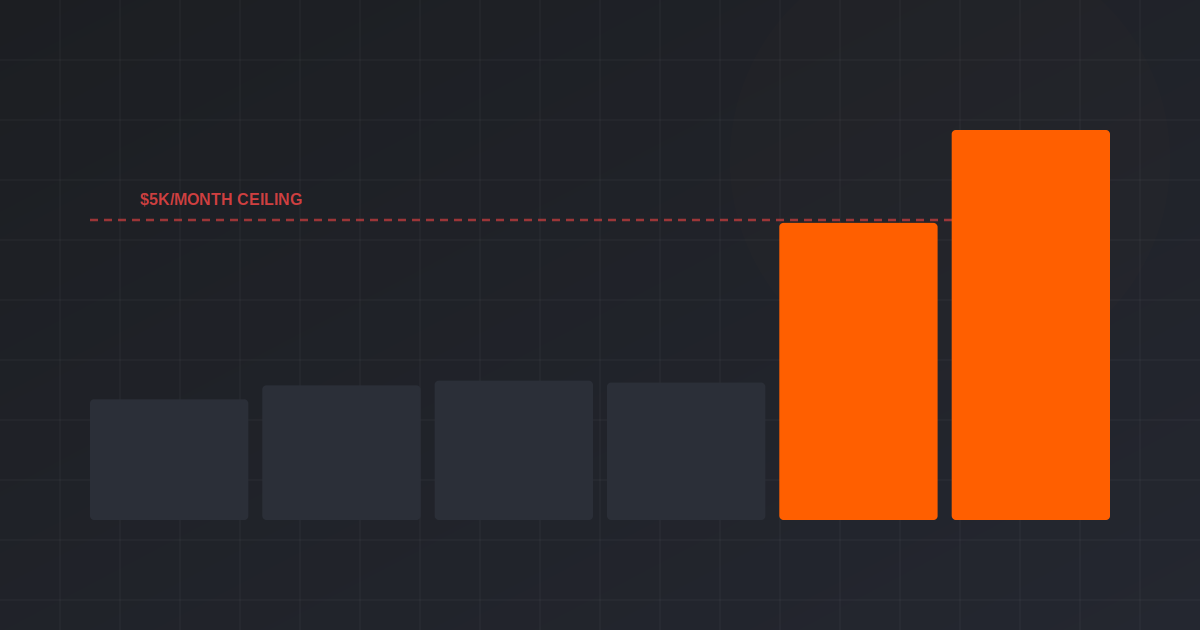
We see the same pattern constantly: a Meta Ads account runs profitably at $2,000 to $5,000 a month, the business tries to scale it, and instead of growing revenue proportionally, ROAS collapses and CPA spikes. It’s rarely a targeting problem. It’s almost always one of three structural mistakes that only become visible once spend increases.
Understanding which of the three is happening in your account is the difference between a scaling attempt that works and one that just burns budget re-learning what already worked at a smaller size.
- Scaling budget without scaling creative volume is the most common cause of a stalled account.
- Increasing daily budget by more than 20% at once resets the learning phase and temporarily tanks performance.
- Frequency above 3-4 within a 7-day window is a reliable early warning sign of creative fatigue.
- Horizontal scaling (new audiences, new campaigns) often outperforms vertical scaling (bigger budget, same campaign).
- A ceiling is a signal to diversify creative and audiences, not a signal to reduce spend.
The $5K Ceiling Isn’t a Budget Problem
$5,000 a month isn’t a magic number where Meta’s algorithm stops working, it just happens to be the point where most small accounts’ creative supply runs out relative to how fast the algorithm needs fresh signal at higher spend. The ceiling is a symptom of creative and structural limits, not a platform limitation.
Accounts that scale past this point smoothly almost always share one trait: they treat creative production as a continuous pipeline, not a one-time setup task. The businesses that stall are the ones still running the same three ads that worked at $2,000 a month, now trying to support five times that spend.
Mistake #1: Scaling Budget Without Scaling Creative
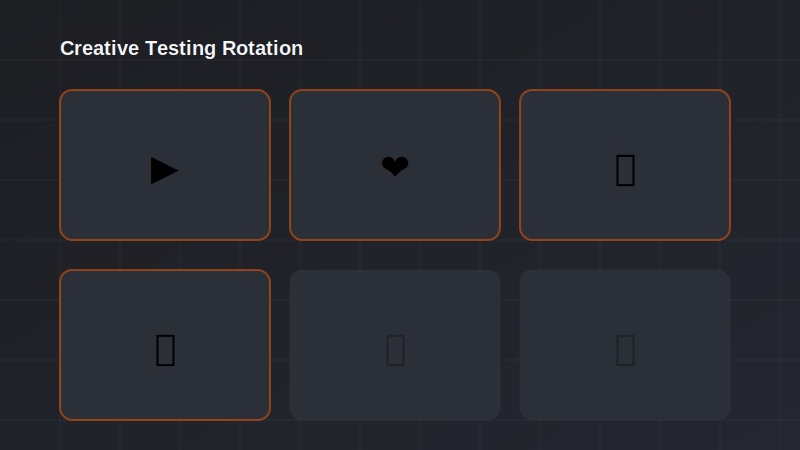
The same 3 to 5 ads that performed well at low spend get shown to progressively more of your audience as budget increases, which means frequency climbs and the same people see the same ad repeatedly. Fatigue sets in fast, and performance degrades even though nothing about targeting changed.
The fix isn’t complicated, it’s volume: more angles, more formats, more hooks tested continuously, so the algorithm always has fresh options to serve as reach expands.
Mistake #2: Resetting the Learning Phase Mid-Scale
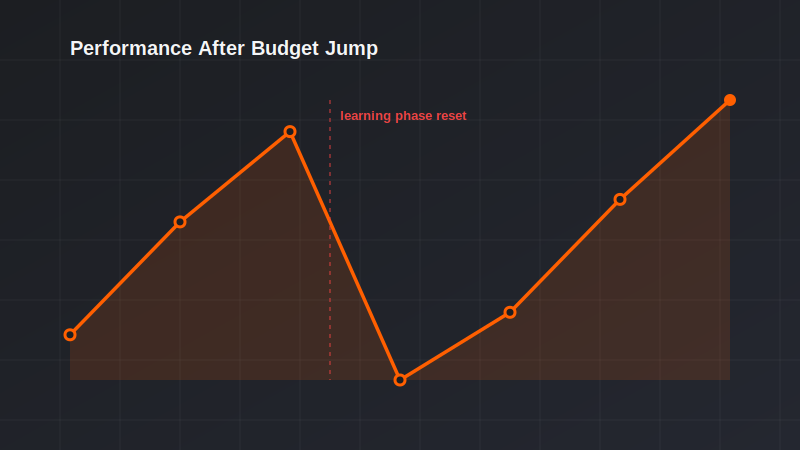
Meta’s own guidance is that budget changes beyond roughly 20% can trigger a new learning phase, during which delivery becomes less efficient while the algorithm re-calibrates. Businesses that double or triple budget overnight, hoping to scale fast, often see performance crater for a week or two right when they most need consistency.
Gradual increases, roughly 20% every 3 to 4 days, let the algorithm adapt without a full reset, and preserve the performance history that’s actually driving your results.
Mistake #3: Ignoring Frequency Until It’s Too Late
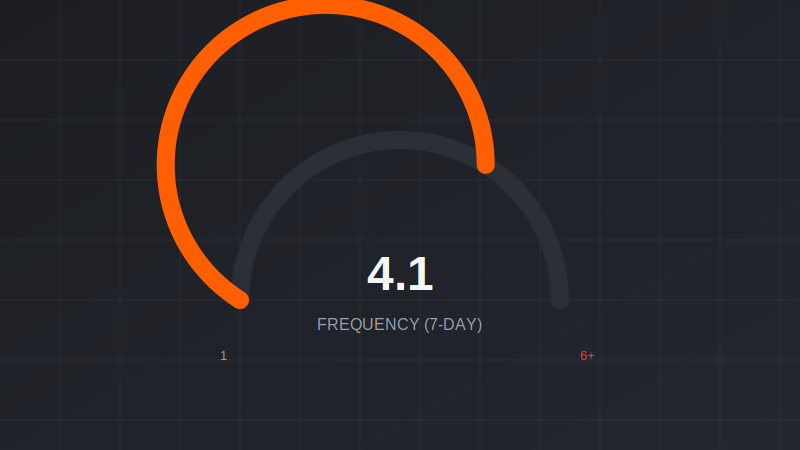
Frequency measures how many times, on average, the same person has seen your ad within a given window. Above 3 to 4 within 7 days, click-through rate and conversion rate typically start declining measurably as audience fatigue sets in, well before most dashboards make this obvious.
Checking frequency weekly, alongside CPA, catches this early. By the time CPA has visibly spiked, frequency has usually already been elevated for a week or more.
What Breaking Through Actually Looks Like
Accounts that successfully scale past the $5K ceiling share a pattern: they expand horizontally before they expand vertically. New campaigns targeting adjacent audiences, new creative angles tested in parallel, and new placements (Reels alongside Feed, for example) all add fresh reach without over-saturating any single audience segment.
Vertical scaling, just increasing budget on what’s already running, works up to a point, then hits diminishing returns as frequency climbs within a fixed audience size. Horizontal scaling sidesteps that ceiling by expanding the audience the budget spreads across.
How to Scale Without Blowing Up What’s Working
- Duplicate winning ad sets instead of just raising their budget, which lets you scale spend while keeping the original as a stable baseline.
- Increase budget gradually, roughly 20% every few days, rather than large jumps that trigger a fresh learning phase.
- Keep a rolling creative testing calendar so new angles are always entering rotation before frequency climbs on existing ones.
- Expand audiences before you exhaust the current one, adding lookalikes or adjacent interest groups as a parallel campaign rather than waiting for performance to already be declining.
Stuck at a Spend Ceiling?
We’ll audit your account’s creative velocity, frequency trends, and scaling history to show you exactly what’s capping growth.
Book a Free Meta Ads Audit →FAQs
How fast can I actually increase my Meta Ads budget?
Roughly 20% every 3 to 4 days is the commonly cited safe threshold before risking a learning phase reset. Faster increases are possible but typically cause a temporary performance dip while the algorithm recalibrates.
How many new ads should I be testing each week?
There’s no universal number, but accounts scaling successfully past $5K a month are typically testing several new creative variations weekly, not monthly. The right volume scales with your budget size.
What frequency is too high?
Above 3 to 4 within a rolling 7-day window is a common warning sign, though the exact threshold varies by audience size and industry. Track the trend over time rather than fixating on one static number.
Is it better to scale one campaign or launch new ones?
Duplicating and launching new campaigns targeting adjacent audiences generally scales more smoothly than just raising budget on a single existing campaign, since it avoids over-saturating one audience segment.
Do I need a video production team to keep up with creative volume?
No. Much of what performs well at scale is native, UGC-style content that doesn’t require studio production, phone-shot footage with strong hooks often outperforms polished video ads.
Should I pause underperforming ad sets while scaling?
Yes, but gradually and based on a full data cycle (usually 3-4 days minimum) rather than same-day reactions, since early performance data is noisy and can mislead quick decisions.
Ready to Put This Into Practice?
Book a free 30-minute audit. We’ll review what you’re running today and show you exactly where the next dollar of budget should go.
Book Free Strategy Audit →