
More App Installs, Lower Cost Per Install, and Users Who Stay
We run Meta app install campaigns on Facebook and Instagram for iOS and Android apps, and we judge them on registrations, trials, subscribers and Day-30 retention, not on the install count alone.
Updated
- Meta SDK
- AppsFlyer
- Adjust
- Branch
- SKAdNetwork
What Are Meta App Install Campaigns?
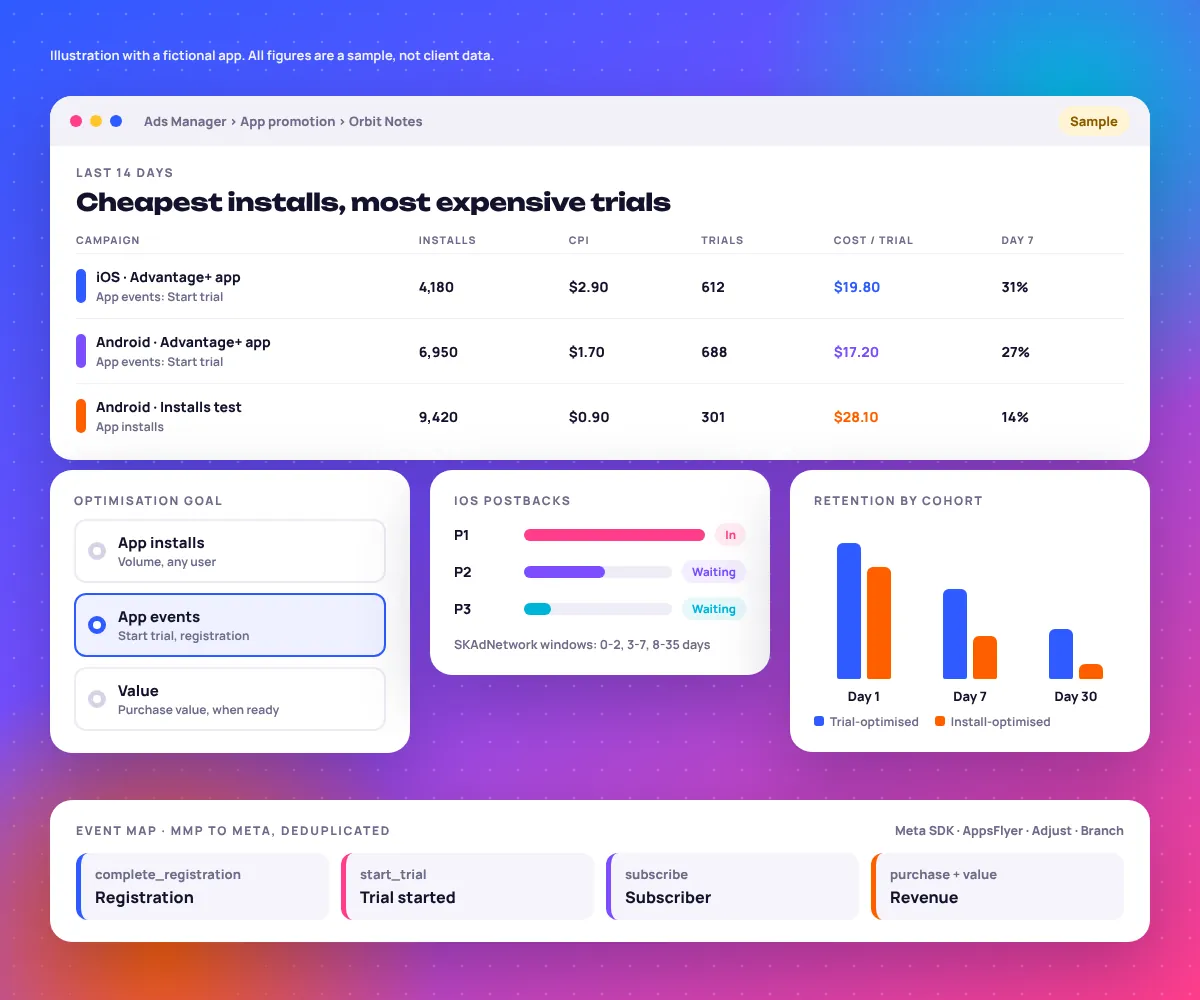
Meta app install campaigns are Facebook and Instagram ads built on the App promotion objective that send people to the App Store or Google Play, then optimise toward installs, in-app events such as registration or trial start, or purchase value reported by your SDK or MMP.
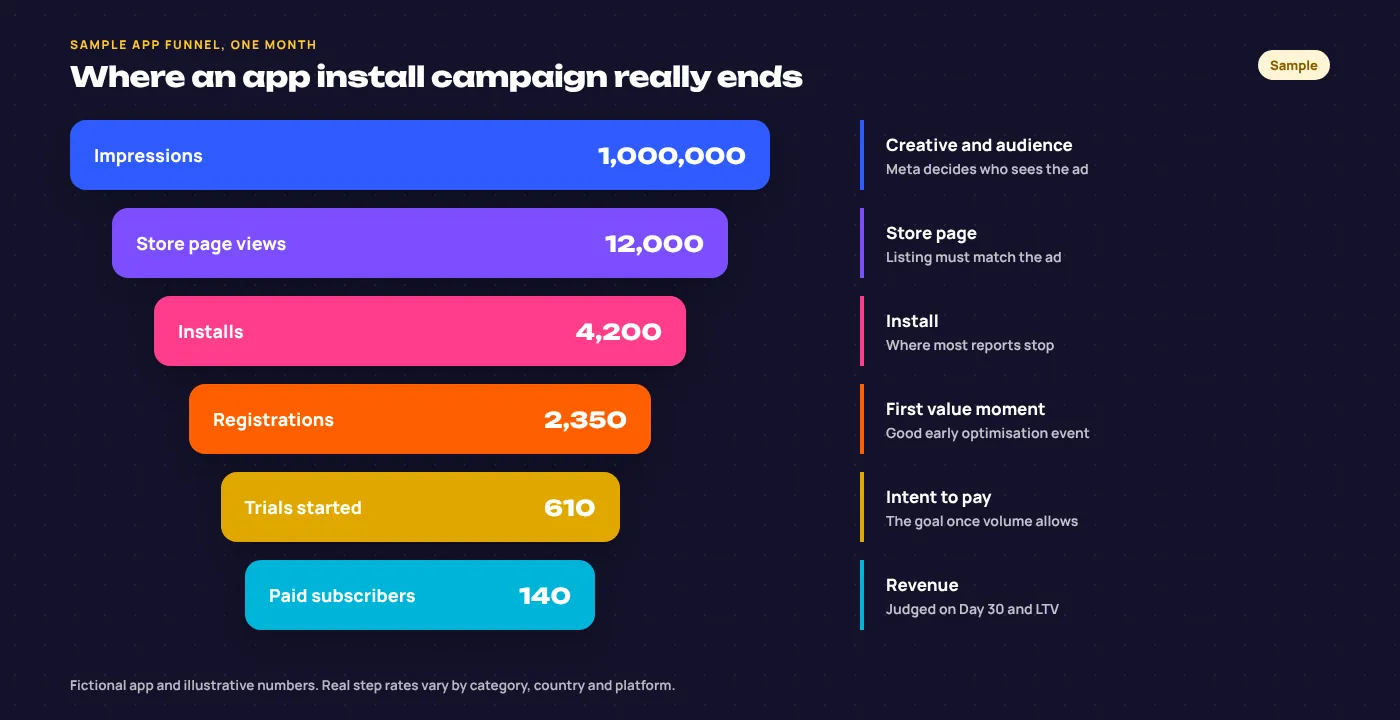
Cheap installs are not the same as good users. A campaign can deliver thousands of downloads from people who open the app once, and the dashboard still looks healthy. Your retention curve tells the truth a month later.
EmergingAds is a performance marketing agency founded in 2021 and based in Gurugram, India, working with brands in the US, UK, UAE, India and Australia. We have served 85+ brands. This page covers Meta only; for the cross-network picture, Google, TikTok and Apple Search Ads included, see our app marketing and user acquisition service.
Should You Optimise for App Installs, App Events or Value?
Start with the deepest in-app event that each ad set can reach about 50 times a week, usually registration or trial start. Use installs only to seed a brand new app with data, and move to value optimisation once you send purchase events with revenue and have a steady base of payers.
Meta finds exactly what you ask for. Ask for installs and it finds people who install. The 50-event figure is Meta’s own guidance for leaving the learning phase, from the Meta Business Help Centre, so we pick the event to fit the volume rather than hoping.
| Goal | What Meta looks for | Use it when | Watch out for |
|---|---|---|---|
| App installs Volume | Anyone likely to download | A new app with no event history, or a short seeding phase | Low Day-7 retention; cheap installs that never register |
| App events Our usual start | People likely to complete one event, such as registration or trial start | The event clears roughly 50 a week per ad set | Picking an event too deep to get volume, so delivery stalls |
| Value Revenue | People likely to spend more, from purchase values | Purchases with revenue flow reliably from the SDK or MMP | Wrong currency or duplicated purchases poison the model |
Advantage+ app campaigns vs manual app campaigns
Advantage+ app campaigns hand targeting, placements and most creative mixing to Meta, and in most accounts we test them first. Manual campaigns still earn a place when you need tight country splits, a separate creative test, or a clean read on one platform.
The settings we always check: the optimisation event, the attribution setting, iOS and Android split into separate campaigns, and enough creative variety for the system to work with. The same logic runs our Advantage+ sales campaigns for online stores.
How Does SKAdNetwork Work With Meta Ads on iOS and Android?
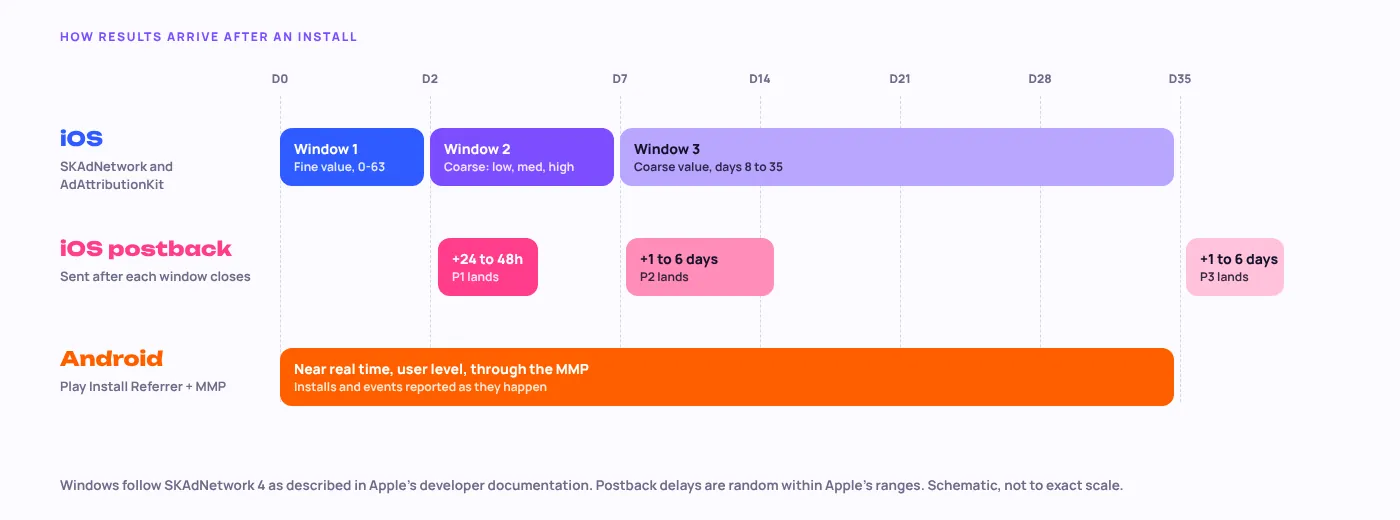
On iOS, users who decline Apple’s tracking prompt are reported through SKAdNetwork and AdAttributionKit: delayed, grouped postbacks with a limited conversion value. Meta adds its own Aggregated Event Measurement and modelling. On Android, the Play Install Referrer and your MMP report installs and events at user level, close to real time.
That gap is why we never compare iOS and Android inside one campaign. Apple documents the timings in its AdAttributionKit developer documentation; AdAttributionKit arrived with iOS 17.4 and works alongside SKAdNetwork.
iOS
Privacy first, data late
- Attribution
- SKAdNetwork 4 and AdAttributionKit, plus MMP data for users who allow tracking
- Timing
- Three windows: days 0-2, 3-7 and 8-35, each postback sent a day or more later
- Detail
- Fine conversion value (0-63) only in the first window, then low, medium or high
- Our job
- A conversion value schema that says who registered and who paid in the first postback
Android
User level, near real time
- Attribution
- Google Play Install Referrer plus your MMP’s postbacks to Meta
- Timing
- Installs and events show within hours
- Detail
- Full event and revenue data per cohort
- Our job
- Clean event names, deduplication and the right attribution window
MMP setup: AppsFlyer, Adjust or Branch plus the Meta SDK
Most apps already use one of Meta’s mobile measurement partners. The AppsFlyer Meta integration, or its Adjust or Branch equivalent, sends your in-app events to Meta through the partner connection.
- One sender per event. If the Meta SDK and your MMP both send purchases, Meta counts them twice.
- Standard event names wherever they fit, so Meta’s optimisation recognises them.
- Test events in Events Manager before a single ad goes live.
Deep links that land on the right screen
An ad about a feature should open that feature. We set up deferred deep links through your MMP’s link tool, plus Universal Links on iOS and App Links on Android, so new users land past the generic home screen.
Deep links matter most when you win back lapsed users, which our app retargeting service covers. For web tracking around the app, our Meta pixel and Conversions API setup handles the site side.
What Creative Works for Facebook App Install Ads?
Creative that shows the app being used. Screen recordings, creator-style demos filmed on a phone and playable-style ads beat polished brand films, because they set honest expectations. The hook needs to land in the first two seconds and the real screen should appear by second three.
Here is how we time the four formats we test most. Each bar is one 15-second ad.
UGC demo
A real person, their phone, one problem solved
Screen recording
The core flow, captions burned in
Playable-style
Try a level or a feature in the ad
Problem and payoff
Before the app, after the app
We judge each concept on cost per registration first, then Day-7 retention, never on click-through rate alone. And the store page has to keep the promise the ad made, which is why our app store optimisation work runs alongside the ads.
Cost Per Install on Meta Ads vs Cost Per Trial and Subscriber
Cost per install tells you what a download costs. Cost per trial, cost per subscriber and retention cohorts tell you what a user is worth. We report all of them side by side, and when they disagree, the deeper metric wins.
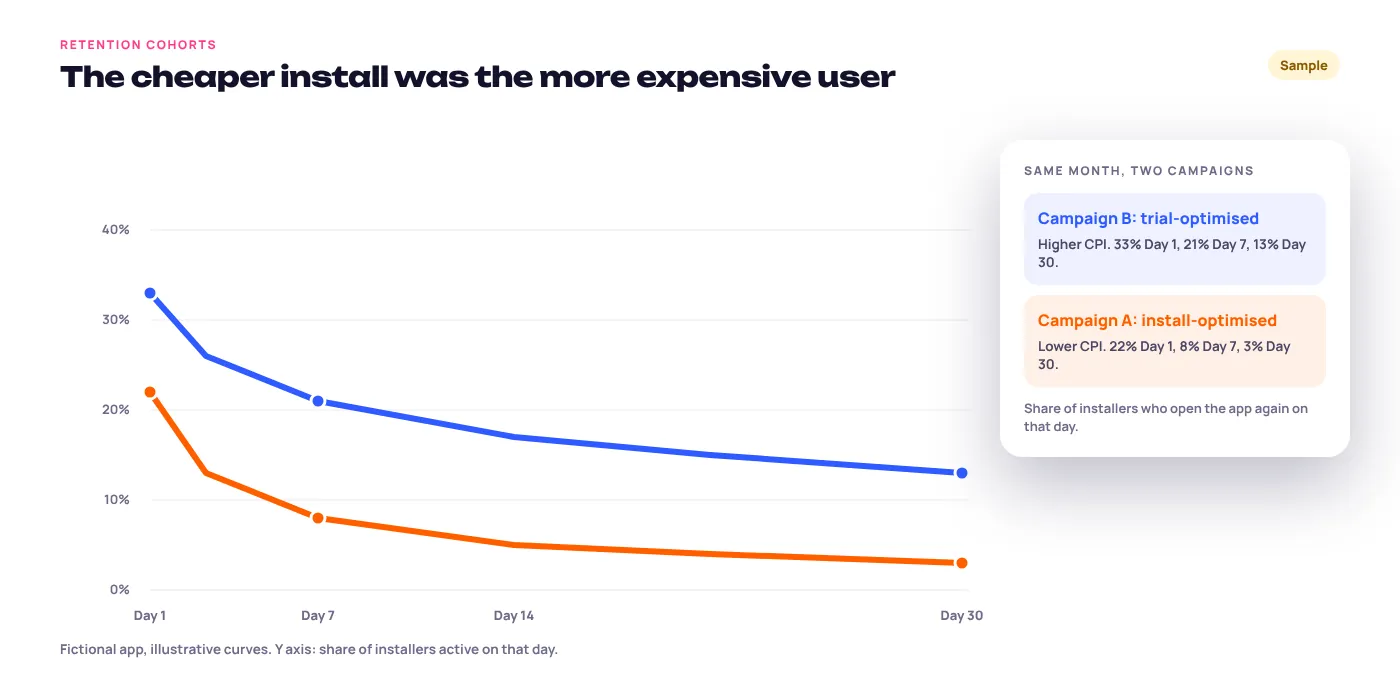
Sample figures for a fictional app. Campaign A wins one row out of four, the one that matters least.
Reading app retention cohorts by Day 1, 7 and 30
Day 1 tells you whether onboarding works. Day 7 tells you whether the ad promised the right thing. Day 30 tells you whether the user will ever pay. We pull cohorts from your MMP by campaign, country and creative, then move spend toward the segments whose users stay.
How We Launch Meta App Campaigns
Live in about 14 days. Each step has a gate, and we do not move on until it is met. Engagements run a 3-month minimum, then month to month.
- Days 1 to 3
Measurement review
SDK, MMP integration, event names and the iOS conversion value schema, checked against your own backend numbers.
GateInstalls and key events match the MMP within a few percent
- Days 3 to 6
Pick the optimisation event
We look at your volume and choose the deepest event each ad set can reach weekly.
GateThe event can realistically reach about 50 a week per ad set
- Days 5 to 10
Creative round one
Six to ten concepts across UGC demo, screen recording and playable-style, cut for Reels, Stories and Feed.
GateEvery concept shows the real app within three seconds
- Days 10 to 14
Launch, split by platform
Separate iOS and Android campaigns, Advantage+ app campaign first, deep links tested on real devices.
GateTest installs attributed correctly on both platforms
- Week 3 onward
Optimise toward value
Weekly reads by cost per trial and Day-7 retention; move the goal deeper as volume allows.
GateDay-30 cohort data before any big scaling decision
App Campaign Results From Real Clients
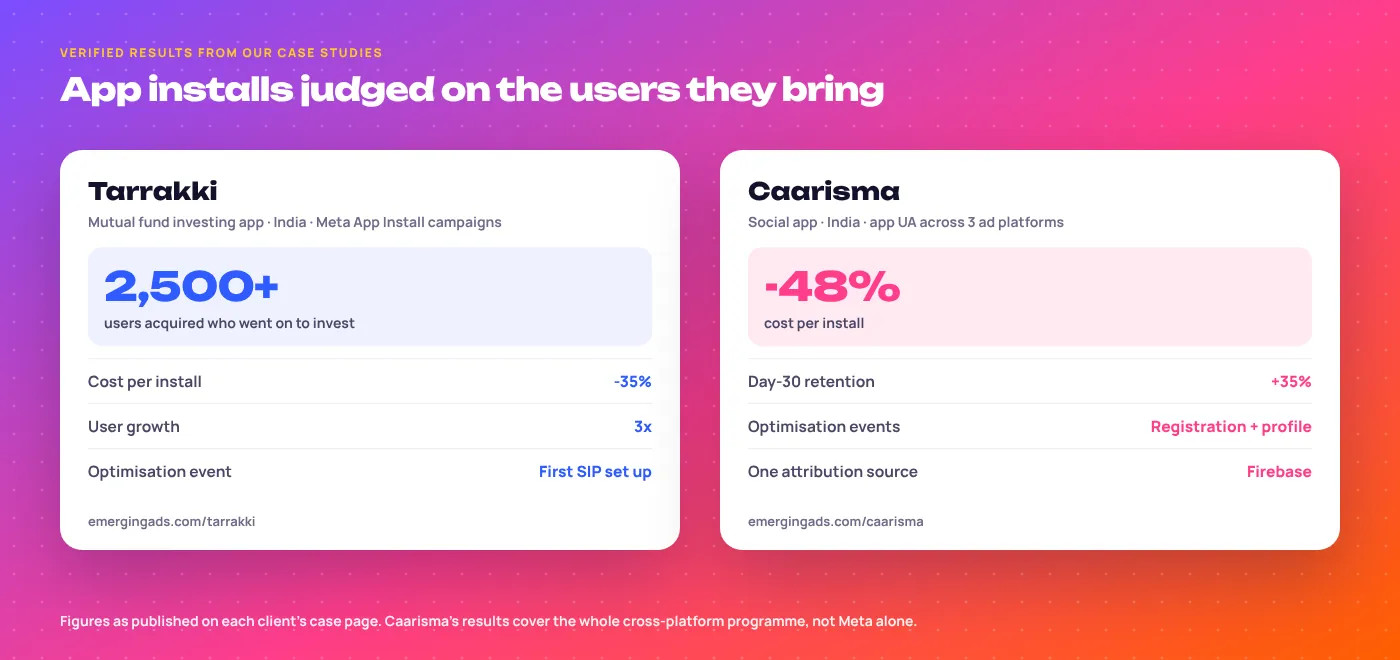
Tarrakki: users who actually invested
Tarrakki simplifies mutual fund investing. We ran Meta App Install campaigns for first-time investors with education-first creative, optimised toward the first SIP being set up rather than the raw install.
Caarisma: lower CPI and better retention
Caarisma was paying too much per install and losing users by Day 30. We moved optimisation to registration and profile completion and measured every platform through Firebase. This was a cross-platform programme, so the figures cover the whole account, not Meta alone.
Figures as published on each case page. More in our client success stories and the brands we work with. Building a finance app? See our fintech and finance marketing work, or SaaS and subscription app marketing.
More Meta Ads Services for Apps
Want the whole channel first? Read our Meta ads agency overview, or browse practical guides on the EmergingAds blog.
Meta App Campaign Questions, Answered
What is a Meta app campaign?
It is a Facebook and Instagram campaign on the App promotion objective that drives installs or in-app actions such as sign-ups and purchases. It relies on event data from the Meta SDK or your mobile measurement partner.
Should I optimise my Meta app ads for installs or for app events?
App events, as soon as you have the volume. Use installs only to seed a new app, then switch to the deepest event each ad set can reach about 50 times a week, usually registration or trial start.
How does Meta measure app installs on iOS after App Tracking Transparency?
Through SKAdNetwork and AdAttributionKit postbacks, plus Meta’s Aggregated Event Measurement and modelling. The data is delayed and grouped, so we design the conversion value schema carefully and cross-check against your MMP.
Are Advantage+ app campaigns better than manual app campaigns?
Usually, yes, for scale. They tend to find users efficiently with less setup. We keep manual campaigns for clean tests, tight country splits or when one platform needs its own read.
How long do Meta app campaigns take to work?
Expect a first read after two to three weeks. Each ad set needs about a week in the learning phase, and you need Day-30 cohort data before trusting a campaign with a big increase.
Do I need AppsFlyer, Adjust or Branch to run Meta app ads?
No, the Meta SDK alone works. But an MMP is strongly recommended if you advertise on more than one network, because it deduplicates installs and gives every channel the same yardstick.
Should iOS and Android run in the same campaign?
No, we separate them. Measurement, costs and user behaviour differ, and mixing them makes results hard to read and harder to act on.
What is a good Day-30 retention rate for an app?
It depends heavily on category, so we benchmark against your own history. The useful comparison is between campaigns and creatives inside your app, which shows where spend should move.
Do you make the app ad creative?
Yes. Our creative lead briefs and edits UGC demos, screen recordings and playable-style concepts, cut for Reels, Stories and Feed. Your existing footage and creator content are welcome too.
Is it worth hiring an agency for Meta app campaigns?
Yes, if your measurement is messy or your CPI looks fine but retention does not. Most of the gain comes from the right optimisation event, clean tracking and steady creative testing.
Can you also win back users who installed but stopped using the app?
Yes. Re-engagement campaigns with deep links bring lapsed users back to a specific screen, often for less than a new install. See our app retargeting service.
Get Your Free Meta App Audit
EmergingAds · Performance marketing
What’s in this audit
- Your optimisation event, and whether it gets enough volume
- SDK and MMP event check, including double counting
- iOS conversion value schema and attribution settings
- Creative and store page match, with first fixes