
App Retargeting That Brings Lapsed Users Back to Your App
We run app retargeting campaigns on Google, Meta and TikTok for people who installed your app and went quiet, with deep links that open the exact screen they left and holdout tests that show what the ads really added.
Updated
- Installed
- Quiet for 14 days
- Push and email
- Paid retargeting
- Back on their screen
What Is App Retargeting, and How Is It Different From Re-Engagement?
App retargeting is paid advertising aimed at people who already installed your app, on networks such as Google, Meta and TikTok, with a deep link so the click opens a specific screen. Re-engagement is the wider goal of bringing users back, and it includes owned channels like push and email.
EmergingAds is a performance marketing agency founded in 2021 and based in Gurugram, India, working with brands in the US, UK, UAE, India and Australia. We have served 85+ brands. For acquisition across every network, see our app marketing and user acquisition service.
| Owned re-engagement | Paid app retargeting | New user acquisition | |
|---|---|---|---|
| Who you reach | Users who opted in to push, email or WhatsApp | Installed users on ad networks, matched by device ID or audience list | People who have never installed |
| Main metric | Return sessions and conversions per send | Reattributions, cost per return action, retention after return | Cost per registration or trial, Day-30 retention |
| Biggest risk | Opt-out and unsubscribes from over-sending | Paying for users who would have returned anyway | Cheap installs who never come back |
Who Should You Retarget? Segments, Triggers and Deep Links
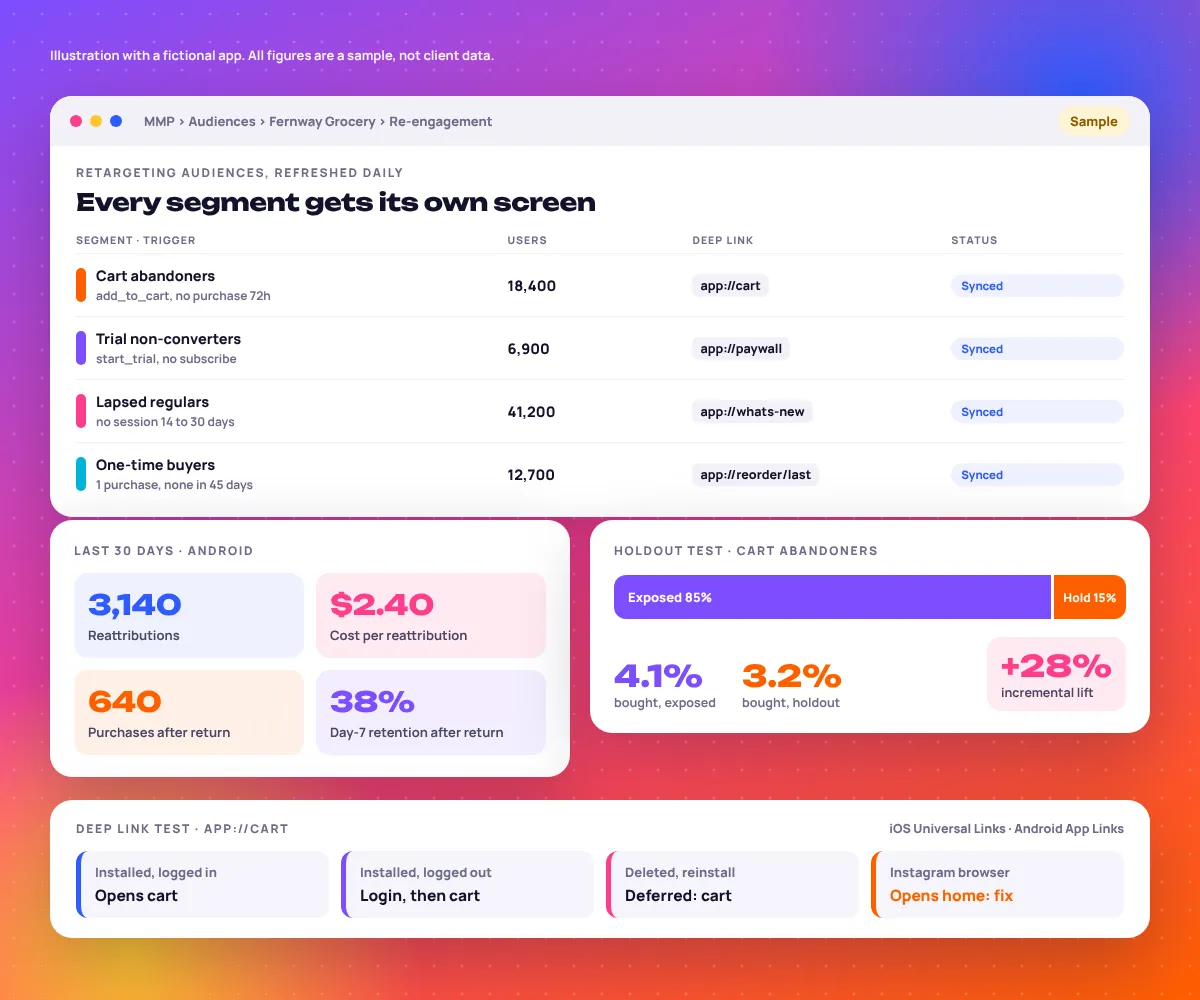
When retargeting lapsed app users, segment by the last meaningful thing they did, not by how long they have been away. A cart abandoner, a trial user who never paid and a quiet regular need different messages, so good app retargeting campaigns give each segment its own trigger, creative and deep link.
| Segment | Trigger (in-app events) | Message | Deep link |
|---|---|---|---|
| Cart abandoners | add_to_cart with no purchase within 24 to 72 hours | The exact item left behind, with stock or delivery date | app://cart |
| Trial non-converters | start_trial with no subscribe, two days before the trial ends | The one feature they never tried, and what they lose | app://paywall?plan=annual |
| Onboarding drop-offs | Install with no complete_registration after 3 days | Finish setup in one tap, progress saved | app://signup/step-2 |
| Lapsed regulars | 3+ sessions in month one, then none for 14 to 30 days | What is new since they left | app://whats-new |
| One-time buyers | One purchase, no second within 45 days | Reorder, or the next product people like them buy | app://reorder/last |
Windows are starting points: a habit app is lapsed after a week, a travel app maybe after two months.
How do you build retargeting audiences from AppsFlyer, Adjust or Branch?
Your mobile measurement partner already records every install and in-app event per device. We define each segment from those events, then sync it to the ad networks: AppsFlyer and Adjust both have audience tools that push lists to Meta and Google, and with Branch we export event-based cohorts or build lists in Firebase.
- Exclude recent activity. Anyone with a session in the last 7 days comes out of every paid audience.
- Exclude the conversion you are paying for. A cart audience must drop people the moment they purchase.
- Merge tiny segments. Meta and Google will not deliver to very small lists, so segments below a few thousand users are combined.
How Do Deep Links and Deferred Deep Links Work in Retargeting?
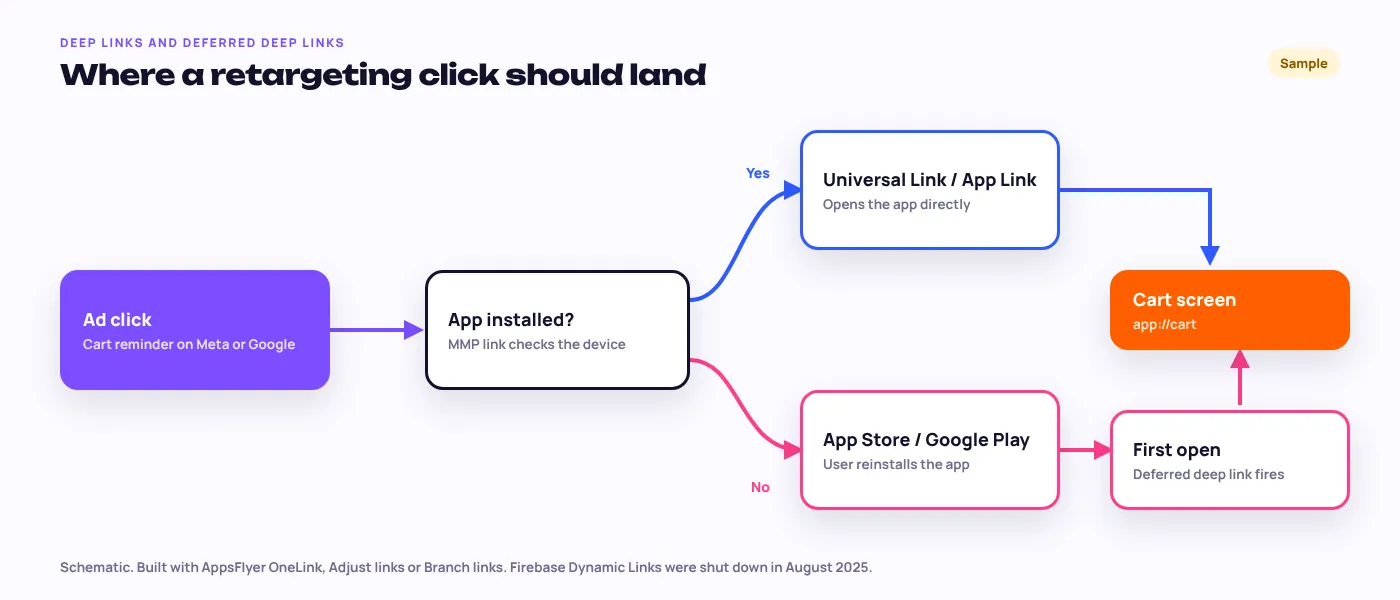
A deep link opens a specific screen inside your app instead of the home screen. A deferred deep link does the same for someone who deleted the app: the click goes to the store, and after the reinstall the first open still lands on the intended screen. On iOS this runs on Universal Links, on Android on App Links.
Deep linking for retargeting is where most clicks are wasted. A user who taps an ad for the item in their cart and lands on the home screen often gives up. We test every link across these cases:
- App installed, logged in: opens the screen directly.
- App installed, logged out: login first, then the screen, not the home feed.
- App deleted: store, reinstall, then the deferred deep link fires on first open.
- Opened inside Instagram or Facebook’s in-app browser: still hands off to the app.
Still on Firebase Dynamic Links? Google shut them down in August 2025; AppsFlyer OneLink, Adjust or Branch links replace them.
Google App Campaigns for Engagement vs Meta App Re-Engagement Ads
How do Google App campaigns for engagement work?
You give Google an audience of existing users, an in-app action to bid toward and a set of text, image and video assets. Google mixes the ads across Search, YouTube and the Display Network and bids toward people likely to take that action. Deep links are optional now, but results suffer without them.
Google Ads Help, in its “Create an App campaign for engagement” guide, sets eligibility rules on install base and audience size, so we check those first. Audiences come from Firebase, GA4 or your MMP.
How do Meta app re-engagement ads work?
Meta builds a custom audience from your app activity, sent by the Meta SDK or your MMP, and shows Facebook and Instagram ads to those users with a deep link on the ad. You optimise toward an app event such as purchase. Dynamic ads from a product catalogue suit shopping, food delivery and content apps.
We keep retargeting separate from acquisition and exclude existing users from install campaigns. The acquisition side is covered on our Meta app campaigns page.
Mobile App Retargeting on iOS vs Android After ATT
Mobile app retargeting needs to recognise a device. On Android the advertising ID is available unless the user opts out, so audiences stay large. On iOS, App Tracking Transparency means only users who tap Allow can be matched by IDFA, so iOS audiences are much smaller and measurement is thinner.
Apple’s AdAttributionKit documentation describes re-engagement attribution for clicked ads from iOS 18. SKAdNetwork never measured re-engagement at all, so older iOS reporting will undercount what retargeting did.
Smaller lists, softer data
App Tracking Transparency- Audience: only users who allowed tracking, plus email or phone matches
- Measurement: AdAttributionKit re-engagement for clicks, MMP data for opted-in users
- Limit: no view-through re-engagement, delayed and aggregated reports
Most of the volume
Advertising ID, Play referrer- Audience: device-level lists from your MMP, refreshed daily
- Measurement: user-level reattribution and post-return events, near real time
- Limit: users who reset or delete their advertising ID drop out of lists
Is App Retargeting Worth It? Testing Incrementality With Holdouts
It is worth it when a holdout test shows lift. Some of the users you retarget would have come back on their own, and attribution gives the ad credit for them too. Holding out 10 to 20 percent of a segment, then comparing return and purchase rates, shows the part the ads actually caused.
Sample numbers for a fictional app.
Frequency and creative fatigue
Audiences are small, so app retargeting campaigns show the same people your ads again and again. We watch frequency by segment weekly. When frequency climbs and click-through falls two weeks running, we rotate in a new reason to return rather than raising bids, and we retire segments whose holdout lift disappears.
Cheaper First: Push, Email and WhatsApp Before Paid Retargeting
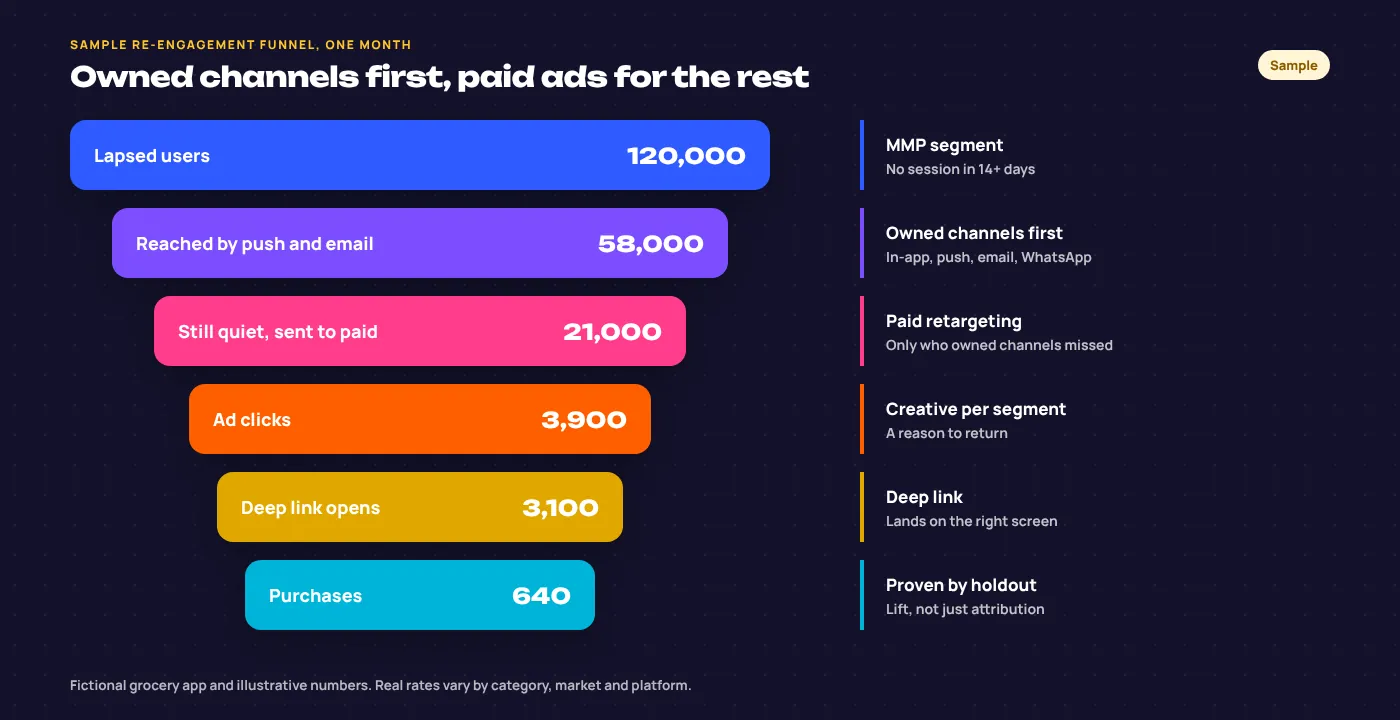
Strong app re-engagement campaigns start with the channels you own. In-app messages, push, email and WhatsApp reach installed users without an auction, so they run first, and paid retargeting takes only the users they could not move. That keeps ad spend on people who need a nudge from outside the app.
In-app message
Next time they open, show the thing they missed.
OwnedPush
Timed to the segment trigger, two or three sends at most.
OwnedEmail
Longer reasons to return, through your email automation flows.
OwnedWhatsApp
For opted-in users in markets where it is the main inbox. See WhatsApp marketing.
Owned, per messagePaid retargeting
Only for users still quiet after the steps above.
Paid at auction
How We Launch App Retargeting Campaigns, Step by Step
Live in about 14 days. Engagements run a 3-month minimum, then month to month.
- Days 1 to 3
Audit events and links
MMP events, deduplication and every deep link, tested on real devices.
Done when: key events match your backend within a few percent
- Days 3 to 5
Define segments
Lapse windows from your session data, then four to six segments.
Done when: each segment has a size, a trigger and a destination screen
- Days 4 to 7
Check owned channels
Push, email and WhatsApp sequences for the same segments, gaps fixed first.
Done when: paid audiences only include users owned channels did not move
- Days 6 to 10
Creative per segment
Cart, paywall and what’s-new messages, plus catalogue ads where you have a feed.
Done when: every ad names a reason to return, not “we miss you”
- Days 10 to 14
Launch with holdouts
Separate iOS and Android campaigns, a holdout per segment, daily list syncs.
Done when: test clicks reattribute correctly in the MMP
- Week 3 onward
Read lift, then scale
Weekly reads on cost per return action and Day-7 retention; monthly holdout reads.
Done when: spend sits only on segments with proven lift
What Our App Acquisition Results Tell You About Retargeting
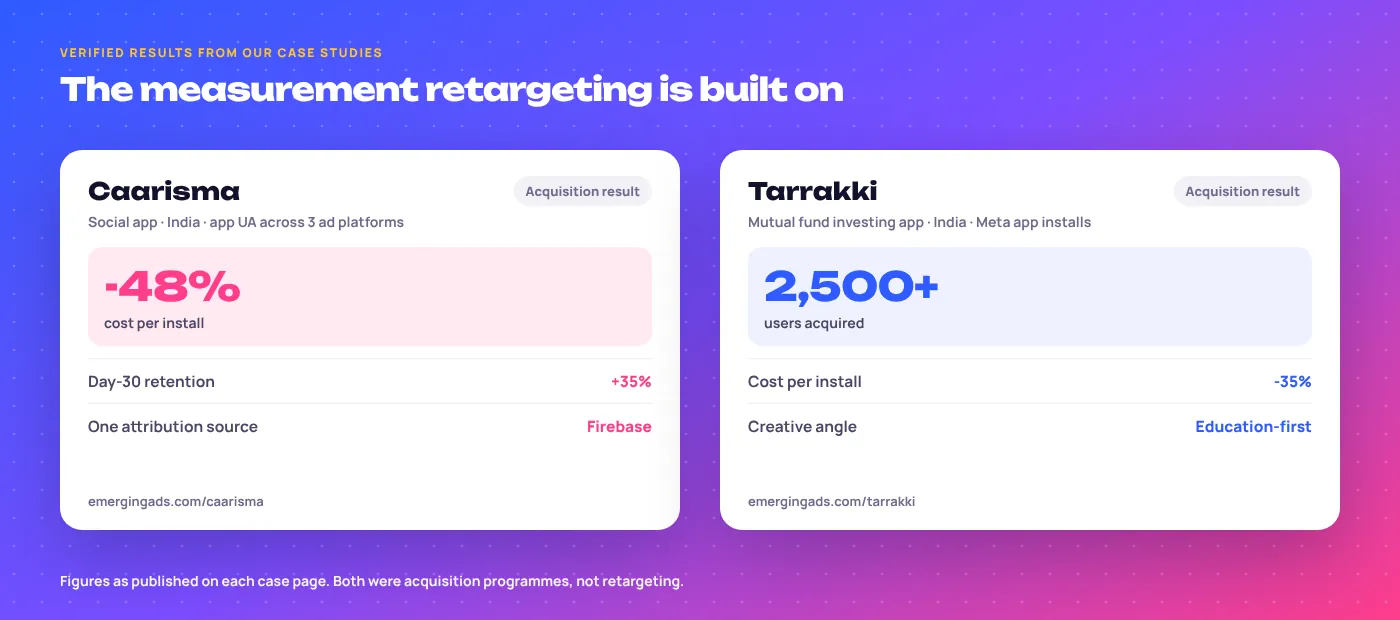
To be straight with you: neither of these was a retargeting programme. Both were acquisition work, with figures as published on each case page. We show them because retargeting only works when the events underneath are right, and that is what these projects fixed.
Caarisma
Caarisma paid too much per install and lost users by Day 30. We moved optimisation to registration and profile completion, measured through Firebase.
- -48%
- cost per install
- +35%
- Day-30 retention
What carries overClean event data across platforms is exactly what retargeting segments are built from.
Tarrakki
A mutual fund investing app. We ran Meta app install campaigns for first-time investors with education-first creative.
- 2,500+
- users acquired
- -35%
- cost per install
What carries overOptimising toward a meaningful in-app action, not the raw install, is the same rule we apply to return actions.
More in our client success stories and the brands we work with. Building a finance app? See our fintech and finance marketing, or SaaS and subscription app marketing. A store page that matches your ads helps returning users too, which is where app store optimisation comes in.
More App Marketing Services
Retargeting web visitors instead of app users? See Meta retargeting ads. Practical guides live on the EmergingAds blog.
App Retargeting Questions, Answered
What is app retargeting?
App retargeting is paid advertising to people who already installed your app. The ads run on networks like Google, Meta and TikTok, and a deep link opens a specific screen, such as the cart or paywall.
What is the difference between app retargeting and re-engagement?
Retargeting is the paid part; re-engagement is the whole effort, including push, email and WhatsApp, which should run first.
How does app retargeting work with an MMP like AppsFlyer or Adjust?
The MMP builds the audience and measures the return. It records in-app events per device, syncs segments to the ad networks, and reports reattributions when a lapsed user comes back through an ad.
Do I need deep links for app retargeting?
Yes, in practice. Google App campaigns for engagement can run without them, but sending a returning user to the home screen wastes most clicks. We set up Universal Links, App Links and deferred deep links.
Does app retargeting still work on iOS after App Tracking Transparency?
Yes, but on a much smaller audience. Only users who allow tracking can be matched by device ID, so iOS relies more on owned channels, hashed customer lists and lift tests.
How long does app retargeting take to show results?
Expect the first read in two to three weeks after launch, which is about 14 days from kickoff. A reliable holdout result usually needs 30 days of data per segment.
Is app retargeting worth it for a small app?
Often not yet. If your lapsed segments are only a few thousand users, ad networks struggle to deliver, and push and email will do more. Paid retargeting earns its place once segments are large enough to test.
How do I know if retargeting is incremental?
Run a holdout. Keep 10 to 20 percent of each segment away from the ads and compare purchase or return rates over the same period. The gap is the lift the ads caused.
Which users should I retarget first?
Cart abandoners and trial users near their end date. They are closest to paying, so results show quickly.
How often should retargeting ads be shown to the same user?
Less than most accounts do. We rotate creative when click-through falls while frequency rises.
Get a free audit of your app re-engagement
We check your MMP events, deep links, segments and iOS setup, and show where returning users are being lost.