How Much Does a CRO Audit Cost
Key Takeaways
- CRO audit pricing spans a wide range depending on depth, from a light heuristic review to a full audit combining analytics, heatmaps, and user testing.
- A genuinely useful audit should produce a prioritized, specific action list, not just a generic checklist of best practices copied across every client.
- The cost of a good audit is typically recovered quickly once even one or two of its recommendations lift conversion rate on meaningful traffic volume.
- Audit quality depends heavily on whether the provider actually reviews real user behavior data, not just opinion-based best-practice review of the page design.
- A audit is only valuable if there’s a realistic plan to implement the findings, otherwise it’s a report that sits unused regardless of price.
What a CRO Audit Actually Is
A conversion rate optimization audit is a structured review of a website or landing page aimed at finding specific reasons visitors aren’t converting, whether that’s completing a purchase, submitting a lead form, or taking whatever action the page exists to drive. A genuine audit combines several sources of evidence, analytics data, heatmaps and session recordings, page speed, mobile experience, and copy and design review, rather than relying on a single reviewer’s opinion of what looks good.
It’s worth distinguishing an audit from ongoing CRO work upfront. An audit is a bounded diagnostic deliverable, a report with prioritized findings, while ongoing conversion optimization work is the implementation and testing that follows. Pricing for the two is usually separate, and understanding that distinction avoids the common confusion of expecting an audit fee to also cover months of testing and implementation.
It’s also worth clarifying who the audit is actually for. A well-scoped audit should be written so a business owner without a deep technical or marketing background can understand the core findings, while still being specific enough for a developer or designer to act on directly, a balance that surprisingly few providers strike well, since it’s easier to write either a purely technical report or a purely high-level summary than to do both at once.
The Three Common Pricing Tiers
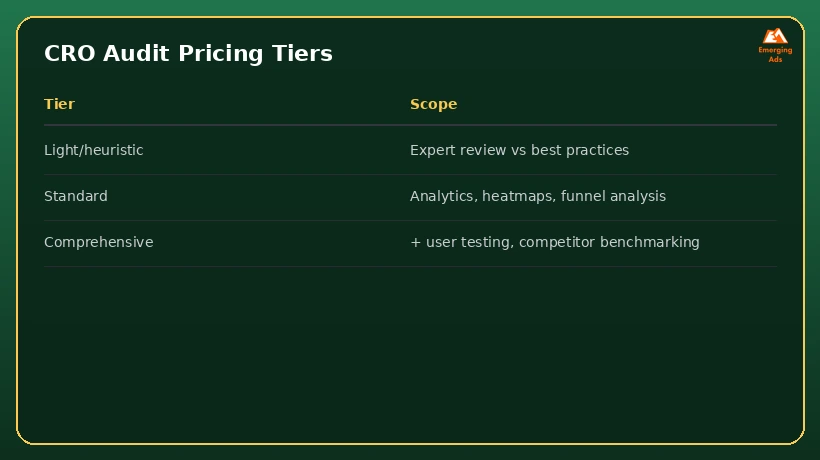
| Tier | Typical Scope | Best For |
|---|---|---|
| Light/heuristic review | Expert opinion-based review against best-practice checklist | Early-stage sites with limited traffic for real data analysis |
| Standard data-driven audit | Analytics review, heatmaps, funnel analysis, prioritized findings | Established sites with meaningful traffic wanting a genuine diagnostic |
| Comprehensive audit | All of the above plus user testing, competitor benchmarking, technical review | Larger sites where even small conversion gains represent significant revenue |
The gap between the lowest and highest tier is substantial, and it should be, since the depth of evidence gathered and the specificity of the resulting recommendations differ enormously between a checklist review and a full data-driven diagnostic backed by real user behavior analysis.
What Should Be Included at Each Tier
- A light audit should still include a specific, prioritized list of issues, not just a generic best-practices checklist applied uniformly to every client
- A standard audit should include real analytics review, funnel drop-off analysis, and at least basic heatmap or session recording evidence
- A comprehensive audit should add direct user testing or interviews, competitor benchmarking, and a technical review covering page speed and mobile experience
- Every tier should end with a prioritized roadmap, not just a list of observations without a recommended order of implementation
What Drives the Price Up
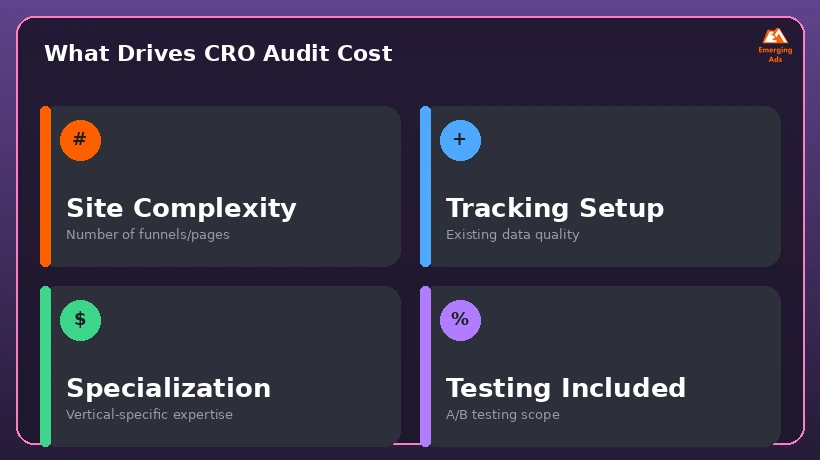
Site complexity is the biggest driver, a simple single-funnel landing page takes far less time to audit thoroughly than a multi-category e-commerce site with dozens of distinct user paths. The number of pages or funnels being reviewed, whether tracking is already properly configured or needs to be set up first, and how much existing data is available to analyze all meaningfully affect scope and therefore price.
Provider experience and specialization matter too. A CRO specialist with deep experience in a specific vertical, e-commerce checkout flows, SaaS trial signup funnels, lead-gen form optimization, often charges more than a generalist, and that premium is frequently justified by pattern recognition built from having reviewed many similar funnels before, spotting issues in minutes that a generalist might take days of analysis to uncover.
Heuristic Review vs. Data-Driven Audit
A heuristic review is based on expert judgment against known best practices, useful, but inherently more generic since it isn’t grounded in how this specific site’s actual visitors are behaving. A data-driven audit incorporates real behavioral evidence, where users actually click, scroll, and drop off, which produces findings specific to that site rather than generic advice that could apply to almost any page in the category.
The tradeoff is that a data-driven audit requires enough existing traffic and properly configured tracking to produce meaningful data, so a very low-traffic site sometimes genuinely can’t support a full data-driven approach yet, and a heuristic review, done well by an experienced reviewer, is a more honest and proportionate starting point until traffic grows.
How to Tell a Thorough Audit From a Shallow One
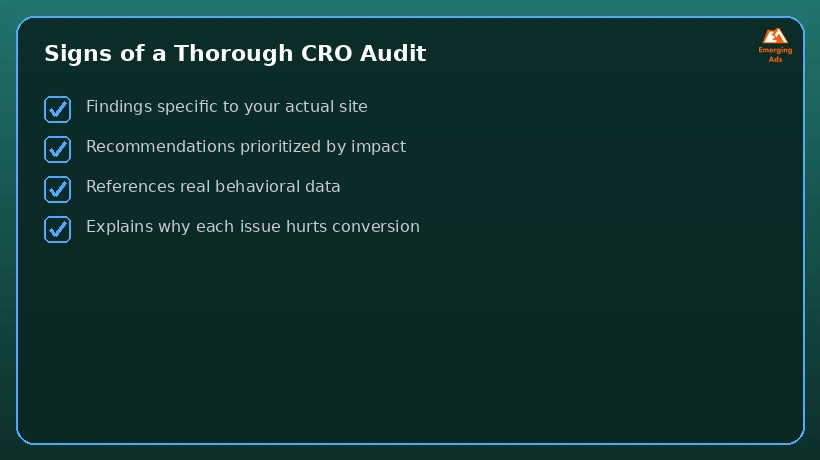
- Findings are specific to the actual site, screenshots, exact page URLs, specific elements, not generic best-practice statements
- Recommendations are prioritized by estimated impact and effort, not just listed in the order they were noticed
- The audit references real data, actual conversion rates, drop-off points, session recordings, not assumptions
- There’s a clear explanation of why each issue likely hurts conversion, not just what to change
Asking to see an anonymized sample audit before purchasing is a reasonable request and a fast way to judge depth. A provider unwilling to share any example of their actual deliverable format is harder to evaluate fairly before committing budget, and that reluctance alone is often a useful signal worth weighing alongside the quoted price itself.
Is the Cost Worth It? Doing the Math
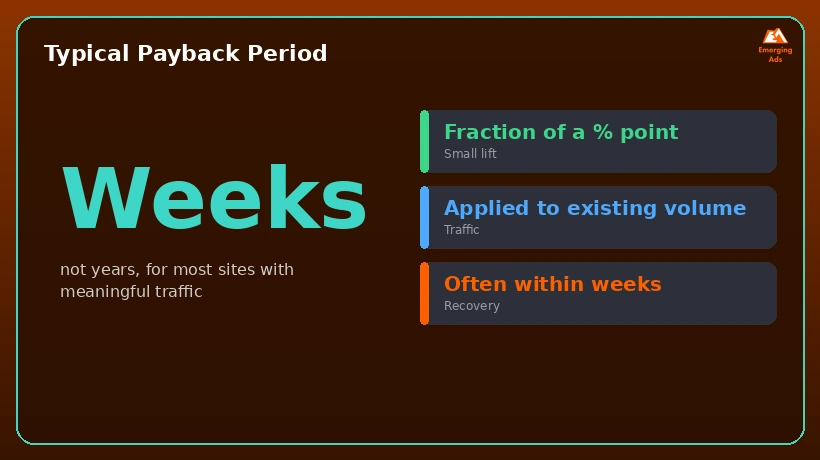
A useful way to frame the decision is against current traffic and conversion value rather than the audit fee in isolation. A site converting at a modest rate on meaningful monthly traffic, even a small percentage-point improvement in conversion rate, can represent a significant amount of recovered revenue over a year, often several multiples of the audit’s cost from implementing just the highest-priority findings.
This math breaks down, however, if the findings never get implemented. The audit itself doesn’t move the conversion rate, the changes it recommends do, so the real return depends as much on having the capacity to act on the findings, whether that’s an in-house team or a follow-on CRO implementation engagement, as it does on the audit’s quality itself.
A useful exercise before committing budget is estimating the value of a single conversion, and then working backward: if the audit costs a certain amount and even one implemented recommendation improves conversion rate by a fraction of a percentage point on existing traffic, how many weeks does it take to recover that cost through incremental conversions alone. For most sites with meaningful traffic, that payback period is measured in weeks or a couple of months, not years, which is what makes a well-scoped audit one of the more defensible marketing expenses to justify internally.
Common Mistakes When Buying a CRO Audit
- Buying a comprehensive audit for a low-traffic site that can’t yet support meaningful behavioral data analysis
- Treating the audit as a one-time fix rather than the starting point for ongoing testing and iteration
- Choosing a provider based purely on price without reviewing a sample of their actual audit format and depth
- Not budgeting for implementation, ending up with a detailed report and no plan or resource to act on it
What Happens After the Audit
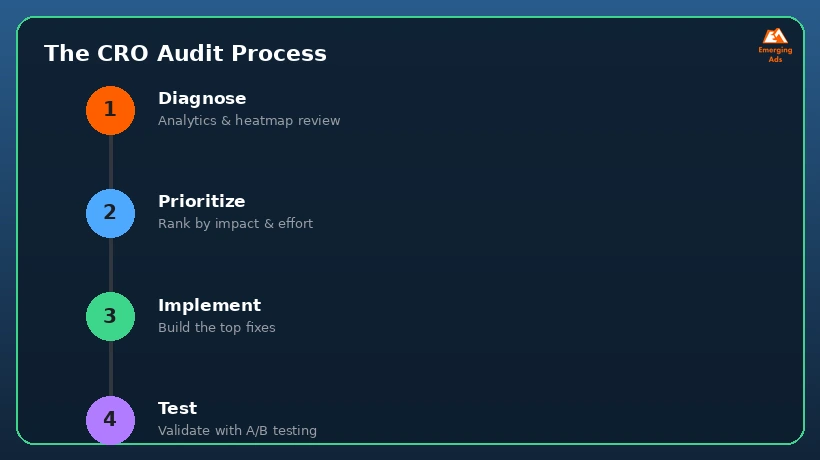
A good audit ends with a clear handoff, either into an internal team’s roadmap or into a follow-on optimization engagement. The findings should be specific enough that a developer or designer could act on them directly without needing extensive clarification, and prioritized clearly enough that the highest-impact, lowest-effort changes get tackled first rather than getting lost among a long undifferentiated list.
It’s also worth setting expectations upfront about testing. Serious CRO work treats recommendations as hypotheses to validate through A/B testing wherever traffic allows, rather than assuming every recommendation will automatically improve results once implemented, since even well-reasoned hypotheses sometimes don’t pan out exactly as predicted, which is precisely why testing rather than blind implementation is the more disciplined approach whenever traffic volume makes it feasible.
What Good Tracking Infrastructure Adds to Audit Quality
An audit is only as good as the data behind it, and a surprising number of sites requesting a CRO audit turn out to have gaps in their underlying tracking that limit how deep a data-driven review can actually go. Before paying for a comprehensive audit, it’s worth confirming that analytics and event tracking are actually capturing the full funnel accurately, since an audit built on incomplete or misconfigured data can produce confidently wrong conclusions that look authoritative but don’t hold up.
This is a common enough issue that some CRO providers now include a tracking health check as a standard first step before the behavioral analysis begins, and it’s worth asking directly whether a prospective provider does this. A provider that dives straight into heatmap and funnel analysis without first verifying the data source is trustworthy is skipping a step that materially affects how much confidence to place in the final recommendations, and it’s a fair question to raise directly during the sales conversation before any money changes hands.
For businesses whose attribution and tracking setup hasn’t been reviewed recently, addressing that gap first, even before commissioning a full CRO audit, often produces a better return than jumping straight to behavioral analysis on top of a shaky data foundation. It also tends to be the cheaper fix of the two, which makes it a sensible place to start for a business trying to sequence a limited budget wisely.
For Reference: What Conversion Rate Optimization Covers Broadly
For readers newer to the discipline, it’s worth stepping back from audit pricing specifically to understand what conversion rate optimization covers as a broader practice, since that context makes it much easier to judge whether a given audit’s scope is actually proportionate to the problem being solved. Our companion piece on what conversion rate optimization is and how it works is a useful primer alongside this pricing-focused guide.
Understanding that broader context also clarifies a subtlety that trips up first-time buyers: an audit measures and diagnoses, while CRO as an ongoing discipline is really a testing and iteration loop, diagnose, hypothesize, test, learn, repeat, so a single audit, however thorough, is best understood as the entry point into that loop rather than a standalone fix applied once and then forgotten about for years. Businesses that treat the first audit as the beginning of an ongoing practice tend to see compounding gains over time, while those that treat it as a one-off checkbox usually see the initial lift plateau within a quarter or two, having addressed the obvious issues without building the habit of continued testing, which is ultimately what separates a site that keeps improving from one that stalls after an initial round of fixes and slowly drifts back toward its earlier, less effective baseline as design and content naturally decay over time and visitor expectations continue to shift.
When a Free Audit Makes More Sense Than a Paid One
For businesses still deciding whether a deeper, paid CRO engagement is worth the investment, a lighter free review can be a sensible first step, surfacing the most obvious issues without committing budget to a full comprehensive audit upfront. It won’t replace the depth of a paid, data-driven audit on a complex site, but it’s a reasonable way to gauge whether there’s likely enough opportunity to justify going deeper.
A free audit covering the broader marketing and conversion picture is often the most practical starting point for a business that hasn’t invested in CRO before, since it can surface whether the bigger opportunity actually sits in conversion optimization specifically or somewhere else in the funnel entirely, before committing to a specialized paid audit and a larger line-item budget commitment.
Frequently Asked Questions
What’s a reasonable price range for a CRO audit?
It varies widely by scope, a light heuristic review costs meaningfully less than a comprehensive audit including user testing and competitor benchmarking, so the right comparison is against the specific scope and deliverables offered rather than a single industry-wide number.
How long does a typical CRO audit take to complete?
A light review can often be turned around within a week or two, while a comprehensive audit incorporating user testing and deeper data analysis typically takes three to five weeks, depending on how much existing data and tracking infrastructure is already in place.
Do I need a lot of traffic to get value from a CRO audit?
A data-driven audit benefits from meaningful existing traffic to analyze real behavior, but lower-traffic sites can still get real value from a heuristic, best-practice-based review while traffic grows toward a level that supports deeper behavioral analysis.
What’s the difference between a CRO audit and a UX audit?
They overlap significantly but aren’t identical. A UX audit focuses broadly on usability and user experience quality, while a CRO audit is specifically focused on identifying barriers to a defined conversion goal, sometimes at the expense of broader usability considerations that don’t directly affect that specific goal.
Should the audit include competitor analysis?
It’s a valuable addition, especially at the comprehensive tier, since seeing how competitors structure similar funnels can surface both opportunities and category-standard expectations a visitor may be bringing with them from elsewhere.
Can I do a CRO audit myself instead of paying for one?
It’s possible with the right tools and enough analytical rigor, but an experienced outside reviewer typically catches issues an internal team has become blind to simply from familiarity with their own site, which is part of what justifies the cost for many businesses.
What should I do if the audit’s recommendations don’t seem realistic to implement?
Raise it directly with the provider. A good audit should account for realistic implementation constraints, and a reasonable provider should be able to reprioritize or suggest a lighter-weight version of a recommendation that fits actual development capacity.
Is a CRO audit a one-time purchase or something to repeat regularly?
Most sites benefit from revisiting it periodically, roughly annually or after a significant site redesign, since conversion barriers shift as design, traffic sources, and visitor expectations change over time.
Does the audit provider need access to my analytics and heatmap tools directly?
For a data-driven audit, yes, meaningful access to existing analytics, heatmap, and session recording tools is what separates a genuine behavioral review from an opinion-based one, so expect to grant view access as part of the process rather than only sharing exported reports.
What’s a reasonable timeline expectation for seeing results after implementing audit recommendations?
It depends on traffic volume and which changes get implemented first, but most sites with meaningful traffic can expect to see measurable movement within four to eight weeks of implementing and properly testing the highest-priority recommendations, assuming those changes are given enough traffic to reach statistical confidence. Pairing a CRO audit with a proper Google Tag Manager setup ensures every test result you act on is actually trustworthy.