
Amazon DSP Advertising That Reaches Shoppers Beyond Search
Sponsored ads only catch people already typing your category into Amazon. DSP finds the rest: shoppers in your category who have not searched yet, people who viewed your product and left, and past buyers due to reorder, on Amazon, Prime Video and sites across the web.
- Prime Video
- Fire TV
- Twitch
- Amazon sites and apps
- Third-party exchanges
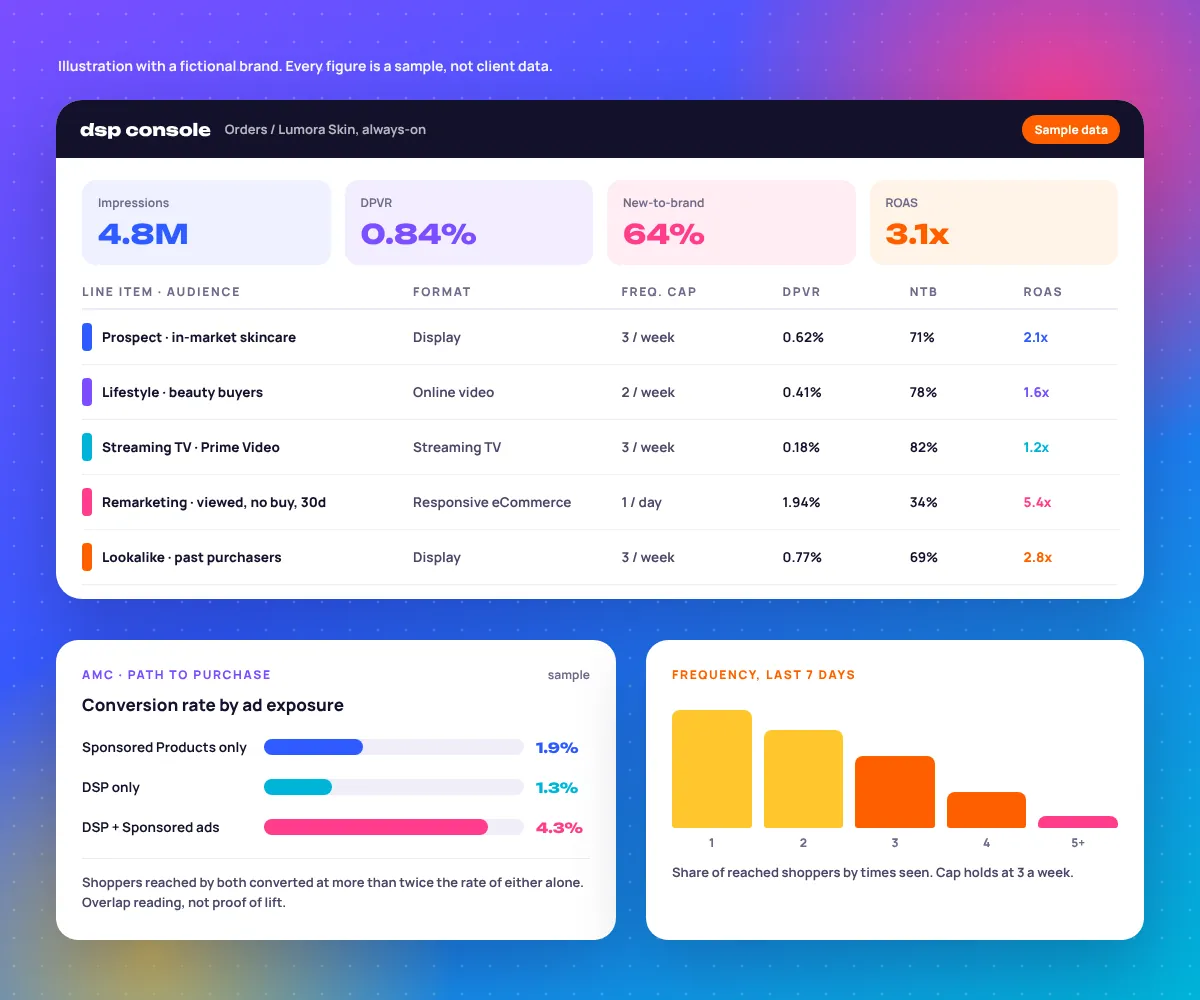
What Is Amazon DSP, and How Is It Different From Sponsored Display?
Amazon DSP is Amazon’s demand-side platform for buying display, video, streaming TV and audio ads programmatically, targeted with Amazon’s shopping signals, on Amazon’s own sites and apps and across third-party websites and apps.
Sponsored Display looks similar, but it lives in the self-serve ads console, builds creative from your listing and offers fewer audiences. Our Amazon PPC management team runs Sponsored Display alongside Sponsored Products and Brands; DSP is planned as its own channel.
EmergingAds is a performance marketing agency founded in 2021 and based in Gurugram, India. We work with brands in the US, UK, UAE, India and Australia and have served 85+ brands.
| Feature | Sponsored Display | Amazon DSP |
|---|---|---|
| Who can run it | Brand-registered sellers and vendors | Any advertiser, including brands not sold on Amazon |
| Where you buy | Amazon Ads console, self-serve | DSP self-service seat, or Amazon’s managed service |
| Audiences | Product and category targeting, views and purchase remarketing, interests, in-market | In-market, lifestyle, remarketing, lookalikes, contextual, advertiser and AMC audiences |
| Formats | Display and video built from your listing | Display, responsive eCommerce, online video, streaming TV, audio |
| Inventory | Amazon plus selected third-party placements | Amazon sites and apps, Prime Video, Fire TV, Twitch, IMDb, third-party exchanges |
| Bidding and control | CPC or vCPM bids | CPM bids, pacing and frequency caps per line item |
| Best for | Retargeting and defending your product pages | Planned reach, new-to-brand growth and full-funnel remarketing |
Amazon DSP Self-Service vs Managed Service
With self-service, you or your agency run the DSP seat directly: every line item, audience, cap and report is in your hands. With managed service, Amazon’s own team builds and runs campaigns for you. Self-service gives more control and faster changes; managed service suits brands that want Amazon to do the hands-on work.
Self-service
We run campaigns in a self-service seat. You see every line item.
- Control
- Full: audiences, caps, creative, pacing
- Data
- Line-item reports plus AMC queries
- Speed
- Same-day edits
Managed service
Amazon’s team plans and runs the media. Useful for large streaming TV buys.
- Control
- Through your Amazon contact
- Data
- Reports shared by Amazon
- Speed
- Changes go through a request
Amazon DSP Audiences, Mapped to the Funnel
Amazon DSP audiences are built from what people browse, buy and stream on Amazon, plus data you bring yourself. The skill is not picking audiences; it is giving each one a single job, a matching format and the right number to judge it on, then keeping them from overlapping.
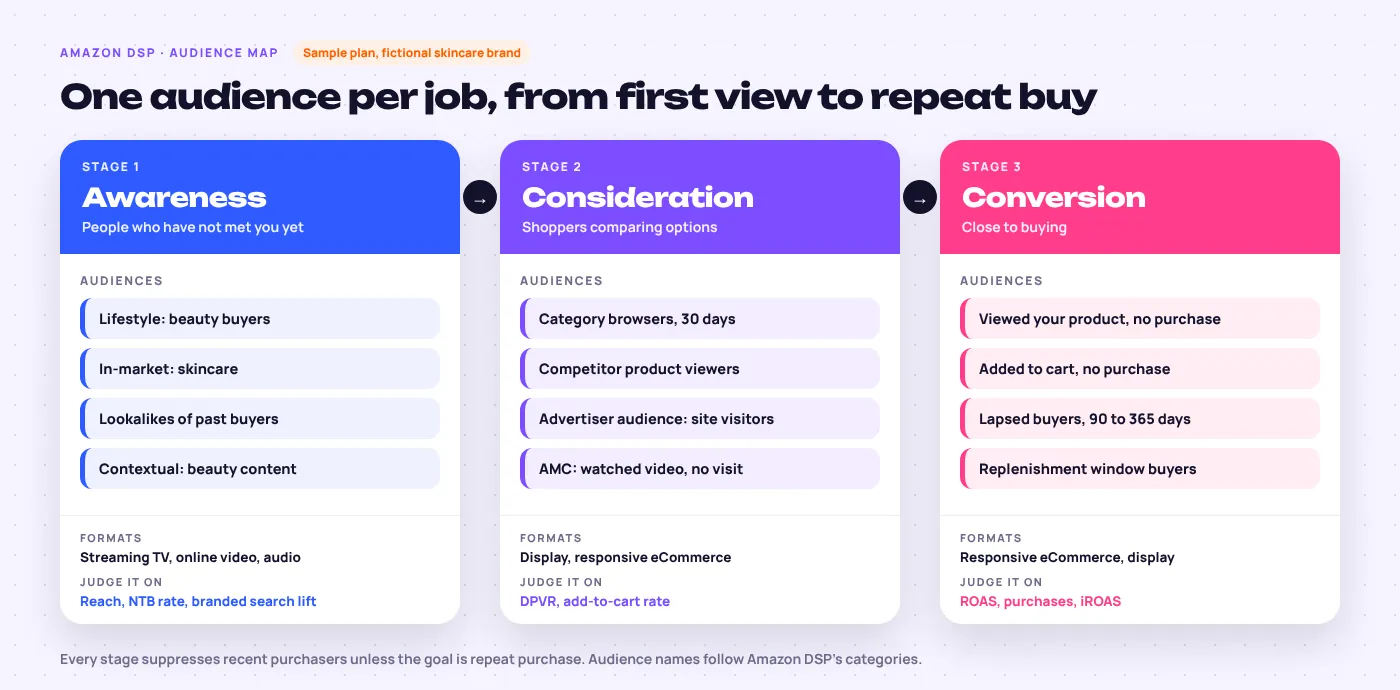
In-market Prospecting
Recently browsed or bought in your category. Our first prospecting test.
Lifestyle Reach
Longer-term habits, such as pet owners. Wider; best with video.
Remarketing Conversion
Viewed your product, added to cart or bought before. We usually test 14, 30 and 90-day windows.
Lookalikes Scale
Shoppers who behave like your buyers. Built for new-to-brand growth.
Advertiser audiences Your data
Hashed customer lists and visitors tracked by the Amazon Ad Tag on your site.
Contextual Placement
Pages and apps about your topic. Useful when audience pools are small.
Remarketing only pays if the product page can close the sale, so we check it first, often with our Amazon listing optimisation team. We also confirm stock cover before retargeting.
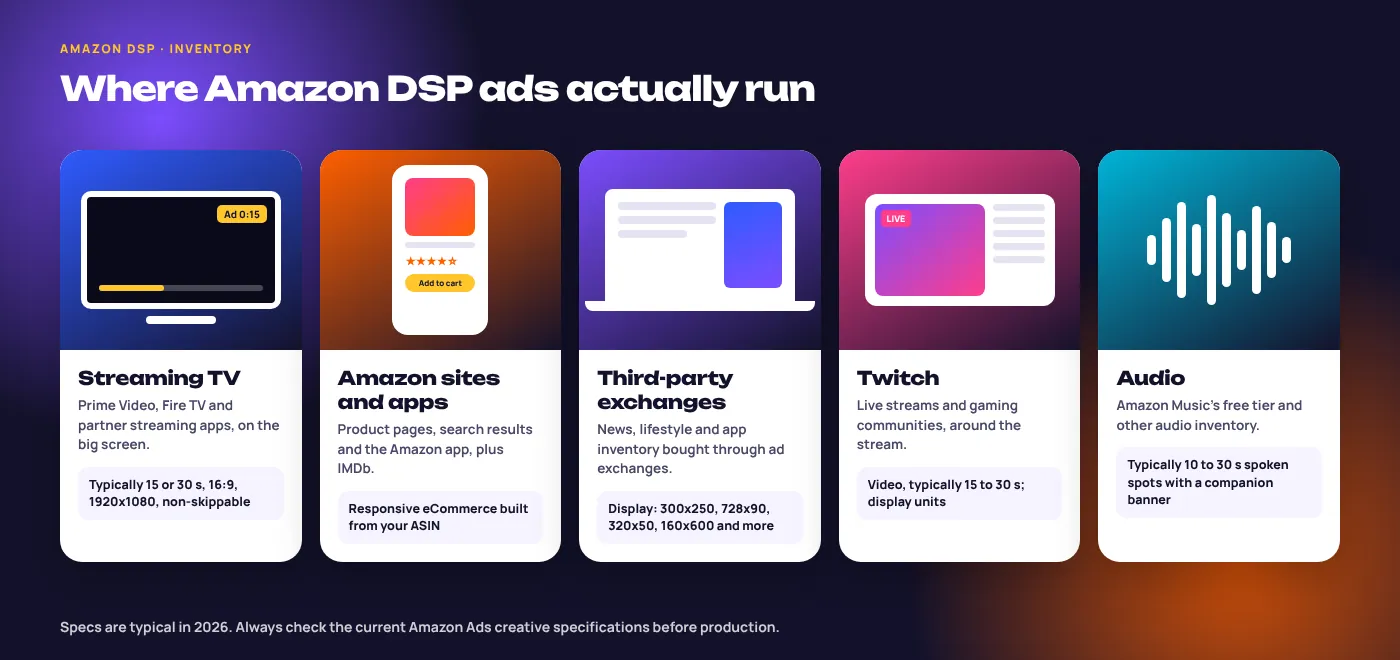
Where Do Amazon DSP Ads Run, and in What Formats?
Amazon DSP ads run on Amazon’s own sites and apps, Prime Video, Fire TV, Twitch, IMDb and Amazon Music, and across third-party sites and apps bought through ad exchanges. Amazon DSP ad formats are display, responsive eCommerce creative, online video, streaming TV and audio.
Responsive eCommerce creative is the workhorse for Amazon sellers. It pulls the image, price, rating and Prime badge from your ASIN, so it stays accurate. Streaming TV is the reach play.
Amazon DSP ad formats: typical creative specs
- DisplayCommon sizes 300×250, 728×90, 160×600, 320×50, 300×600 and 970×250
- Responsive eCommerceYour ASINs, a logo and an optional headline; Amazon builds the rest
- Online videoTypically 15 to 30 seconds, 16:9, 1920×1080
- Streaming TVTypically 15 or 30 seconds, 1920×1080, non-skippable
- AudioTypically 10 to 30 seconds, spoken, with a companion banner
Specs are typical. We check the current Amazon Ads creative specifications before every production.
Can Brands That Don’t Sell on Amazon Use Amazon DSP?
Yes. Amazon DSP is open to advertisers whether or not they sell on Amazon. Travel, finance, apps and direct-to-consumer brands use it to reach Amazon audiences, then send people to their own site or app and measure the results with the Amazon Ad Tag.
The catch: remarketing and new-to-brand reporting are built around Amazon purchases, so off-Amazon brands lean on lifestyle, in-market and advertiser audiences. Our conversion tracking setup work sets up the tag and events before launch.
- Pick Amazon audiencesLifestyle and in-market segments close to your buyer.
- Run video, display or streaming TVCreative that links to your site or app.
- Track with the Amazon Ad TagSign-ups and purchases report back to DSP.
- Remarket your own visitorsTag-based audiences bring visitors back.
How Does Amazon Marketing Cloud Show What DSP Added?
Amazon Marketing Cloud (AMC) is Amazon’s clean room. It lets us run SQL queries on event-level ad data across DSP and Sponsored ads, and see paths to purchase that standard reports hide: which shoppers saw a streaming TV ad before their first search, or how conversion changes with frequency.
Results are aggregated, so very small audiences can fall below privacy thresholds. AMC can also turn a query into an audience and send it to DSP. See the Amazon Marketing Cloud overview from Amazon Ads.
SELECT exposure_path, COUNT(DISTINCT user_id)
FROM conversions
WHERE new_to_brand = true
GROUP BY exposure_path
38%of new-to-brand buyers saw a streaming TV ad before their first Sponsored Products click.
Kept streaming TV on despite low last-click ROAS, and widened remarketing from 14 to 30 days.
Which Amazon DSP Metrics Matter: DPVR, NTB, ROAS and iROAS?
Judge each line item on the Amazon DSP metric that matches its job. Prospecting is judged on new-to-brand rate and detail page view rate. Remarketing is judged on ROAS. The whole programme is judged on incremental ROAS, because DSP gets credit for sales that some shoppers would have made anyway.
- DPVRDetail page view rate
- How often an impression sends a shopper to your product page.
Detail page views ÷ impressionsOur first creative check. - NTBNew-to-brand
- Purchases from shoppers who have not bought your brand on Amazon in the last 12 months.
NTB purchases ÷ total purchasesThe growth number. - ROASReturn on ad spend
- Attributed sales per unit of media spend, using DSP’s 14-day window for views and clicks.
Attributed sales ÷ spendFlattering for broad view-through. - iROASIncremental ROAS
- Only the sales that would not have happened without the ads.
Incremental sales ÷ spendMeasured with holdout tests or AMC.
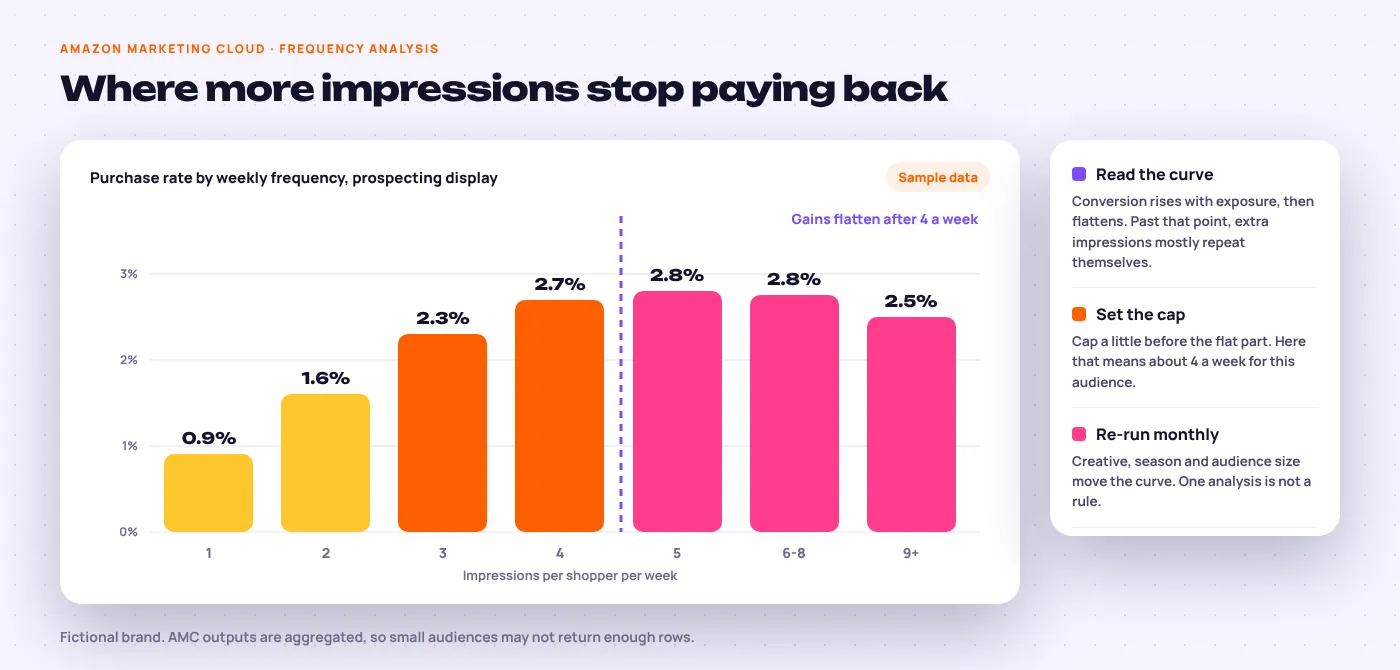
How do frequency caps work in Amazon DSP?
Amazon DSP frequency caps limit how many times one person sees a line item’s ads per day, week or campaign. Too low and nobody remembers you; too high and the same shoppers see you a dozen times while new ones see nothing. We start from these caps, then adjust with AMC.
- Prospecting displayAbout 3 a week per person to start
- Streaming TV2 to 3 a week
- Remarketing, product viewersAbout 1 a day during the window
Starting points from our own practice, not Amazon rules.
How We Launch Amazon DSP Advertising, Step by Step
A new Amazon DSP programme is live in about 14 days. Week one is audit, audiences and tracking; week two is creative and launch. We then give it four to six weeks of learning before scaling or cutting anything, because prospecting results take time to show up as purchases.
- Days 1 to 3
Audit and goals
Sponsored ads, listings, stock and margins. One goal per stage.
- Days 3 to 6
Access and tracking
Seat access, the Amazon Ad Tag, AMC and reporting.
- Days 5 to 8
Audience map
One audience per job, recent buyers suppressed.
- Days 7 to 11
Creative
Responsive eCommerce, display sizes, and video cuts if you have footage.
- Days 11 to 14
Build and launch
Line items with caps, pacing and brand safety, then a 48-hour delivery check.
- Weeks 3 to 8
Learn, then scale
Weekly reviews, creative rotation and a first AMC read.
How We’d Approach Your Amazon DSP Account
We have not published an Amazon DSP case study yet, so there is no made-up one here. This is what we can show and what we won’t claim.
What we can show
- Full-funnel remarketing elsewhere: the US baby brand in our Simple Seed Baby case study held 4x ROAS across Meta, Google and Klaviyo.
- Creative that sells: Elan Store reached 4.8x ROAS with occasion-led Meta creative.
What we won’t claim
- Those are not Amazon results, and we will not dress them up as DSP numbers.
- No promised ROAS before we have seen your account, traffic and margins.
- No view-through sales counted as growth until AMC or a holdout test backs them.
Start with the free audit, then browse our success stories or the brands we work with.
Amazon Services That Feed Your DSP
DSP is one part of our full Amazon advertising services. Selling on your own site too? See ecommerce marketing and B2C marketing services, or read more on the EmergingAds blog. Official reference: Amazon DSP on Amazon Ads.
Amazon DSP Questions Answered
What is Amazon DSP?
Amazon DSP is Amazon’s demand-side platform for buying display, video, streaming TV and audio ads by audience. It uses Amazon’s shopping signals and reaches people on Amazon, Prime Video, Fire TV, Twitch and third-party sites and apps.
How does Amazon DSP work?
You pick an audience, a format and a set of placements, then bid on impressions. Each line item has its own caps, pacing and goals, and results are reported back on Amazon metrics such as detail page views, purchases and new-to-brand sales.
Is Amazon DSP worth it for a smaller brand?
It can be, once the basics are in place: profitable Sponsored ads, listings that convert and enough product page traffic to build remarketing audiences. If those are missing, fix them first; the free audit tells you which.
What’s the difference between Amazon DSP and Sponsored Display?
DSP gives far more control. Sponsored Display is self-serve and builds ads from your listing with a short audience list. DSP adds streaming TV and audio, your own creative, frequency caps, lookalikes, advertiser audiences and wider third-party inventory.
Can I use Amazon DSP if I don’t sell on Amazon?
Yes. Any advertiser can use Amazon DSP. You target Amazon audiences, send traffic to your own site or app, and track conversions with the Amazon Ad Tag. Remarketing to Amazon product viewers only applies if you have products on Amazon.
How long does it take to launch an Amazon DSP campaign?
About 14 days from audit to launch. We then allow four to six weeks of learning before making big scaling decisions, because prospecting ads often turn into purchases days or weeks after the first view.
What does new-to-brand mean in Amazon DSP?
A new-to-brand purchase is a first purchase of your brand on Amazon in the last 12 months. NTB rate shows how much of your DSP-driven sales come from new customers rather than people who would have bought again anyway.
Do you use Amazon Marketing Cloud?
Yes, wherever the data volume allows. We use AMC to read paths to purchase, overlap between DSP and Sponsored ads, and frequency against conversion, and to build audiences we send back into DSP.
What creative do I need for Amazon DSP?
Less than you think. Responsive eCommerce ads only need your ASINs and a logo. Display sizes and a short video come next; streaming TV needs a broadcast-quality cut.
How do you know if Amazon DSP is really working?
We look past last-click ROAS to incremental results. NTB rate, branded search trends and AMC path analysis show what DSP added, and holdout tests measure incremental ROAS directly when volume is high enough.
Find Out Where DSP Fits Your Amazon Plan
Send us your Amazon Ads access, read-only. We check Sponsored ads, listings, stock and tracking, then show you which DSP audiences and formats are worth testing first, and which are not yet.
