
Cut ACoS. Scale Revenue. Own Your Category.
Our Amazon PPC management services start with one number: the ACoS at which each product stops making money. Every bid, keyword and budget move is then judged against it, across Sponsored Products, Sponsored Brands and Sponsored Display.
- Live in about 14 days
- Search terms read weekly
- 3-month minimum, then monthly
What Our Amazon PPC Management Services Cover
Each Amazon ad type has a different job. Most accounts we audit judge all three on the same ACoS target, which is how Sponsored Display gets switched off for “not working” while it was quietly protecting your product pages.
The closer
- Shows
- In search results and on product pages, looking almost exactly like an organic listing.
- Judged on
- ACoS against break-even, per search term.
- Needs
- The Buy Box. Lose it and your Sponsored Products ads stop serving.
The billboard
- Shows
- Headline banner above results, store spotlight and video in the middle of search.
- Judged on
- New-to-brand orders and brand search growth, not ACoS alone.
- Needs
- Brand Registry, a Store, and at least three products or one strong video.
The bodyguard
- Shows
- On your own and competitor product pages, plus audiences who viewed but did not buy.
- Judged on
- Defended page traffic and return visits that convert.
- Needs
- Brand Registry and a small, capped budget. It is a support role.
Break-Even ACoS: The Number Every Bid Answers To
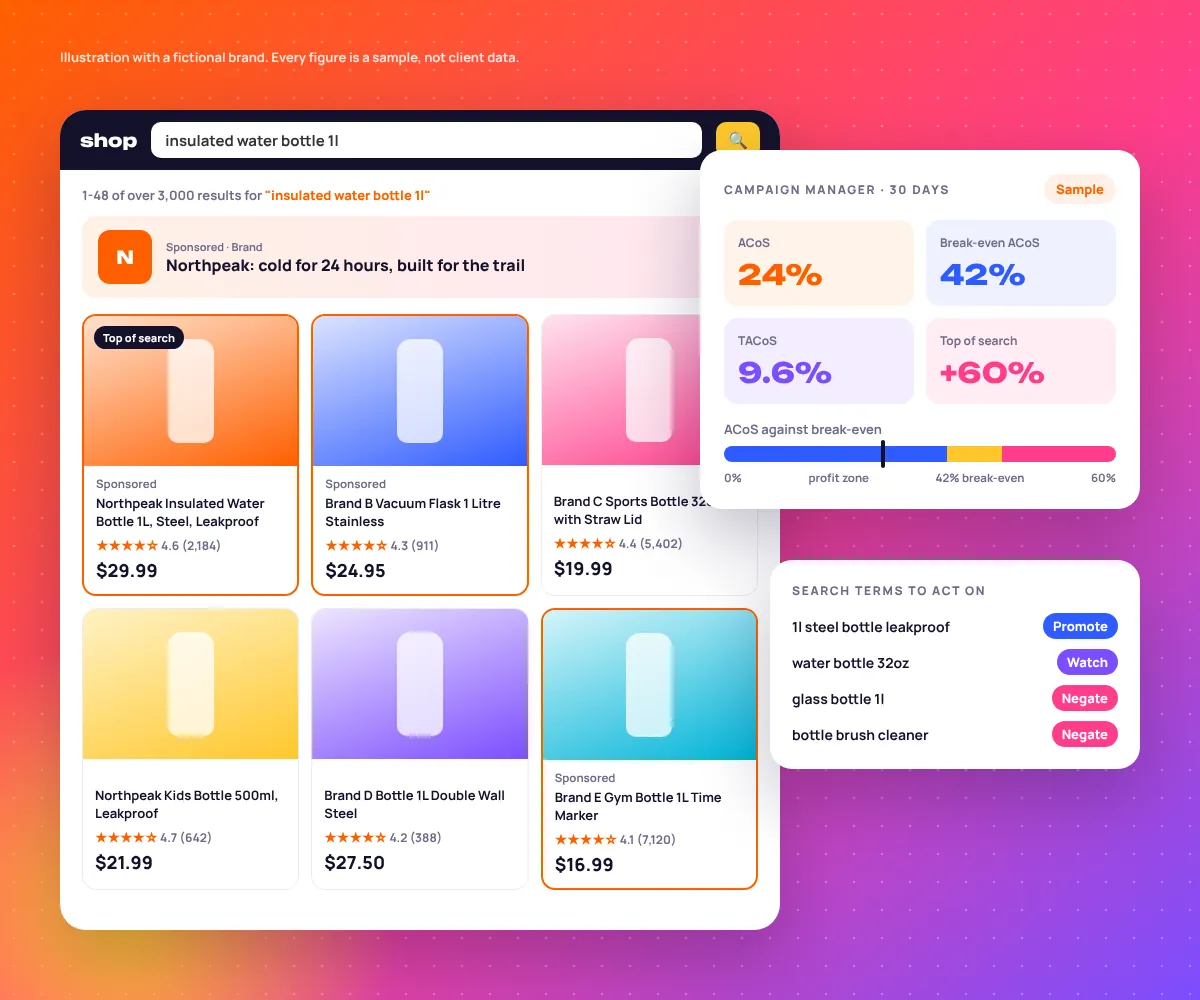
ACoS is ad spend divided by the sales those ads brought in. On its own it tells you little. A 35% ACoS is a disaster at 25% margin and comfortable at 50%.
So we work out break-even ACoS for every ASIN group before we touch a bid. Take your selling price, subtract the cost of the product, Amazon’s referral fee, the FBA fee and a fair allowance for returns and storage. What is left is profit before ads. Divide that by the price and you have the most you can spend on ads per sale without losing money.
ACoS vs TACoS, and why we report both
TACoS is ad spend divided by all your sales, organic included. ACoS keeps each keyword honest. TACoS tells you whether ads are building the business. If ads bring $10,000 in sales at 32% ACoS and the listing sells another $20,000 organically, TACoS is about 10.7%. When TACoS falls while sales grow, the ads are lifting your organic rank.
Break-even ACoS calculator
Sample numbers, change themWorked example (sample product): a $29.99 bottle costing $6.50, with a 15% referral fee ($4.50), a $5.20 FBA fee and $1.20 for returns and storage, leaves $12.59. Break-even ACoS is 42%. If you want 10% of the price as profit, the target ACoS is 32%. Check your real fees in Seller Central’s fee preview, as they change by size tier and category. Scale on the ruler runs from 0% to 60%.
The Keyword Harvesting Loop We Run Every Week
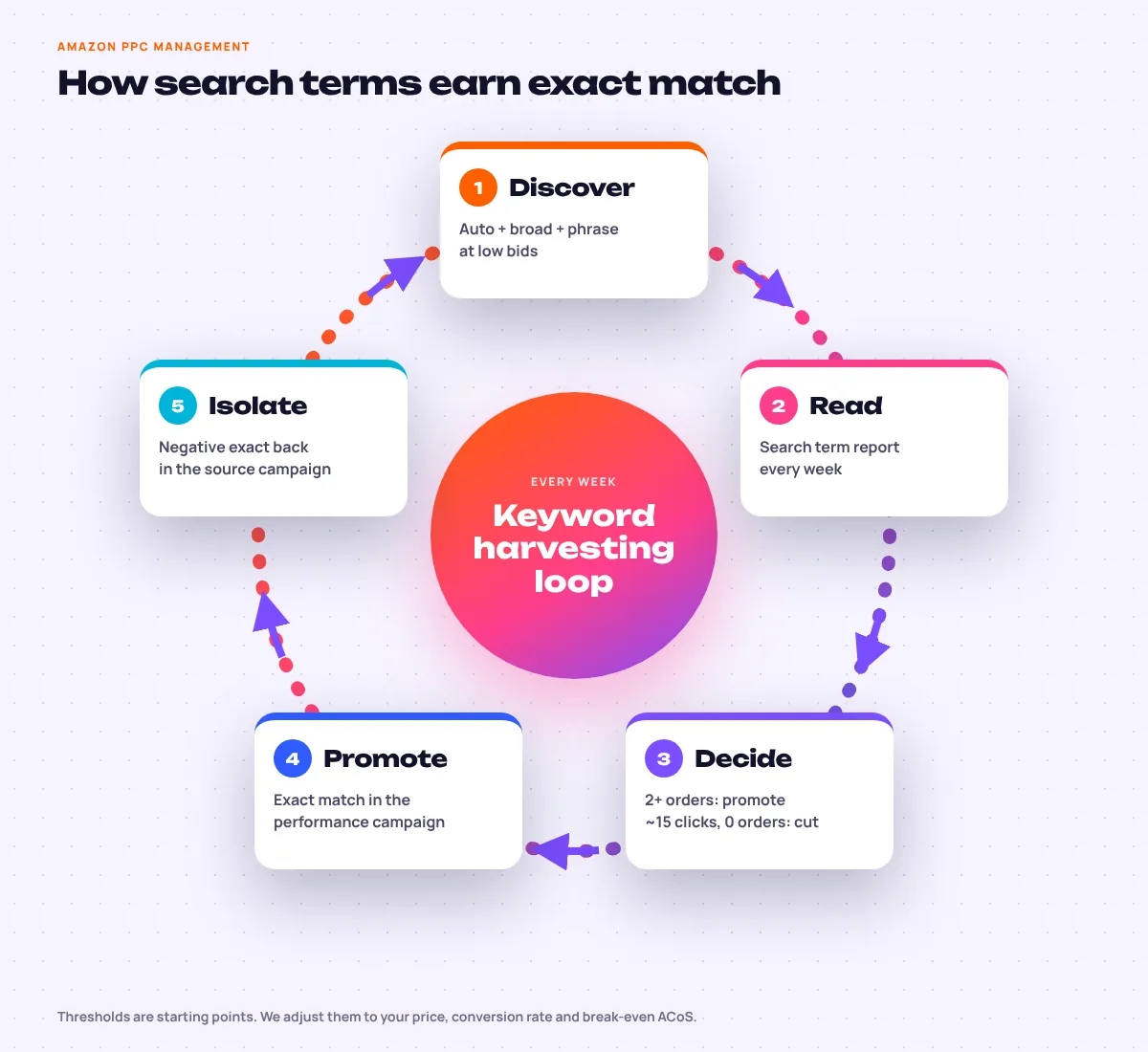
Auto campaigns are a research tool, not a strategy. Left alone for months they become the most expensive line in the account. The loop below is how search terms move from discovery to their own exact-match bid.
Exact, phrase, broad and negative exact
Each match type has one job in the loop.
broadFinds new phrasing at low bids. “steel water bottle” can match “metal flask for school”.
"phrase"Keeps word order, adds words around it. Good for mid-length terms like “water bottle 1l”.
[exact]Proven terms only, with the real bid and placement boosts. This is where the money goes.
-negative exactBlocks one search in one campaign. Used to stop a promoted term being bought twice.
-negative phraseBlocks a theme, like “glass” when you sell steel.
Our starting rules: a term with two or more orders in 30 days gets promoted. A term that has spent about 1.5 times your target cost per order with no sale gets cut or negated. Converting terms only convert if the page is good, which is why we often pair this with Amazon listing optimisation for the main search terms.
Amazon PPC Campaign Structure, Built Per ASIN Group
We group ASINs that share a buyer and a margin, usually variations of one product, and give each group the same set of campaigns. Budgets stay separate, so one hungry product cannot starve the rest.
ResearchFind terms cheaply
NP1L | SP | AUTO | RESClose match and substitutes on, loose match trimmed. Low bids.
NP1L | SP | BRD-PHR | RESSeed terms from Brand Analytics and competitor listings.
PerformanceWhere profit is made
NP1L | SP | EXACT | PERFPromoted terms with their own bids and a top-of-search boost.
NP1L | SP | EXACT | HEROThe two or three terms that drive rank, each in its own campaign.
ConquestTake shelf space
NP1L | SP | ASIN | CONQCompetitor ASINs with weaker reviews or higher prices than yours.
NP1L | SBV | CAT | CONQCategory terms where a 15-second demo beats a static image.
DefenceProtect what is yours
NP1L | SP | BRAND | DEFCheap clicks, kept separate so they never flatter the real ACoS.
NP1L | SD | ASIN | DEFYour ads on your own pages, pushing buyers to the bigger pack size.
The naming code means a bulk sheet can be filtered in seconds and nobody pauses the wrong thing. Brand campaigns sit apart because branded searches convert cheaply and would hide a weak account if mixed in.
Placements, Dayparting and Bid Rules
The same keyword has a different value depending on where the ad appears and what time it is.
Placement modifiers Top of search
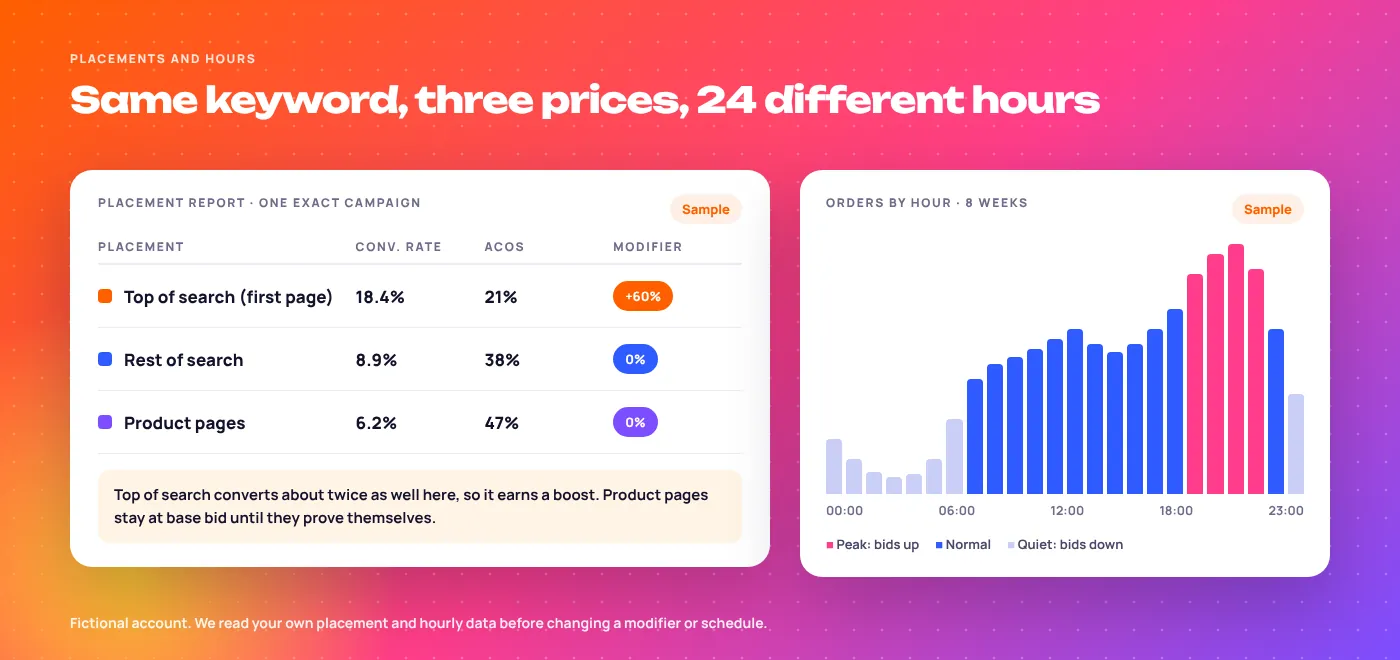
Amazon lets you raise bids by up to 900% for top of search, rest of search or product pages. We size the boost to the measured gap in conversion rate. Most exact campaigns end up between +20% and +100% on top of search.
Bidding strategy Dynamic
Research campaigns run on “down only” so Amazon can only lower bids. “Up and down” is reserved for proven exact terms, where we are happy for Amazon to bid harder.
Dayparting Schedules
After about eight weeks of hourly data, we lower bids in hours that rarely convert and protect budget for the evening peak, using schedule rules or a tool on the Amazon Ads API.
Bid rules Automated
Rules handle the routine moves: trim targets above target ACoS, nudge up winners losing impression share, cap budgets when stock runs low.
Four Gates Your Listing Passes Before We Raise Spend
Ads buy the visit. The listing makes the sale. If the page does not convert, more budget just buys more expensive failure and hurts your rank. We check these four first.
Buy Box
You need the featured offer most of the time, or Sponsored Products ads stop serving.
Reviews
As a rule of thumb, under about 15 reviews or below 4 stars, paid clicks convert poorly.
Images and copy
A clean main image, six or more supporting images, a video and bullets that answer objections.
Stock cover
At least six to eight weeks of inventory. Running out wipes ads and organic rank together.
Reading Search Query Performance in Brand Analytics
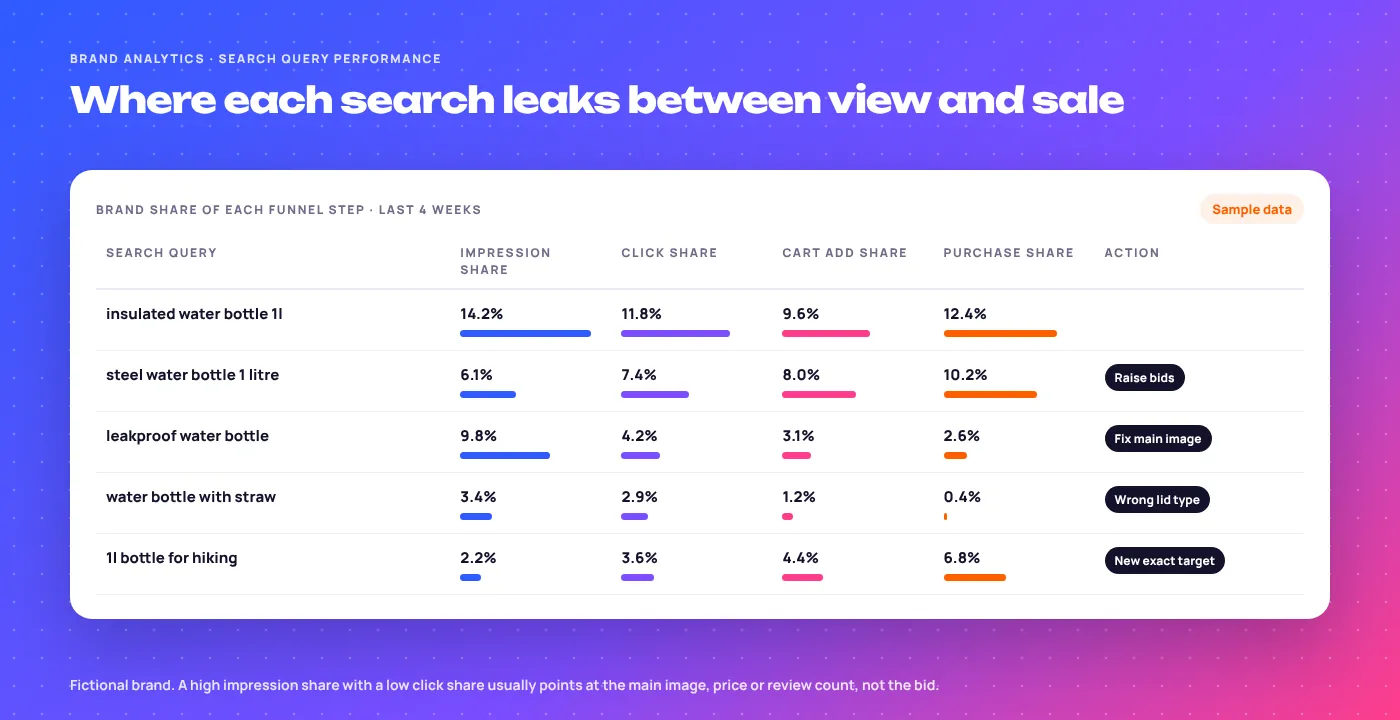
If you are brand registered, Search Query Performance shows your share of impressions, clicks, cart adds and purchases for each search. It is the best free diagnostic Amazon gives you.
High impression share with low click share points at the main image, price or rating. Purchase share above impression share means you convert better than the market, so that term deserves more bid.
What a Month of Amazon PPC Management Looks Like
Good accounts run on a calendar, not on memory.
Around Prime Day, Black Friday and big local sale events the calendar compresses: budgets go up for the event days, bids are reviewed daily and deals are lined up two weeks before. New products follow a different, faster rhythm covered in our Amazon launch strategy.
Your First 90 Days With Our Amazon PPC Agency
We have not published an Amazon case study yet, so we will not show you a made-up one. Here is exactly what you get, and when.
Launch pack
- Audit of the last 60 days of search terms
- Break-even and target ACoS per ASIN group
- New structure live, brand split out
First harvest
- Wasted terms negated, with the spend they had eaten
- Converting terms promoted to exact
- Listing fixes flagged from SQP data
Placements and hours
- Top-of-search modifiers set from your data
- Dayparting where the hourly pattern supports it
- First Sponsored Brands video test
Scale plan
- TACoS trend per ASIN group
- Which products earn more budget, which do not
- Next quarter’s event and launch calendar
What we can show is the wider record: 85+ brands served, $10M+ in ad spend managed and $25M+ in revenue generated for clients across all channels since 2021. Product brands like the UK packaging store in our Artsy Packaging Google Shopping case study and the US baby brand behind the Simple Seed Baby case study were run with the same margin-first thinking. Browse all client success stories or the brands we work with.
Services That Plug Into Your Amazon PPC
Amazon PPC sits inside our wider Amazon advertising service, and most sellers we work with also sell direct. See how we run ecommerce marketing and B2C marketing services, or read practical guides on the EmergingAds blog.
Amazon PPC Questions Answered
What is Amazon PPC management?
The ongoing work of building, checking and adjusting Sponsored Products, Sponsored Brands and Sponsored Display campaigns: keyword harvesting, negatives, bids, placements, budgets and reporting, all judged against what each product can afford to pay for a sale.
What is a good ACoS on Amazon?
One below your break-even ACoS, which is profit per unit before ads divided by price. For a product with 42% break-even, 30% is healthy. For one with 20% break-even, 30% loses money on every ad sale.
What is the difference between ACoS and TACoS?
ACoS is ad spend divided by ad-attributed sales. TACoS is ad spend divided by total sales, including organic. ACoS judges campaigns and keywords. TACoS shows whether advertising is growing the whole business.
How long does Amazon PPC take to work?
We launch in about 14 days. The first month is about data and cutting waste. Placement, dayparting and scaling decisions usually land between days 30 and 90, which is why we work on a 3-month minimum.
Is Amazon PPC worth it for a small seller?
Usually yes, if the listing is ready: Buy Box, decent reviews, good images and enough stock. On Amazon, ad sales also help organic rank, so the return is often bigger than the ad report shows.
Should I keep auto campaigns running?
Yes, at low bids, as a research campaign. What goes wrong is leaving them as the main campaign. Terms that sell should move to exact match and be added as negative exact in the auto campaign.
Do I need Brand Registry for Amazon ads?
Not for Sponsored Products. You do need it for Sponsored Brands, most Sponsored Display options, Stores and Brand Analytics reports such as Search Query Performance.
Do you manage Vendor Central accounts too?
Yes. We run Amazon PPC for third-party sellers on Seller Central and first-party vendors. The campaign work is the same. Margin inputs differ, since vendors sell at wholesale cost to Amazon.
Which Amazon marketplaces do you work in?
Mostly the US, UK, UAE, Australia and India. Each marketplace gets its own break-even maths, as fees and prices differ.
What reports will I get?
A monthly report with ACoS and TACoS per ASIN group, waste removed, terms promoted and next month’s plan, plus a strategy call.
Find Out Where Your Ad Budget Is Leaking
Send us your account and we send back your break-even ACoS per product, the search terms wasting the most money and the structure we would build. Free, and no pitch deck.
