
Launch New ASINs. Dominate Page 1.
Our Amazon product launch strategy takes a new ASIN from zero reviews and zero rank to steady page 1 sales in about 90 days, without the shortcuts that get listings pulled.
- Pre-launch
- Discovery
- Ranking push
- Efficiency
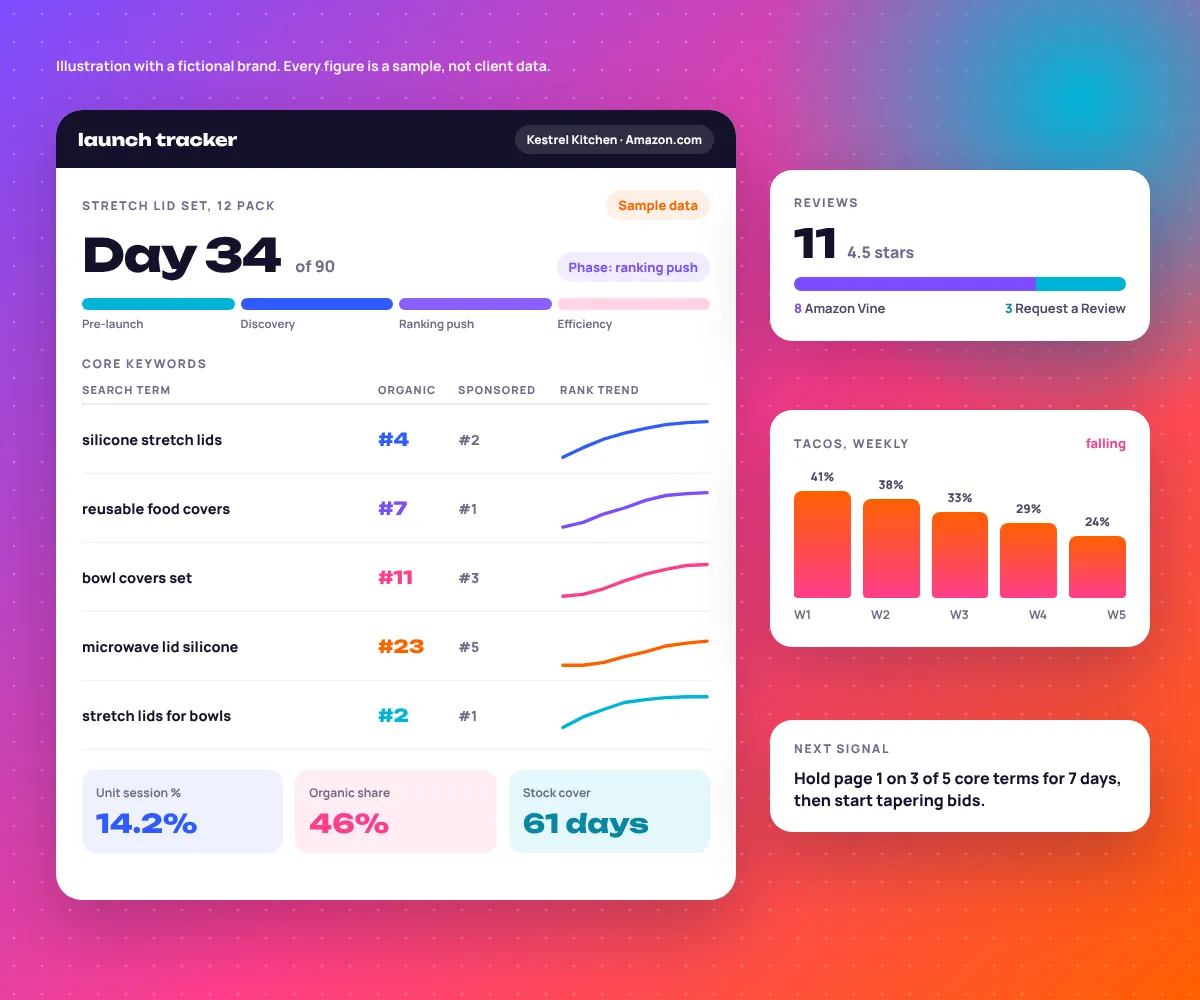
What Is an Amazon Product Launch Strategy?
An Amazon product launch strategy is the plan that takes a new ASIN from no sales history, no reviews and no organic rank to steady page 1 sales, by lining up listing, stock, reviews, ads and outside traffic in order.
A new listing gives Amazon nothing to judge. Every early sale, click and review teaches the algorithm what your product is relevant for, so how to launch a product on Amazon is really about making those first signals good ones.
EmergingAds is a performance marketing agency founded in 2021 and based in Gurugram, India. We work with brands in the US, UK, UAE, India and Australia and have served 85+ brands.
How to launch a product on Amazon, and what this page is not
- Launch = the first 90 days of one ASINReadiness, first reviews, rank, then the switch to efficiency.
- Not ongoing adsBids after day 90 belong to Amazon PPC management.
- Not a listing rewriteCopy and images come from Amazon listing optimisation; we check they are ready.
Is Your ASIN Ready? The Pre-Launch Checklist
A new ASIN is ready to launch when Brand Registry is active, the listing is indexed for its core keywords, the image stack and A+ Content are live, and enough FBA stock shows as available to cover the plan. Advertising before all four is the commonest launch mistake.
| Item | Ready means | Why it matters at launch |
|---|---|---|
| Brand Registry | Approved in this marketplace | Unlocks Vine, A+ Content, Sponsored Brands and the Brand Referral Bonus |
| Keyword indexing | The ASIN shows for each core term | Ads cannot build organic rank where you are not indexed |
| Images and video | White main image, 6+ more images, one video | Early clicks are expensive; the gallery decides if they convert |
| A+ Content | Approved, Brand Story added | Answers objections zero reviews cannot |
| FBA inbound | Units show as available, not “inbound” | Check-in can take one to three weeks, longer in Q4 |
| Stock cover | 90 days of planned sales plus reorder lead time | A mid-launch stock-out resets the rank you paid for |
| Tracking | Attribution tags and rank tracker set up | Phase changes need daily rank and source data |
Account-side tasks like inbound shipments and capacity limits sit with our Amazon Seller Central management team.
Amazon Vine Reviews and Early Reviews Within Policy
How do you get reviews on a new Amazon product?
Enrol the ASIN in Amazon Vine, which sends free units to invited reviewers, and use the Request a Review button on every eligible order. Both are Amazon’s own tools. Anything that pays, refunds or rewards a buyer for a review, or asks only happy buyers, breaks Amazon’s Community Guidelines.
Per Seller Central Help, Vine needs Brand Registry, FBA stock and fewer than 30 reviews on the parent ASIN, and you can offer up to 30 units. Amazon Vine reviews are honest and can be blunt, so the listing gets fixed first.
- AllowedAmazon Vine
Enrol as soon as stock is live. Vine reviews are labelled and count toward your rating.
- AllowedRequest a Review
One neutral request per order, 5 to 30 days after delivery.
- AllowedNeutral inserts
Care tips and a support contact; never a review ask or a gift.
- Not allowedRebates, review clubs, swaps
These get reviews, or the listing, removed.
New-to-Brand Programmes Worth Using in a Launch
Two different things share the label; both matter early.
New Seller Incentives and FBA New Selection
Amazon offers credits and fee relief on eligible new parent ASINs and newly registered brands in several marketplaces. Terms change yearly, so we claim what applies before day 0.
New-to-brand metrics in Amazon Ads
Amazon Ads counts an order as new-to-brand when the shopper has not bought from your brand in 12 months. A high share at launch means ads are finding new customers.
Amazon Launch PPC in Three Phases
Amazon launch PPC starts wide to find the search terms that convert, narrows to push rank on the few that matter, then cuts spend where organic rank holds. Each phase ends on a signal in the data, not a date. Rushing to efficiency is the classic way to lose rank you paid for.
| Phase | Goal | Tactics | Signal to move on |
|---|---|---|---|
| DiscoveryRoughly days 0 to 21 | Find converting terms | Auto and broad research, exact on 5 to 10 core terms, rival product targeting | Two weeks of search term data; terms converting at category rate |
| Ranking pushRoughly days 21 to 60 | Core terms onto page 1 | Exact match with top-of-search bids, Sponsored Brands video once reviews land | Page 1 organic rank holding for 7 to 14 days |
| EfficiencyRoughly days 60 to 90 | Keep rank, lower ad share | Taper bids where organic holds, pause losers, defend brand terms | TACoS falling as organic share rises |
Day ranges are typical; crowded categories take longer.
Coupons, Prime Exclusive Discounts and Lightning Deals
Promotions lift conversion while reviews are thin.
Coupons
A clippable badge in search results. The easiest early conversion lift, with no sales history needed.
Prime Exclusive Discounts
Shown to Prime members. Rating and price history rules apply, so we check each ASIN.
Lightning Deals
Time-boxed deals that usually need sales history and a minimum rating, so not day one.
Avoid launching at a deep discount and then jumping the price; reference price rules and conversion both punish it.
External Traffic and the Amazon Brand Referral Bonus
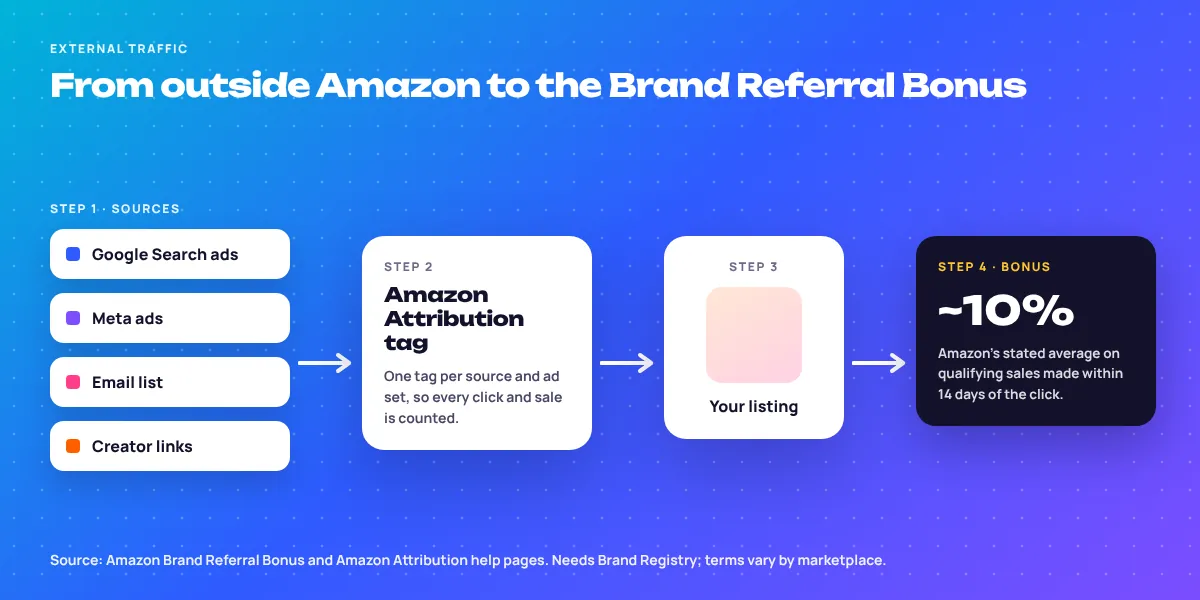
Traffic from Google, Meta, email or creators adds sales that help rank. Tag every link with Amazon Attribution and enrol in the Brand Referral Bonus, and Amazon pays brand owners a bonus that averages 10% of qualifying sales from that traffic.
Source: Amazon’s Brand Referral Bonus page and Amazon Attribution docs; purchases qualify within 14 days of the click. Off-Amazon clicks convert lower, so warm audiences go first.
The Meta and Google side is the work behind our Simple Seed Baby case study (4x ROAS on its own store, not Amazon). Bigger launches can add Amazon DSP advertising.
Is the Amazon Honeymoon Period Real?
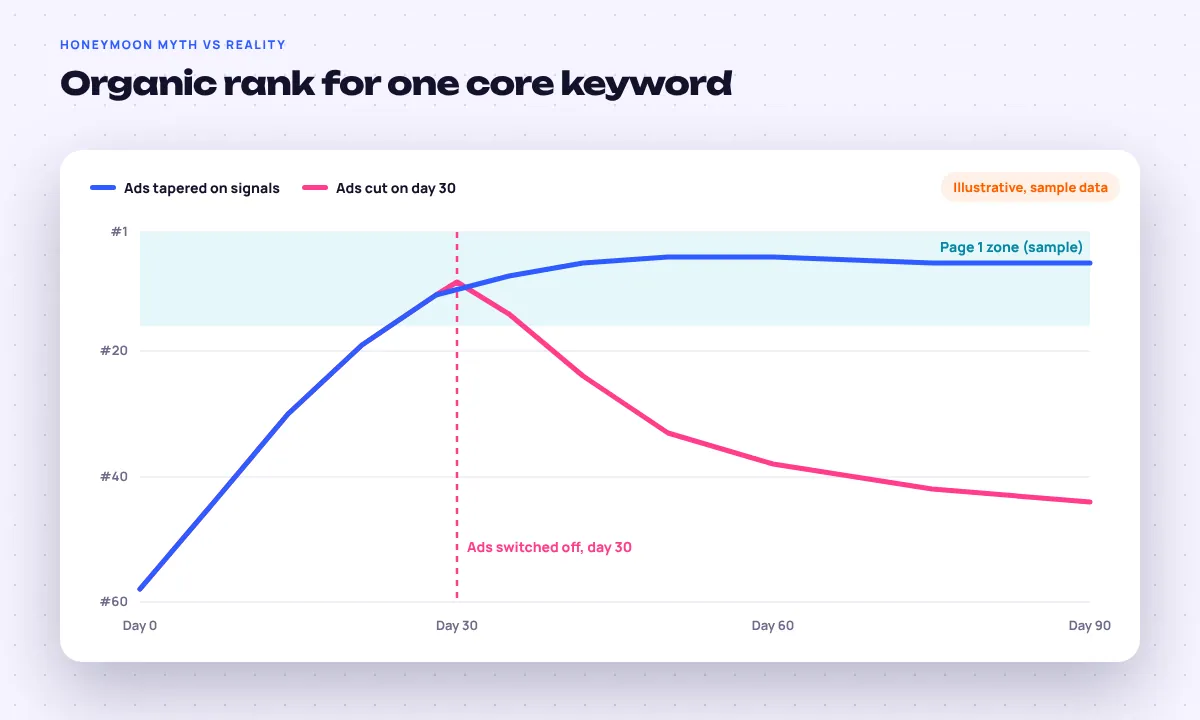
Partly. Amazon has never documented a honeymoon period, but new listings do get tested in search, and the sales velocity and conversion rate you show early feed ranking quickly. There is no fixed window that closes forever; a weak launch can be recovered.
| What sellers hear | What we see |
|---|---|
| “Amazon boosts every new ASIN for 30 days” | New listings get test impressions; conversion decides if they stay |
| “Miss the window and the ASIN is dead” | Rank can be rebuilt with better listing, reviews and steadier ads |
| “Sell units at any price” | Sales from relevant searches count most |
| “Turn ads off once you hit page 1” | Cutting ads overnight often drops rank; taper on signals |
Amazon Keyword Rank Tracking During a Launch
How do you track keyword rank on Amazon?
Track organic and sponsored position for 10 to 20 core search terms every day, per marketplace. Pair it with Search Query Performance in Brand Analytics, which shows your share of impressions, clicks, add-to-carts and purchases per search term. Best Sellers Rank alone lags too much to steer by.
Amazon keyword rank tracking is half the report; the rest:
- Organic rank, core terms Daily
- The launch scoreboard and the phase signal.
- Unit session percentage Daily
- Amazon’s conversion rate. If it lags, more traffic will not fix rank.
- Purchase share by query Weekly
- Winning sales for the term, not just clicks.
- Reviews and star rating Weekly
- Vine progress and early complaints to fix.
- TACoS and organic share Weekly
- Ad share of sales should fall as organic orders rise.
- Days of stock cover Weekly
- A stock-out undoes rank.
How Long Does an Amazon Product Launch Take?
Plan on about 90 days from first sale to a stable ASIN, plus two to four weeks of prep before day 0. Easy categories can settle in 45 to 60 days; crowded ones take longer. Each step below is gated by a signal, not the calendar.
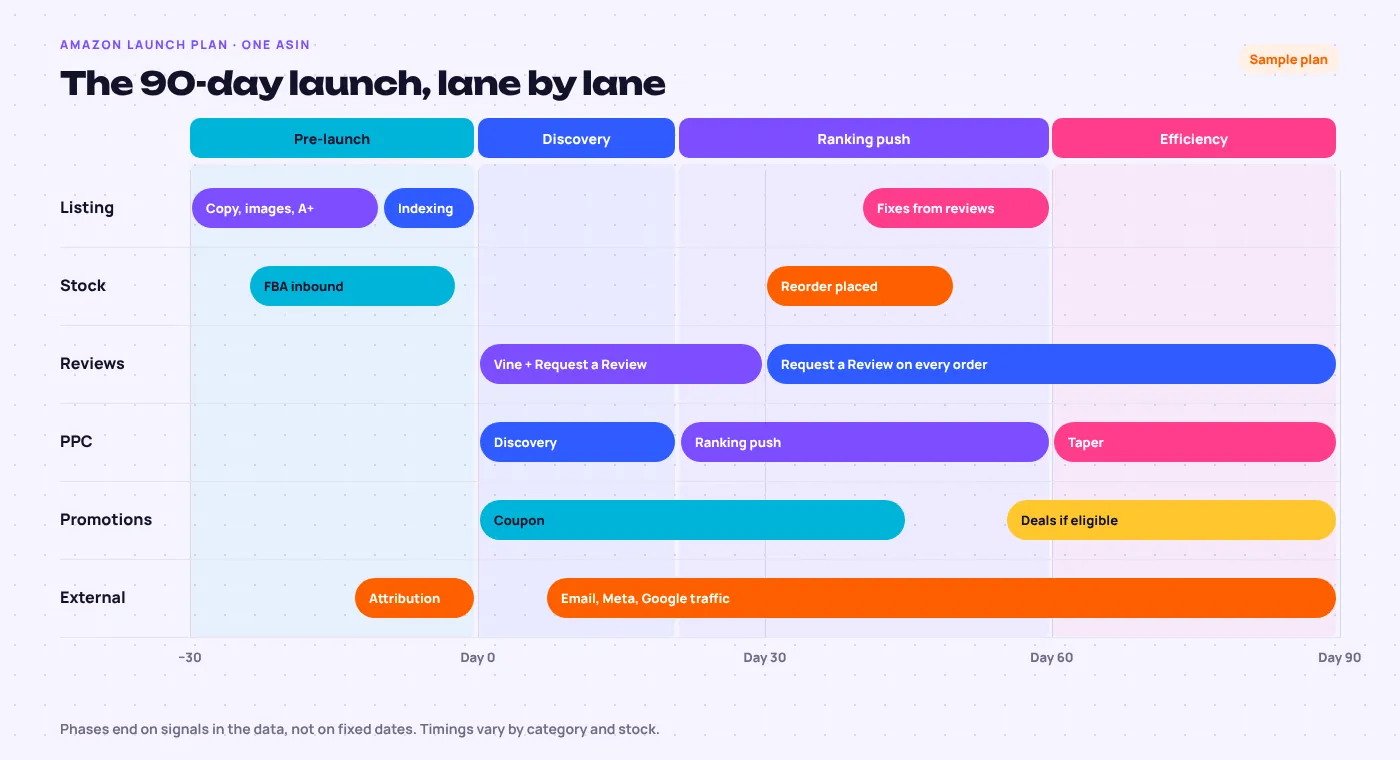
- Day −30
Keyword map and teardown
Core and long-tail terms, rival reviews and weak spots.
10 to 20 core terms agreed - Day −21
Readiness checks
The checklist above, line by line.
Every core term indexed - Day −14
Stock in, tracking built
FBA inbound, Attribution tags, rank tracker, incentives claimed.
Units show as available - Day 0
Go live
Vine, launch coupon and discovery campaigns switch on together.
First orders on core terms - Day 7
External traffic on
Warm email, Meta and Google audiences through tagged links.
Attribution data flowing - Day 21
Ranking push
Spend focused on converting exact terms, top-of-search bids up.
Core terms nearing page 1 - Day 45
Fix and add
Listing tweaks from reviews, Sponsored Brands video, deals if eligible.
Page 1 holding 7 to 14 days - Day 60 to 90
Taper and hand over
Bids tapered, TACoS target set, ongoing management takes over.
TACoS falling, organic rising
Review Manipulation, Rank-and-Bank and Other Launch Traps
Amazon’s Prohibited Seller Activities page bans paid or fake orders that inflate sales rank; its Community Guidelines ban rewarded reviews. Penalties reach account suspension.
Rank-and-bank schemes
Discounted or refunded orders through special links to push rank. It is sales rank manipulation, and rank falls when it stops.
Incentivised reviews
Free product, refunds or gift cards for a review. Amazon removes them in bulk.
Borrowing reviews
Merging into an unrelated variation family to inherit ratings breaks policy.
Launching thin on stock
A big ad push on little stock means a week-three stock-out and lost rank.
Day 31 ads switch-off
Cutting ads because the honeymoon is “over” drops velocity and rank.
Keyword stuffing
Irrelevant terms get clicks that never convert and teach Amazon the wrong match.
How We’d Run Your Amazon Launch
We have not published an Amazon launch case study yet, so we will not show you an invented one.
Those are agency-wide figures, not Amazon results. What carries over is the habit: written phase signals, daily numbers, one owner per problem. Your launch starts with the free audit and a written 90-day plan. See our success stories and the brands we work with.
Amazon Services That Carry the Launch Forward
- Amazon PPC managementTakes over bids, harvesting and structure after day 90.
- Amazon listing optimisationTitles, bullets, images and A+ built before launch.
- Amazon Seller Central managementInbound shipments, stock cover and account health.
- Amazon DSP advertisingReach and retargeting on and off Amazon.
Launches sit inside our full Amazon advertising services. Selling direct as well? See ecommerce marketing and B2C marketing services, or read more on the EmergingAds blog.
Amazon Launch Strategy Questions Answered
What is an Amazon launch strategy?
It is a plan for the first 90 days of a new ASIN: readiness, first reviews, launch PPC, promotions and external traffic, so the product earns organic rank.
How long does an Amazon product launch take?
About 90 days from first sale, plus two to four weeks of prep. Less crowded categories can stabilise in 45 to 60 days.
How do I get my first reviews on a new Amazon product?
Use Amazon Vine and the Request a Review button. Vine needs Brand Registry and fewer than 30 reviews; Request a Review works 5 to 30 days after delivery.
Is Amazon Vine worth it for a new product?
Usually yes. A few honest reviews early lift conversion, so ranking takes less ad spend.
Is the Amazon honeymoon period real?
Not as a fixed window. Amazon has never documented one, though new listings get tested early and sales velocity helps rank.
How does the Amazon Brand Referral Bonus work?
Enrolled brand owners earn a bonus averaging 10% of qualifying sales made within 14 days of a click from tagged external traffic. It needs Brand Registry and Attribution links.
Should I run Lightning Deals at launch?
Not on day one. They usually need sales history and a minimum rating, so coupons come first.
Are rank-and-bank or search-find-buy services allowed?
No. Amazon prohibits paid or incentivised orders meant to inflate sales rank. The risk is review removal, listing removal or suspension.
When should I lower ad spend after launching on Amazon?
When page 1 organic rank has held for one to two weeks on core terms. Taper bids gradually; never switch ads off overnight.
Do I need Amazon Brand Registry to launch a product?
Not strictly, but we advise it. Vine, A+ Content, Sponsored Brands and the Brand Referral Bonus all require it.
Which Amazon marketplaces do you launch products in?
Amazon US, UK, UAE, India, Australia and Canada, each with its own keyword map and stock plan.
Ready to Launch Your New Product on Amazon?
Send us the ASIN or product you are about to list. We check readiness, keywords and rivals, then send a 90-day plan.
- Listing and indexingCheck
- Stock and FBA timingCheck
- Reviews planCheck
- Launch PPC phasesCheck
