How Much Should I Pay a Digital Marketing Agency
Key Takeaways
- Agency pricing ranges widely by scope, channel, and business size, so any number without context is close to meaningless on its own.
- Retainer, percentage-of-spend, and project-based pricing each fit different situations, and the wrong model can quietly misalign incentives even at a fair rate.
- The lowest quote is rarely the best value once account management quality, reporting rigor, and actual media buying skill are factored in.
- A fair quote should scale roughly with complexity and ad spend managed, not just with how many channels are bundled into a package.
- Asking an agency to walk through exactly what’s included at a given price point, hours, deliverables, reporting cadence, is the fastest way to spot a lowball or a padded quote.
Why There’s No Single Right Answer to This Question
Anyone promising a single number for what a digital marketing agency should cost is oversimplifying a question that genuinely depends on scope, channel mix, business size, and competitiveness of the category. A local service business running a modest Google Ads campaign and a national e-commerce brand running paid social, email, and SEO simultaneously are not buying the same thing, and pricing them against the same benchmark is not useful to either one.
What’s more useful than a single number is understanding the pricing models agencies actually use, the ranges typical for different business sizes, and the specific factors that push a quote up or down, so a given number can be evaluated in context rather than compared against a vague industry rumor.
It’s also worth separating the question of what’s typical from the question of what’s fair for a specific business’s situation. A price can be perfectly typical for the industry and still be a poor fit, either too much for a business that only needs light, focused support, or genuinely too little to deliver the coordinated, multi-channel strategy a growing business actually needs. The rest of this guide is built around helping answer that second, more useful question rather than chasing a single universal number.
The Three Common Agency Pricing Models
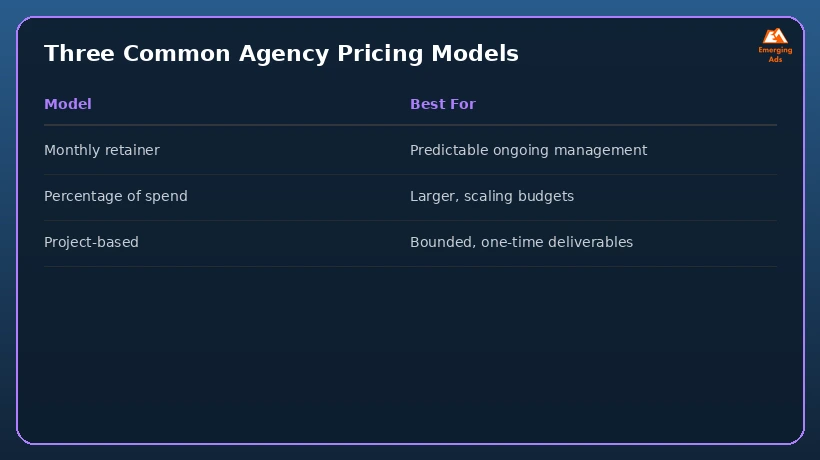
| Model | How It Works | Best For |
|---|---|---|
| Monthly retainer | Fixed fee for an agreed scope of ongoing work | Businesses wanting predictable, ongoing management |
| Percentage of ad spend | Fee scales as a percentage of the media budget managed | Larger budgets where spend and effort roughly correlate |
| Project-based | Fixed fee for a defined, bounded deliverable | One-time work like a website rebuild or a strategy audit |
Many agencies blend models, a base retainer covering strategy and account management plus a smaller percentage on ad spend, which can actually align incentives better than either model alone, since it rewards the agency for both strategic thinking and effective spend management rather than just one or the other.
Typical Retainer Ranges by Business Size
Small, local businesses running a single channel typically see monthly retainers in a modest range that covers basic campaign management, reporting, and light optimization. Growing businesses running multiple channels, paid search plus paid social plus email marketing, for example, sit meaningfully higher, since coordinating a multi-channel strategy takes more strategic and account management time even before media spend enters the picture.
Established mid-market and enterprise businesses running significant ad budgets across several channels, often paired with content and conversion optimization work, sit at the higher end, reflecting both the complexity of coordinating multiple workstreams and the larger media budgets typically being managed alongside the strategic work.
What Actually Drives the Price Up or Down
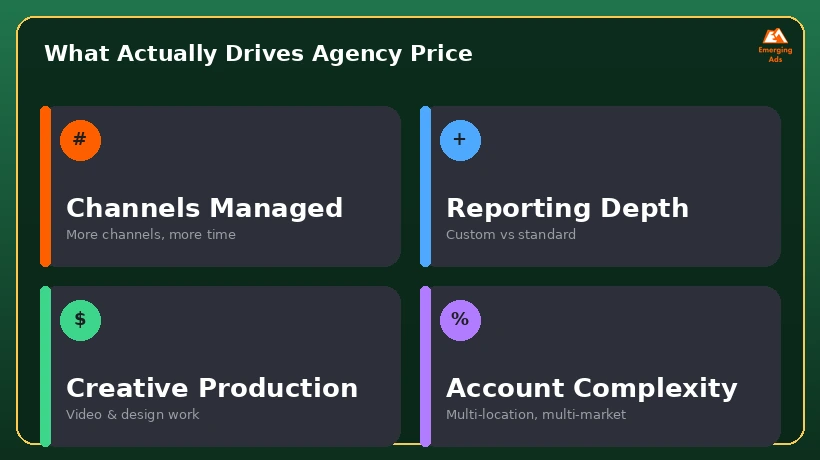
- Number of channels being managed simultaneously, each one adds real strategic and execution time, not just a flat add-on fee
- Reporting cadence and depth, weekly custom reporting costs more to deliver than a standard monthly dashboard
- Level of creative production involved, ongoing video and design work adds meaningfully more cost than campaign management alone
- Account complexity, a business with multiple locations, product lines, or target markets takes more setup and ongoing management time
- Agency seniority and specialization, a boutique agency with deep category expertise often charges more than a generalist shop, sometimes justifiably
Percentage-of-Spend Pricing, and Why It’s Controversial
Percentage-of-spend pricing, typically a range around media budget, scales naturally with account size, which sounds fair on paper. The controversy comes from a misaligned incentive: an agency paid a straight percentage of spend has a built-in reason to recommend spending more, even when a lower, better-optimized budget would serve the client just as well or better.
This doesn’t make percentage-of-spend pricing inherently bad, many reputable agencies use it responsibly, but it does mean a client should watch for whether budget recommendations seem tied to genuine performance opportunity or simply to growing the fee. Asking directly how the agency’s recommendations would change if the pricing model were flat instead of percentage-based is a useful gut check, and a confident agency should be able to answer that question without hesitation, walking through specific examples from recent client work rather than offering a vague reassurance, and being upfront about how those recommendations have shifted budget in either direction for existing clients, including cases where they advised a client to spend less because the data didn’t support scaling further, since that willingness to recommend against more spend is often the clearest signal of genuine trustworthiness available.
Red Flags That a Quote Is Too Good to Be True
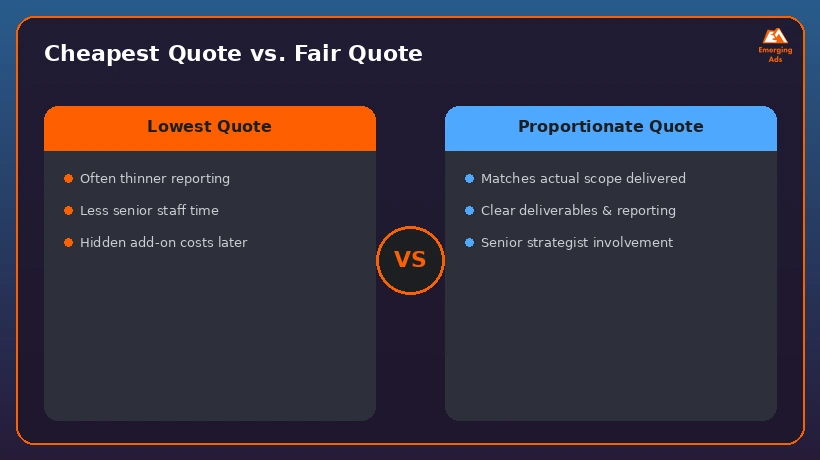
- A price dramatically below every other quote received, often a sign of inexperienced staff, minimal actual account attention, or hidden add-on fees later
- No clear explanation of what’s actually included at that price point beyond vague language like ‘full management’
- Guaranteed results promised at an unusually low fee, a combination that rarely holds up once the account is live
- Heavy reliance on automated, templated campaign setups with little evidence of custom strategy work
The cheapest quote often ends up costing more in the long run through wasted ad spend, missed optimization opportunities, or the cost of eventually switching agencies after underperformance becomes obvious, at which point months of momentum have already been lost.
Signs You’re Being Overcharged for What You’re Getting
Overpaying looks different from underpaying, but it’s just as common. Warning signs include a retainer that’s climbed steadily without a corresponding increase in scope or results, reporting that stays generic and high-level despite repeated requests for more detail, or an account team that’s clearly stretched thin across too many clients to give genuine strategic attention to any one of them.
Another quieter sign is a lack of proactive recommendations. An agency genuinely earning its fee should periodically surface new opportunities, an underused channel worth testing, a landing page worth revisiting, a targeting adjustment based on recent performance, rather than only reacting when the client asks a question. A retainer that’s functioning as pure maintenance, with no strategic momentum behind it, is rarely worth what it’s costing, regardless of how the number compares to the broader market.
A useful sanity check is comparing the retainer against what an in-house hire of equivalent seniority would cost, factoring in that an agency typically brings a broader skill set and tooling than a single hire could. If the retainer significantly exceeds that comparison without a clear reason, tenure, specialization, results, that’s worth raising directly rather than assuming it’s simply the market rate.
How to Compare Quotes From Different Agencies Fairly
Comparing quotes side by side only works when the scope is actually equivalent. Request a detailed breakdown from each agency, channels covered, reporting cadence, whether creative production is included, and how much dedicated strategist time the retainer buys, before comparing the headline number. A quote that looks 30 percent cheaper but excludes creative production or reporting that another quote includes isn’t actually cheaper, it’s just narrower.
It’s also worth asking each agency directly how they’d approach the account differently, rather than only comparing price. Two agencies quoting similar fees can have meaningfully different strategic points of view, and that difference often matters more to eventual results than a few hundred dollars of monthly fee variance.
Requesting a written scope of work alongside the quote, not just a verbal summary on a sales call, gives a much clearer basis for comparison later and also protects against scope creep once the engagement is underway. An agency reluctant to put the scope in writing before signing is itself a useful data point about how the relationship is likely to be managed going forward.
Questions to Ask Before Signing Any Agreement
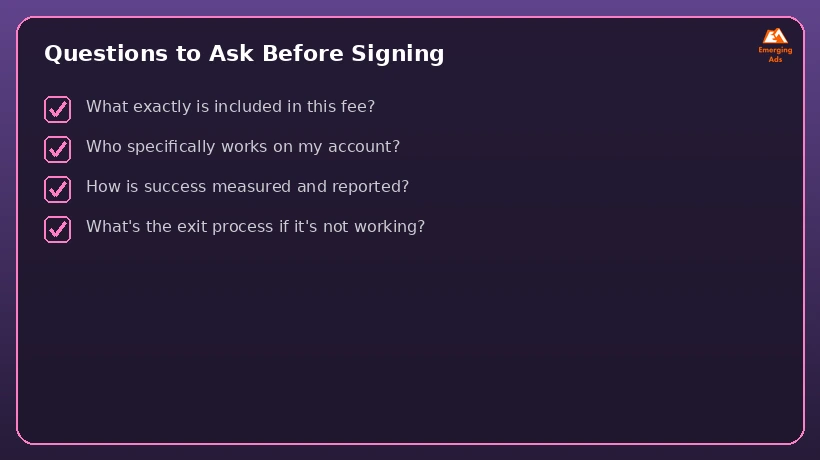
- What exactly is included in this fee, and what would trigger an additional charge
- Who specifically will be working on the account, and how many other clients does that person manage
- How is success measured and reported, and how often
- What’s the minimum commitment period, and what does the exit process look like if it’s not working out
- Can I see an anonymized example of reporting for a client in a similar situation
An agency confident in its own work should answer all five of these clearly and specifically. Vague or evasive answers to any of them, particularly the second and third, are a stronger signal than the price itself about what the actual experience of working together will look like, since these questions cut straight through marketing language and into how the day-to-day relationship will actually run.
Agency vs. Freelancer vs. In-House: A Cost Comparison
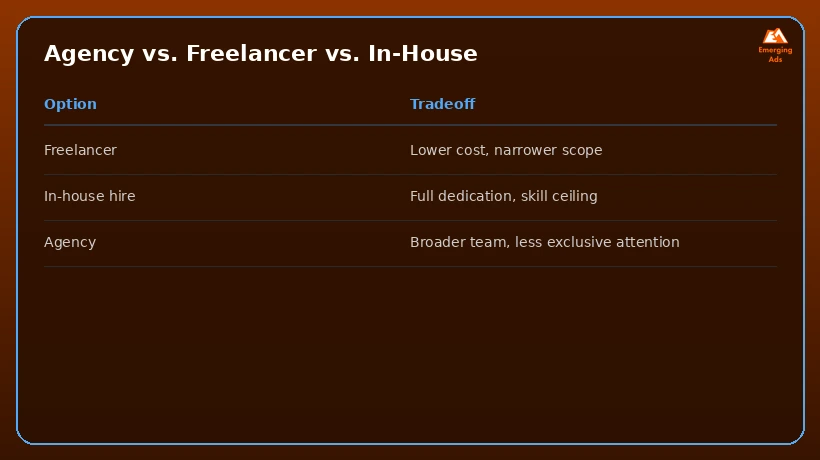
Agency pricing only makes sense in context against the realistic alternatives, freelance specialists and an in-house hire. A freelancer typically costs less per hour than an agency’s blended rate, but usually covers a narrower skill set, one channel or discipline rather than coordinated strategy across several, and lacks the built-in backup coverage an agency team provides when a single freelancer gets sick, goes on leave, or simply moves on to other work.
| Option | Typical Cost Pattern | Tradeoff |
|---|---|---|
| Freelancer | Lower hourly rate, narrower scope | Single point of failure, limited strategic breadth |
| In-house hire | Salary plus benefits and tools, fixed regardless of workload | Full-time dedication, but a ceiling on skill diversity per hire |
| Agency | Retainer scaling with scope and complexity | Broader skill set and coverage, but less exclusive attention than a dedicated hire |
The right choice often isn’t purely about which option is cheapest on paper, it’s about which one matches the actual complexity and channel mix a business needs managed. A business running one simple channel might genuinely be better served by a skilled freelancer, while a business coordinating several channels with real strategic interdependence, paid, organic, email, tracking, all needing to work together, usually gets more value from an agency’s coordinated team than from stitching together several freelancers who don’t naturally communicate with each other.
For a deeper look at how to evaluate the decision beyond just cost, factors like specialization, communication style, and reporting transparency, our related guide on how to choose a digital marketing agency walks through the selection process this pricing-focused piece doesn’t cover in depth.
When It Makes Sense to Pay More
Paying above the typical range makes sense when a business is entering a genuinely complex situation, a highly competitive category, a multi-market or multi-language expansion, or a business with an unusually intricate attribution and measurement setup, where deep specialization is worth the premium over a generalist agency charging less.
It also makes sense to pay more for an agency with a demonstrated, verifiable track record in the exact category, versus one making broad claims without specific proof. Reviewing real case studies from a prospective agency, and ideally talking to a current or former client directly, is worth more than any pricing comparison alone.
Finally, it’s worth paying more for genuine responsiveness and communication quality, since a slightly cheaper agency that’s slow to respond, inconsistent with reporting, or difficult to reach when something urgent comes up ends up costing more in lost time and missed opportunities than the fee difference would ever suggest. If it’s unclear whether current spend, with an existing agency or in-house, is actually proportionate to results, a free audit is a straightforward way to get an outside read on that before the next renewal conversation.
Frequently Asked Questions
What’s a typical starting retainer for a small business?
It varies by channel and market, but most small businesses running a single well-managed channel should expect a modest monthly retainer that covers campaign management, basic reporting, and ongoing optimization, scaling up meaningfully once multiple channels or heavier creative production get added.
Is percentage-of-spend pricing always a bad sign?
No, many reputable agencies use it responsibly and it can align well with larger budgets. The key is watching whether spend recommendations seem driven by genuine opportunity or by growing the fee, and asking directly how recommendations would change under a flat-fee model.
Should I choose the cheapest agency that quotes me?
Not automatically. The cheapest quote often means less senior staff time, thinner reporting, or hidden add-on costs that surface later, and the total cost of underperformance or an eventual agency switch frequently exceeds the initial savings.
How do I know if my current agency is overcharging me?
Compare the retainer against the actual scope delivered, channels covered, reporting depth, strategist attention, against both the market rate for that scope and what an equivalent in-house hire would cost, and watch for a retainer that’s grown without a corresponding increase in results or scope.
Do agencies charge extra for creative production like video or design?
Often yes, ongoing creative production is frequently priced separately from campaign management, since it requires meaningfully different skills and time investment. Always ask whether creative is included in a quoted retainer or billed as an add-on.
Is a longer contract term usually cheaper?
Sometimes agencies offer a modest discount for a longer commitment, but locking into a long contract before confirming the relationship works well is a real risk. A shorter initial term, even at a slightly higher rate, is often worth it to validate fit before committing longer.
What’s a reasonable minimum ad spend to justify hiring an agency?
There’s no universal threshold, but if the media budget itself is very small, a full-service retainer may cost more than the ad spend it’s managing, in which case a project-based audit or a lighter-touch consulting arrangement might be a more proportionate starting point.
How often should agency pricing be renegotiated?
An annual review is reasonable for most ongoing relationships, checking whether the scope, results, and market rate still justify the current fee, and adjusting in either direction if the relationship has genuinely grown or shrunk in complexity.
Should setup or onboarding fees be expected as separate from the monthly retainer?
Many agencies do charge a one-time onboarding fee covering initial audits, account setup, and tracking implementation, separate from the ongoing retainer, since that upfront work is genuinely different in scope from ongoing management. It’s reasonable to ask what that fee covers specifically and whether it’s waived or reduced for a longer initial commitment.
Is it normal for agency fees to increase after the first few months?
It can be, if scope genuinely expands, more channels added, more ad spend to manage, more reporting complexity, but an increase without a corresponding scope change is worth questioning directly rather than assuming it’s standard practice. For a sense of how these numbers play out in practice, our link building services page breaks down pricing tiers by scope.