How Much Does Content Marketing Cost
Key Takeaways
- Content marketing cost ranges enormously based on volume, format, and whether strategy work is included, not just per-piece writing fees.
- A single blog post from a freelancer and a fully managed content program are different services entirely, and pricing should reflect that difference.
- The cheapest option per piece is rarely the cheapest option overall once wasted, unfocused content gets factored into the real cost.
- Content marketing ROI takes months to show up in organic traffic and leads, so budgeting needs to account for a realistic time horizon.
- In-house content teams and agency retainers solve different problems, and the right choice depends on volume, consistency needs, and existing internal capacity.
Why This Question Doesn’t Have One Answer
Content marketing cost spans an enormous range because ‘content marketing’ covers wildly different services under one label. A single blog post from a freelance writer might cost a fraction of what a fully managed content program costs per month, and both are legitimately called content marketing. The honest answer to this question starts with a different question: are you buying individual pieces of content, or are you buying a strategy, a production system, and ongoing optimization built around specific business goals.
Most of the confusion around content marketing pricing comes from comparing quotes across these two categories as if they were the same service. They’re not, and treating them as interchangeable is how businesses end up either overpaying for simple writing or underpaying for what should have been a strategic engagement. The right question to start with isn’t ‘what does content cost’ but ‘what problem is this content supposed to solve,’ since that answer determines which pricing model actually fits.
Pricing Models You’ll Actually Encounter
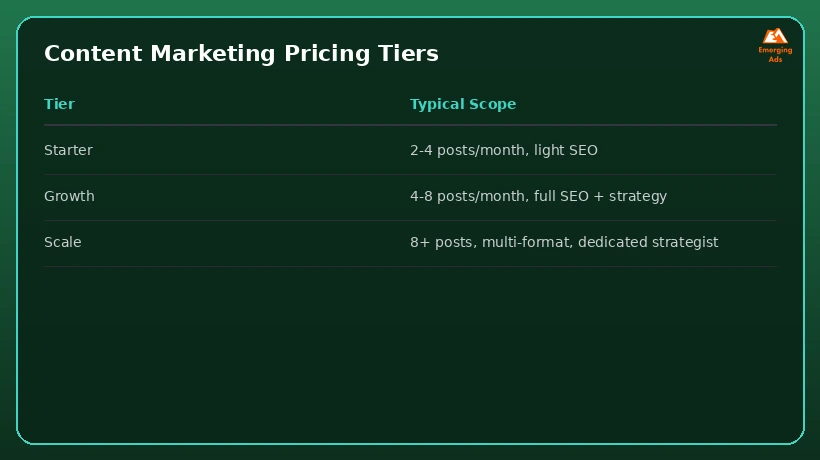
Per-piece pricing charges a flat or word-count-based rate for each article, typically used by freelancers and content mills. Retainer pricing charges a monthly fee covering a defined volume of content plus strategy, editing, and distribution work, typically used by agencies running an ongoing program. Project-based pricing covers a defined scope, like a content audit or a pillar page cluster, with a fixed price for the whole deliverable.
| Model | Best For | Watch Out For |
|---|---|---|
| Per-piece | Occasional, standalone content needs | No strategy tying pieces together |
| Monthly retainer | Ongoing, consistent content programs | Vague deliverables buried in vague language |
| Project-based | Defined, one-time deliverables | Scope creep without a change-order process |
What Drives Cost Up or Down
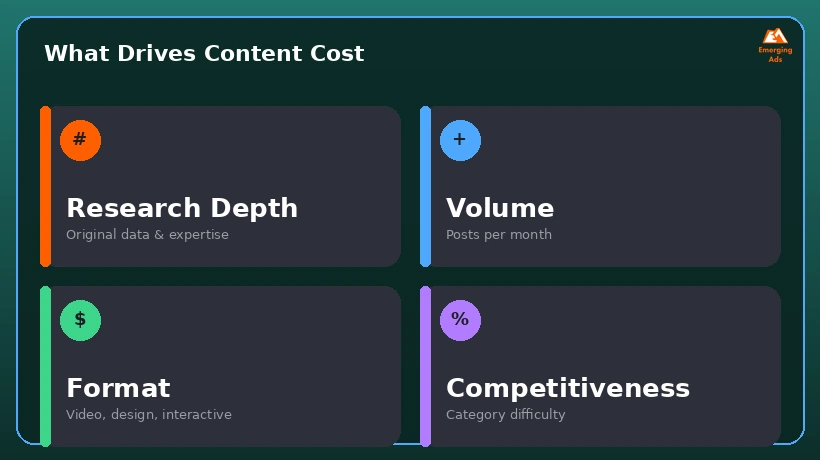
Research depth is the single biggest cost driver most businesses underestimate. A thousand-word article that required original data, subject matter expert interviews, and competitive research costs meaningfully more to produce well than the same word count written from a quick search. Technical or regulated industries, finance, healthcare, legal, also carry a cost premium because the writer needs either subject expertise or significant fact-checking time.
- Depth of research and whether original data or interviews are involved
- Industry complexity and compliance requirements
- Whether SEO keyword research and on-page optimization are included or billed separately
- Content format, a long-form guide costs more than a short update post
- Revision rounds and whether strategy calls are included in the fee
Freelancer vs. Agency vs. In-House: Real Cost Comparison
A freelancer is usually the cheapest per-piece option and works well for businesses that already have a content strategy and just need execution. The tradeoff is inconsistency, different freelancers have different strengths, and coordinating a content calendar across multiple freelancers takes internal time that’s easy to underestimate when comparing quotes.
An in-house hire makes sense once content volume justifies a full-time role, since the fully loaded cost of a salaried hire, salary, benefits, tools, management time, is usually higher than it first appears on a job posting. An agency retainer sits between these two options: higher than a single freelancer, but it includes strategy, editorial consistency, and usually a broader skill set, SEO, design, distribution, than one person can realistically cover alone.
What’s Usually Included (and What Isn’t) in a Content Retainer
A well-structured retainer should spell out exactly what’s covered: number of pieces per month, word count ranges, whether keyword research is included, how many revision rounds, and whether distribution, sharing to social, email inclusion, is part of the service or billed separately. Vague retainers that just say ‘content marketing services’ without itemizing deliverables are the ones most likely to create friction three months in.
- Content strategy and editorial calendar planning
- Keyword research tied to actual search demand, not guesswork
- Writing, editing, and formatting for publication
- Basic on-page SEO, meta descriptions, internal linking, schema where relevant
- Performance reporting showing what’s actually working
How Content Marketing Cost Connects to ROI
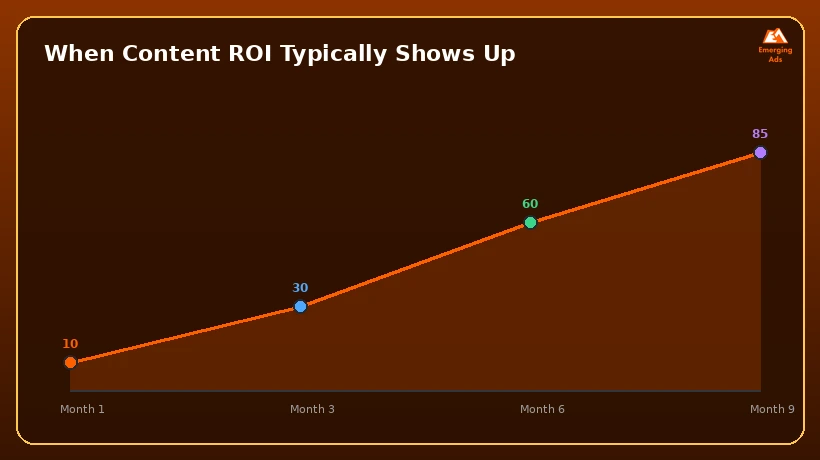
Content marketing is a compounding asset, not a one-time purchase, which makes ROI calculations different from paid ads where results largely stop the day spending stops. A well-optimized article can keep generating organic traffic and leads for years after it’s published, but that also means the payback period is longer than most businesses expect when they first start, often six months to a year before organic traffic meaningfully shows up.
Judging content marketing cost purely on a monthly basis without accounting for this compounding effect leads businesses to quit right before the investment starts paying off. Tracking organic traffic, keyword rankings, and lead attribution from content specifically, not just overall website traffic, is what makes the ROI conversation honest rather than a guess, and it’s the single most common reason content programs get cancelled just before they were about to start working.
Hidden Costs Businesses Often Forget to Budget For
The quoted price per article or the monthly retainer fee is rarely the entire cost of running a content program. Internal review time, someone on the client side reading drafts, giving feedback, and approving publication, adds up quickly and is almost never factored into the budgeting conversation upfront. Design and imagery for each piece, custom graphics, data visualizations, screenshots, either gets bundled into the writing fee or billed separately, and it’s worth clarifying which before signing anything.
- Internal time spent reviewing and approving drafts before publication
- Design, imagery, and any custom graphics needed per piece
- Technical publishing work, formatting for the CMS, adding schema, internal linking
- Ongoing content refreshes for older pieces that lose ranking over time
- Distribution costs if content is meant to be promoted through paid channels as well
That last point matters more than it first appears. A great piece of content or video work that never gets promoted anywhere beyond the blog itself will take considerably longer to earn organic visibility than one that gets a modest promotional push through email or social in its first few weeks.
Budget Ranges by Business Size
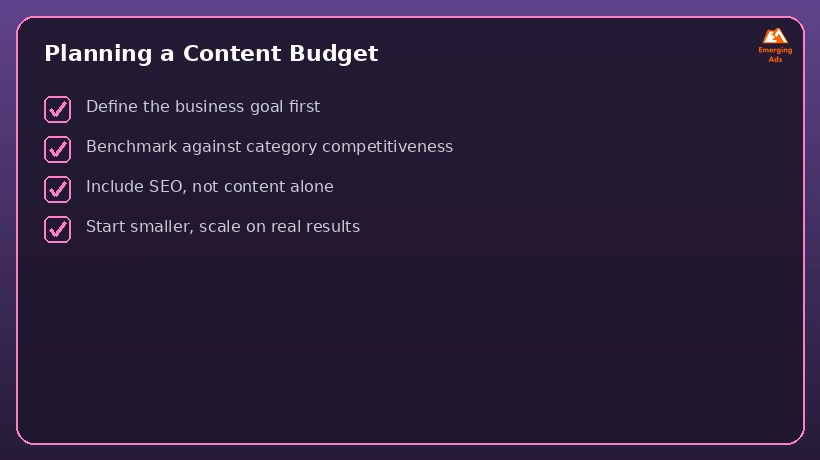
A small local business testing content for the first time can start meaningfully with a modest monthly budget covering a handful of well-researched pieces a month. A growing business competing for real organic visibility in a competitive category typically needs a more substantial monthly investment to produce enough volume and depth to compete. Enterprise and highly competitive B2B categories often require the largest budgets, reflecting both higher content volume and more sophisticated distribution and promotion work layered on top.
| Business Stage | Typical Monthly Focus | What Changes at This Stage |
|---|---|---|
| Early stage / local | A handful of targeted, well-researched pieces | Building initial topical authority from near zero |
| Growth stage | Consistent weekly publishing with SEO depth | Competing seriously for organic visibility |
| Established / competitive B2B | High-volume, expert-level content plus promotion | Defending and expanding existing rankings |
Content Marketing Cost vs. Paid Advertising Cost
Comparing content marketing cost directly against paid advertising cost is a common but misleading exercise, because the two operate on completely different timelines and produce different kinds of value. Paid advertising cost is largely linear, spend more, get proportionally more traffic, and results stop the moment spend stops. Content marketing cost behaves more like an investment in a compounding asset, a piece of content published today can keep earning organic traffic and leads for years without any additional spend, but only after an upfront period where it earns little to nothing.
This is why the smartest budgets rarely pick one channel exclusively. Running paid search or paid social alongside a content program lets a business generate leads immediately while the organic content asset builds in the background, and over time the blended cost per lead across both channels tends to improve as the content library matures and starts carrying more of the traffic load on its own.
| Factor | Paid Advertising | Content Marketing |
|---|---|---|
| Time to first results | Days | Months |
| Cost behavior over time | Linear, stops when spend stops | Compounding, keeps earning after publication |
| Best role in the mix | Immediate lead flow | Long-term organic visibility and authority |
How to Avoid Overpaying Without Cutting Corners
The instinct to cut content costs usually lands on the wrong lever, reducing word count or research depth, which is exactly what makes content underperform in search rankings and fail to build real authority. A better place to trim cost is publishing frequency rather than quality per piece, four genuinely strong, well-researched articles a month will typically outperform twelve rushed, shallow ones, both in search rankings and in the time it takes internal or agency resources to keep up with the calendar.
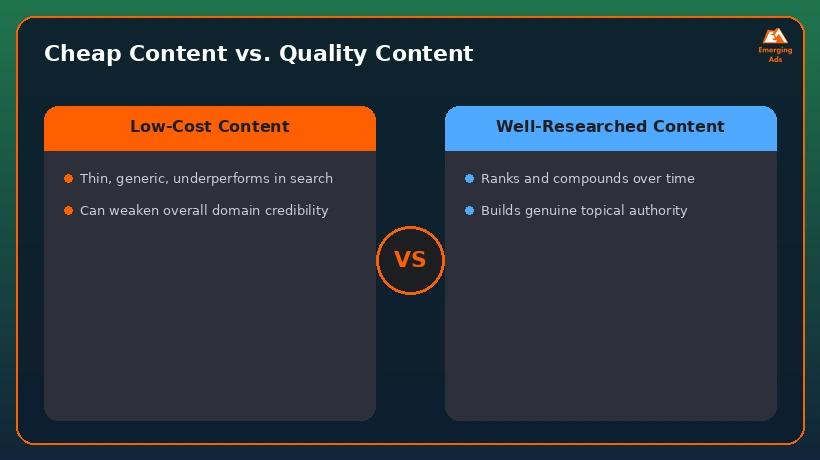
It’s also worth pushing back on any vendor quote that bundles a large volume of content at a suspiciously low per-piece rate, since that pricing model usually only works by cutting research time, using inexperienced writers, or relying heavily on unedited AI-generated drafts, none of which tend to hold up well once Google’s ranking systems and human readers actually evaluate the content on its merits.
Questions to Ask Before Signing a Content Contract
Ask exactly what’s included per piece, keyword research, editing rounds, images, internal linking, so there’s no ambiguity about scope once the contract starts. Ask how success is measured and reported, since a vendor who can’t explain their reporting process upfront usually doesn’t have a strong one. Ask who actually writes the content, an in-house team, a network of vetted freelancers, or outsourced at volume, since this materially affects quality consistency.
A vendor unwilling to share writing samples relevant to your specific industry, or unwilling to explain their research process for unfamiliar topics, is a signal worth taking seriously before committing budget to an ongoing retainer. It’s also reasonable to ask for a single trial piece before committing to a full monthly retainer, which gives both sides a low-risk way to confirm fit before locking into a longer agreement.
How We Price Content Work
Our content strategy engagements start with a scoping conversation about actual business goals, lead generation, organic visibility, brand authority, before quoting a number, because the right volume and depth of content depends entirely on what the content needs to accomplish. A business chasing competitive B2B keywords needs a different investment than a local service business building initial visibility.
If you’re unsure whether your current content spend, in-house or with another vendor, is actually producing a reasonable return, a free audit is a straightforward way to see where the gaps are before committing to a new budget.
Frequently Asked Questions
What’s a reasonable starting budget for content marketing?
It depends heavily on competitiveness of the industry and goals, but most small businesses can start meaningfully with a modest monthly retainer covering a handful of well-researched pieces, then scale up once early results show what’s working. Starting smaller and scaling based on real performance data is a safer approach than committing to a large budget before any results exist to justify it.
Is cheap content ever worth it?
Rarely for anything meant to drive organic traffic or leads. Low-cost, thin content tends to underperform in search rankings and can actually work against a domain’s overall credibility if it’s published at volume without genuine depth or research behind it. The exception is simple, low-stakes internal or informational content where ranking competitively was never the goal to begin with.
How long before content marketing shows ROI?
Most businesses start seeing meaningful organic traffic and lead movement within four to eight months of consistent publishing, though this varies by competitiveness of the target keywords and the site’s existing domain authority. A brand new website in a competitive category should expect the longer end of that range, while an established site with existing authority can often see movement sooner.
Should content marketing cost include SEO work?
Ideally yes, or at minimum be closely coordinated with a separate SEO effort, since content written without keyword research and on-page optimization in mind tends to underperform regardless of writing quality.
Is it cheaper to hire in-house or use an agency?
It depends on volume. Below a certain content volume, an agency retainer is usually more cost-effective than a full-time salaried hire once benefits, tools, and management overhead are factored in. Above that volume, in-house can become more cost-efficient, though it sacrifices the broader skill set an agency team typically brings, so the decision should weigh both cost and capability, not cost alone.
What’s the difference between content marketing and copywriting?
Content marketing typically refers to informational content, blog posts, guides, resources, aimed at building organic visibility and authority over time. Copywriting typically refers to persuasive, conversion-focused writing, ad copy, landing pages, email sequences, aimed at driving an immediate action. Many businesses need both, and the strongest programs coordinate them so content builds awareness that copywriting then converts.
Does content marketing cost more for competitive industries?
Yes, competitive industries typically require deeper, more authoritative content to rank, which takes more research and writing time, and often more content volume overall to compete against established players already publishing at scale, particularly in categories where the top-ranking pages are already backed by dedicated in-house teams. Budgeting an extra 20 to 30 percent above a baseline estimate for a competitive niche is a reasonable starting assumption when scoping a new content program and setting stakeholder expectations early.
How many blog posts should a small business publish per month to see results?
Consistency matters more than raw volume, but most small businesses need at least four to eight well-researched pieces a month sustained over several months before seeing meaningful organic movement in a competitive category, and pulling back after a couple of months usually resets that progress before it fully takes hold.
Can content marketing replace paid advertising entirely?
Rarely as a complete replacement, since content marketing builds organic visibility over a longer timeline while paid advertising can drive results immediately. Most effective strategies run both together, using paid to generate results now while content builds a compounding asset for the long term, then gradually shifting budget as the organic content library starts carrying more of the traffic load on its own.
What should be tracked to know if content marketing spend is working?
Organic traffic growth to content pages specifically, keyword ranking movement for target terms, and lead or conversion attribution tied back to content, not just overall site traffic, which can be misleading if it includes unrelated sources. A monthly reporting cadence that isolates these numbers makes it far easier to judge whether the spend is actually earning its keep.