How to Build Brand Positioning From Scratch
Key Takeaways
- Positioning is the decision about who you’re for and who you’re not for, made before a single word of copy gets written.
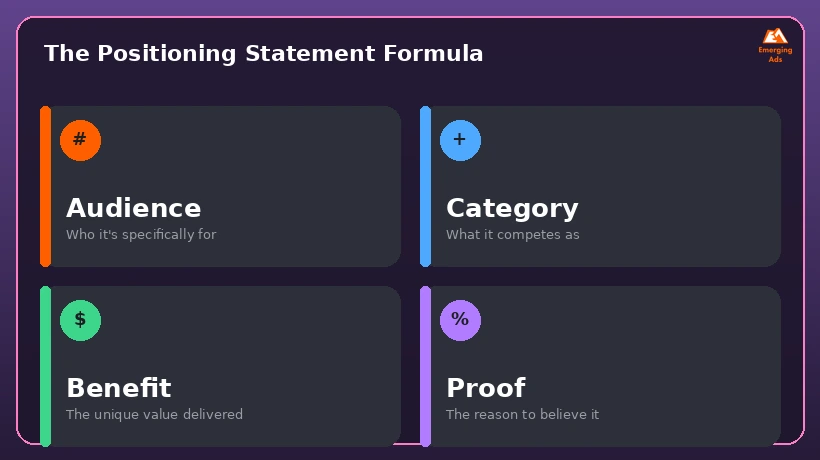
- A workable positioning statement fits in one sentence: for [audience], [brand] is the [category] that [unique benefit], because [reason to believe].
- Competitor mapping only works when you plot on axes that matter to the buyer, not axes that flatter your own product.
- Positioning has to survive contact with your actual sales conversations and support tickets, not just a slide deck.
- Weak positioning shows up downstream as inconsistent ad messaging, mismatched landing pages, and a brand identity that changes every quarter.
What Brand Positioning Actually Means
Brand positioning is the specific place your brand occupies in a customer’s head relative to every other option they could pick instead. It is not a tagline, a logo, or a mission statement, though all three usually flow from it once it’s set. Positioning answers one question honestly: if a buyer is choosing between you and three competitors, why does the choice land on you and not them. If that question doesn’t have a crisp answer, the brand doesn’t have positioning yet, it has a name and a website.
A lot of small businesses skip this step and go straight to visual identity, colors, fonts, a nicer logo, because that feels like tangible progress. The problem is a beautiful identity built on top of vague positioning just makes the confusion look more polished. We’ve seen brands spend real budget on a full rebrand that changed nothing about how customers actually chose between them and a competitor, because the underlying positioning question was never answered first.
Why Positioning Has to Come Before Design or Ad Copy
Every downstream decision, ad headlines, landing page structure, even which channels to prioritize, gets easier or harder depending on whether positioning is settled. When it’s settled, writing an ad headline is a matter of translating one sentence into fewer words. When it’s not settled, every headline becomes its own small argument about who the brand is, and campaigns end up sounding like they were written by three different people, because in practice they often were.
- Ad copy stops drifting between five different value propositions across campaigns
- Landing pages can lead with the specific claim instead of generic category language
- Sales and support teams describe the product the same way prospects heard it in an ad
- New team members and freelancers can get briefed in minutes instead of a long onboarding call
This is also why we treat positioning work as a required first pass on any content strategy engagement rather than an optional add-on. Content built on top of unclear positioning tends to read as generic, competent but forgettable, because it’s not actually arguing for anything specific.
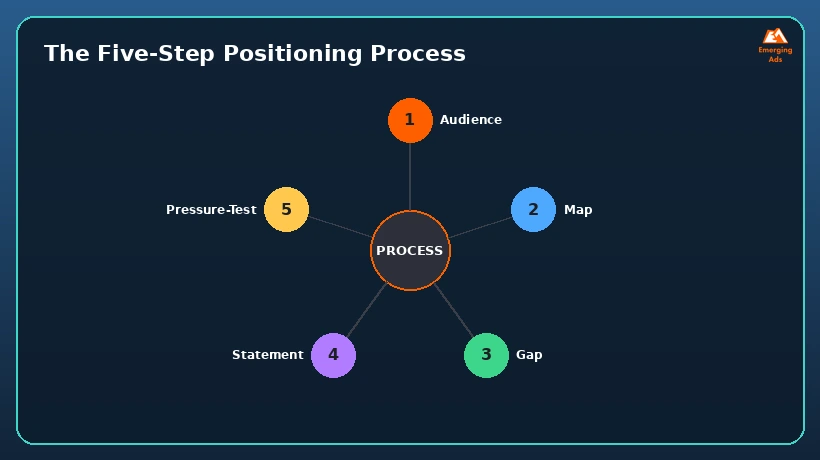
Step 1: Get Specific About Who You’re For
Positioning starts by narrowing, not broadening. The instinct for a small business is to describe the audience as broadly as possible, because narrowing feels like turning away revenue. In practice the opposite happens: a brand that’s clearly for someone attracts that someone efficiently, while a brand that’s vaguely for everyone has to work much harder and spend much more to get anyone’s attention at all.
Write down the actual person, not a demographic bracket. What are they trying to get done, what have they already tried that didn’t work, what would make them roll their eyes at a competitor’s claim. If two people in the room can’t agree on who the ideal customer is in a single sentence, that disagreement is the actual first problem to solve, before any statement gets drafted, since a positioning statement built on two different mental pictures of the customer will never fully align.
Step 2: Map the Competitive Field Honestly
Pick two axes that genuinely matter to the buyer’s decision, not axes that happen to flatter the brand. Price versus service depth is common. So is fast-and-generic versus slow-and-tailored. Plot every real competitor and every real alternative, including the alternative of the customer doing nothing or handling it in-house, since that’s often the strongest competitor of all for a service business.
| Positioning Axis | What It Actually Tests | Common Trap |
|---|---|---|
| Price vs. depth of service | Whether buyers are optimizing for cost or for outcome certainty | Assuming everyone wants the cheapest option |
| Speed vs. customization | Whether the buyer values a fast generic fix or a tailored one | Claiming both without proof of either |
| DIY vs. done-for-you | Whether the real competitor is another vendor or the status quo | Only mapping against direct competitors |
The map usually reveals an uncomfortable truth: most competitors are clustered in the same corner, all claiming the same thing in slightly different words. That crowded corner is a signal, not a strategy to copy.
Step 3: Find the Gap You Can Own
The gap has to satisfy two conditions at once: it has to be genuinely open on the competitive map, and it has to be something the business can actually deliver on, consistently, not just claim in an ad. A gap that isn’t backed by real operational capability turns into an overpromise, and overpromises get exposed the moment a customer compares the ad to the actual experience.
This is where a lot of positioning work quietly fails. A brand identifies a real gap on paper, writes a positioning statement around it, then never changes the product, service delivery, or pricing to actually support the claim. Positioning isn’t just a messaging exercise, it’s a commitment about what the business will prioritize operationally going forward.
Step 4: Write a Positioning Statement You Can Test
A usable positioning statement follows a simple structure: for [specific audience], [brand] is the [category] that [unique benefit], because [reason to believe]. It doesn’t need to be clever and it’s never meant to be published word-for-word in an ad. Its job is internal: it’s the sentence every other piece of messaging gets checked against.
- Draft three versions with different audiences or benefits, don’t settle on the first one
- Read each version out loud to someone outside the business and ask what they’d expect the product to actually do
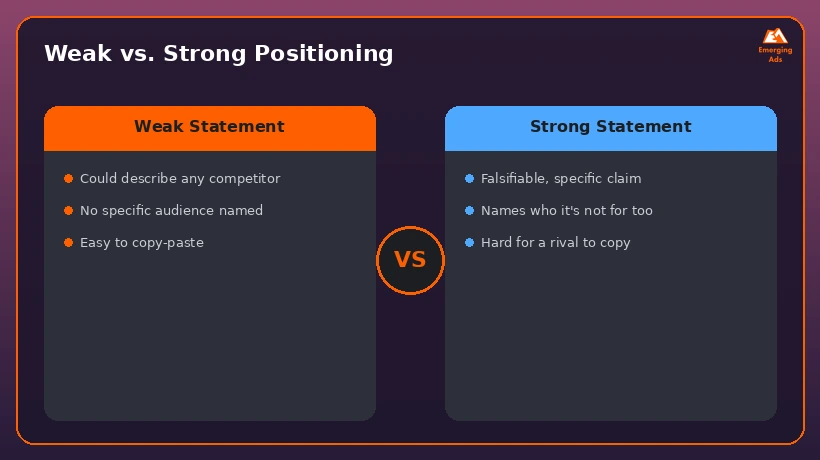
- Cut any version that could apply equally well to a direct competitor with the brand name swapped out
- Pick the version the team can defend under pushback, not just the one that sounds best in a meeting
Real Positioning Statement Examples and Why They Hold Up
Abstract frameworks are easier to absorb with a couple of worked examples. Take a small accounting firm competing against both larger national chains and cheap DIY software. A weak statement might say something like ‘we provide reliable accounting services for businesses of all sizes,’ which is technically true and useless, because it could describe almost every firm in the category. A working version instead narrows hard: ‘for founder-led businesses under twenty employees, our firm is the accounting partner that catches cash-flow problems before they become emergencies, because we review books monthly instead of once a year.’ That version is falsifiable, it makes a specific claim a competitor could contest, and it gives the sales team an actual argument to make instead of a category description.
A second example, a boutique gym competing against big-box chains and home fitness apps. ‘We help people get in shape’ says nothing. ‘For people who’ve quit three gym memberships already, we’re the studio that builds habits through small accountability groups instead of solo workouts’ says a lot, and it immediately tells you what the space should feel like, what the marketing should show, and who shouldn’t bother signing up. Notice that both examples name who the brand is explicitly not for, which is often the part founders resist most and the part that does the most work.
The pattern across strong statements is specificity that a competitor would have to genuinely change their business to copy, not just their marketing copy. If a rival could adopt the exact same statement by editing a paragraph on their website, the positioning was never differentiated enough to begin with, it was just a preference stated more confidently. That test alone, could a direct competitor copy-paste this statement without lying, is often the single fastest way to spot a positioning draft that still needs work.
Step 5: Pressure-Test It Against Real Conversations
Positioning drafted in a conference room and positioning that survives an actual sales call are often two different things. Pull the last ten sales conversations or support tickets and check whether the language customers actually use matches the language in the statement. If customers consistently describe the value in different words than the brand does, that gap is worth closing before the statement gets finalized, not after.
We run this check on every branding and content engagement before touching a single visual asset, because a positioning statement that only exists in a strategy document isn’t actually positioning yet, it’s a hypothesis waiting to be tested against how real buyers talk.
Turning Positioning Into Brand Identity and Content
Once positioning is settled, visual identity work moves faster because there’s something specific to express rather than a blank brief. Fonts, color, and tone all become translation choices instead of taste-based debates. The same applies to a video or content production plan: knowing exactly who the brand is for changes which stories are worth telling and which formats actually reach that audience.
This is also the point where it’s worth reviewing real client work rather than theory. Looking through case studies of brands we’ve repositioned shows the pattern clearly: the visual refresh gets the attention, but the actual performance lift almost always traces back to the positioning decision that came before it.
Common Mistakes That Undo Good Positioning
- Writing positioning around what the founder wants to say instead of what the buyer needs to hear
- Trying to own two gaps at once, which usually means owning neither convincingly
- Changing the positioning every time a competitor launches something new, instead of holding the line
- Treating a rebrand as a fix for weak positioning rather than fixing the positioning first
- Never revisiting the statement once the market or the product genuinely changes
That last point matters more than most businesses expect. Positioning isn’t meant to be permanent, it’s meant to be stable enough to build on for a year or two at a time, then revisited deliberately, not drifted away from by accident.
How Long This Actually Takes
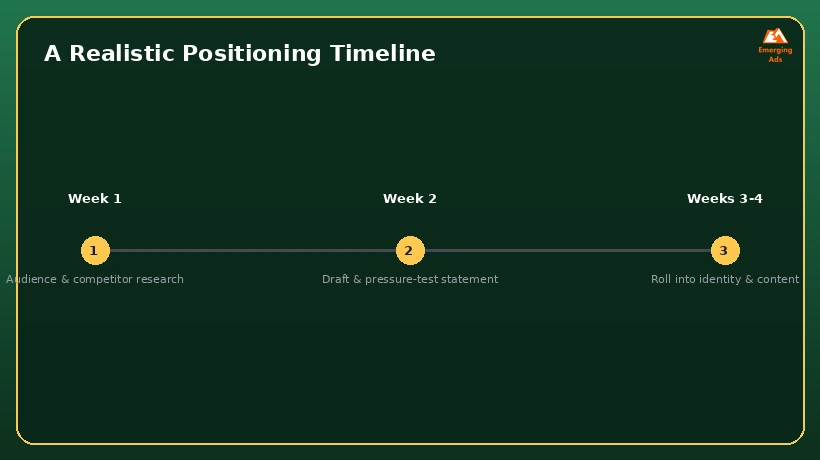
Done properly, with real customer input and a genuine competitive map rather than a guess, positioning work takes two to four weeks for most small businesses. Rushing it to a single afternoon workshop usually produces a statement that sounds fine in the room and falls apart the first time it meets an actual customer conversation. The time investment upfront is what makes every later marketing dollar work harder, from ad copy to the content calendar that follows.
If the business is already running ads or content without a settled positioning statement behind it, that’s usually visible in the numbers, inconsistent click-through rates across creative, high traffic with flat conversion, a brand that different customers describe in completely different terms. Reviewing that gap honestly is where a free audit of the current setup tends to be the fastest way to see exactly where positioning and execution have drifted apart. It’s also usually cheaper than it sounds, since the fix is rarely a full creative overhaul, it’s tightening the message that already exists so every channel is finally arguing for the same thing.
Frequently Asked Questions
What’s the difference between brand positioning and brand identity?
Positioning is the strategic decision about who the brand is for and why they should choose it over alternatives. Brand identity, the logo, colors, fonts, and visual system, is how that decision gets expressed visually. Identity without positioning behind it usually looks fine but doesn’t actually differentiate the brand in a buyer’s mind.
Can a small business really do positioning work without an agency?
Yes, the framework itself doesn’t require outside help, though an outside perspective often catches blind spots a founder is too close to see. The bigger risk for a solo effort is skipping the pressure-testing step against real customer conversations and settling for a statement that sounds good internally but doesn’t match how buyers actually talk. Running the exercise with at least one person outside the founding team, someone who can push back honestly, tends to produce a sharper result than doing it alone.
How often should positioning be revisited?
Most businesses should revisit it every twelve to eighteen months, or sooner if the product changes significantly, a major new competitor enters the market, or the target customer shifts. Revisiting too often signals the original positioning wasn’t tested thoroughly enough to begin with.
Does positioning matter for a business that’s mostly referral-driven?
Yes, arguably more, since referrals depend on the existing customer being able to describe clearly why someone should choose the business. Vague positioning makes a referral conversation harder even when the underlying product or service is strong, because the person making the referral has to do the differentiation work themselves instead of repeating a clear line.
What’s a red flag that positioning is broken?
The clearest sign is when different people on the sales or support team describe the value proposition in noticeably different ways, or when marketing materials from different quarters seem to be selling slightly different things, which usually means the team is improvising a new answer every time rather than repeating a settled one.
Should positioning be different across different marketing channels?
The core positioning statement should stay consistent, but the emphasis can shift by channel. A LinkedIn ad might lead with the credibility angle of the positioning while a search ad leads with the specific outcome, both drawing from the same underlying statement rather than inventing new claims per channel.
How do you position against a much larger, well-known competitor?
Usually by conceding the ground the larger competitor legitimately owns, like scale or brand recognition, and claiming a specific gap they can’t easily match, like specialization, speed, or a more tailored process. Trying to out-broad a bigger competitor rarely works.
Is positioning a one-time project or ongoing work?
It’s set once as a foundation, then maintained. The initial work is a defined project with a clear deliverable, the statement and the reasoning behind it, but it needs periodic review as the business and market evolve.
What’s the biggest risk of skipping positioning work entirely?
Wasted ad spend is the most measurable cost, campaigns that test multiple unclear value propositions instead of refining one clear one. The less measurable but larger cost is a brand that never builds a distinct reputation, so every sale has to be won from scratch on price or convenience rather than earned brand preference, which compounds into higher acquisition costs every year the gap stays unaddressed.
Can positioning change if the business pivots to a new audience?
It has to. Positioning is built around a specific audience and their specific alternatives, so a genuine audience pivot means the whole exercise needs to be redone rather than lightly edited.