What Is Lead Nurture Automation and Why Does My Business Need It

Key Takeaways
- Lead nurture automation is a sequence of automated, triggered touchpoints, email, SMS, sometimes retargeting ads, that moves a lead from initial interest toward a sales-ready decision without manual follow-up for every individual contact
- Most B2B leads aren’t ready to buy on first contact, industry research consistently shows the majority need multiple touchpoints before converting, which is exactly the gap nurture automation fills
- Lead scoring, assigning points to specific actions like opening emails or visiting pricing pages, lets automation prioritize which leads sales should actually call first
- A generic, one-size-fits-all nurture sequence underperforms a segmented approach that adjusts messaging based on how a lead entered the funnel and what they’ve engaged with since
- Nurture automation doesn’t replace sales, it makes sales more efficient by ensuring reps spend time on leads who’ve shown genuine, tracked engagement rather than cold, unqualified names
What Lead Nurture Automation Actually Does
Lead nurture automation is a system of triggered, automated touchpoints, most commonly email, often supplemented with SMS or retargeting ads, that moves a lead progressively closer to a buying decision over time without requiring a person to manually follow up with every individual contact. Rather than a single sales rep remembering to check in with each lead at the right moment, an automated nurture sequence handles that follow-up consistently, at scale, triggered by specific actions or time intervals, freeing up human attention for the conversations that genuinely need it.
The practical effect for a small business is that leads who aren’t ready to buy immediately, which is most of them, don’t simply fall through the cracks after an initial inquiry. Instead, they receive a structured, relevant sequence of follow-up content that keeps the business top of mind and gradually builds toward a sales-ready moment, all running largely on autopilot once it’s properly set up.
Why Most Leads Aren’t Ready to Buy on Day One
A consistent finding across B2B marketing research is that the substantial majority of leads aren’t ready to make a purchasing decision at the moment of first contact, they’re still researching, comparing options, or building internal buy-in before committing. A sales process built purely around immediately pushing every new lead toward a close misses this reality and often burns through leads too early, before they’ve had the chance to reach genuine buying intent, effectively wasting the acquisition cost already spent generating that lead in the first place.
Nurture automation exists precisely to bridge this gap, keeping a not-yet-ready lead engaged with useful, relevant content over the weeks or months it takes them to move through their own decision process, rather than either bombarding them with premature sales pressure or, just as commonly, losing touch with them entirely after one unanswered follow-up call.
The Core Building Blocks of a Nurture Sequence
| Component | Purpose | Example |
|---|---|---|
| Trigger | The action that starts the sequence | Form submission, content download, demo request |
| Content cadence | Timing and spacing of follow-up touchpoints | Day 1, Day 3, Day 7, Day 14 email sequence |
| Content type | What’s actually being sent at each step | Educational content early, case studies mid-sequence, direct offer later |
| Exit criteria | What removes someone from the sequence | Booking a call, unsubscribing, reaching a defined inactivity threshold |
A well-built nurture sequence maps each of these components deliberately rather than sending a loosely connected series of emails without a clear underlying logic for why each one exists and what it’s meant to accomplish at that specific stage of the lead’s journey.
Lead Scoring: Letting Behavior Prioritize Follow-Up
Lead scoring assigns numeric point values to specific actions, opening an email, clicking a link, visiting a pricing page, attending a webinar, accumulating into an overall score that signals how engaged and sales-ready a given lead actually is. Once a lead crosses a defined score threshold, automation can trigger a direct sales notification or move them into a more direct, conversion-focused nurture track, effectively acting as an always-on filter separating genuinely warm leads from ones still early in their research.
Getting the initial point values right takes some trial and error, and it’s reasonable to start with a simple, rough scoring model and refine it over the first few months as real conversion data reveals which specific actions actually correlate with a lead becoming a customer, rather than trying to build a perfectly calibrated system before any real data exists to calibrate it against.
- Assign higher point values to high-intent actions (pricing page visits, demo requests) than passive ones (a single email open)
- Set a clear score threshold that triggers a sales handoff, avoiding sales wasting time on leads who haven’t shown real engagement yet
- Review and recalibrate scoring periodically based on which score ranges actually convert into real customers over time
- Combine explicit data (job title, company size) with behavioral scoring for a more complete picture of lead quality
Segmenting Nurture Tracks by Lead Source and Behavior
A single, generic nurture sequence sent to every lead regardless of how they entered the funnel or what they’ve shown interest in tends to underperform a segmented approach. A lead who downloaded a pricing comparison guide has shown different intent than one who downloaded a general educational ebook, and treating them identically wastes the specific intent signal each action already provided, sending the pricing-curious lead the same slow, educational content the ebook downloader receives.
Building distinct nurture tracks, even just two or three, segmented by entry point or expressed interest, and tailoring the content sequence to match, consistently produces stronger engagement and conversion than a single blanket sequence trying to serve every lead type at once with the same generic messaging.
Email, SMS, and Beyond: Choosing the Right Channels
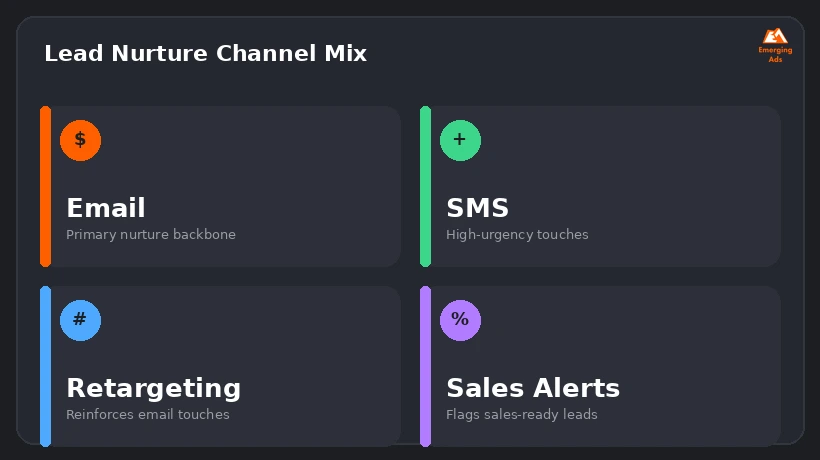
Email remains the backbone of most lead nurture automation, given its low cost and the ease of building multi-step automated sequences within most marketing platforms. SMS can supplement email for time-sensitive touchpoints, a webinar reminder or a limited-time offer, though it demands genuine restraint given SMS’s more intrusive nature compared to email. Retargeting ads can run alongside an email sequence as a complementary channel, keeping the brand visible even to leads who aren’t actively opening emails.
How Nurture Automation Changes What Sales Actually Does
With nurture automation properly in place, sales reps stop spending significant time manually following up with every new, unqualified lead and instead focus their limited hours on leads that automation has already identified as genuinely engaged and sales-ready, through scoring thresholds and behavioral signals. This shift generally improves both sales efficiency and morale, since reps spend more time in conversations with people who’ve shown real interest rather than working through a long list of cold, unresponsive contacts.
It’s worth being clear that nurture automation supports and feeds sales, it doesn’t replace the relationship-building and negotiation work a good sales rep still needs to do once a lead is genuinely ready for that direct conversation.
Common Mistakes When Building a Nurture Sequence
These mistakes tend to compound each other rather than existing in isolation, a generic sequence with a premature pitch and no exit criteria produces a noticeably worse experience than any single mistake would on its own.
- Sending the same generic sequence to every lead regardless of source or expressed interest
- Front-loading a hard sales pitch too early, before the lead has received enough value to build trust first
- Never setting exit criteria, leaving converted customers or clearly disqualified leads stuck receiving irrelevant nurture content indefinitely
- Setting lead scoring thresholds without revisiting them based on actual conversion data over time
- Treating nurture sequence setup as a one-time project instead of an ongoing process refined based on performance
Tools Commonly Used for Lead Nurture Automation
A range of platforms support lead nurture automation depending on business size and complexity needs, from CRM-integrated tools like HubSpot and GoHighLevel that combine nurture automation with broader pipeline and contact management, to dedicated email marketing platforms with automation capabilities for a business with simpler needs. The right choice generally depends on whether nurture automation needs to live alongside broader CRM and sales pipeline functionality or can operate as a more standalone marketing tool.
For a business already using a CRM for sales tracking, keeping nurture automation within that same platform, rather than a separate, disconnected email tool, usually simplifies lead scoring and handoff between marketing and sales considerably, since both teams are working from the same underlying contact and activity data rather than reconciling two separate systems that don’t naturally talk to each other.
Measuring Whether Your Nurture Sequence Is Actually Working
Open rates and click rates certainly matter as early engagement signals, but the metric that genuinely proves a nurture sequence is working is downstream: what percentage of leads entering the sequence eventually convert into a sales conversation, and ultimately a closed customer, compared to leads who received no structured nurture at all. Without that comparison, it’s easy to mistake decent engagement metrics for real business impact when the actual conversion lift might be smaller, or larger, than engagement numbers alone would suggest.
| Metric | What it measures | Limitation if used alone |
|---|---|---|
| Open rate | Whether subject lines and sender reputation are working | Says nothing about actual interest in the content itself |
| Click rate | Whether content is compelling enough to act on | Doesn’t confirm downstream sales conversation or close |
| Sequence-to-opportunity rate | Real business conversion from nurture into an actual sales opportunity | Requires CRM integration to track accurately |
| Time to conversion | How much the sequence shortens or lengthens the sales cycle | Needs a baseline (no-nurture) comparison to be meaningful |
Setting up this fuller tracking takes real integration work between your email or automation platform and your CRM, but it’s the difference between assuming a nurture sequence is helping based on decent-looking open rates and actually knowing it’s moving real revenue, which is ultimately the only measure that justifies the ongoing investment of building and maintaining it.
Content Ideas for Each Stage of a Nurture Sequence
Getting this content-to-stage matching right is one of the more overlooked levers in nurture performance, often more impactful than fine-tuning send timing or subject line copy alone, yet it rarely gets the same amount of deliberate attention. Early-stage content, right after initial contact, should focus on genuinely useful, educational material with minimal sales pressure, establishing credibility before asking for anything. Mid-sequence content can introduce social proof, case studies, testimonials, or comparison content, that helps a lead evaluate options as they move further into active consideration. Late-stage content can become more directly sales-focused, addressing common objections and offering a clear, low-friction next step like a demo or consultation.
- Early stage: educational guides, industry benchmarks, problem-awareness content that doesn’t yet pitch a specific solution
- Mid stage: case studies, comparison guides, testimonials that help evaluate your offering against alternatives
- Late stage: direct offers, limited-time incentives, clear calls to book a call or start a trial
- Ongoing: re-engagement content for leads who’ve gone quiet, checking whether their situation or priorities have changed
Signs Your Business Genuinely Needs This
A few clear signals suggest lead nurture automation would meaningfully help a business: leads regularly go cold after an initial inquiry with no further follow-up, sales spends significant time manually chasing unqualified contacts, or there’s simply too much lead volume for a small team to personally follow up with everyone at the right cadence. If any of these describe your current situation, the gap nurture automation fills is likely costing real, recoverable revenue every month it goes unaddressed.
A useful, low-effort test before building a full automated system is auditing how the last 20-30 leads were actually followed up with manually, how many received a second or third touchpoint, and how many simply went quiet after one unanswered outreach attempt. That audit alone often makes the case for automation clearer than any general industry statistic could, because it reflects exactly what’s happening inside your own specific sales process right now, not an abstract benchmark from a different kind of business entirely.
Want us to look at your account?
We’ll audit your setup and tell you exactly where the budget is leaking, free.
Get Your Free Ad AuditFrequently Asked Questions
How long should a lead nurture sequence run?
This varies by sales cycle length, a simpler B2C purchase might use a 1-2 week sequence, while a longer B2B sales cycle might run a nurture sequence over 60-90 days or more, with exit criteria removing someone once they convert or clearly disqualify. Reviewing actual conversion timing data every quarter is the most reliable way to keep the sequence length matched to how your buyers genuinely behave.
Do I need a CRM to run lead nurture automation?
Not strictly, many dedicated email marketing platforms support automated nurture sequences on their own, but a CRM becomes valuable once you need to combine nurture automation with broader sales pipeline tracking and lead scoring tied to a sales team’s workflow.
How many touchpoints should a nurture sequence include?
There’s no universal number, but most effective sequences include somewhere between 5-10 touchpoints spread over the sequence’s full duration, balancing consistent presence against the risk of over-messaging and fatiguing the lead.
What’s the difference between lead nurture and a simple newsletter?
A newsletter typically sends the same content to an entire list on a fixed schedule. Lead nurture automation is triggered by specific behavior and tailored to where an individual lead sits in their own buying journey, generally far more targeted and behavior-responsive than a blanket newsletter.
Can lead nurture automation work for a very small business?
Yes, even a simple 3-5 email automated sequence triggered by a contact form submission can meaningfully improve follow-up consistency for a small business without dedicated sales staff to manually track every lead.
How do I know if my lead scoring thresholds are set correctly?
Review which score ranges have historically converted into real customers versus which haven’t, and adjust thresholds based on that actual data rather than an initial guess, revisiting this calibration periodically as more conversion data accumulates.
Should nurture emails ever include a direct sales pitch?
Generally later in the sequence, once earlier touchpoints have established value and trust. Leading with a hard pitch too early, before the lead has received anything of genuine value, tends to underperform a more gradual, value-first approach.
What happens to a lead who doesn’t engage with any nurture emails?
A well-built sequence includes exit or downgrade criteria for consistently unengaged leads, either removing them from active nurture after a defined period of no activity or moving them to a lower-frequency, long-term nurture track rather than continuing the same cadence indefinitely.
Does lead nurture automation replace the need for a sales team?
No, it makes a sales team more efficient by surfacing genuinely engaged, sales-ready leads rather than replacing the relationship-building and negotiation work that still requires a real person once a lead reaches that stage.
How quickly can I expect to see results after setting up nurture automation?
Initial engagement data (open rates, click rates) is visible within the first few weeks, but meaningful improvement in actual conversion rates typically takes a full sales cycle or two to properly measure, since that’s how long it takes leads to move through the full nurture and decision process.
Ready to fix what’s costing you conversions?
Book a free, no-pressure audit of your ad account or website.
Get Your Free Ad Audit