The short answer
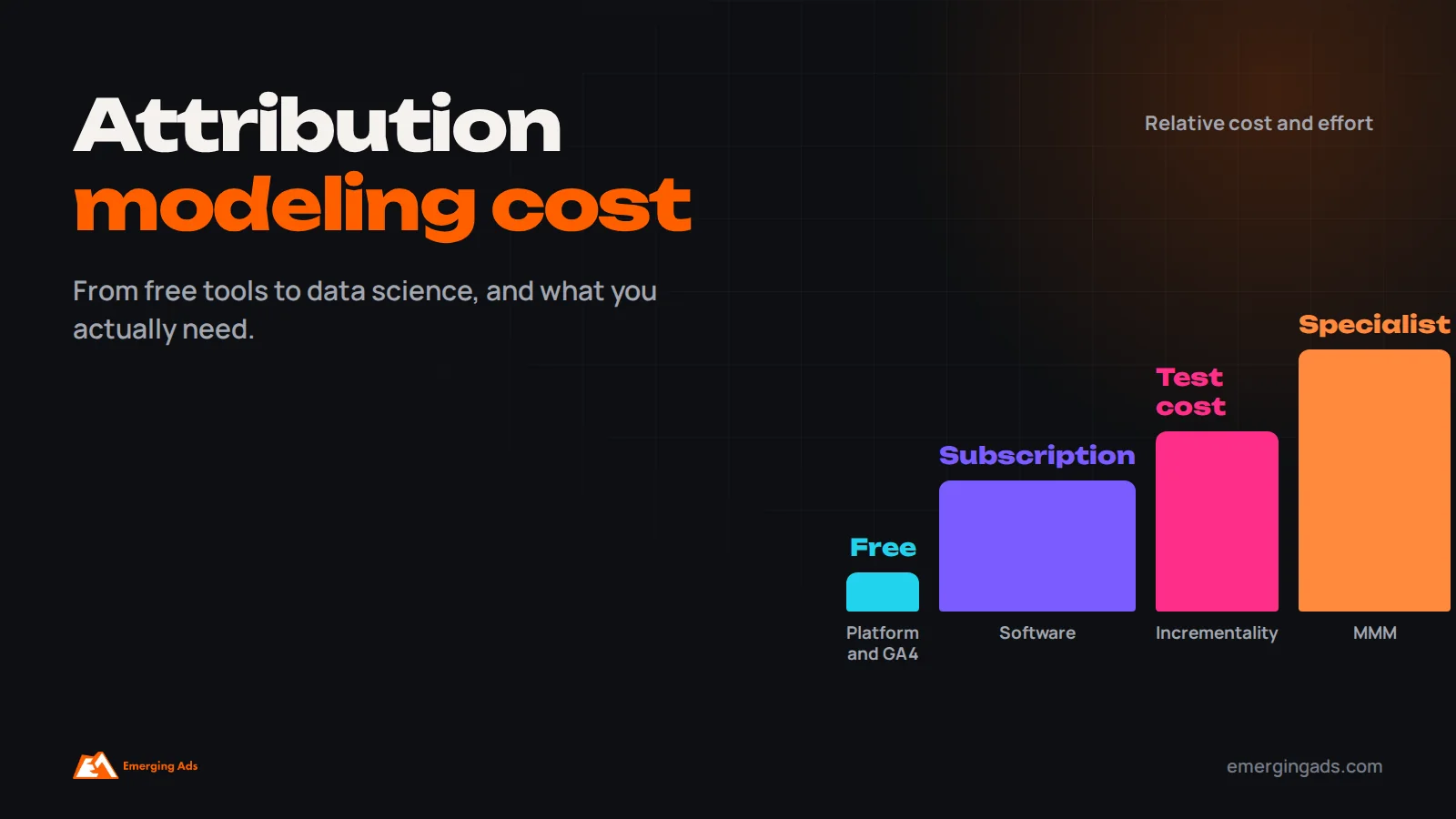
Attribution modeling can cost nothing, if you use the data-driven models built into Google Analytics 4 and the ad platforms, or a great deal, if you build custom models, marketing mix modeling and incrementality testing on a data warehouse. The main cost drivers are how many channels you run, whether sales happen offline or through a CRM, how clean your tracking is, and whether you need software, specialists or both. For most businesses, the biggest and most overlooked cost is cleaning up tracking first, because no model can fix bad data.
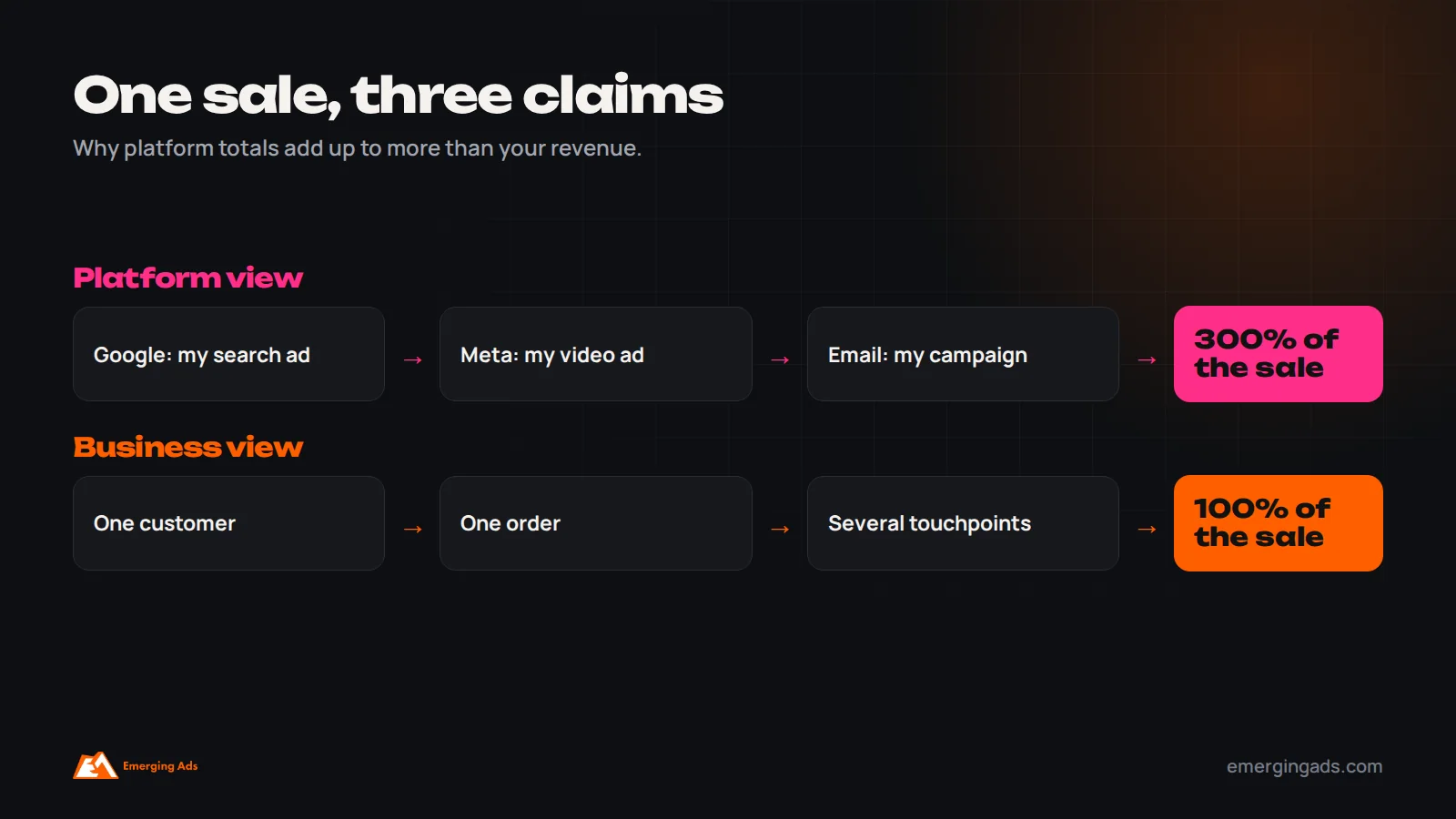
Every business running ads on more than one channel eventually asks the same question: which marketing is actually working? Google says it drove the sale. Meta says it drove the same sale. Email claims it too. Add them up and your channels have apparently generated more revenue than you made.
Attribution modeling is the attempt to answer that question properly, by assigning credit for conversions across the touchpoints that led to them. It can be as simple as switching on a setting in GA4 or as complex as a data science project. The cost range is enormous, and many businesses either spend too little to get a useful answer or too much on sophistication their data cannot support.
This guide explains what attribution modeling is, the approaches available, what drives cost, the hidden cost most people miss, a step-by-step setup process and what a sensible budget looks like at different stages of growth.
What attribution modeling actually is
A customer rarely buys after a single interaction. They might see an Instagram ad, search for the brand on Google a few days later, read an email, click a retargeting ad and finally buy. Attribution modeling decides how much credit each of those touchpoints gets for the sale.
Different models give different answers from the same data:
- Last click gives all the credit to the final touchpoint before conversion. Simple, but it undervalues anything that introduced the customer.
- First click gives all the credit to the first touchpoint. Useful for understanding discovery, but it ignores everything that closed the sale.
- Linear, time decay and position-based models split credit using fixed rules, such as equal shares or more weight to touchpoints near the conversion.
- Data-driven attribution uses machine learning on your own conversion paths to estimate how much each touchpoint contributed.
Google has removed the rule-based models, such as first click, linear, time decay and position-based, from Google Ads and GA4, leaving data-driven and last click as the main options. That simplifies choices within Google’s tools, but it does not solve the cross-channel problem on its own.
Why attribution is harder than it used to be
Attribution has always been imperfect, and recent changes have made it harder. Browser privacy features, Apple’s App Tracking Transparency and consent requirements mean a meaningful share of customer journeys can no longer be tracked from start to finish. People move between phones, laptops and TVs. Platforms report results within their own walls using their own rules. And some influence, such as a YouTube ad on a television or a recommendation from a friend, never produces a trackable click at all.
That is why modern measurement usually combines several methods rather than trusting a single model: attribution for day-to-day decisions, incrementality tests to check what channels really add, and, for larger budgets, marketing mix modeling for strategic budget allocation.
Attribution windows: why platforms disagree
Even with identical tracking, platforms disagree because they use different attribution windows, the period after an interaction during which a conversion can be credited to it. Meta’s default for most advertisers counts conversions within seven days of a click and one day of a view. Google Ads often uses longer click windows, and its data-driven model shares credit across Google touchpoints. Amazon uses its own windows. GA4 uses its own model across the channels it can see.
View-through windows are a particular source of disagreement. A view-through conversion credits an ad that someone saw but did not click. For video and social platforms, where many people never click, view-through credit captures real influence. But it also captures people who scrolled past an ad and would have bought anyway. When comparing platforms, check which windows each uses, and avoid comparing a platform that counts views with one that counts only clicks as if they were equivalent.
Choosing consistent windows within each platform, documenting them, and not changing them casually makes trends far more reliable over time.
The approaches and what each costs
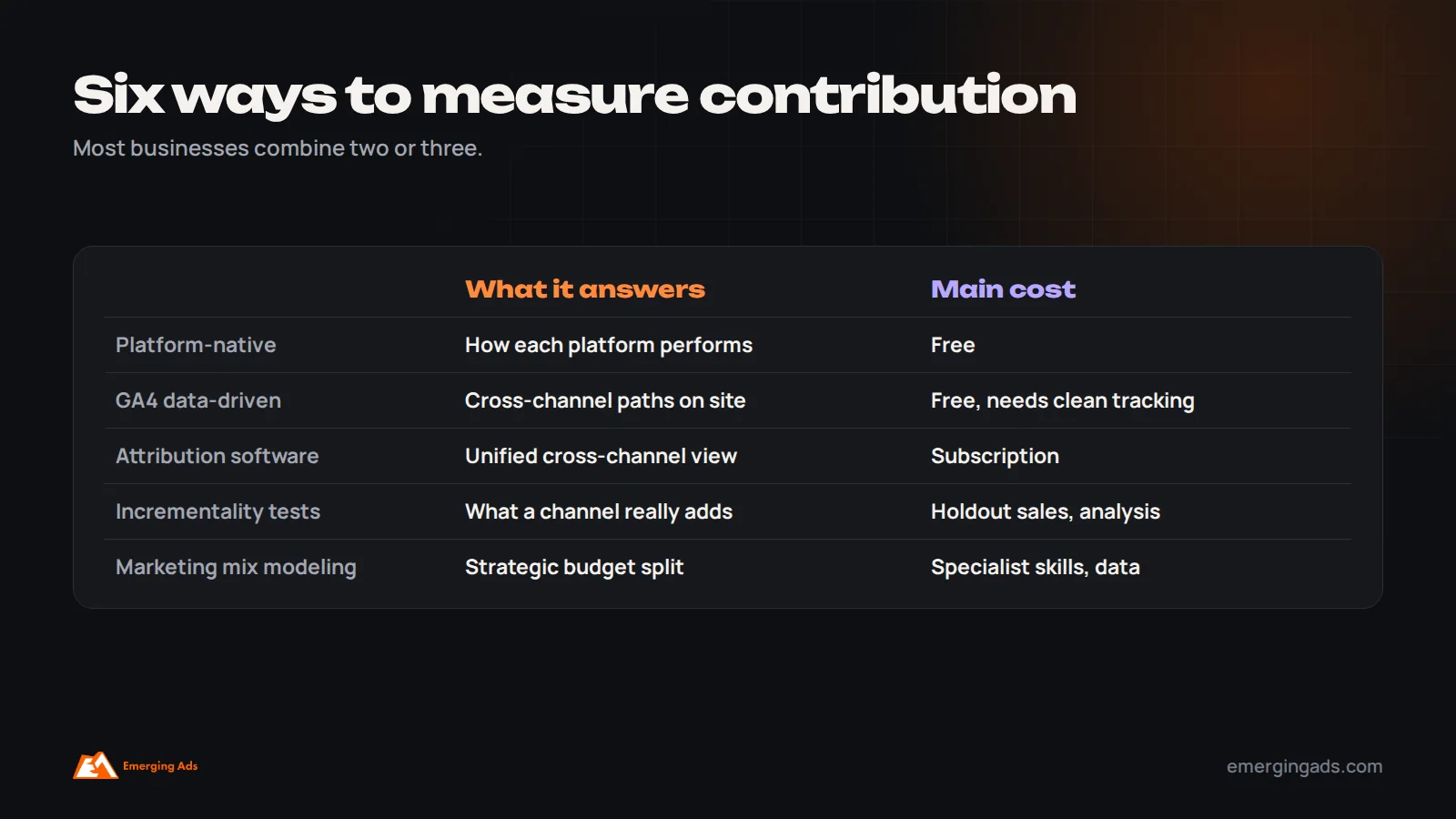
1. Platform-native attribution (free)
Google Ads, Meta, TikTok, LinkedIn and Amazon all report conversions using their own attribution. It costs nothing and is essential for optimizing within each platform. Its limit is that each platform credits itself, so totals overlap.
2. Google Analytics 4 (free)
GA4 offers data-driven attribution across the channels it tracks, with reports comparing models and showing conversion paths. The standard version is free. Its accuracy depends on how well your tracking, UTM tagging and consent setup work, and it sees less of the journey for platforms like Meta where many interactions are views rather than clicks.
3. Attribution software (subscription)
Dedicated attribution tools, many built for ecommerce on Shopify, combine first-party tracking with ad platform data to produce a unified view across channels. Pricing usually scales with revenue, order volume or ad spend, ranging from modest monthly fees for small stores to significant annual contracts for larger businesses. They save a lot of analysis time, but their results still depend on tracking quality, and different tools often disagree with each other.
4. Incrementality testing (variable)
Incrementality tests answer a different question: what would have happened without this channel? Methods include geographic holdouts, where you pause ads in some regions and compare, conversion lift studies offered by Meta and Google, and before-and-after tests. The cost is mostly the sales you might lose in holdout groups, plus analysis time. For businesses with meaningful spend, they are often the most reliable evidence available.
5. Marketing mix modeling (higher cost)
Marketing mix modeling uses statistics on historical spend and sales, often including seasonality, pricing and external factors, to estimate how each channel contributes. It does not rely on user-level tracking, which makes it resilient to privacy changes. Open-source tools from Meta and Google have lowered the software cost, but MMM still needs enough historical data, typically at least a year or two of weekly figures, and specialist skills to build and interpret.
6. Custom data warehouse modeling (highest cost)
Larger companies sometimes bring ad platform data, analytics, CRM and sales into a data warehouse and build their own attribution and reporting. This offers the most control and flexibility, at the highest cost in engineering, tooling and ongoing maintenance.
What drives the price up or down
- Number of channels. Two channels are easy to reason about. Eight, including offline, need more sophisticated methods.
- Sales process. Ecommerce purchases happen on the site and are easy to track. Lead generation with sales calls, quotes and contracts needs CRM data connected to marketing data.
- Offline and retail sales. Sales in stores, through distributors or on marketplaces such as Amazon are harder to connect to online marketing.
- Data volume. Data-driven models and MMM need enough conversions to produce stable results. Small businesses often lack the volume, which limits what sophisticated methods can do.
- Tracking quality. Messy tracking needs fixing before any model is useful, and that work is often the largest cost.
- In-house skills. A business with an analyst can use free tools well. One without may need to pay for software that does more of the work, or for external help.
Software vs custom attribution modeling
Off-the-shelf attribution software is quicker to start, cheaper at small and mid sizes, and comes with dashboards that marketers can use without an analyst. Its models are fixed by the vendor, and it may not handle unusual business models or offline data well.
Custom modeling fits your exact business, can combine any data you hold, and gives full control over methods. It costs more to build and maintain, needs specialist skills, and takes longer to produce answers. It usually makes sense only for larger businesses with complex journeys, significant spend and an internal data team.
Many mid-sized businesses land in between: GA4 and platform data for daily decisions, an attribution tool for cross-channel views, and periodic incrementality tests to check the tool’s conclusions.
The hidden cost: tracking cleanup
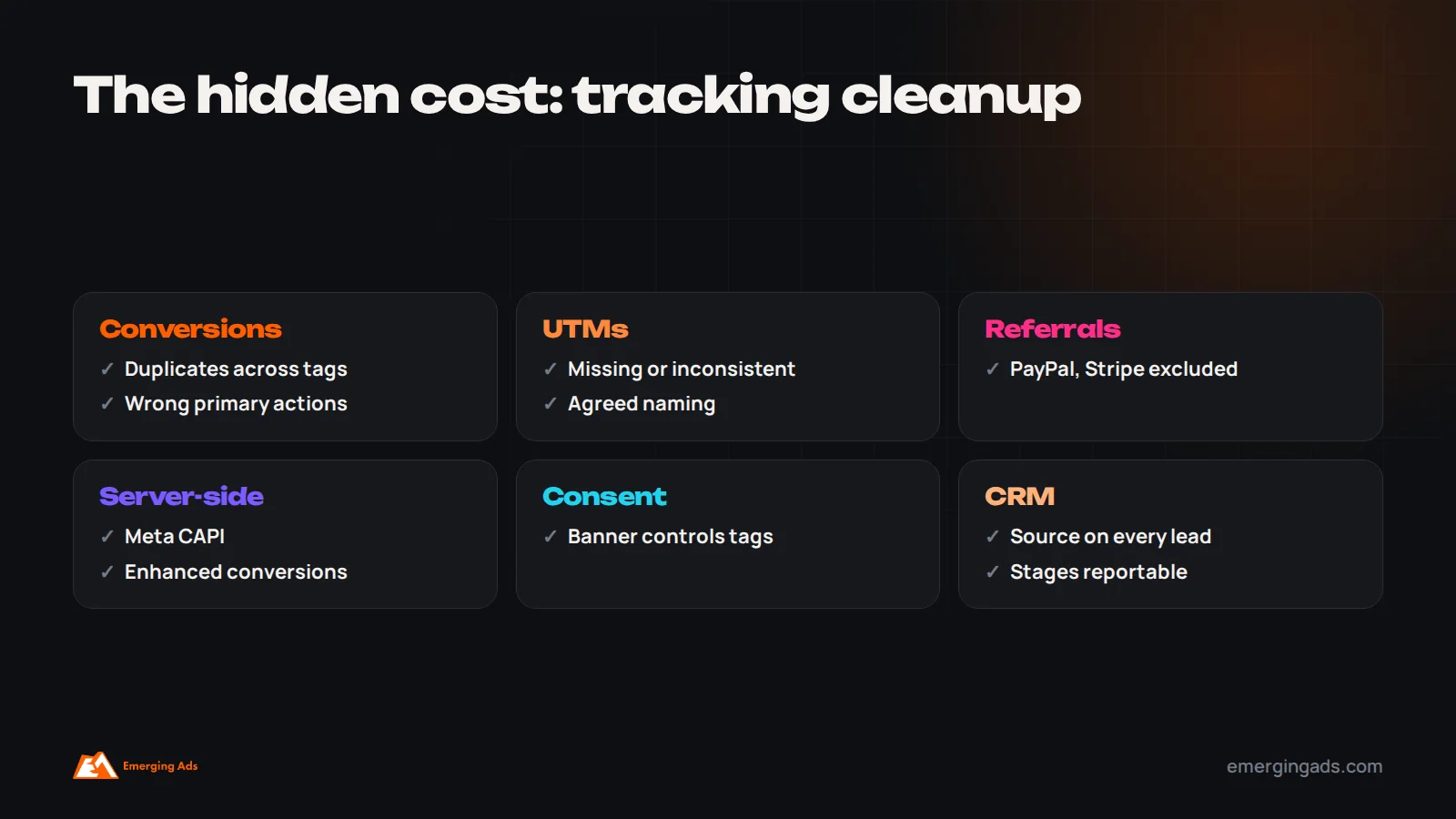
Almost every attribution project we have been involved in started with the same discovery: the underlying tracking was not good enough to support it. Common problems include:
- Duplicate conversions across Google Ads tags, GA4 imports and plugins.
- Missing or inconsistent UTM parameters, so traffic sources are mislabeled.
- Payment providers appearing as referral sources, stealing credit from real channels.
- Meta and other platforms missing conversions without server-side tracking.
- Consent banners not connected to tags.
- CRM records with no marketing source, so lead quality cannot be tied back to campaigns.
Fixing these is not glamorous, but it is the foundation. A sophisticated model on top of broken tracking produces confident-looking wrong answers. We usually recommend budgeting for tracking cleanup before or alongside any attribution investment. Our guides on Meta pixel tracking setup and on cleaning up Google Ads conversions in lowering Google Ads CPA cover the essentials.
How to set up attribution modeling, step by step
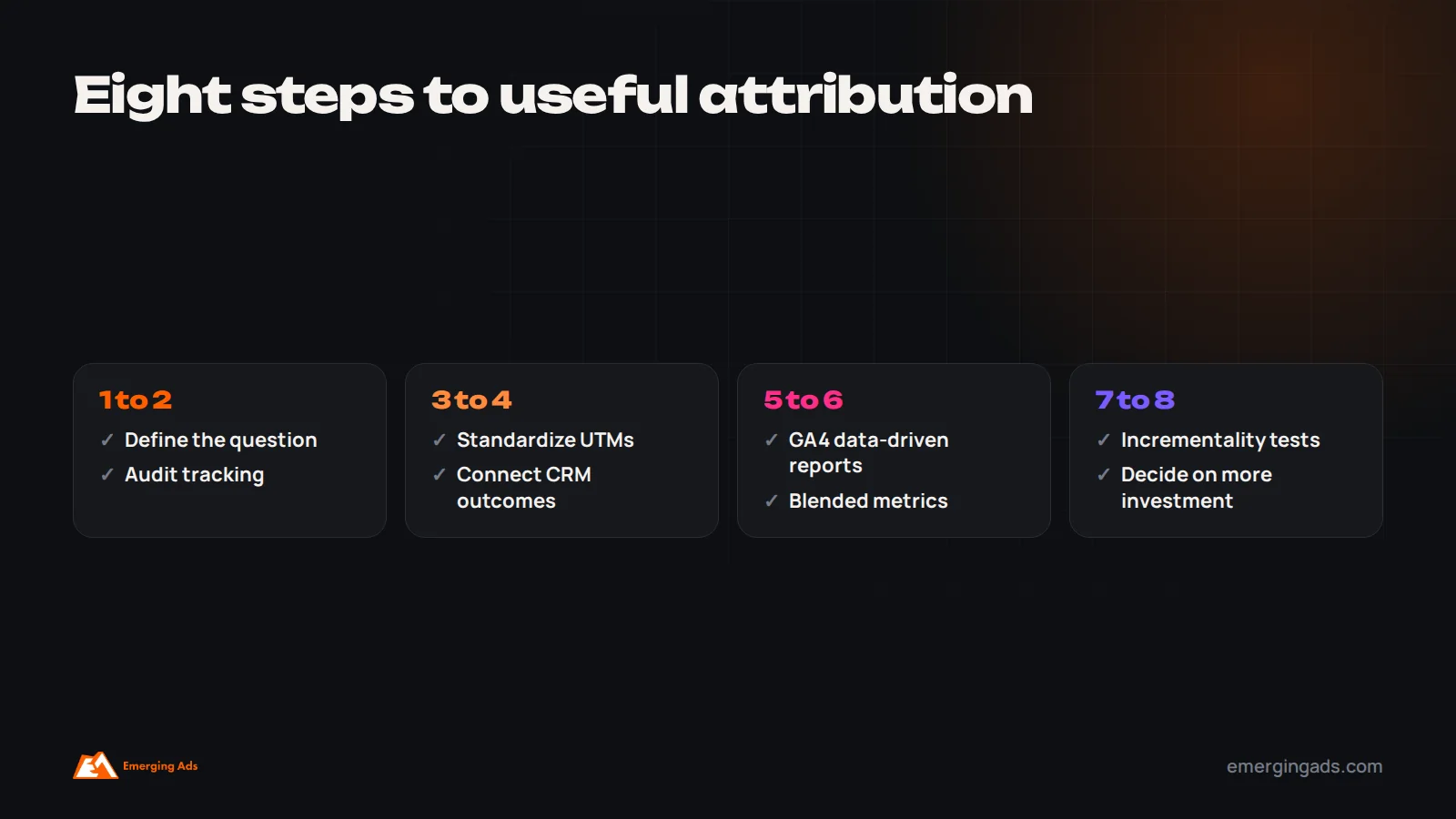
- Define the question. Are you trying to split budget between channels, understand which campaigns bring new customers, or prove that a channel is worth keeping? The question decides the method.
- Audit tracking. Check conversion tracking on every platform, GA4 configuration, UTM tagging and CRM source capture. Fix what is broken.
- Standardize naming. Agree UTM conventions for source, medium and campaign, and apply them to every link in ads, emails and social posts.
- Connect sales outcomes. For lead generation, make sure the CRM records the original source and campaign, and that later stages can be reported against them.
- Start with what you have. Use GA4’s data-driven attribution and model comparison reports, alongside platform reports, for a few months.
- Add blended metrics. Track total revenue divided by total ad spend, and blended cost per new customer, so you have a reality check that does not depend on any model.
- Test incrementality. Run holdout or lift tests on your largest channels to see whether attribution’s conclusions hold.
- Decide whether to invest further. If spend is large and decisions are hard, consider attribution software or MMM.
What a reasonable budget looks like at each stage
Rather than quoting figures that vary widely by market and vendor, here is how we think about attribution investment by stage:
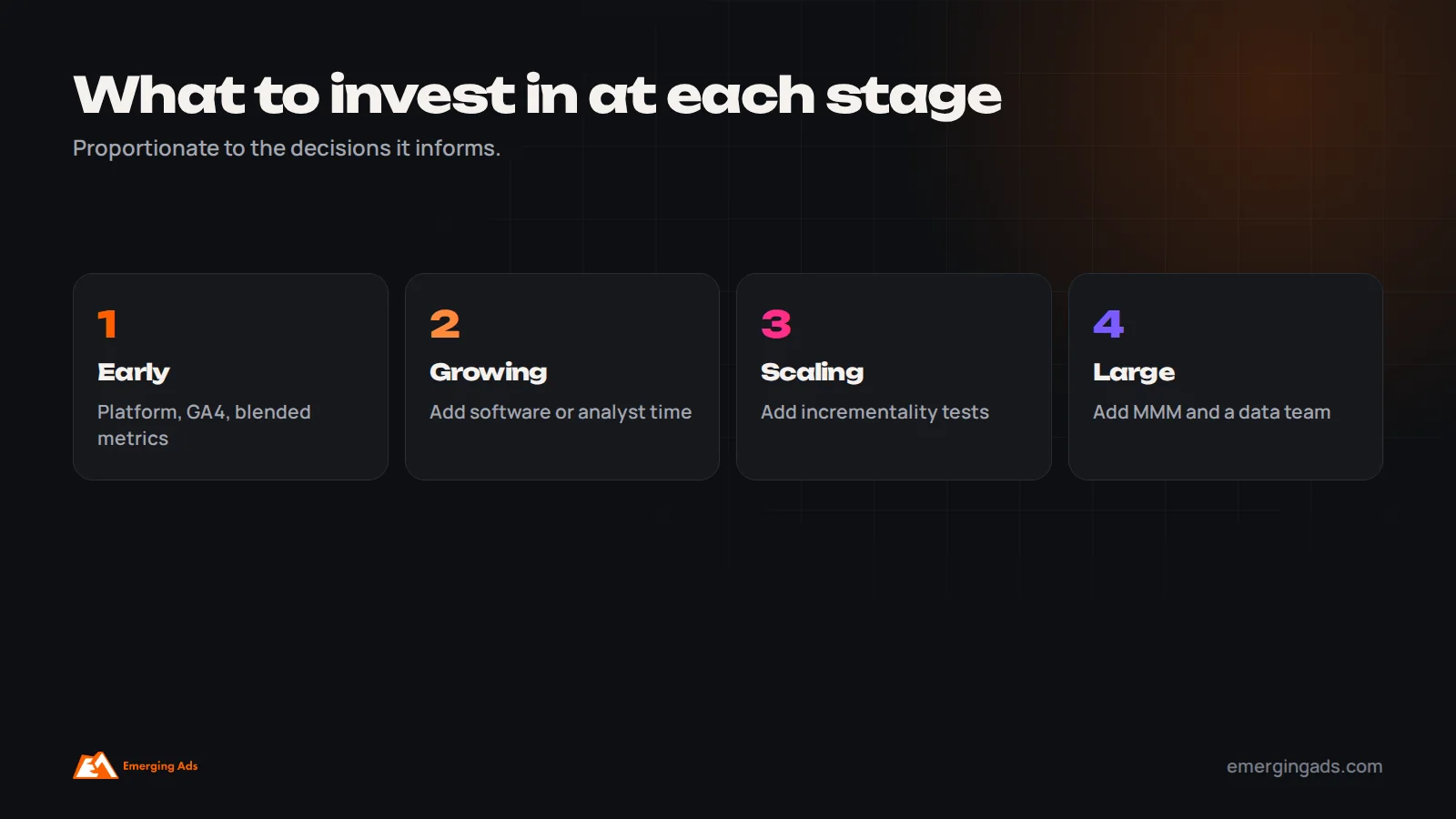
| Stage | Typical setup | Main cost |
|---|---|---|
| Early: one or two channels | Platform reports, GA4, blended metrics | Time to set up tracking properly |
| Growing: three or more channels | Above, plus attribution software or regular analyst time | Software subscription or analyst hours, plus tracking cleanup |
| Scaling: significant multi-channel spend | Above, plus incrementality tests on major channels | Analysis time and short-term holdout cost |
| Large: complex journeys, offline sales | Marketing mix modeling, data warehouse, in-house data team | Specialist skills, tooling and ongoing maintenance |
A useful rule: measurement spend should be proportionate to the decisions it informs. If better measurement could change how you allocate a large annual budget, investing a small percentage of that budget in measurement is easy to justify. If you spend modestly on two channels, free tools and good habits are usually enough.
Blended metrics: the cheapest reality check
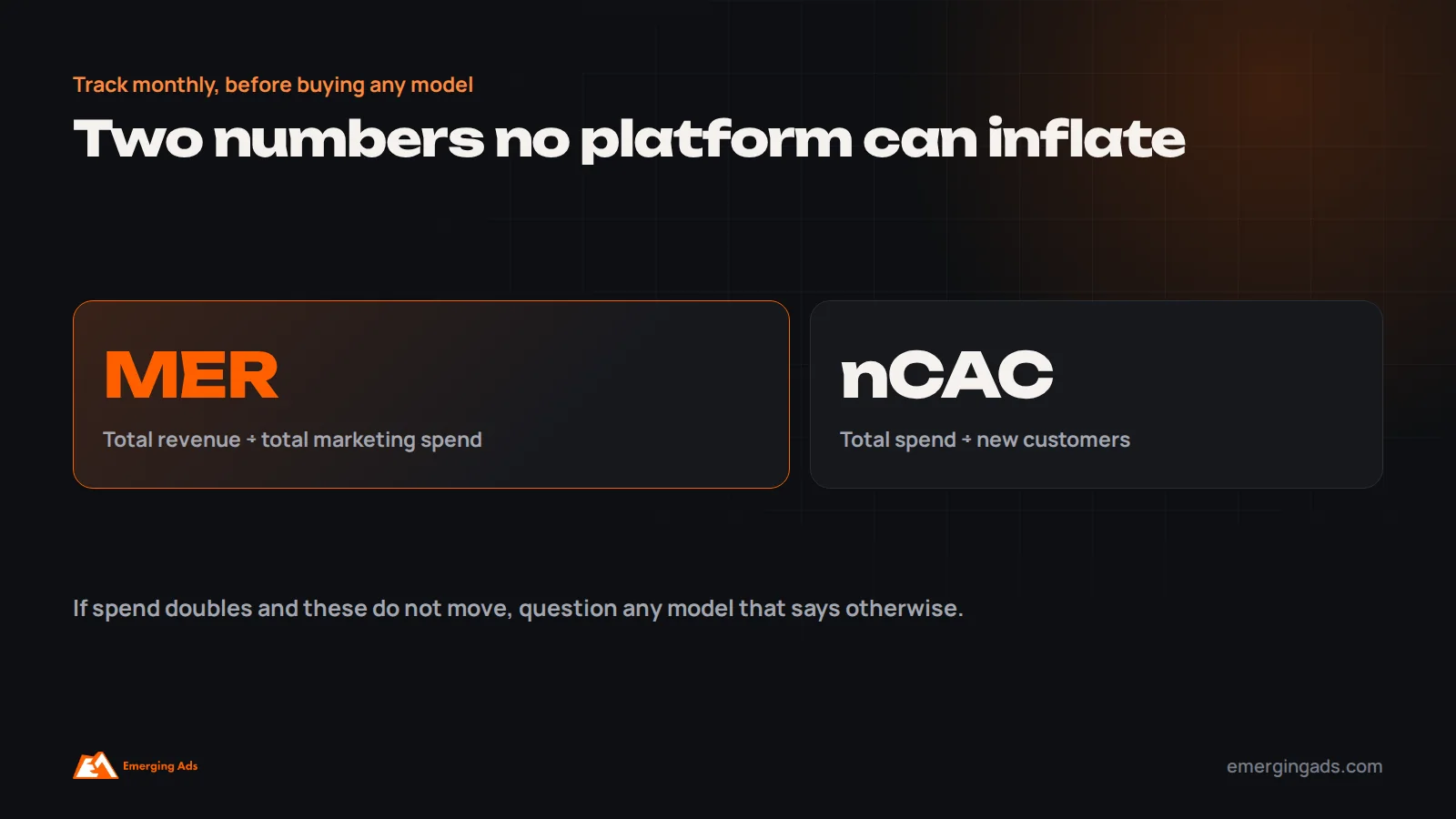
Before paying for any model, track two simple numbers every month. The first is marketing efficiency ratio, total revenue divided by total marketing spend. The second is blended cost per new customer, total marketing spend divided by the number of new customers. Neither tells you which channel did what, but both tell you whether marketing as a whole is working, and they cannot be inflated by overlapping platform claims.
When a channel is added, paused or scaled, watch how these blended numbers move. If you double Meta spend and total revenue barely changes, no attribution model claiming Meta drove a large share of sales should be trusted without further testing.
Incrementality testing in practice
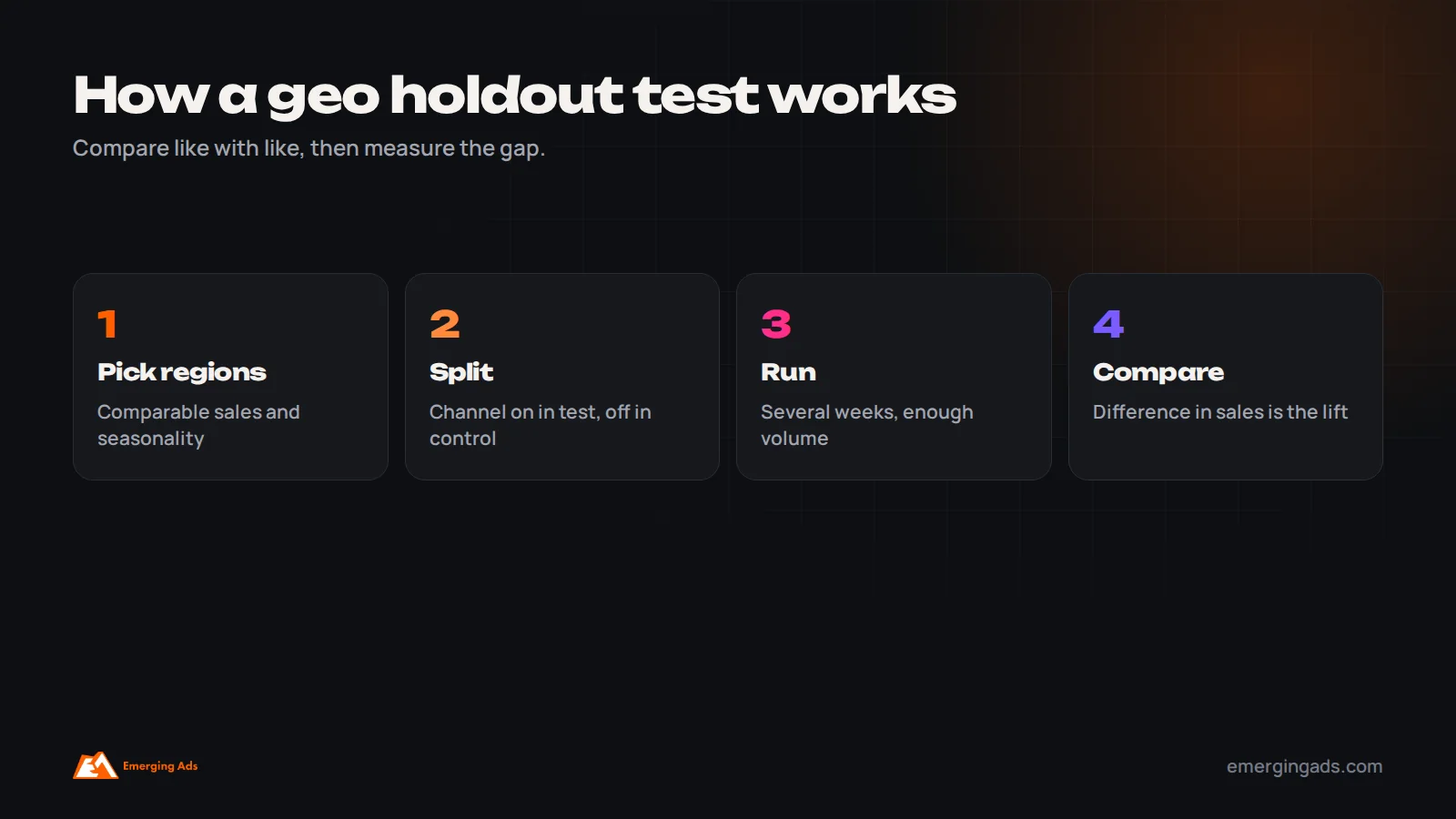
Incrementality tests are the closest thing marketers have to a controlled experiment. A geographic holdout might pause a channel in a few comparable regions for several weeks while keeping it running elsewhere, then compare sales. Conversion lift studies run by Meta and Google randomly withhold ads from a control group and measure the difference in conversions.
They need enough volume to detect a difference, careful design so test and control groups are comparable, and acceptance that some sales may be lost during the test. For businesses spending significantly on a channel, that cost is usually small compared with the cost of continuing to fund a channel that adds little, or cutting one that adds a lot.
Attribution for lead generation businesses
For businesses that sell through sales teams, the most important attribution work is connecting marketing to the CRM. Every lead should carry its original source, campaign and, ideally, ad. Later stages, such as qualified, opportunity and won, should be reportable against those sources. Sending those stages back to ad platforms as offline conversions also helps the platforms optimize for quality.
Without this, lead generation businesses usually optimize for cost per lead, which often favors channels producing cheap, low-quality leads. Our article on CRM automation mistakes explains how to fix the gaps.
Attribution for ecommerce businesses
For online stores, the key questions are usually which channels bring new customers rather than returning ones, and how much paid social contributes beyond what it gets credit for. Post-purchase surveys asking “how did you first hear about us?” are a simple, inexpensive addition. They often credit channels like TikTok, YouTube, podcasts and word of mouth far more than any tracking-based model can.
Combine survey data, platform reports, GA4 and blended metrics, and run periodic holdouts on your largest paid channels. That combination answers most ecommerce attribution questions without heavy investment.
Post-purchase surveys: inexpensive and surprisingly useful
A single question after checkout, “How did you first hear about us?”, with a short list of options and an “other” box, captures information no tracking system can: podcasts, word of mouth, a TV-screen YouTube ad, an influencer mention, a billboard. Survey tools integrate with most ecommerce platforms, and many brands get responses from a large share of buyers.
Survey answers have their own biases, since people remember imperfectly and tend to credit the most memorable touchpoint. But comparing survey results with platform and GA4 reports often reveals channels that tracking undervalues. If a meaningful share of buyers say they first heard of you on TikTok while TikTok shows few attributed sales, that is worth investigating with an incrementality test before cutting the budget.
A reporting rhythm that keeps attribution useful
Attribution is only valuable if it changes decisions. A rhythm that works for most growing businesses: weekly, platform reports guide in-channel optimization. Monthly, a single cross-channel view combines GA4 or attribution software, blended metrics and survey data, with a short written summary of what changed and why. Quarterly, a deeper review looks at incrementality test results, new customer economics and whether budget allocation should change. Keep definitions and windows stable between reviews so trends are comparable.
Questions to ask attribution software vendors
- How do you collect data, and how do you handle consent and privacy rules in our markets?
- How do you account for view-based influence from platforms like Meta and YouTube?
- Can you include CRM, offline and marketplace sales?
- How do you handle customers who switch devices?
- How do your numbers compare with incrementality tests your clients have run?
- What does pricing look like as our revenue grows?
- How easily can we export raw data if we leave?
Vendors who answer specifically, and who acknowledge the limits of their methods, are usually more trustworthy than those promising perfect accuracy.
Marketplaces, retail and offline channels
Brands that sell on Amazon, in retail stores or through distributors face an extra challenge: a large share of sales happens where website tracking cannot see it. A Meta ad might send someone to search for your product on Amazon, or to buy it in a shop, and no click-based model will connect the two.
The practical answer combines several signals. Amazon’s own attribution tools can measure some off-Amazon traffic sent through tagged links. Retail sales data by region can be compared with regional ad spend, which is essentially a simple form of marketing mix modeling. Geographic holdouts work well here: increasing or pausing ads in some regions and watching total sales across every channel there. And survey questions at the point of sale or in packaging inserts can capture how customers first heard of the brand. Our guide to ACoS vs TACoS explains how Amazon measurement fits alongside the rest.
Who should own attribution?
Attribution sits awkwardly between marketing, analytics, sales and finance, which is why it often belongs to nobody. Give one person clear ownership of measurement: the tracking setup, naming conventions, reporting rhythm and test plan. That person does not need to be a data scientist for most businesses, but they need enough authority to insist that every campaign follows the naming rules and that tracking is fixed before budgets are scaled. Finance should agree the blended metrics, so marketing performance is judged on numbers the whole business trusts.
Common attribution mistakes
These come up again and again when we review how clients measure marketing. Most are habits rather than technical problems, which means they can be fixed without buying anything new.
- Adding up platform-reported conversions and treating the total as real.
- Buying attribution software before fixing tracking.
- Expecting one model to give a single, definitive truth.
- Using last click alone, which undervalues channels that create demand.
- Running sophisticated models on too little data.
- Ignoring offline sales and CRM outcomes.
- Never testing whether attribution conclusions hold up with incrementality tests.
- Changing models frequently, so trends become impossible to compare.
How to choose what to invest in
Start with the decision you are trying to make. If you are deciding how to split a modest budget between two channels, GA4, platform reports and blended metrics are enough. If you are scaling several channels and finding that platform reports disagree, add attribution software or analyst time, and start testing incrementality. If you are allocating a large budget across many channels, including offline, consider MMM alongside the rest.
Revisit the decision once a year, or whenever you add a major channel. The right level of measurement changes as the business grows.
Whatever you choose, invest first in clean tracking, consistent naming and CRM source capture. They make every method more accurate, and they are useful for years regardless of which tools you use later.
Getting help
We help clients audit and fix tracking, set up GA4 and CRM source capture, design blended reporting and plan incrementality tests, as part of our Google Ads and Meta ads work and our marketing automation service. For the channel-planning side, see our performance marketing guide. You can also start with a free ad audit, which includes a tracking review.
Frequently asked questions
How much does attribution modeling cost?
It ranges from free, using GA4 and platform data-driven attribution, to significant ongoing costs for attribution software, marketing mix modeling or custom data warehouse work. The main drivers are channel count, sales process, data volume, tracking quality and in-house skills.
What is the best attribution model?
No single model is best for everything. Data-driven attribution is a sensible default within Google’s tools, but it should be combined with blended metrics and incrementality tests for cross-channel decisions.
Is GA4 attribution good enough?
For many small and mid-sized businesses, yes, especially combined with platform reports and blended metrics. It depends on tracking quality and sees less of view-based influence from platforms like Meta and YouTube.
What is marketing mix modeling?
Marketing mix modeling uses statistical analysis of historical spend and sales, often with seasonality and other factors, to estimate each channel’s contribution without relying on user-level tracking. It needs substantial historical data and specialist skills.
What is incrementality testing?
It measures what a channel truly adds by comparing results with and without it, for example by pausing ads in some regions or using platform lift studies with randomized control groups.
Why do my ad platforms report more sales than I made?
Each platform credits itself for conversions within its own attribution window, so the same sale can be claimed by several platforms. Blended metrics give a more realistic picture.
Do small businesses need attribution software?
Usually not. Clean tracking, GA4, platform reports, blended metrics and post-purchase surveys answer most questions for small businesses.
What should I fix before investing in attribution?
Conversion tracking on every platform, GA4 configuration, consistent UTM tagging and CRM source capture. No model can compensate for broken tracking.