ACoS vs TACoS: Why the Metric You’re Optimizing For Might Be Wrong
Most Amazon sellers obsess over ACoS and never look at TACoS, which means they’re often making bidding decisions with an incomplete picture. ACoS only tells you how efficient your ad spend was against ad-attributed sales. It says nothing about the organic sales your ads may have helped generate indirectly.
Understanding the difference, and specifically when each metric should drive your decisions, is the difference between a seller who cuts a genuinely working campaign because ACoS looks high, and one who correctly reads what’s actually happening across their whole account.
- ACoS measures ad spend against ad-attributed sales only. It’s a campaign-level efficiency metric.
- TACoS measures ad spend against total sales, including organic. It’s an account-level health metric.
- A campaign can have a rising ACoS while TACoS falls, which usually means ads are driving organic rank and sales.
- New product launches justify a temporarily high ACoS in exchange for building organic ranking.
- Mature, stable listings should be judged more by ACoS, since there’s less organic lift left to gain.
What ACoS Actually Measures
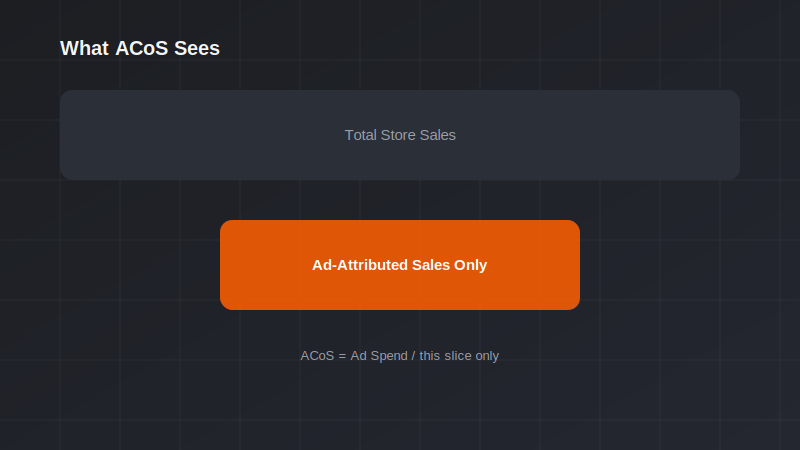
ACoS, Advertising Cost of Sale, is your ad spend divided by the ad-attributed revenue it generated, expressed as a percentage. Spend $200 on ads that generate $1,000 in ad-attributed sales, and ACoS is 20%. It’s the metric Amazon surfaces most prominently in Seller Central, which is exactly why it gets over-relied on.
The limitation: ACoS only counts sales Amazon directly attributes to that ad click. It has no visibility into whether that ad exposure influenced someone who later bought without clicking the ad again, which happens constantly, especially for repeat or brand-aware shoppers.
What TACoS Actually Measures
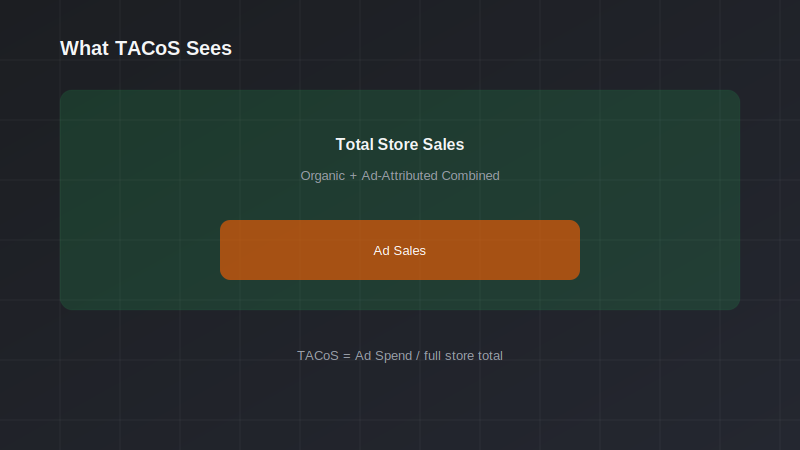
TACoS, Total Advertising Cost of Sale, is your ad spend divided by total sales, both ad-attributed and organic combined. It answers a different, broader question: relative to everything you’re selling, how much are you spending on ads?
A falling TACoS over time, even while individual campaign ACoS stays flat or rises, is one of the clearest signals that your ads are doing their job at building organic momentum, not just buying isolated sales.
Why a “Bad” ACoS Can Still Be a Good Sign
Imagine a new listing with a 45% ACoS, which looks alarming in isolation. But if that listing’s organic sales are climbing month over month and TACoS is falling even as ACoS stays elevated, the ads are successfully building rank and visibility that will eventually reduce reliance on paid traffic entirely.
This is exactly why we prioritize TACoS trend, not ACoS snapshot, when evaluating whether a launch campaign is actually working.
When to Optimize for ACoS vs TACoS
Use ACoS as your primary lens for mature, stable listings where organic rank is already established and there’s limited additional organic lift left to capture. At that stage, ads are mostly about defending position and capturing incremental demand, and efficiency matters more than growth.
Use TACoS as your primary lens for new launches, listings actively climbing in rank, or any period where you’re intentionally trading short-term ad efficiency for long-term organic growth. Judging these situations by ACoS alone leads to prematurely cutting campaigns that are actually working exactly as intended.
How to Calculate Both Correctly
ACoS = (Ad Spend / Ad-Attributed Sales) x 100. This is available directly in your Sponsored Products, Sponsored Brands, and Sponsored Display campaign reports.
TACoS = (Total Ad Spend / Total Sales, Including Organic) x 100. Total sales pulls from your Business Reports in Seller Central, not the advertising dashboard, since it needs your full sales picture, not just ad-attributed orders.
Track both monthly at minimum, ideally weekly during a launch phase when you need to react faster to whether the strategy is working.
A Real Example Walkthrough
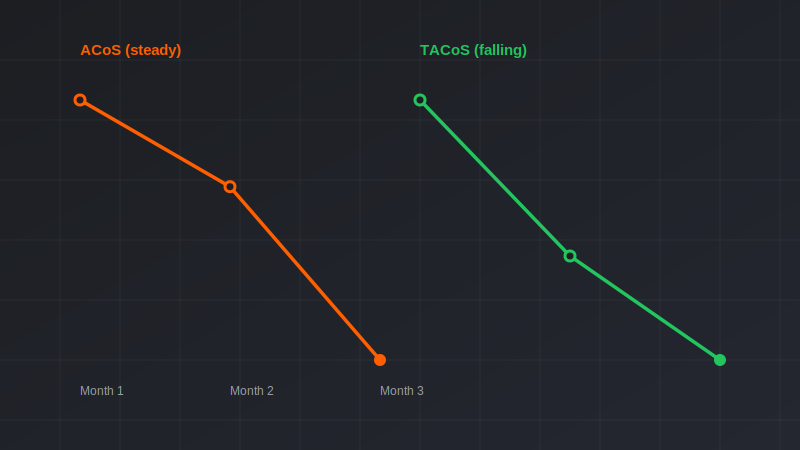
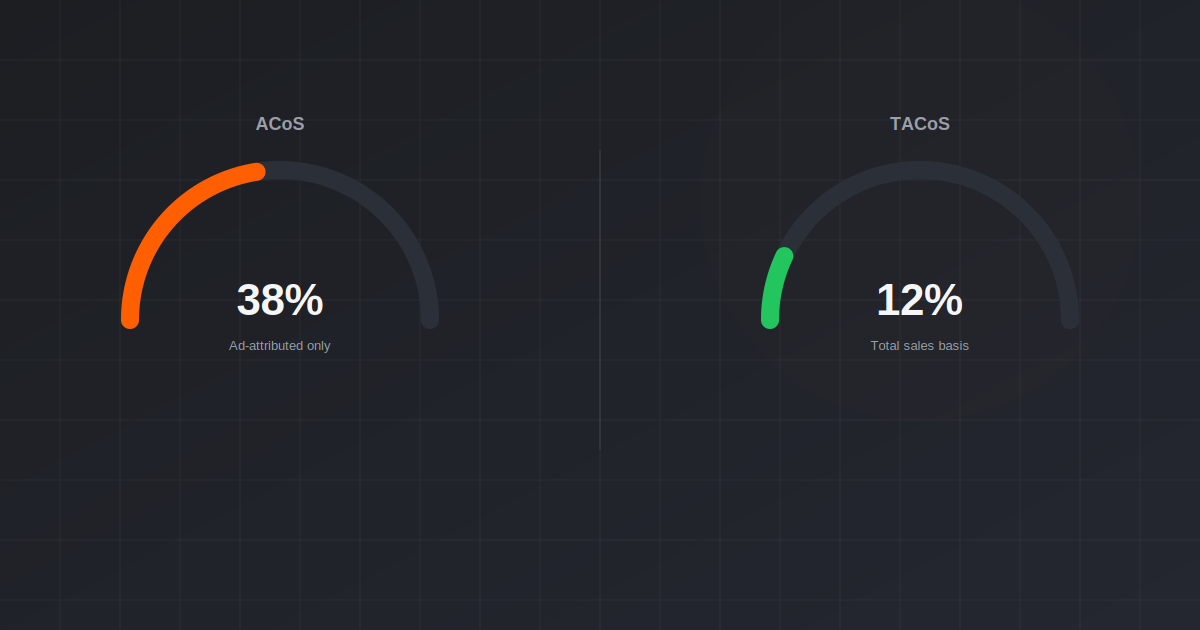
A supplement brand launches a new product with a 38% ACoS in month one, spending aggressively to build initial velocity and reviews. Total sales that month are $8,000, of which $3,000 came from ads, meaning TACoS sits at roughly 14%.
By month three, organic sales have grown to $12,000 alongside $3,500 in ad sales at a similar 35% ACoS, essentially unchanged. But TACoS has fallen to roughly 9%, since total sales grew faster than ad spend did. ACoS alone would suggest nothing improved. TACoS shows the campaign is doing exactly what it should: building an organic base that increasingly carries the listing on its own.
Not Sure Which Metric to Trust on Your Account?
We’ll pull both ACoS and TACoS trends across your catalog and show you which listings are genuinely healthy versus which need a real fix.
Book a Free Amazon Audit →FAQs
Is a lower ACoS always better?
Not necessarily. A very low ACoS can mean you’re bidding too conservatively and leaving ranking opportunity and sales volume on the table, particularly for newer listings that still need visibility.
What’s a good TACoS target?
This varies by category and margin, but many sellers aim for TACoS in the 5 to 15% range once a listing matures, with room for it to run higher temporarily during a launch phase.
Can TACoS be calculated per product or only account-wide?
It can be calculated per product if you track that product’s total sales (ad-attributed and organic) separately, though many sellers start by tracking it account-wide since Amazon’s Business Reports make that easier to access.
Should I stop advertising once organic rank is strong?
Not usually. Even well-ranked listings benefit from some ad presence to defend against competitors bidding on your branded terms and to maintain visibility as competition changes.
How long should I expect ACoS to stay elevated on a new launch?
This varies by category competitiveness, but many sellers see ACoS begin normalizing within 60 to 90 days as organic rank builds, assuming the underlying product and listing quality support conversion.
Does TACoS account for DSP spend too?
It should, for the most complete picture. Include all advertising spend, Sponsored Ads and DSP, against total sales when calculating TACoS if you’re running both.
Ready to Put This Into Practice?
Book a free 30-minute audit. We’ll review what you’re running today and show you exactly where the next dollar of budget should go.
Book Free Strategy Audit →