The short answer
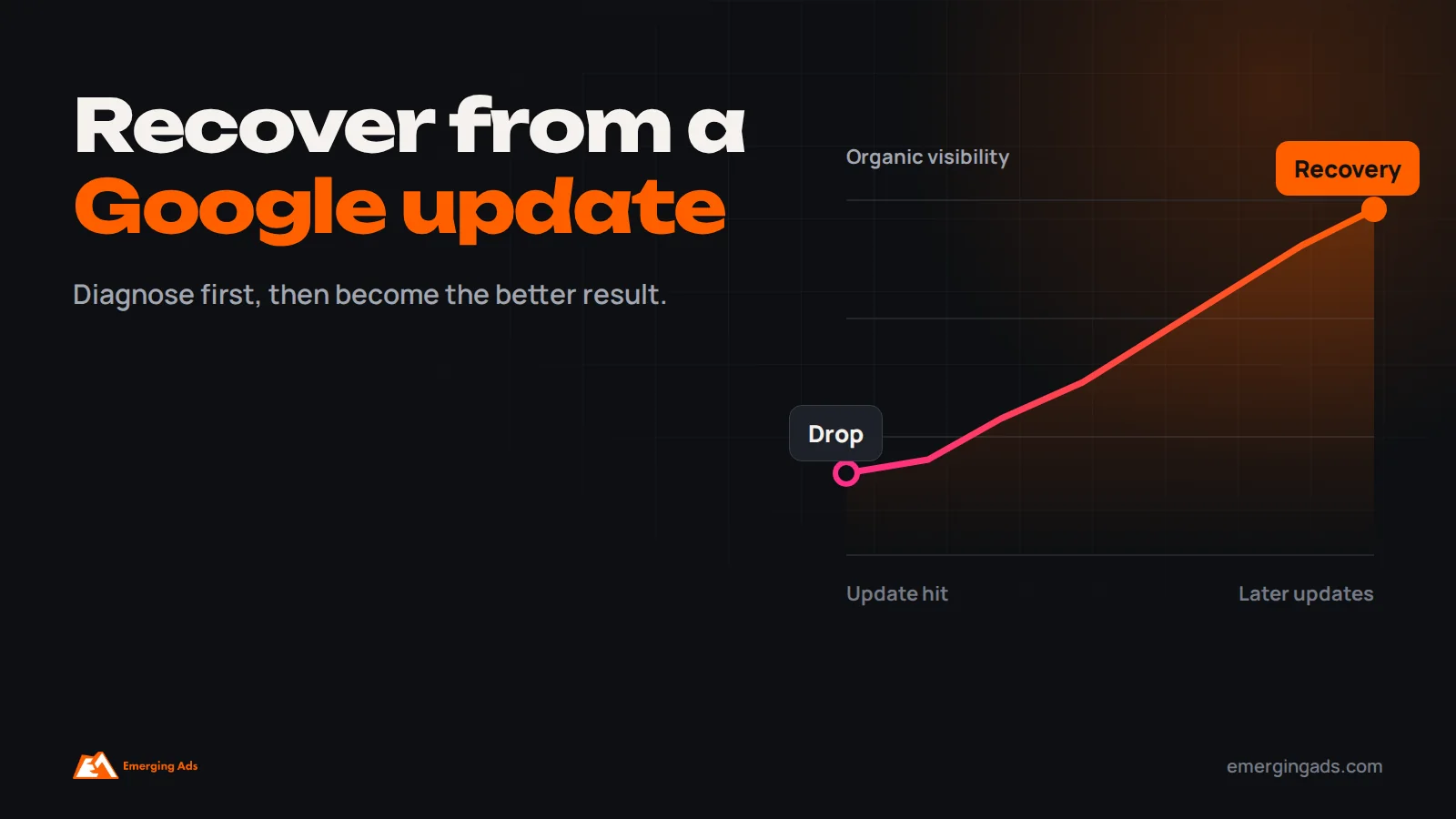
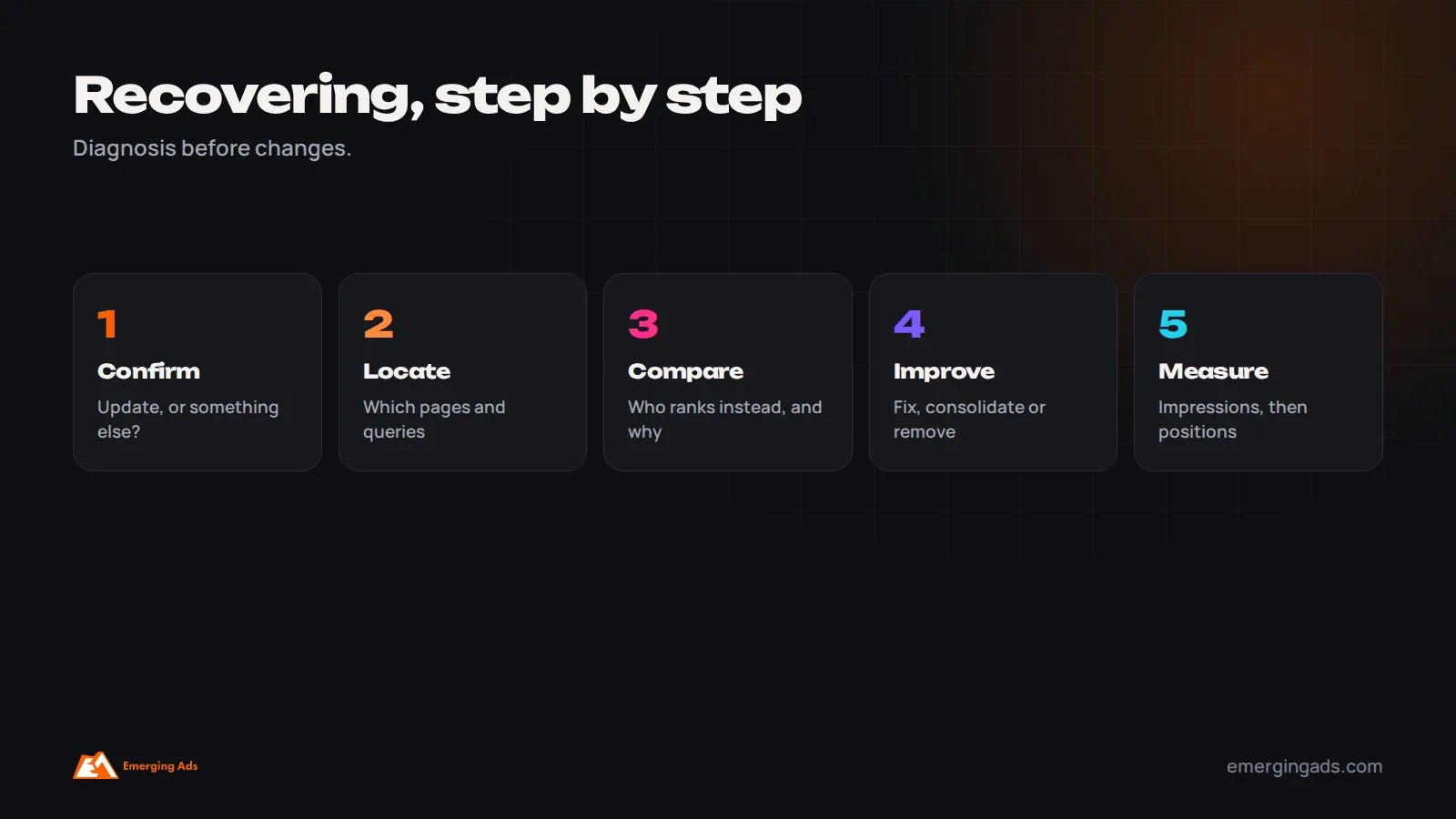
To recover from a Google algorithm update, first confirm the drop really coincides with an update rather than a technical problem, tracking change or seasonal dip. Then identify which pages and queries lost visibility, compare them with the pages that now rank, and improve your content so it is genuinely more helpful, specific and trustworthy for those searches. Fix technical issues, remove or improve thin and outdated pages, and strengthen signals of real expertise. Recovery is usually gradual and often appears around later core updates, so expect months rather than days.
Few things are as stressful for a business that depends on search as watching traffic fall overnight after a Google update. Leads slow down, sales dip, and the natural reaction is to change everything at once in the hope that something works.
That reaction usually makes things worse. Recovering from an algorithm update is less about quick fixes and more about diagnosing accurately, understanding what Google now prefers for your searches, and improving the site in ways that would make sense even without an update. This guide walks through that process step by step, based on how we approach traffic drops for clients.
If you are not yet sure whether an update caused your drop, start with our guide on diagnosing a sudden traffic drop, which covers technical and tracking causes in detail.
What Google algorithm updates actually are
Google changes its ranking systems constantly, with many small changes every year that most site owners never notice. A few times a year it announces larger updates, most notably core updates, which make broad changes to how Google assesses content across the web. It also releases targeted updates, such as spam updates, and introduces or changes policies, such as those covering site reputation abuse and scaled low-quality content.
Core updates are not penalties. Google has repeatedly explained that a drop after a core update does not necessarily mean anything is wrong with a page; it may simply mean other pages are now judged more relevant or helpful. That distinction matters, because the response to a penalty is to fix a violation, while the response to a core update is to become the better result.
Google lists confirmed updates and their rollout dates on its Search Status Dashboard. Core updates typically take up to around two weeks to roll out fully, and rankings can fluctuate throughout.
The different kinds of update, and what each means for you
Core updates are broad changes to how Google evaluates content and relevance. They affect sites across every industry and are the most common cause of large, unexplained ranking shifts. The response is broad improvement in quality and helpfulness, not a specific fix.
Spam updates target sites using tactics that violate Google’s spam policies, such as link schemes, cloaking, auto-generated content and keyword stuffing. If a drop coincides with a spam update, review your link profile and content practices carefully, and stop any tactics that could be considered manipulative.
Policy-related changes address specific abuses, such as third-party content hosted on reputable sites mainly to exploit their ranking power, expired domains repurposed to rank low-quality content, and content produced at scale with little value. Sites engaged in these practices can lose visibility quickly and sometimes receive manual actions.
Changes to search features, such as the expansion of AI Overviews, new result layouts or more ads, can reduce clicks without any change to rankings. These are not algorithm penalties, but they affect traffic and require a different response: optimizing for the clicks that remain and for visibility within the new features.
Knowing which kind of change you are dealing with avoids wasted effort. Rebuilding your link profile will not help with a core update driven by content quality, and rewriting content will not fix a drop caused by a new search feature.
Algorithm update or manual action?
A manual action is different from an algorithm update. It is applied by a human reviewer at Google when a site violates spam policies, such as unnatural links, thin scraped content or cloaking. Manual actions are reported in Google Search Console under Security and Manual actions. If you have one, the path is clear: fix the violation and submit a reconsideration request.
If there is no manual action, your drop is algorithmic, and there is no request to submit. Recovery comes from improvements that Google’s systems recognize over time.
Step 1: Confirm it really was an update
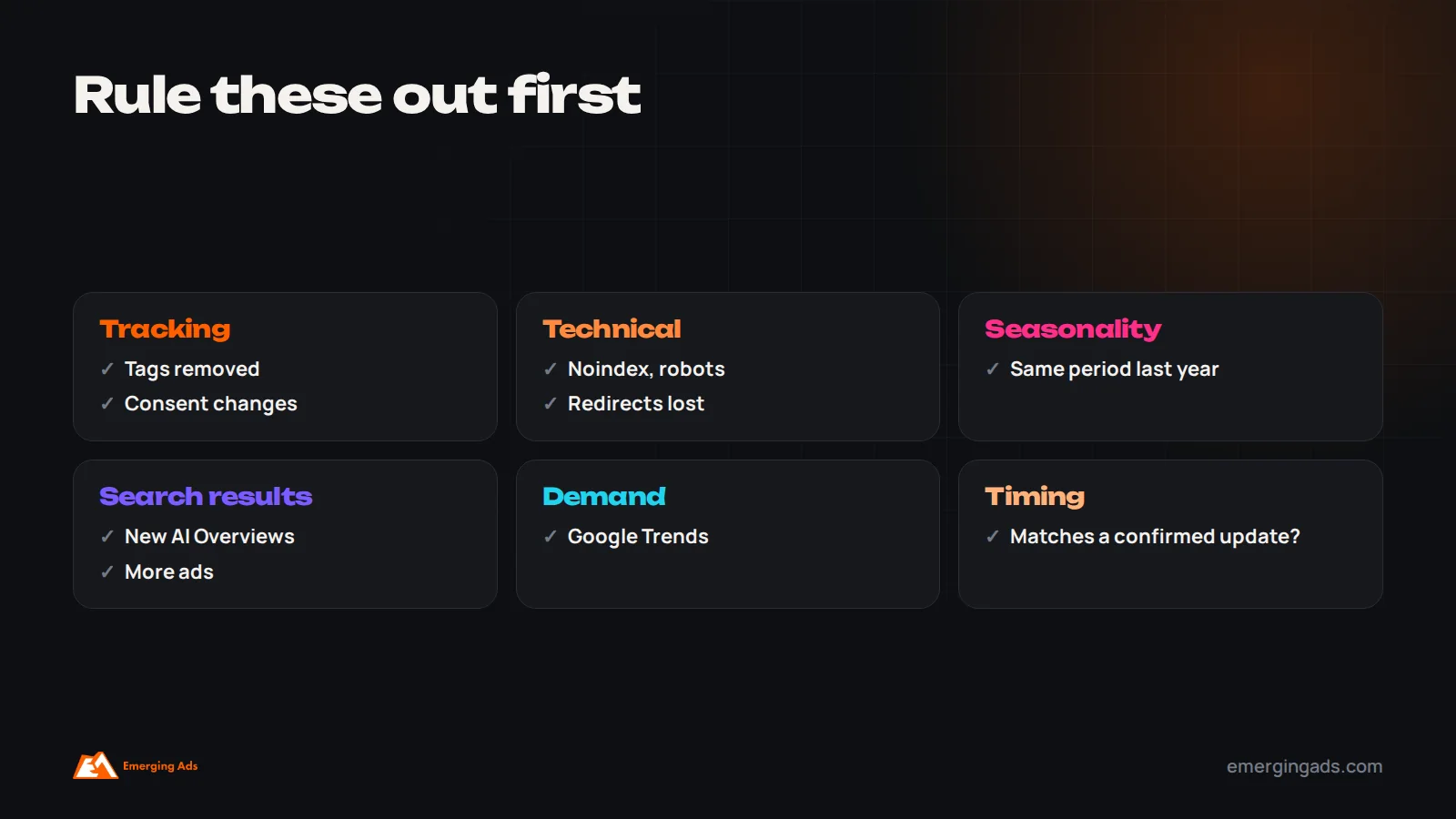
Many “algorithm update” drops turn out to be something else. Before changing content, rule out:
- Tracking problems: analytics tags removed or broken during a site change, consent banner changes or filters added.
- Technical issues: pages accidentally noindexed, robots.txt blocking sections, broken canonicals, redirects lost during a migration, server errors or slow responses.
- Seasonality: compare with the same period last year.
- Changes in search results: new AI Overviews, ads or other features pushing organic results down for your queries without your ranking changing.
- Demand changes: fewer people searching for your topics overall, visible in Google Trends.
Then check whether the timing matches a confirmed update on the Search Status Dashboard. A drop that begins within the rollout window of a core update, without a technical or tracking explanation, is likely update-related.
Step 2: Find exactly what lost visibility
“Traffic dropped” is not specific enough to act on. In Google Search Console, compare the period after the update with an equivalent period before it, and look at:
- Pages: which URLs lost the most clicks and impressions?
- Queries: which searches lost visibility, and did average position fall?
- Sections: did the drop affect the whole site, or specific areas such as the blog, product pages or a particular topic?
- Devices and countries: did one segment change more than others?
Patterns matter. A site-wide drop across many topics suggests Google’s broader assessment of the site changed. A drop concentrated in one section or content type, such as older blog posts or thin category pages, points to a specific problem with that content.
Step 3: Study who now ranks instead
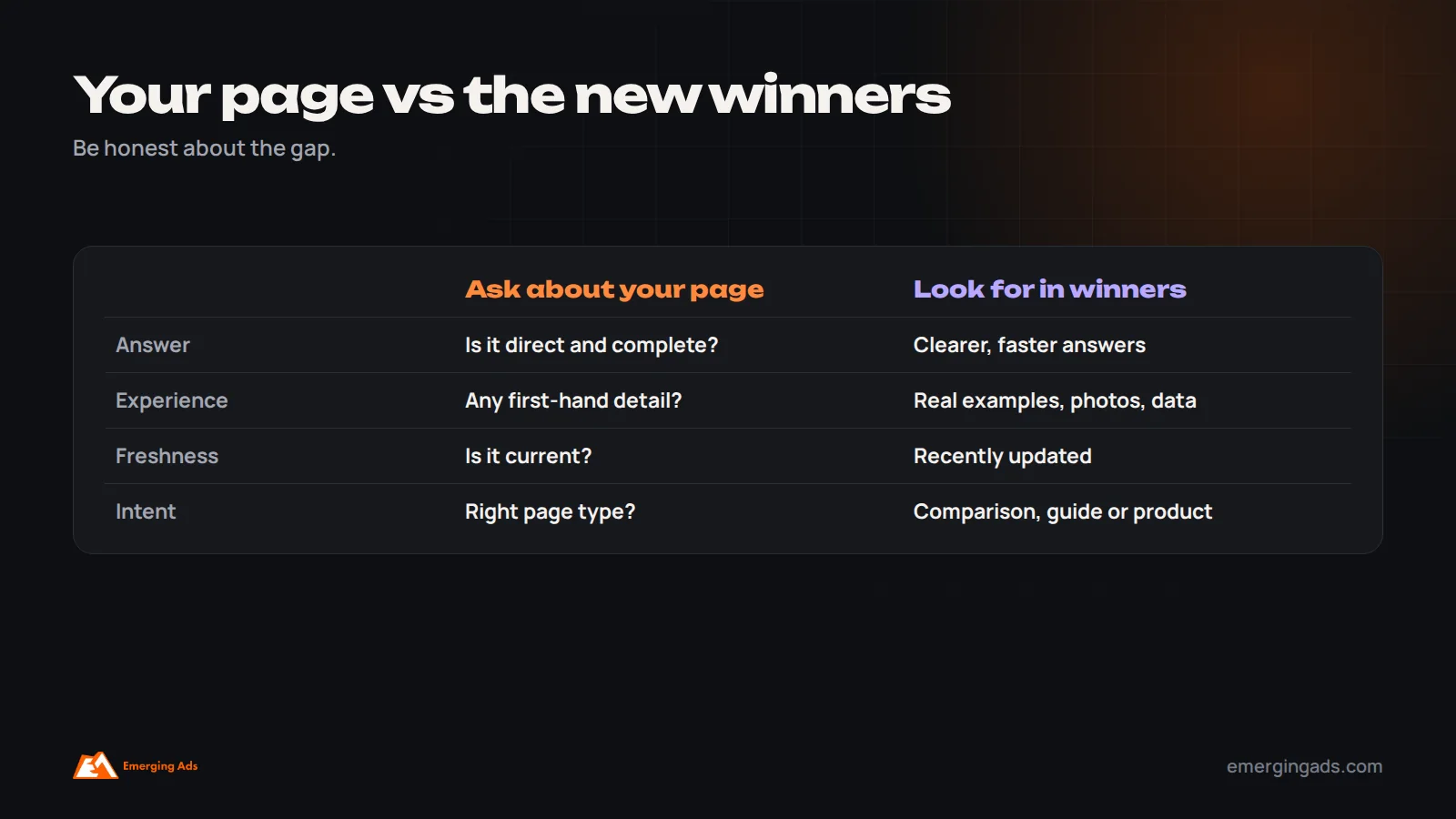
For the queries you lost, search them and study the pages that now rank above you. Ask honestly:
- Do they answer the searcher’s question more directly or completely?
- Do they show first-hand experience, such as original photos, real examples, testing or data?
- Are they written or reviewed by people with clear expertise?
- Are they more current?
- Do they match the intent better, for example a comparison where you have a generic article, or a product page where you have a guide?
- Are they from sites with a stronger reputation on the topic?
This comparison is the most useful diagnostic step. It shows what Google now considers a better result for each search, which is far more actionable than general theories about the update.
Step 4: Assess your content honestly
Google’s guidance on helpful content asks questions worth applying to each affected page. Does the content provide original information, analysis or insight? Does it go beyond the obvious? Would someone reading it leave feeling they learned enough to achieve their goal? Does it demonstrate first-hand experience and expertise? Was it created primarily to help people, or primarily to attract search traffic?
Common problems we find on sites hit by updates include:
- Many thin articles covering slight variations of the same topic.
- Generic content that restates what is available everywhere else.
- Outdated information, such as old prices, tools or rules.
- Content outside the site’s real area of expertise, published mainly for traffic.
- Pages stuffed with keywords or written for search engines rather than people.
- Large volumes of lightly edited AI-generated or templated content.
- Author and business information that is missing or unclear.
Step 5: Improve, consolidate or remove
For each affected page or section, decide what to do:
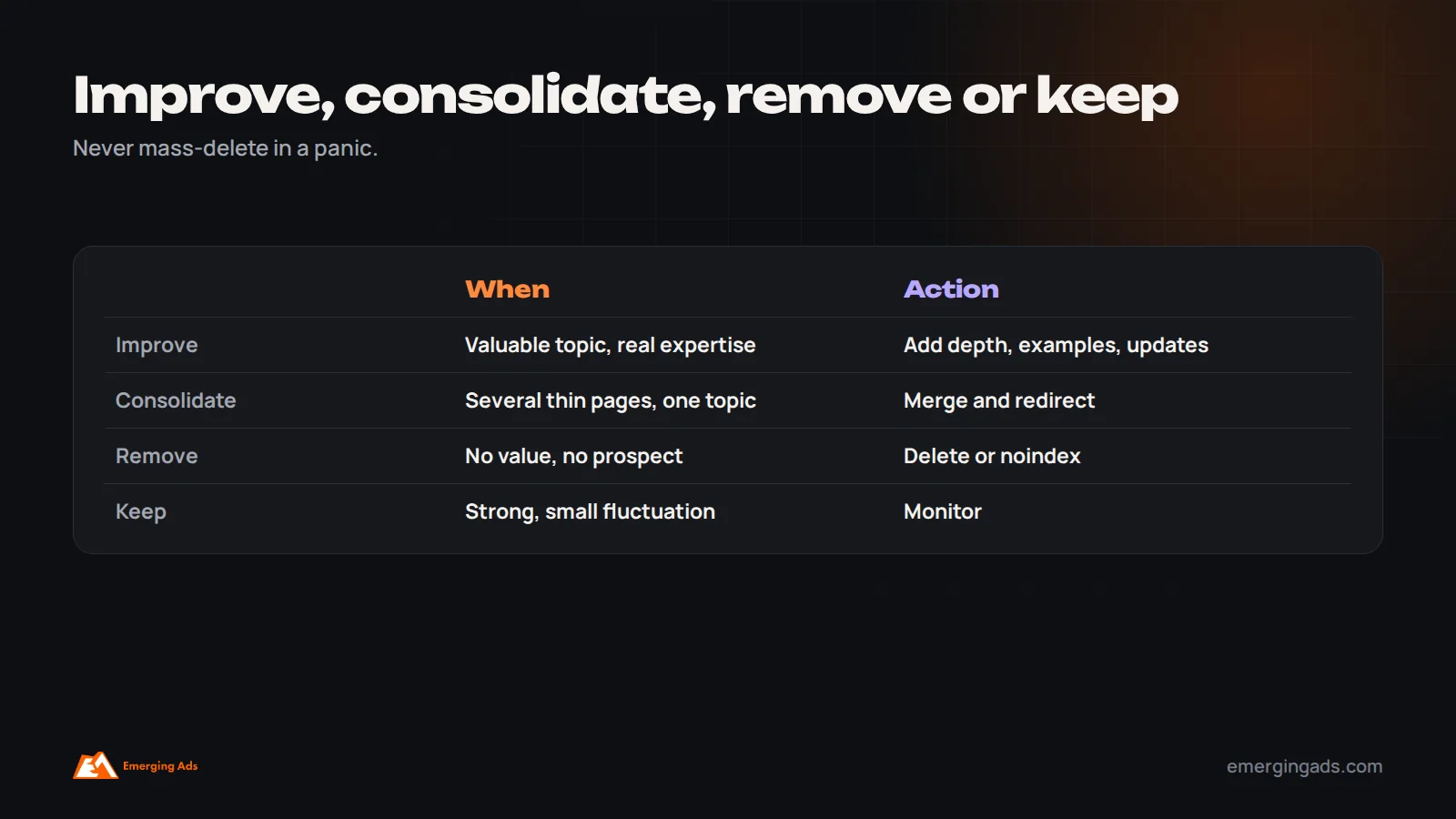
- Improve pages that target valuable topics where you genuinely have expertise: add first-hand detail, original examples, clearer answers, current information and better structure.
- Consolidate several thin pages on the same topic into one strong page, redirecting the old URLs to it.
- Remove or noindex pages with no value to users and no realistic prospect of improvement, such as outdated announcements or auto-generated pages.
- Keep pages that are strong and simply lost a little ground in normal fluctuation.
Do not delete large amounts of content in a panic. Pages that still earn traffic, links or conversions may be worth improving rather than removing. Decide page by page, or section by section, using data.
Running a content audit after an update
For sites with more than a few dozen pages, a structured content audit makes decisions faster and more consistent. Export every indexable URL with its clicks, impressions and average position from Search Console for the twelve months before the update and the period since, along with conversions from analytics and backlinks from a link tool if you have one. Add columns for topic, content type, last updated date and author.
Then sort and group. Pages with strong conversions or links but falling traffic are top priorities to improve. Clusters of thin pages on the same topic are candidates to consolidate. Pages with no traffic, no links and no conversions over a year, on topics outside your expertise, are candidates to remove. Pages that are strong and stable need no action. The audit also reveals patterns, such as all affected pages being older than three years or all coming from one author or content type, which point to root causes.
Keep the audit as a living document. As you make changes, record what was done and when, so you can connect later movements in Search Console to specific actions.
How to rewrite a page that lost rankings
When improving an affected page, start from the searcher, not the old text. Search the main query, read the top results and list what a complete answer needs to cover. Then rewrite the page to answer the main question clearly near the top, cover the related questions people ask, add specific detail from your own experience, such as real examples, numbers, photos, case studies or lessons learned, and remove filler, repetition and outdated claims. Update the title and headings so they describe the content accurately, add or improve author information, and refresh internal links to and from the page. Show a clear updated date if the content has meaningfully changed.
A good test is whether a knowledgeable customer would find the page genuinely useful and specific to your business, rather than something that could have been written by anyone about anything. If not, keep improving it. Our own blog rewrite follows exactly this approach, page by page.
Do backlinks matter for recovery?
Links remain one of the signals Google uses to understand a site’s reputation, but for most core update drops, content quality and relevance matter more than link counts. Building links quickly, especially through paid or manipulative schemes, is risky and rarely fixes the underlying problem. The links that help are those earned naturally: mentions in industry publications, references from partners and customers, citations of original research or data, and coverage of genuinely newsworthy work. If a spam update coincided with your drop, review your link profile for patterns that look manipulative, and stop any such activity.
Stabilizing revenue while you recover
Organic recovery takes time, and many businesses cannot wait months for leads and sales to return. Use other channels to stabilize: paid search on the commercial keywords you lost, ideally prioritizing those with the highest conversion value; email campaigns to existing subscribers and customers; paid social to keep demand flowing; and partnerships or referrals. Paid search data also helps recovery work, because it shows which lost queries are most valuable commercially. Our guide to lowering Google Ads CPA covers running paid search efficiently while organic traffic rebuilds.
Step 6: Strengthen experience, expertise and trust
Google’s quality guidelines describe experience, expertise, authoritativeness and trust, often shortened to E-E-A-T, as signals its raters look for, with trust the most important. While these are not a single ranking factor you can switch on, the things that demonstrate them tend to align with what ranks well after core updates:
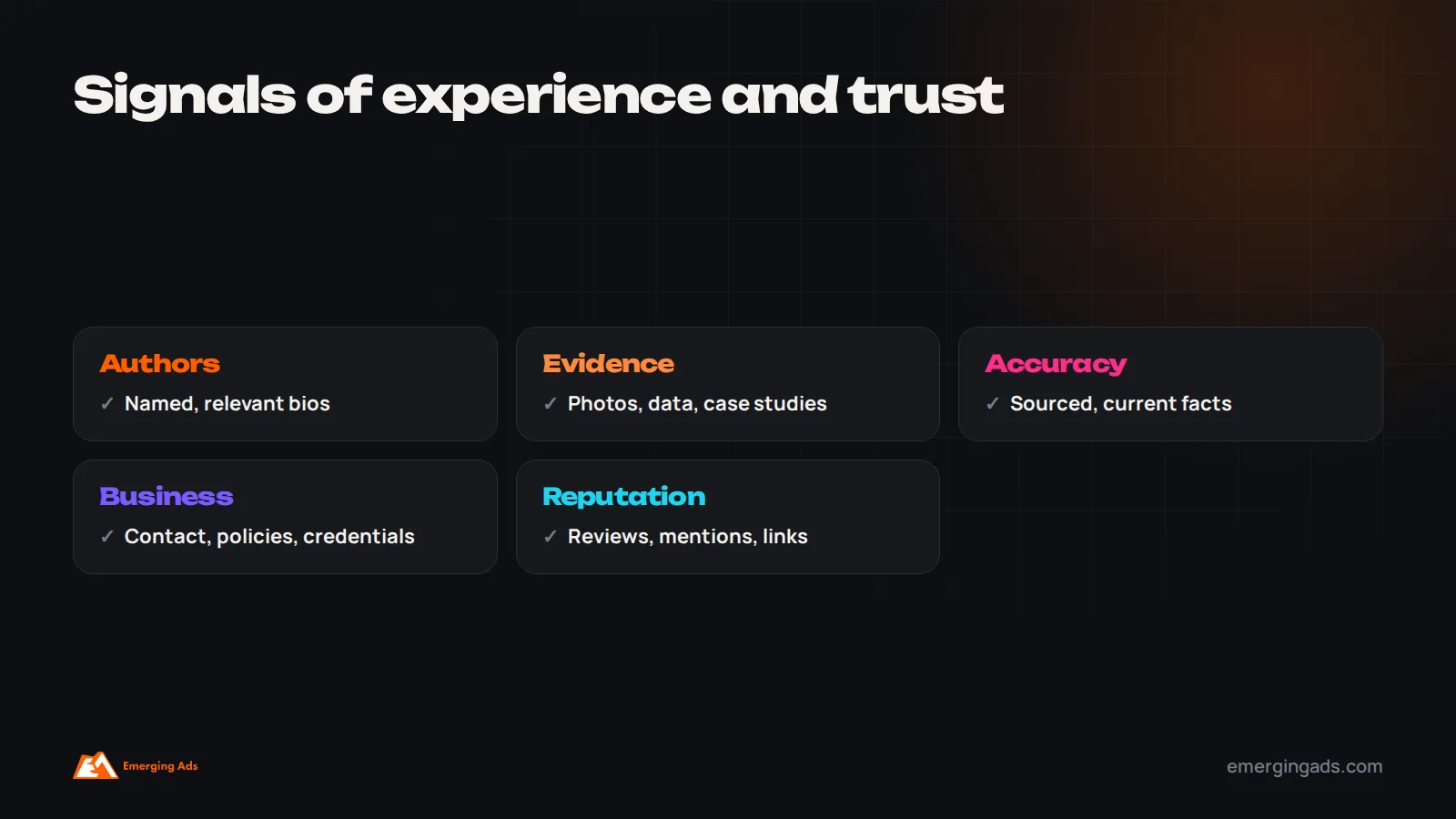
- Named authors with relevant experience and clear bios.
- First-hand evidence, such as photos, case studies, data and real examples from your work.
- Accurate, well-sourced information, especially on health, money and safety topics.
- Clear information about the business: who you are, how to contact you, policies and credentials.
- A reputation that others reflect, through reviews, mentions and links from respected sources.
Step 7: Fix technical and user experience issues
Technical problems rarely cause core update drops on their own, but they can make a weak position worse and slow recovery. Check indexation, crawl errors, Core Web Vitals, mobile usability, intrusive interstitials and site structure. Make sure internal links point clearly to your most important pages. Our technical SEO checklist covers the essentials.
Step 8: Be patient, and measure the right way
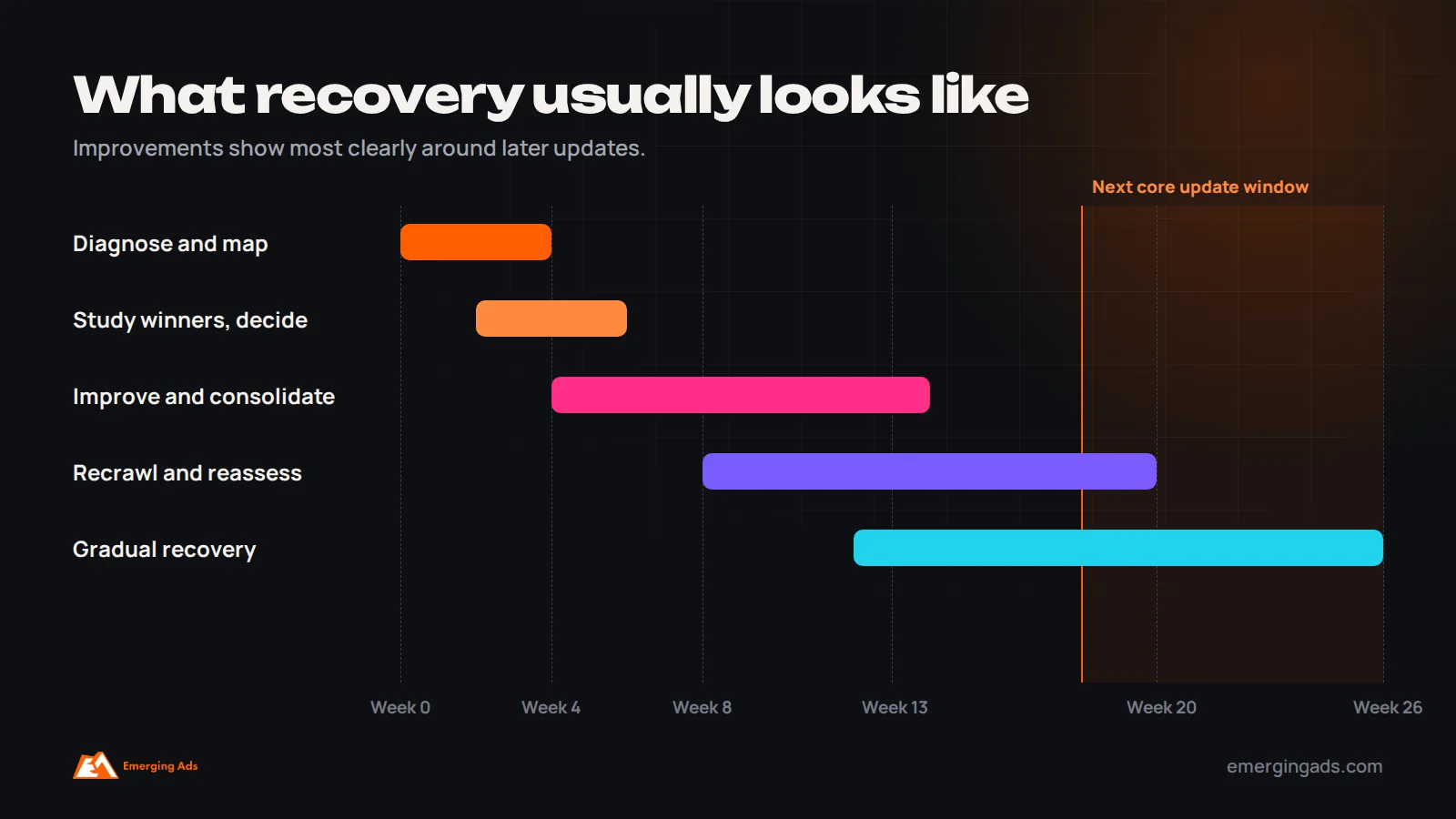
Google’s systems need to recrawl and reassess improved pages, and broad reassessments often show most clearly when later core updates roll out. Many sites see partial recovery over several months, with larger moves around subsequent updates. Some never fully return to previous levels, because search results themselves have changed, for example with more AI Overviews or stronger competitors.
Track progress in Search Console by page and query group, not just total traffic. Look for impressions recovering first, then positions, then clicks. Also track business outcomes, such as leads and sales from organic search, since the pages that matter most commercially may recover differently from informational content.
Communicating a drop to your team or clients
Traffic drops create pressure inside a business, and that pressure often leads to rushed decisions. Explain clearly what happened, what you know and do not know yet, and what the plan is. Share the diagnosis: which pages and queries were affected, whether technical or tracking causes have been ruled out, and how the drop compares with the wider market. Set realistic expectations that recovery is usually gradual and may depend on later updates. Agree the business metrics that matter most, such as organic leads and sales rather than total sessions, and report on them regularly. Calm, evidence-based communication protects the recovery work from panicked changes that could make things worse.
Setting up monitoring so the next update is easier
The businesses that respond best to updates usually saw them coming in their data. Set up a simple monitoring routine: a weekly check of Search Console clicks and impressions by page group, alerts in analytics for unusual drops in organic traffic or conversions, a list of priority queries checked monthly, and a note of every significant site change with its date. Bookmark Google’s Search Status Dashboard and check it whenever numbers move unexpectedly. With that history in place, the next time something changes you can diagnose it in hours instead of weeks.
What not to do after an update
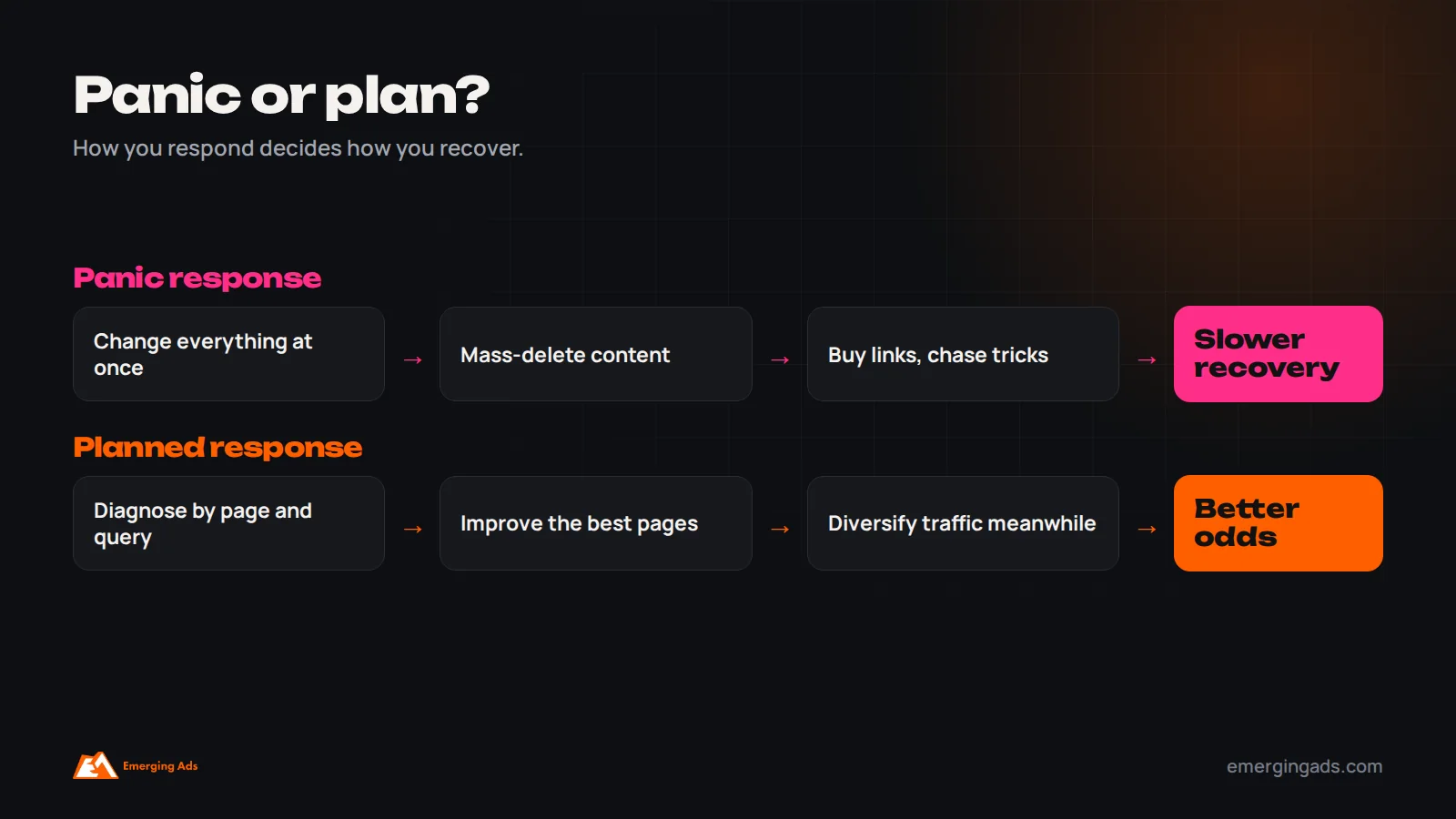
Most of the damage we see after updates comes from the response rather than the update itself. These are the reactions that most often slow recovery or cause new problems on sites that were otherwise sound.
- Do not change everything at once. You will not know what helped, and you may damage pages that were fine.
- Do not mass-delete content without checking traffic, links and conversions page by page.
- Do not chase quick tricks, such as buying links or rewriting every title for keywords.
- Do not publish large volumes of new thin content to “make up” lost traffic.
- Do not assume the update was wrong. Even when it feels unfair, study what now ranks.
- Do not ignore other channels. Paid search, email and social can stabilize revenue while organic recovers.
Recovery for ecommerce sites
Ecommerce sites hit by updates often have thin category pages with little useful content, near-duplicate product descriptions copied from manufacturers, large numbers of filter and variant pages indexed, and buying guides that add little beyond what competitors say. Improving category pages with genuinely helpful content, writing original product information for key products, controlling indexation of filters and variants, and adding real reviews and expert guidance usually help. Our ecommerce SEO team covers these issues in depth.
Recovery for local and service businesses
Local businesses often see drops when location pages are near-identical templates with only the city name changed, or when blog content strays far from their actual services. Fix by making each location page genuinely useful, with local details, team members, real projects and reviews from that area, and by focusing content on questions customers actually ask. A strong Google Business Profile supports local visibility independently of organic rankings. Our local SEO service covers this.
Recovery for content-heavy sites
Sites that rely heavily on informational content, such as blogs, publishers and affiliate sites, have been most affected by recent updates and by AI Overviews answering simple questions directly. The sites that hold up best tend to have a clear focus, genuine expertise, original testing or reporting and a loyal audience that visits directly. Recovery often means narrowing focus, cutting or consolidating content outside the core area, investing in fewer, deeper pieces and building direct relationships through email.
What about AI-generated content?
Google has said it focuses on the quality of content rather than how it is produced. But large volumes of generic, lightly edited AI-generated content tend to be exactly the kind of unhelpful, unoriginal content that core updates and spam policies target, particularly when published at scale mainly to attract search traffic. If your site published a lot of such content before a drop, review it critically: improve the best pieces with real expertise and examples, and consolidate or remove the rest.
Building a site that is resilient to updates
The most reliable protection against algorithm volatility is a site that would be valuable even if search engines did not exist. In practice that means a clear focus on topics where you have real expertise, content created to answer real customer questions with specific detail, regular updates to keep important pages current, a strong brand that people search for directly, diversified traffic from email, social, paid and referrals, and technical foundations kept clean. Sites built this way still see fluctuations, but they rarely face catastrophic drops, and they tend to benefit from updates more often than they suffer.
A 90-day recovery plan
- Weeks 1 to 2: confirm the cause, rule out technical and tracking issues, and map affected pages and queries in Search Console.
- Weeks 2 to 4: study the pages that now rank, assess your affected content honestly, and decide what to improve, consolidate or remove.
- Weeks 4 to 10: rewrite and improve priority pages, consolidate thin content, strengthen author and business information, and fix technical issues.
- Weeks 10 to 13: review early signals such as impressions and positions, adjust priorities, and continue improvements while monitoring for the next core update.
If you would like help diagnosing a drop, our SEO team runs recovery audits that combine Search Console analysis, competitor comparison and content review. You can also read about generative engine optimization, since AI answers increasingly affect organic visibility too.
Frequently asked questions
How long does it take to recover from a Google update?
Usually months rather than weeks. Improvements need to be recrawled and reassessed, and recovery often shows most clearly around later core updates. Some sites never fully return to previous levels because search results themselves change.
Is a core update drop a penalty?
No. Core updates reassess content broadly. A drop means other pages are now judged more helpful or relevant for those searches, not that you broke a rule. Manual actions, shown in Search Console, are different.
How do I know if my site was hit by an update?
Check whether the drop coincides with a confirmed update on Google’s Search Status Dashboard, and rule out tracking, technical, seasonal and demand changes first.
Should I delete content after a Google update?
Only after reviewing each page’s traffic, links and conversions. Improve valuable pages, consolidate overlapping thin ones and remove only pages with no realistic value.
Does AI-generated content cause ranking drops?
Google focuses on quality, not production method, but large volumes of generic AI content published mainly for search traffic are the kind of content updates tend to demote.
What is E-E-A-T?
It stands for experience, expertise, authoritativeness and trust, concepts from Google’s quality rater guidelines describing what helpful, reliable content looks like. Trust is the most important.
Can paid ads help after an algorithm update?
Paid search, email and social can stabilize leads and sales while organic visibility recovers, and paid search data can show which queries matter most commercially.
Will traffic return automatically?
Sometimes rankings recover in later updates without changes, but relying on that is risky. Improving content and the site gives you the best chance of recovery.