
The short answer
To generate B2B leads with LinkedIn ads for SaaS, start with a precise ideal customer profile, target by job function, seniority, company size and industry or by a named account list, and match the offer to how warm the audience is: useful content for cold audiences, case studies and product walkthroughs for warm ones, and demos or trials for people already engaged. Use Lead Gen Forms for low-friction capture, connect them to your CRM for instant follow-up, send pipeline stages back to LinkedIn, and judge campaigns on cost per qualified opportunity and pipeline, not cost per lead.
For SaaS companies selling to businesses, LinkedIn is often the only ad platform where you can reliably reach the exact people who buy: heads of finance at mid-sized retailers, IT directors at hospitals, operations managers at logistics firms. That precision is why LinkedIn ads cost more per click than almost any other platform, and why, used well, they can still be one of the most efficient sources of SaaS pipeline.
Used badly, they burn budget quickly. The most common pattern we see in SaaS accounts is a single “book a demo” campaign shown to a cold audience, with leads downloaded weekly and judged on cost per lead. Most of those leads go nowhere, and the company concludes that LinkedIn does not work for them.
This guide covers how we build LinkedIn lead generation for SaaS clients: defining the audience, choosing objectives and offers, deciding between forms and landing pages, account-based campaigns, budgets, creative, follow-up and measurement. For the errors that inflate costs, see our companion article on LinkedIn ads mistakes.
Why LinkedIn costs more, and why that is often worth it for SaaS
LinkedIn clicks commonly cost several times what a Meta click costs, and sometimes more than Google search clicks for the same category. The inventory is limited, the audience is professional, and many B2B advertisers compete for the same senior decision-makers.
The economics work for SaaS because customer value is high. If an annual contract is worth $20,000 and a customer stays for three years, a cost per qualified opportunity of several hundred dollars, or even a few thousand, can be very profitable. The question is never “is LinkedIn expensive?” but “does the pipeline it produces justify the cost?”
That is also why LinkedIn rarely makes sense for low-priced, self-serve products with small contract values. If your average customer pays $30 a month, the click costs are hard to recover unless targeting is extremely efficient.
Start with a genuinely specific ideal customer profile
Everything on LinkedIn depends on targeting, and targeting depends on knowing exactly who buys. Before building campaigns, write down your ideal customer profile in terms LinkedIn can target:
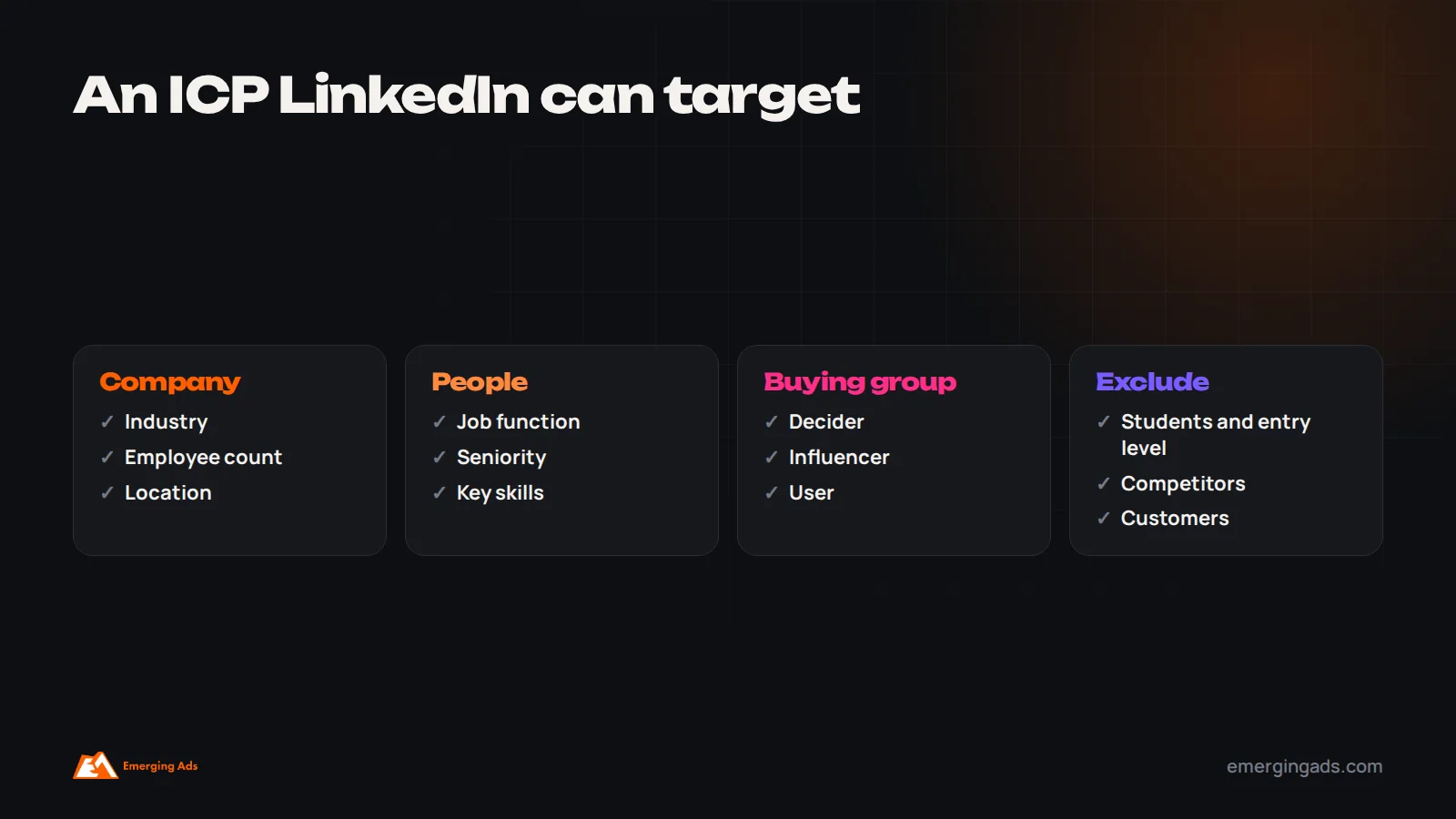
- Company: industry, company size by employee count, location and, where relevant, growth rate or specific company names.
- People: job functions, seniority levels and, sometimes, specific job titles or skills.
- Buying group: who decides, who influences and who uses the product. SaaS deals often involve several people, and each needs different messages.
Look at your closed-won deals from the last year. Which industries and company sizes close fastest, and at the highest value? Which roles were involved? That data is far more reliable than assumptions, and it often shows that your best customers are narrower, or different, from the audience marketing has been targeting.
Building audiences on LinkedIn
LinkedIn’s targeting options for SaaS fall into three groups:
- Attribute targeting: job function, seniority, job title, skills, industry, company size, company name and location. The core of most prospecting campaigns.
- Matched audiences: website visitors through the Insight Tag, contact and company list uploads, people who engaged with your video ads, lead forms, company page or events. The core of retargeting and account-based campaigns.
- Predictive and lookalike-style audiences, built from your existing data, which can extend reach to similar people.
Job function plus seniority usually works better than long lists of exact job titles, which miss people with unusual titles. Combine with company size and industry, exclude students, entry-level roles, competitors and existing customers, and aim for an audience large enough to sustain a campaign for several weeks. We generally treat around 50,000 people as a reasonable floor for prospecting, with account-based campaigns deliberately smaller.
Turn off audience expansion and the LinkedIn Audience Network by default, and test them separately later, so you know exactly who is seeing your ads.
Choosing the right campaign objective for B2B lead gen
LinkedIn optimizes delivery for the objective you choose:
- Lead Generation: finds people likely to submit a Lead Gen Form. The default for capturing contacts.
- Website Conversions: finds people likely to convert on your site, using the Insight Tag or Conversions API. Best when you have a strong landing page and reliable tracking.
- Engagement and Video Views: build familiarity and retargeting audiences. Judge them on how well those audiences convert later, not on cost per view.
- Brand Awareness: reach and frequency within a defined audience, useful for account-based programs.
Choosing a cheaper-looking objective, such as Website Visits, often produces a higher cost per lead in the end, because LinkedIn finds people who click rather than people who convert.
Lead Gen Forms vs landing pages: what converts better
LinkedIn Lead Gen Forms open inside LinkedIn and pre-fill name, email, company and job title from the member’s profile. For cold, top-of-funnel B2B audiences, removing friction this way usually produces a meaningfully higher conversion rate and lower cost per lead than sending the same audience to an external page.
The tradeoff is intent. Because submitting is effortless, some form leads barely remember doing it. Landing pages ask more of the visitor, and those who convert have usually read more about the offer.
Our default for SaaS is Lead Gen Forms for content offers to cold and warm audiences, with one or two qualifying questions such as team size or current tool, and a fast, focused landing page tested for high-intent offers such as demos and trials. Whichever you use, measure on cost per qualified opportunity, not cost per lead. Our team builds dedicated landing pages for paid traffic when existing pages hold campaigns back.

Account-based targeting for SaaS companies
Many SaaS companies sell to a defined universe of target accounts. LinkedIn’s company list targeting lets you upload a list of company names or domains and show ads only to people at those companies, filtered further by function and seniority.
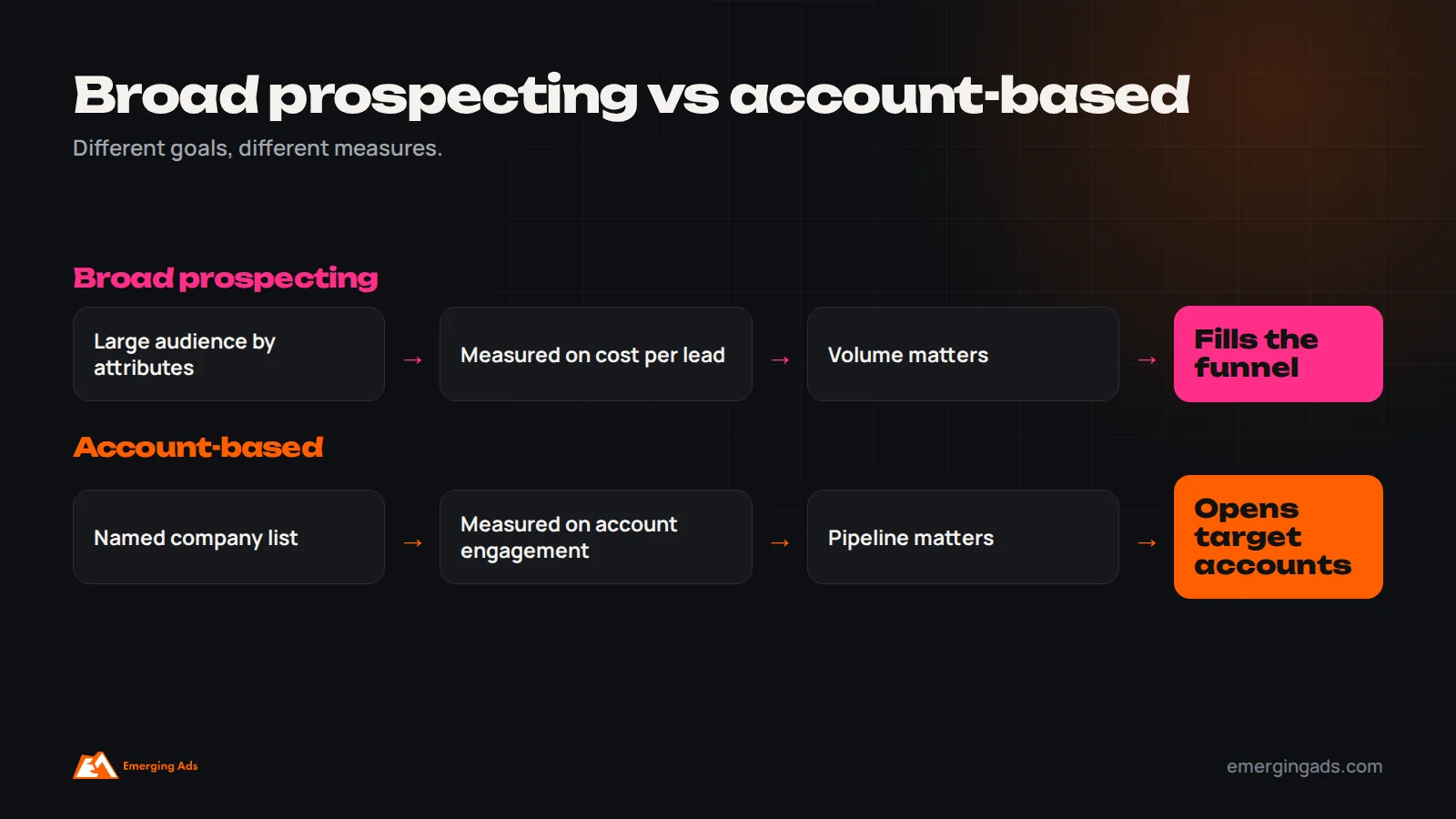
Account-based campaigns work differently from broad prospecting:
- Audiences are deliberately small, so frequency is higher and creative fatigues faster.
- Cost per lead often looks high, because volume is not the goal.
- Success is measured by account engagement, the number of people reached per target account, meetings booked and pipeline from those accounts.
- Coordination with sales matters, so outreach happens while accounts are seeing ads.
A common pattern is tiering: a small top tier of strategic accounts with highly tailored creative, a middle tier with industry-specific messages, and a broader tier with general messaging.
Offer structure: what to gate and what to give away
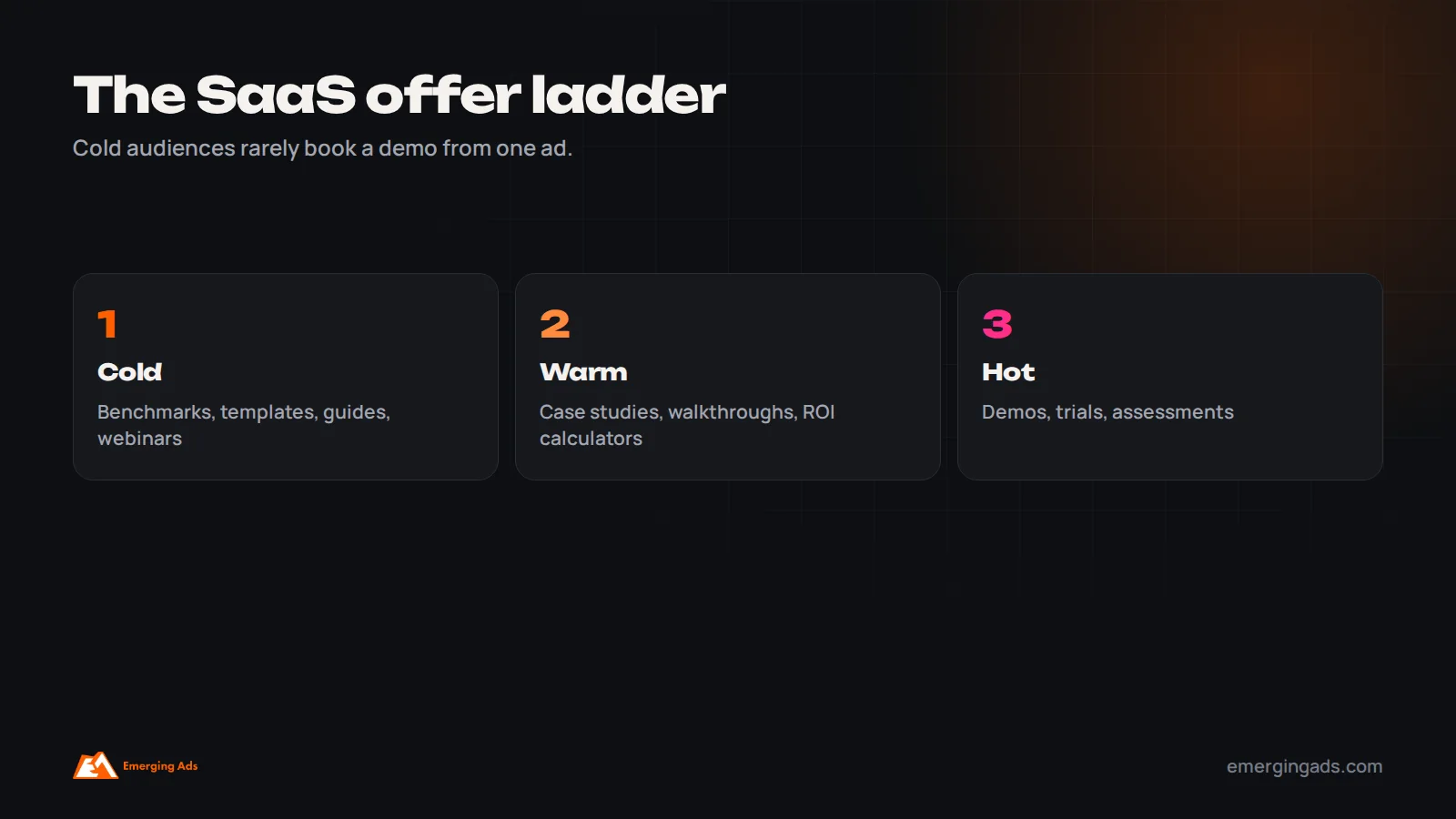
The offer is usually the biggest lever in a SaaS LinkedIn account. Cold audiences rarely book a demo from one ad. The accounts that perform best use a ladder of offers matched to how warm each audience is:
- Cold: genuinely useful content with low commitment, such as industry benchmark reports, templates, calculators, short guides or webinars.
- Warm, people who engaged with content or visited the site: customer case studies, product walkthrough videos, ROI calculators and comparison guides.
- Hot, pricing page visitors, trial users and past leads: demos, free trials, consultations and assessments.
Not everything should be gated. Short, useful content shown freely, through document ads or video, builds familiarity and retargeting audiences without asking for anything. Gate content that is substantial enough that people will trade their details for it, such as original research, detailed templates or tools.
Ad formats that work for SaaS
- Single image and carousel ads in the feed, the workhorse formats for most campaigns.
- Document ads, which let people preview a guide or report in the feed and optionally gate the full version with a Lead Gen Form. These often perform very well for B2B.
- Video ads, for product walkthroughs, customer stories and building retargeting audiences.
- Thought Leader Ads, which promote posts from individuals, such as founders or subject experts, and often feel more native than company page ads.
- Conversation and Message ads, delivered to LinkedIn inboxes. They can work for warm audiences and event invitations, but often feel intrusive to cold audiences.
- Event ads, for webinars and virtual events.
Creative and copy that works for a B2B SaaS audience
LinkedIn audiences respond differently from consumer platforms. Specific, useful claims outperform generic brand messages. “How finance teams cut month-end close from ten days to four” beats “Streamline your finances”. Real numbers, real customer names where permitted, and clear statements of the problem you solve all help.
Native-feeling formats tend to outperform obviously promotional creative. Posts from real people, simple visuals with a clear headline, and documents that teach something usually beat polished brand graphics. Keep copy focused on one idea, write for skimming, and make the next step obvious.
Refresh creative every three to four weeks for most campaigns, and sooner for small account-based audiences.

Organic content makes paid campaigns cheaper
LinkedIn ads perform better when the people seeing them already recognize the brand or the person behind it. SaaS companies whose founders and team members post useful content regularly often find that paid campaigns convert better, because ads reach people who have seen helpful posts before. Organic posts that perform well also make excellent Thought Leader Ads, since they have already proven they resonate.
A practical rhythm is for founders or subject experts to post two or three times a week about problems your customers face, lessons from the market and specific insights from your product data, while the company page shares case studies, product updates and events. Paid campaigns then amplify the best of that content to the precise audience you want. Our guide to LinkedIn content strategy for small businesses covers the organic side.
Webinars and events as lead sources
Webinars remain one of the most effective B2B offers on LinkedIn because they combine education with a natural next step. LinkedIn Event ads and Lead Gen Forms make registration easy. The registrants who attend live, ask questions or watch most of the recording are often much warmer than content download leads. Plan follow-up before the event: a recording for everyone, a relevant case study for attendees, and a personal outreach from sales for people at target accounts who asked questions. Smaller, specific sessions, such as a 30-minute walkthrough of how a particular role solves a particular problem, usually attract better leads than broad industry panels.
Budget and bidding realities on LinkedIn
LinkedIn has minimum daily budgets per campaign, and given typical click costs, small budgets produce very little data. In our experience, SaaS companies should plan for at least around $5,000 a month to run a meaningful program, concentrated on one or two audiences and offers rather than spread across many.
Automated bidding, which aims to spend the full budget for the most results, is a reasonable starting point. It can spend aggressively in small audiences, so watch frequency. Cost cap and manual bidding give more control once you understand typical costs for your audience. Give campaigns at least two to three weeks before major changes.
Plan budget in proportion to deal value and sales cycle. A company with $50,000 annual contracts and a six-month cycle can justify a longer, larger investment than one with $5,000 contracts.
Retargeting and nurture
Because cold LinkedIn traffic is expensive, people who have already engaged are especially valuable. Build matched audiences from website visitors, video viewers, people who opened but did not submit a lead form, Lead Gen Form submitters and company page engagers, and give each a relevant next step.
Someone who downloaded a benchmark report should see a case study from their industry next. Someone who watched most of a product video should see a demo invitation. Someone who visited the pricing page should see a trial or demo offer with proof. Combine LinkedIn retargeting with email nurture from your CRM, so leads keep hearing from you between ads. Our guide to lead nurture automation covers the email side.
Follow-up: where most LinkedIn leads are lost
Lead Gen Form leads sit inside Campaign Manager until someone downloads them. In many companies, that happens weekly. By then, the person has forgotten the ad, the content and the company.
Connect Lead Gen Forms directly to your CRM, using LinkedIn’s native integrations or an integration tool, so leads arrive instantly. Deliver the promised content immediately and automatically. Route leads to the right salesperson or sequence based on the qualifying answers. Then follow up with something genuinely useful within a day, not an aggressive demo push to someone who asked for a template. Our article on CRM automation mistakes explains how to fix slow follow-up.
Measuring what matters: pipeline, not cost per lead
Cost per lead on LinkedIn often looks expensive next to other channels. If decisions are made on that number alone, LinkedIn usually loses. But a $200 lead that becomes a qualified opportunity one time in four costs $800 per opportunity, while a $40 lead from elsewhere that converts one time in fifty costs $2,000.
Measure LinkedIn on cost per marketing-qualified lead, cost per sales-qualified opportunity, pipeline generated and, eventually, closed revenue, with enough time allowed for your sales cycle. To do that, capture campaign source in your CRM for every lead, and send later stages back to LinkedIn through its Conversions API or offline conversion uploads so LinkedIn can optimize for quality. Our guide on attribution modeling covers how much measurement complexity is worth it at different stages.

Aligning marketing and sales
LinkedIn lead generation fails most often in the gap between marketing and sales. Agree definitions before launching: what counts as a marketing-qualified lead, what makes a lead sales-ready, how quickly sales will follow up, and what happens to leads that are not ready yet. Share campaign content with sales so they know what the lead downloaded. Review lead quality together monthly, using CRM data rather than impressions, and feed sales insights back into targeting and messaging.
Trials, freemium and product-led growth
For SaaS companies with a free trial or freemium plan, LinkedIn can drive signups directly, but the economics need care. Optimize for trial signups only if you can also track activation and conversion to paid, and send those outcomes back to LinkedIn where possible. Otherwise campaigns may fill the trial with users who never activate. A hybrid approach often works: content and education on LinkedIn, trial offers to warm audiences, and in-product onboarding plus email to convert trial users.
Mistakes that keep SaaS LinkedIn programs from working
- Running only a “book a demo” campaign to cold audiences.
- Targeting broad job functions with no seniority or company filters, reaching people who cannot buy.
- Leaving audience expansion and the Audience Network on without testing them.
- Downloading leads weekly instead of syncing them to the CRM instantly.
- Judging LinkedIn on cost per lead instead of cost per opportunity.
- Running the same ads for months in small audiences.
- No agreement with sales on lead definitions and follow-up speed.
- Spreading a small budget across many campaigns so none gathers enough data.
The numbers worth watching
Within LinkedIn, watch click-through rate on each ad compared with its own earlier level, Lead Gen Form completion rate, frequency, and cost per lead by audience and offer. In the CRM, watch the share of leads that become marketing-qualified, the share that become sales opportunities, time to first contact, and pipeline value by campaign. The second set matters far more, but the first set tells you early when creative is fatiguing or an audience is too small.
Running LinkedIn across several markets
SaaS companies often sell into several countries at once, and LinkedIn behaves differently in each. Membership density varies by country and industry, click costs differ widely between markets such as the US, UK, Gulf and India, and language and buying culture shape which messages work. In the Gulf, for example, decision-makers in larger companies are often reached more effectively through a mix of English and Arabic creative and through events, while in India, large audiences and lower click costs make broader prospecting viable before narrowing.
Run separate campaigns by market rather than one global campaign, so budgets and bids reflect local costs and you can see which markets produce pipeline. Localize case studies and proof wherever possible, because a customer story from the same region is far more persuasive than one from the other side of the world. Respect local data protection rules when syncing leads into your CRM, and adjust follow-up to local working days and hours.
What a strong first campaign looks like
For a SaaS company starting from scratch, a strong first campaign is usually simple: one tightly defined audience of roughly 50,000 to 300,000 people built from job function, seniority, company size and industry; one genuinely useful content offer such as an industry benchmark or a practical template; three or four ads testing different angles on that offer, including at least one document ad; a Lead Gen Form with two qualifying questions; an instant CRM sync with automatic delivery of the content; and a retargeting campaign ready to show case studies to everyone who engages. Run it for at least four weeks before drawing conclusions, and review lead quality with sales every week during that time.
A 90-day LinkedIn plan for SaaS
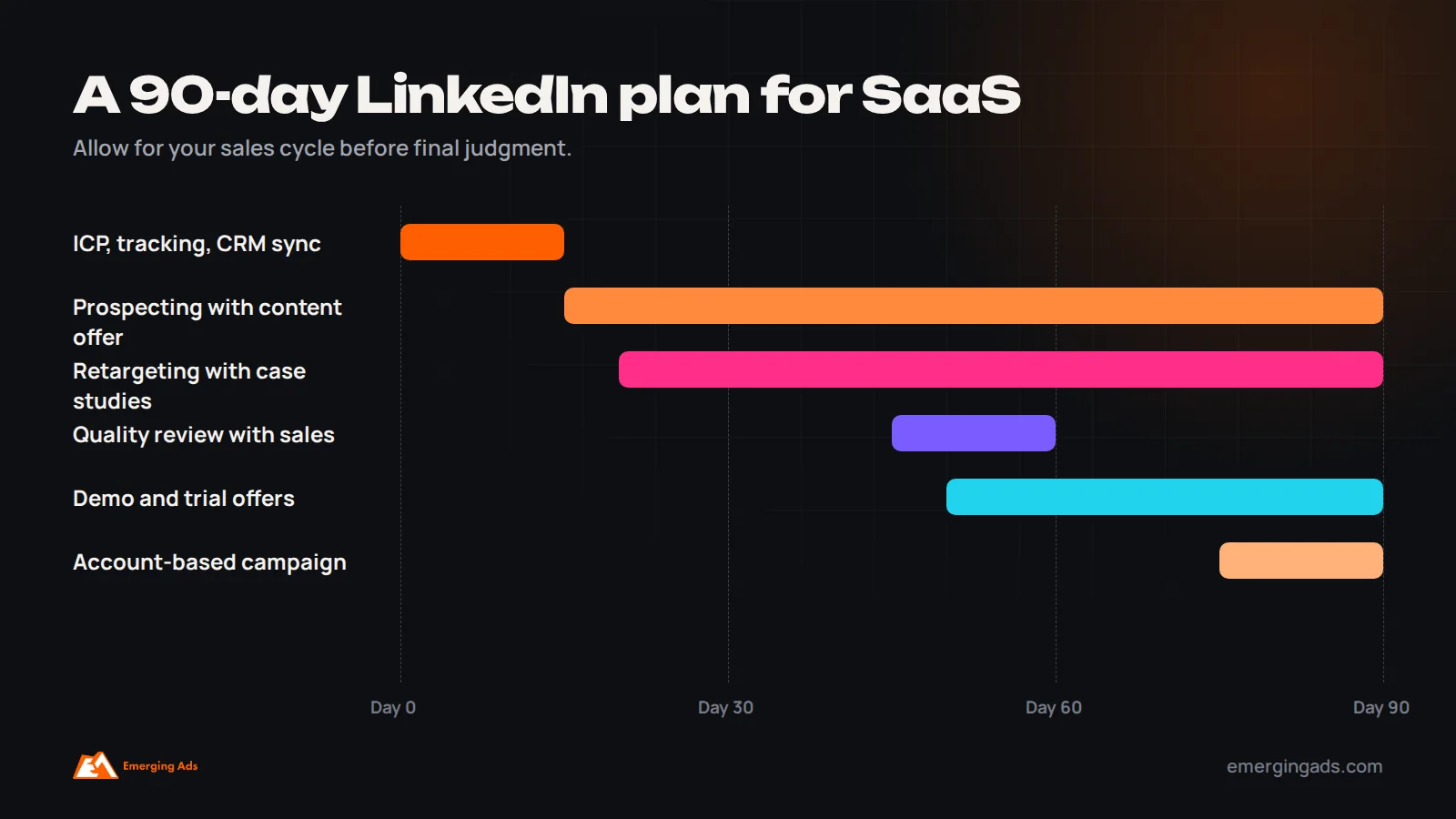
- Days 1 to 15: define the ideal customer profile from closed-won data, install the Insight Tag and Conversions API, connect Lead Gen Forms to the CRM, and agree lead definitions with sales.
- Days 15 to 45: launch one prospecting campaign with a strong content offer and Lead Gen Forms, plus a retargeting campaign for site visitors with a case study offer.
- Days 45 to 75: review lead quality with sales, refresh creative, add a demo or trial offer for hot audiences, and test Thought Leader Ads.
- Days 75 to 90: launch an account-based campaign for top-tier accounts, and evaluate cost per qualified opportunity and pipeline against other channels.
LinkedIn alongside Google and other channels
LinkedIn rarely works alone for SaaS. Google search captures people actively looking for a solution, often at a lower cost per opportunity, and should usually come first if there is search demand for your category. LinkedIn reaches buyers before they search and lets you target specific accounts. Retargeting on Meta and Google can stay in front of LinkedIn-generated audiences more cheaply. Our performance marketing guide explains how we balance channels.
If you would like help, our LinkedIn ads and LinkedIn lead generation teams build and run campaigns, and our SaaS campaign management service covers multi-channel programs. You can also start with a free ad audit.
Frequently asked questions
Is LinkedIn good for SaaS lead generation?
Yes, for SaaS companies selling to defined business audiences with contract values high enough to justify LinkedIn’s costs. It is less suitable for low-priced self-serve products.
How much should a SaaS company spend on LinkedIn ads?
Plan for at least around $5,000 a month to run a meaningful program, concentrated on one or two audiences and offers, with budget proportional to deal value and sales cycle.
Should I use LinkedIn Lead Gen Forms or landing pages?
Lead Gen Forms usually convert cold audiences better and more cheaply. Landing pages can produce more committed leads for high-intent offers like demos. Test both and compare on cost per qualified opportunity.
What offers work best on LinkedIn for SaaS?
Useful content such as benchmarks, templates and guides for cold audiences; case studies and product walkthroughs for warm audiences; demos and trials for people already engaged.
What is account-based marketing on LinkedIn?
It means uploading a list of target companies and showing ads only to people at those companies, measured on account engagement and pipeline rather than lead volume.
How do I measure LinkedIn ads for SaaS?
Track leads in your CRM by source and measure cost per qualified opportunity, pipeline and closed revenue, sending later stages back to LinkedIn through its Conversions API or offline uploads.
How long does LinkedIn take to generate pipeline?
Leads can arrive within days, but pipeline and revenue depend on your sales cycle. Most SaaS companies need at least one to three months to judge LinkedIn properly.
What are Thought Leader Ads?
Thought Leader Ads promote posts from individual LinkedIn members, such as founders or experts, rather than the company page. They often feel more authentic and can perform well for B2B audiences.