The short answer
A LinkedIn content strategy for a small business works best when it is built around people, not just the company page: the founder and a few team members posting two to four times a week about real problems their customers face, lessons from their work, specific results and honest opinions. Choose three or four content pillars, use formats LinkedIn rewards such as text posts, document carousels, short video and comments on others’ posts, engage consistently, and measure profile visits, conversations and enquiries rather than likes. Over a few months, that builds trust that turns into leads, hires and partnerships.
For small businesses selling to other businesses, LinkedIn is one of the few places where the people who buy, recommend and refer can all be reached for free. A consultant, agency, software company or specialist service provider can build visibility with exactly the right audience without a large advertising budget, if they approach it consistently.
Most small businesses do not. They post occasionally from the company page, share links to blog posts, celebrate awards and wonder why nobody engages. The businesses that grow on LinkedIn usually do something different: the people behind the business share what they know, in their own voice, regularly, and they talk with others rather than at them.
This guide is a practical strategy for doing that: why personal profiles matter, how to choose content pillars, which formats work, how often to post, how to engage, how to turn attention into leads and how to measure progress. It also covers how organic content supports paid campaigns, since the two work best together.

Why LinkedIn matters for small businesses
LinkedIn is where business decision-makers spend time thinking about work. Owners, managers, buyers, investors, partners and potential hires all use it. For a small business, a consistent presence there builds three things at once: awareness among potential customers, credibility when someone checks you out before a call, and relationships that lead to referrals and partnerships.
Unlike most social platforms, LinkedIn still gives meaningful organic reach to useful content from individuals. A thoughtful post from a founder can be seen by thousands of relevant people without any ad spend. That reach is not guaranteed, but it is far more accessible than on platforms where business content is mostly paid.
Personal profiles vs the company page
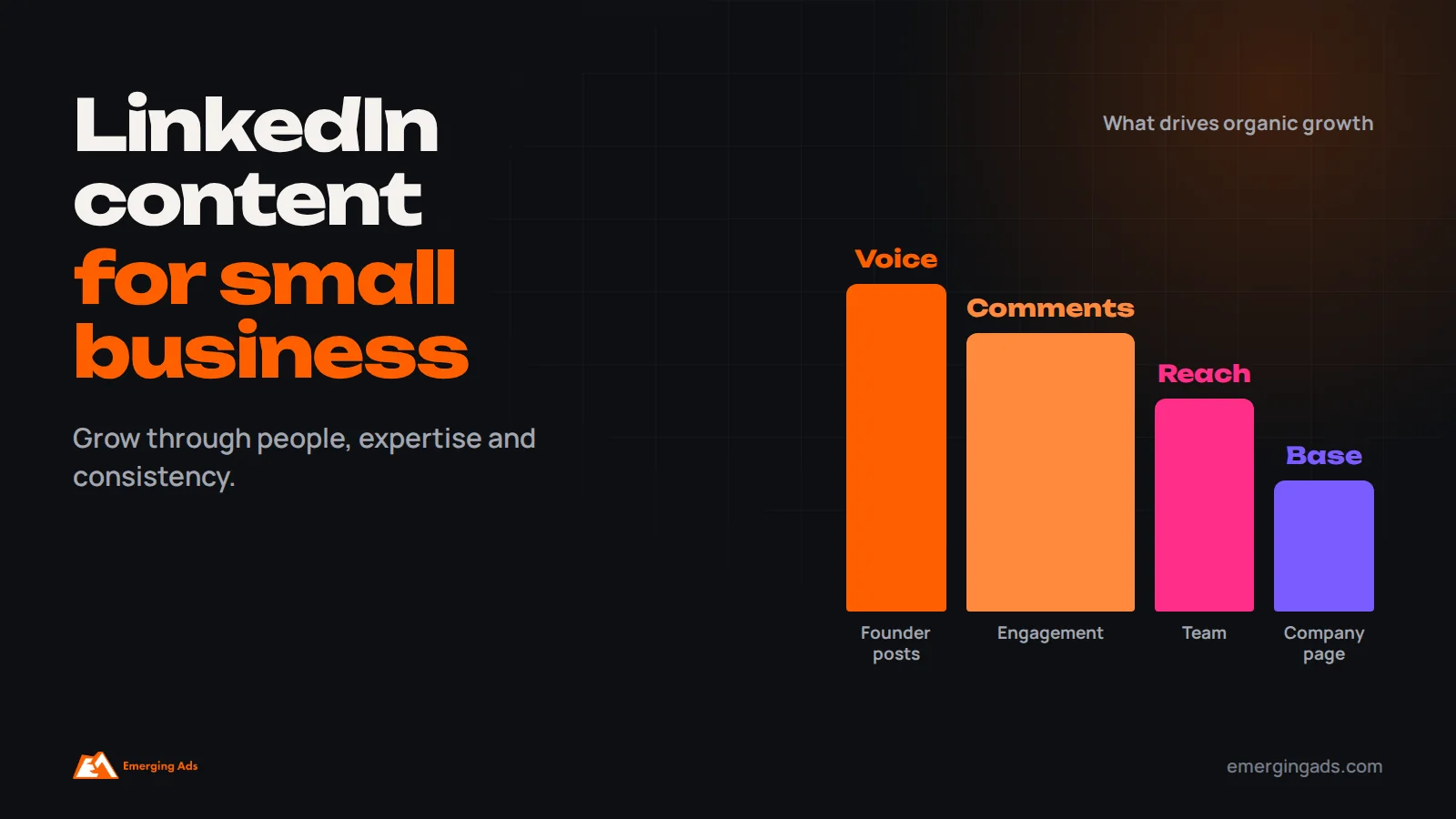
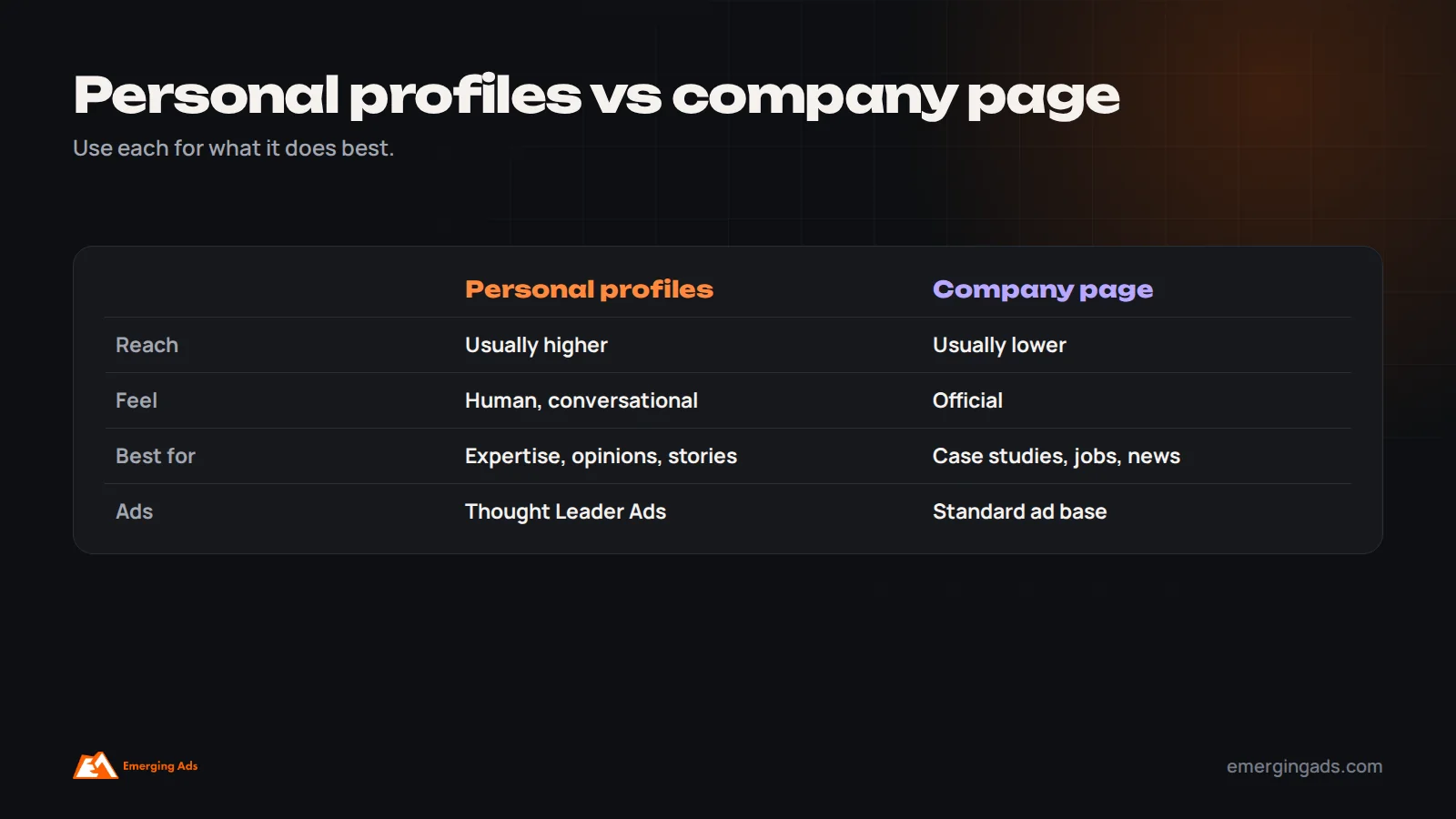
On LinkedIn, people generally connect with people more than with logos. Posts from personal profiles typically reach and engage more people than posts from company pages, because they appear in connections’ feeds and feel more human.
For small businesses, the most effective approach is usually:
- Founder or leader profile as the main voice, sharing expertise, opinions and lessons.
- Key team members sharing their own perspectives on their area, such as sales, delivery or product.
- Company page as the official home for case studies, announcements, job posts and resharing team content, and as the base for ads.
Optimize personal profiles first: a clear photo, a headline that says who you help and how, an About section written for your customers, and a featured section linking to a case study, guide or booking page.
Set clear goals first
Decide what LinkedIn should do for your business, because it shapes what you post. Common goals include generating enquiries from a defined type of customer, building credibility before sales calls, attracting partners or referrers, recruiting, and supporting paid campaigns by warming up audiences. Write down who your ideal reader is, by role, industry and company size, and what you want them to think, feel and do after following you for three months.
Choose three or four content pillars
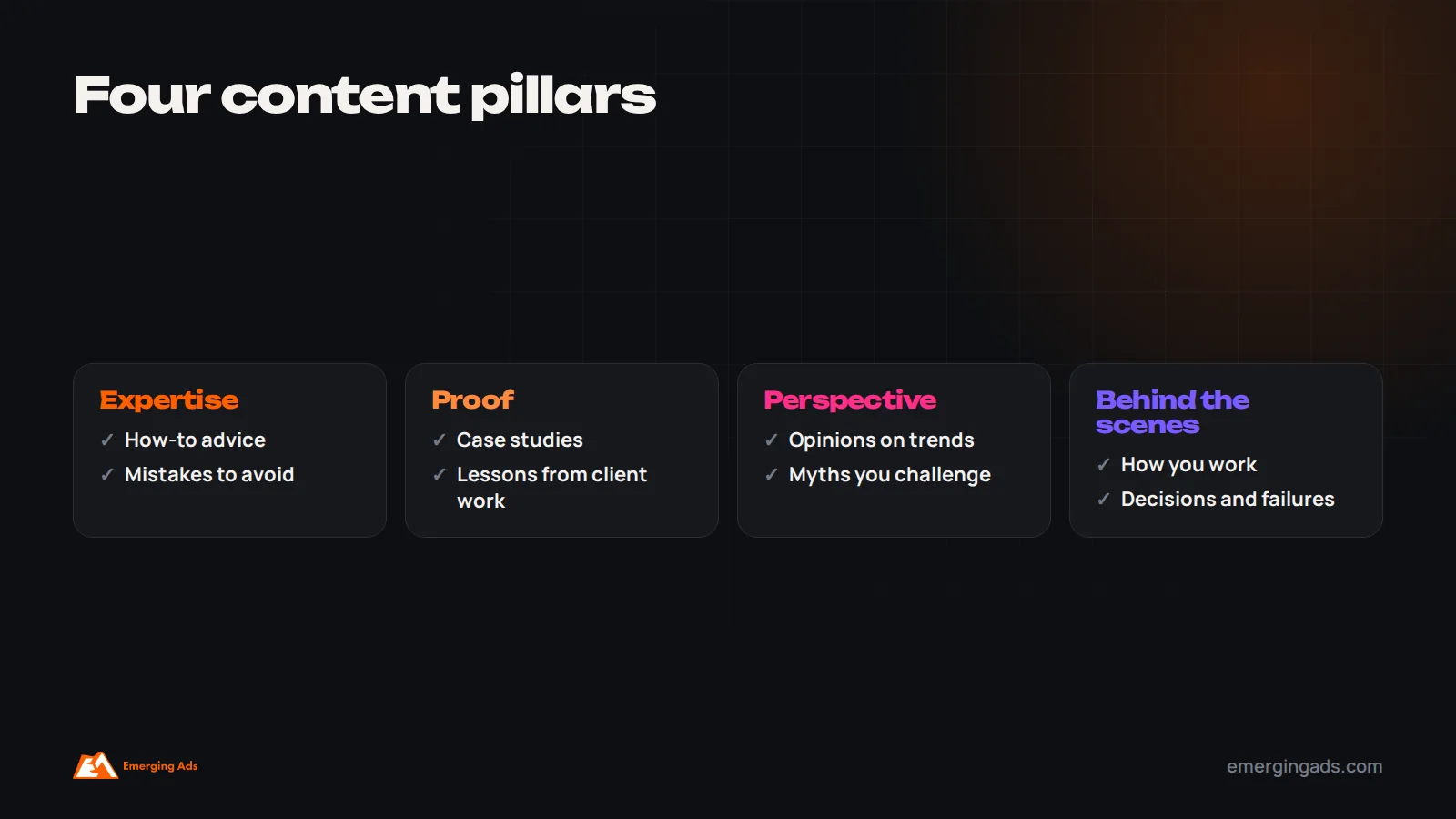
Content pillars are the recurring themes you post about. They keep content focused, make planning easier and help your audience understand what to expect from you. For most small B2B businesses, good pillars come from four sources:
- Expertise: how-to advice, frameworks, mistakes to avoid and answers to customer questions in your field.
- Proof: case studies, results, before-and-after stories and lessons from client work, shared with permission.
- Perspective: opinions on industry trends, myths you disagree with and predictions, backed by experience.
- Behind the scenes: how you work, team stories, decisions, failures and lessons from running the business.
Rotate between pillars so your feed mixes useful advice, credibility and personality.
Formats that work on LinkedIn
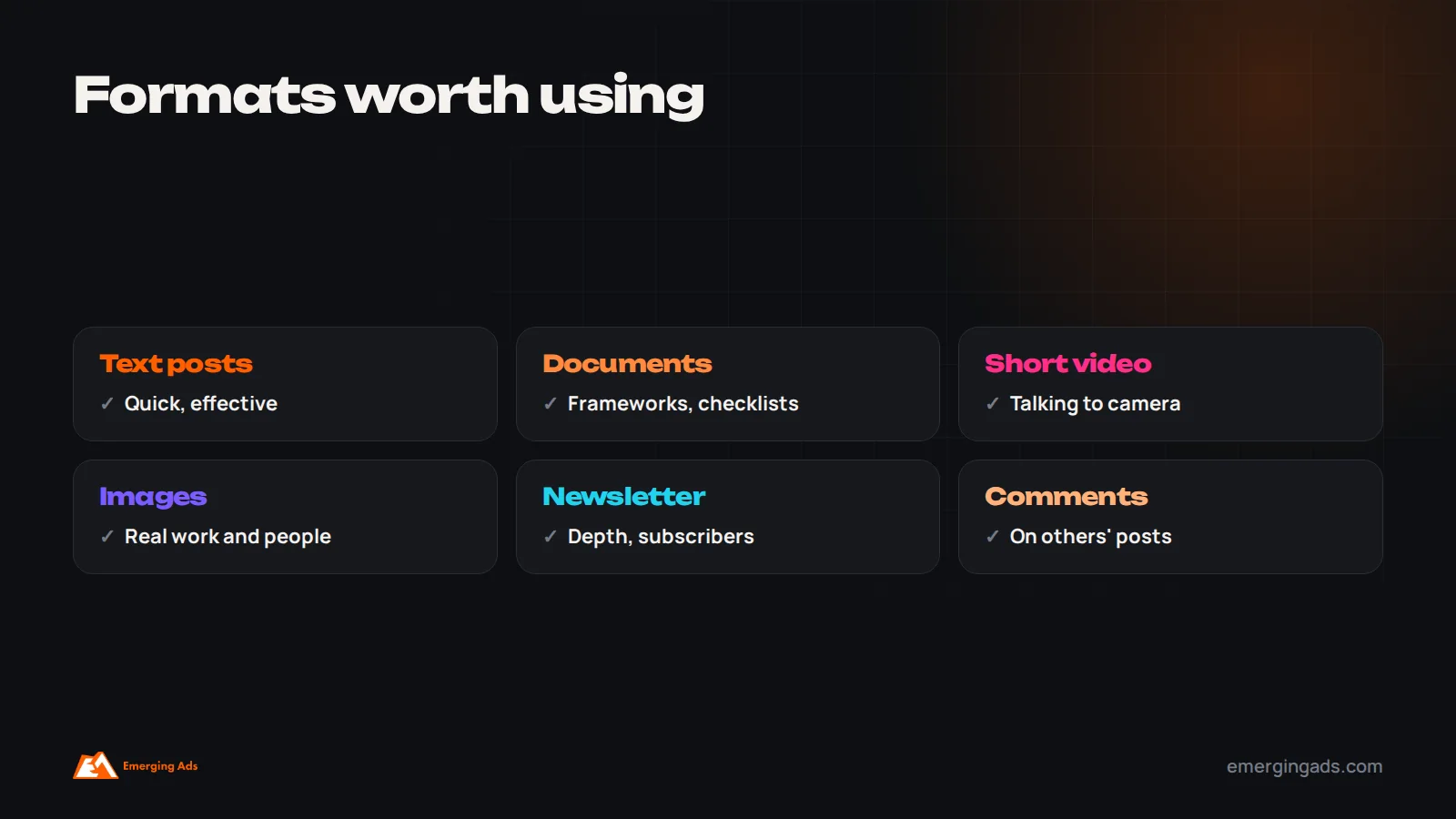
Text posts
Well-written text posts remain one of the most effective formats. A strong first line, short paragraphs, a clear point and a question or call for comments at the end. They are quick to produce and easy to read on mobile.
Document posts, often called carousels
Uploading a PDF creates a swipeable document in the feed. These work well for frameworks, checklists, step-by-step guides and data, because readers spend time swiping through them, which LinkedIn tends to reward.
Short video
Short, vertical or square videos of a person talking to camera, explaining a concept or showing work in progress can build familiarity quickly. Add captions, since many people watch without sound.
Images
Photos of real work, events and people often outperform stock imagery or polished graphics. Charts and screenshots of genuine results can work well with context.
Polls
Polls generate engagement and can provide useful market research, but they are best used occasionally and with genuinely interesting questions.
Newsletters and articles
LinkedIn newsletters let you publish longer content to subscribers who are notified when you post. They suit businesses with depth to share regularly, and can grow a subscriber base inside LinkedIn.
Comments
Thoughtful comments on other people’s posts are content too. They put your name and ideas in front of their audiences and build relationships with peers and potential customers.
How to write posts people read
- Start with a strong first line. Only the first couple of lines show before “see more”. Make them specific, surprising or useful.
- One idea per post. A focused post beats a list of loosely related thoughts.
- Be specific. Real numbers, examples and details are more credible and more interesting than generalities.
- Write like you speak. Short sentences, plain language and your own voice.
- Use white space. Short paragraphs make posts readable on phones.
- End with an invitation, such as a question, a request for experiences or an offer of a resource.
Many creators find that posts with external links in the body get less reach than posts without them, so consider sharing links in the comments or in your featured section instead.

Where to find post ideas
The hardest part of consistent posting is knowing what to say. The best ideas usually come from work you are already doing. Keep a running list and add to it whenever you notice something. Good sources include questions customers ask in sales calls and emails, mistakes you see prospects making, results from recent projects, decisions you made and why, things you disagree with in your industry, lessons from failures, tools and processes you use, and trends you are watching. A single client project can produce several posts: the problem, the approach, a surprising lesson, the result and what you would do differently.
Another reliable source is your own past content. A long blog guide can become several short posts, a document carousel and a short video. Our blog articles, for example, each contain enough material for many LinkedIn posts, which is a practical way to get more value from content you have already invested in.
Batching content so it fits a busy week
Small business owners rarely have time to write a post every morning. Batching solves this. Set aside one or two hours a week to draft several posts at once, using your idea list. Record a few short videos in one sitting. Turn one in-depth piece into a document carousel. Schedule posts using LinkedIn’s built-in scheduler or a tool, but keep time free on posting days to reply to comments, since engagement in the first hours matters. If writing is hard, record yourself talking through an idea for five minutes and have it transcribed and edited into a post. Many of the most natural-sounding posts start that way.
Finding your voice
The most effective LinkedIn content sounds like a specific person, not a brand. Write the way you would explain something to a client over coffee. Share opinions you actually hold, including ones some people will disagree with, as long as you can back them up with experience. Admit what you do not know and what went wrong; honesty builds more trust than polished success stories. Avoid buzzwords and corporate language. Over time, a recognizable voice becomes a reason people follow you, rather than just a reason they scroll past.
Opening lines that earn the click
The first line decides whether anyone reads the rest. Strong openings are specific and promise something. Examples of patterns that work: a surprising result (“We cut a client’s cost per lead by a third without changing their ads”), a direct challenge to common advice (“Most small businesses should not run LinkedIn ads yet”), a clear promise of value (“Five questions to ask before hiring any agency”), a short story (“Last week a prospect told me something I have not stopped thinking about”), or a precise number. Avoid clickbait that the post does not deliver, which damages trust quickly.
What good posts look like for different businesses
A marketing consultant might share a short breakdown of why a client’s campaign failed and what fixed it, with real numbers, ending by asking readers about their own experience.
A software founder might post a document carousel showing the five steps customers use to solve a common problem with or without the product, positioning the company as helpful rather than salesy.
An accounting firm might explain a recent tax change in plain language with a simple example, and invite questions in the comments.
A recruitment agency might share salary trends it is seeing across roles, with practical advice for employers and candidates.
In each case, the post is useful even to people who never buy, which is exactly why it builds trust with those who do.
How often to post
Consistency matters more than volume. For most small business founders, two to four posts a week is sustainable and enough to build momentum. Daily posting can work for people who enjoy it and have enough to say, but quality usually drops if posting becomes a chore. Pick a rhythm you can keep for six months, and batch content creation so busy weeks do not break it.
Engagement: the part most people skip
LinkedIn is a social network, not a publishing platform. Accounts that grow fastest spend as much time engaging as posting. A simple routine:
- Reply to every meaningful comment on your posts, especially in the first hour or two.
- Comment thoughtfully on posts from customers, prospects, partners and respected people in your industry each day.
- Send personalized connection requests to people who engage with your content and fit your audience.
- Continue conversations in direct messages when there is a genuine reason, without immediately pitching.
Fifteen to twenty minutes of engagement a day often matters as much as the posts themselves.
Optimizing your profile so visitors become contacts
Every good post sends people to your profile, where they decide whether to follow, connect or get in touch. Treat the profile as a landing page. Use a clear, friendly photo and a simple banner that says what you do or shows your work. Write a headline that states who you help and the result you deliver, rather than just your job title, for example “Helping ecommerce brands lower their ad costs” rather than “Founder”. Write the About section for your ideal customer: their problem, how you help, proof such as results or notable clients, and how to get in touch. Use the featured section for your best case study, a useful free resource and a booking or contact link. List experience in a way that supports your expertise, and ask satisfied clients for recommendations.
Review your profile every few months. As your positioning sharpens through posting, your profile should evolve with it.
Building the right network
Your content reaches your network first, so the composition of that network matters. Connect deliberately with people in your target audience: potential customers, partners, referrers and respected peers. Send a short personalized note explaining why you would like to connect, especially to people you have not met. Accept requests from relevant people and politely ignore obvious sales spam. Over time, a network of a few thousand well-matched people is far more valuable than a much larger network of random connections.
Engage with your network’s content, not only your own. People notice who comments thoughtfully on their posts, and those small interactions often lead to conversations, introductions and opportunities that no single post could create.
Using LinkedIn events, Live and newsletters
Once you have some momentum, LinkedIn’s longer formats can deepen relationships. LinkedIn events let you invite your network to webinars, workshops and in-person meetups, with attendees notified when you go live. LinkedIn Live allows live video broadcasts, useful for Q&A sessions, interviews and product walkthroughs. Newsletters notify subscribers each time you publish, building an audience that reliably sees your longer thinking. Each of these works best as part of a regular rhythm, such as a monthly webinar or a fortnightly newsletter, rather than as one-off experiments.
Staying consistent when business gets busy
The biggest reason LinkedIn strategies fail is not bad content; it is stopping. Busy weeks, client deadlines and holidays interrupt posting, and momentum fades. Protect consistency with a few simple habits: keep a buffer of two or three drafted posts for busy weeks, schedule posts in advance, set a recurring calendar slot for writing, and lower the bar when needed, since a short, honest post is better than none. If posting stops for a while, simply restart; your network will not hold it against you.
Using AI tools without losing your voice
AI writing tools can help with LinkedIn content: brainstorming ideas, outlining posts, tightening drafts and turning long articles into shorter pieces. They are less good at the things that make LinkedIn content work: real experience, specific examples, honest opinions and a recognizable personal voice. Posts that read like generic AI output tend to blend into the feed and can quietly damage credibility with the people you most want to impress.
Use AI as an assistant rather than an author. Start with your own notes, stories and opinions, use a tool to help structure or edit, then rewrite in your own words and add details only you know. A simple test is whether a colleague reading the post would recognize it as yours. If not, keep editing.
LinkedIn in different markets
LinkedIn usage and expectations vary by market. In the UK, US and Europe, founder-led content and candid professional opinions are widely accepted. In the Gulf, LinkedIn is heavily used by professionals and decision-makers, and content that reflects regional business culture, local market insight and, where relevant, Arabic as well as English can stand out. In India, LinkedIn has a very large and active user base, with strong engagement on career, entrepreneurship and industry content. Wherever you operate, local examples, local clients and local market observations make content more relevant to the people you want to reach.
What to expect in the first month
The first few weeks of consistent posting often feel slow. Early posts may get modest engagement, mostly from existing connections. That is normal. Over the first month, focus on habits rather than results: posting on schedule, engaging daily and noting which topics spark comments. By the end of the month, most people see a clearer picture of which pillars and formats resonate, a few new conversations with relevant people and growing profile views. Real business outcomes usually follow over the following months, as familiarity builds and the right people start recognizing your name.
Getting your team involved
When several people in a small business post and engage, the company’s reach multiplies, and prospects see consistent expertise across the team. Encourage team members to share their own perspectives rather than copying company announcements. Offer simple support: a shared list of post ideas, help with editing, examples of good posts and recognition when posts perform well. Never force it; people who do not enjoy posting can contribute by commenting and sharing.
Turning attention into leads
Content builds trust, but trust only becomes revenue if there is a clear path to a conversation. Make that path easy:
- State clearly on your profile who you help and how to work with you.
- Add a featured link to a case study, free resource or booking page.
- Occasionally, mention your services directly in posts, alongside the value content.
- Offer useful resources, such as a checklist or guide, in exchange for a conversation or email address.
- Follow up with people who engage repeatedly, with a genuine message rather than a pitch.
- Connect your lead capture to your CRM, so enquiries are followed up quickly.
Our article on lead nurture automation covers how to keep in touch with leads who are not ready yet.
How organic content supports LinkedIn ads
Organic and paid LinkedIn work better together. Posts that perform well organically show which messages resonate and can be promoted as Thought Leader Ads, which run posts from individuals’ profiles as ads. People who engage with your organic content can be retargeted with case studies and offers. And prospects who have seen your posts before are more likely to respond to ads. Our guide to B2B leads with LinkedIn ads explains the paid side, and our article on LinkedIn ads mistakes covers what to avoid.
How to measure progress
Likes and impressions are easy to see but not the most useful measures. Track:
- Profile views and follower growth from your target audience.
- Comments and conversations, especially from potential customers.
- Connection requests and direct messages from relevant people.
- Website visits from LinkedIn, using tagged links.
- Enquiries, calls booked and deals where LinkedIn played a role, recorded in your CRM.
Ask new customers how they found you. Many will mention LinkedIn even when analytics cannot show it directly.

A 90-day plan
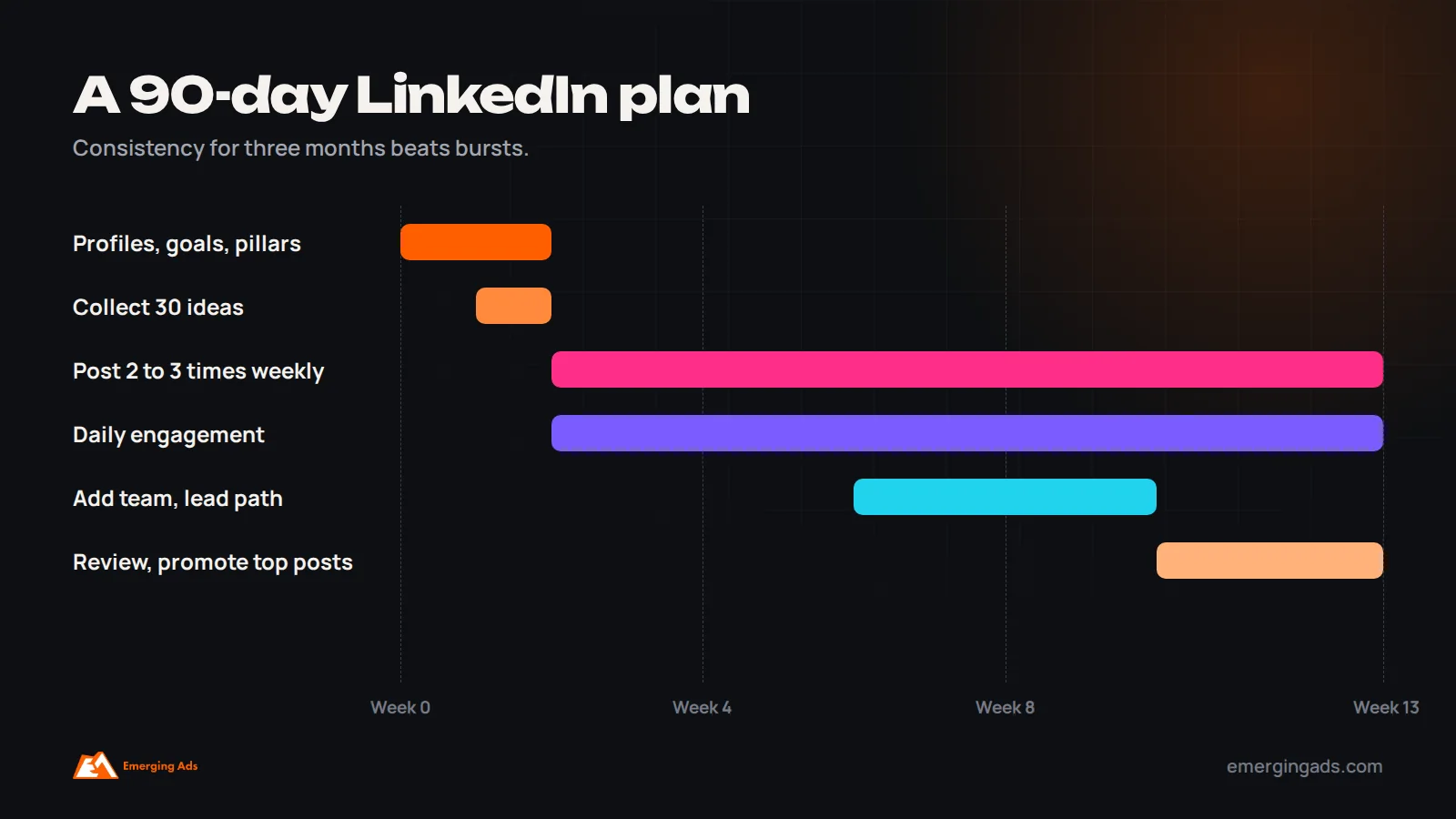
- Weeks 1 to 2: optimize founder and team profiles, define goals, audience and three or four pillars, and collect 30 post ideas from customer questions and recent work.
- Weeks 3 to 6: post two to three times a week, engage daily, and test formats such as text, documents and short video.
- Weeks 7 to 10: double down on the pillars and formats that drive conversations, involve one or two team members, and add a clear lead path.
- Weeks 11 to 13: review results, promote top posts as Thought Leader Ads if relevant, and plan the next quarter.
Common LinkedIn content mistakes
These are the patterns that most often keep small business LinkedIn efforts from paying off, and each one is easy to correct.
- Posting only from the company page.
- Sharing only announcements, awards and links.
- Generic, motivational content with no expertise behind it.
- Posting and disappearing, without engaging.
- Inconsistent posting that stops after a few weeks.
- Pitching in every post, or never mentioning what you offer at all.
- Measuring success by likes instead of conversations and enquiries.
If you would like help, our LinkedIn team supports both organic strategy and paid campaigns, and our branding and content service can help produce documents, graphics and video.
Frequently asked questions
Is LinkedIn worth it for small businesses?
For businesses selling to other businesses, professionals or partners, yes. Consistent, useful content from founders and team members can build awareness, credibility and leads without a large budget.
Should I post from my personal profile or company page?
Personal profiles usually reach and engage more people. Use the founder and team profiles as the main voices, and the company page for case studies, announcements, jobs and ads.
How often should a small business post on LinkedIn?
Two to four posts a week is a sustainable rhythm for most founders. Consistency over months matters more than daily volume.
What type of content works best on LinkedIn?
Specific expertise, real results and lessons, honest opinions and behind-the-scenes stories, in formats such as text posts, document carousels and short video.
Do links in LinkedIn posts reduce reach?
Many creators find posts with external links in the body get less reach, so they share links in comments or in their featured section instead.
How long does it take to see results on LinkedIn?
Engagement can grow within weeks, but meaningful leads and opportunities usually take a few months of consistent posting and engagement.
How do I get leads from LinkedIn content?
Make your offer clear on your profile, add a featured link, mention your services occasionally, offer useful resources and follow up genuinely with people who engage repeatedly.
What are Thought Leader Ads?
They are LinkedIn ads that promote posts from individual members’ profiles, such as a founder’s best posts, to a targeted audience.