How Much Does WhatsApp for E-Commerce Cost
Key Takeaways
- WhatsApp Business App is free for basic use, but WhatsApp Business API (needed for automation, catalogs, and broadcast at scale) involves per-conversation fees plus typically a monthly platform fee from a Business Solution Provider
- Meta’s conversation-based pricing charges per 24-hour conversation window, not per individual message, with different rates for marketing, utility, authentication, and service conversation categories
- Total realistic monthly cost for a small e-commerce business running WhatsApp seriously typically ranges from $50-$500+ depending on conversation volume and whether a BSP platform fee is included
- Markets with strong WhatsApp adoption (India, Brazil, much of Southeast Asia and the Middle East) often see meaningfully higher ROI from WhatsApp investment than markets where the app is less central to daily commerce
- Free tools like WhatsApp Business App’s catalog feature can cover a very small store’s needs before the API’s automation and scale become necessary
WhatsApp Business App vs WhatsApp Business API: The Core Cost Difference
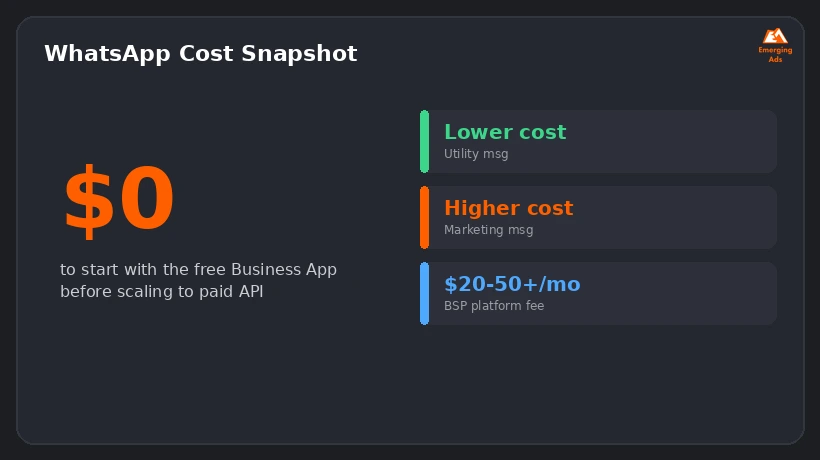
The single biggest factor in what WhatsApp costs an e-commerce business is which version you’re using. WhatsApp Business App, the free consumer-facing app with a business profile, catalog, and basic automated replies, costs nothing beyond a phone and number, suitable for a very small store handling a manageable volume of customer conversations manually.
WhatsApp Business API, the version needed for automated flows, broadcast messaging to larger customer lists, integration with a CRM or e-commerce platform, and multi-agent support, involves real costs: Meta’s own per-conversation charges, plus typically a monthly platform fee from whichever Business Solution Provider (BSP) you use to actually access and manage the API, since Meta doesn’t offer a direct self-serve dashboard for most businesses.
Deciding which version fits your business mostly comes down to volume and complexity. A store handling a handful of daily customer conversations, with one or two people able to respond manually, may never actually need the paid API tier, while a growing store sending regular order updates, running promotional broadcasts, or needing multiple team members to respond through shared, organized conversation queues will hit the free app’s limits fairly quickly.
How Meta’s Conversation-Based Pricing Actually Works
Meta charges for WhatsApp Business API usage based on conversations, a 24-hour messaging window between a business and a customer, not per individual message sent within that window. Once a conversation is opened, either party can send unlimited messages within that 24-hour period at no additional per-message cost, which is a meaningfully different pricing model than SMS, where each individual text carries a cost.
This structure means the actual cost driver isn’t message volume within a conversation, it’s how many distinct conversations get opened in a given period, and which category they fall into. A single customer exchanging twenty messages back and forth with support within one day still counts as one conversation, while sending that same customer a promotional broadcast on a separate day opens a new, separately billed conversation, even if no reply ever comes back.
| Conversation category | Typical use | Relative cost |
|---|---|---|
| Marketing | Promotional messages, broadcasts, new offers | Highest, since this is the most commercially valuable category |
| Utility | Order updates, shipping notifications, account alerts | Moderate |
| Authentication | One-time passwords, login verification codes | Moderate, often priced separately by market |
| Service | Customer-initiated support conversations | Often the lowest cost, or free within Meta’s customer service window in some markets |
Rates vary significantly by country, since Meta prices conversations per market based on local telecom and adoption factors, meaning the same message type can cost noticeably more in one country than another, worth checking Meta’s official current rate card for your specific target markets rather than assuming a single global rate applies.
Business Solution Provider Fees
Since most businesses can’t access WhatsApp Business API directly from Meta, a Business Solution Provider, companies like Twilio, MessageBird, Gupshup, or WATI, sits between your business and Meta’s infrastructure, typically charging a monthly platform fee on top of Meta’s own conversation costs. This fee generally covers the actual interface, automation builder, CRM integration, and customer support you’d use to manage WhatsApp conversations day to day, along with the technical work of maintaining a stable, compliant connection to Meta’s underlying API infrastructure.
- Entry-level BSP plans for a small business often start in the range of $20-$50 a month, covering basic messaging and catalog functionality
- Mid-tier plans with more automation, multi-agent support, and e-commerce platform integrations often run $50-$200 a month
- Enterprise-tier plans with advanced automation, higher message volume, and dedicated support can run considerably higher
- Meta’s own conversation charges are separate and additional on top of whichever BSP platform fee applies
What a Realistic Monthly Budget Looks Like
Combining a BSP platform fee with Meta’s conversation charges, a small to mid-size e-commerce business running WhatsApp seriously, automated order updates, a reasonable volume of promotional broadcasts, active customer service, typically lands somewhere in the $50-$500+ monthly range, with the wide spread driven mainly by conversation volume and target market rates rather than the platform fee alone. Treating this range as a starting estimate rather than a fixed number, and revisiting it once real conversation volume data comes in, keeps budgeting grounded in your own actual usage rather than an industry-wide average that may not reflect your specific situation.
A very small store sending occasional order confirmations and handling light customer service volume might sit toward the lower end of that range, while a store running frequent promotional broadcasts to a large customer list in a higher-cost market could see costs climb well beyond it, making it worth estimating your own expected conversation volume before committing to a specific BSP plan tier.
Setup and Implementation Costs Beyond Messaging Fees
Beyond ongoing platform and conversation fees, there’s often a one-time or early-stage cost to properly set up WhatsApp Business API integration with your e-commerce platform, connecting the catalog to your product feed, building automated flows for order status and abandoned cart-style reminders, and training staff on the chosen BSP’s interface. This upfront work is easy to underestimate when comparing platforms purely on their advertised monthly pricing.
For a small business handling this setup internally, the cost is mostly time rather than a direct expense, though a business without internal technical resources may need to budget for freelance or agency implementation help, which can range from a few hundred to a few thousand dollars depending on how customized the integration needs to be.
Where WhatsApp Delivers the Strongest ROI
WhatsApp’s cost-effectiveness varies considerably by market. In countries with very high WhatsApp adoption for everyday communication and commerce, India, Brazil, Indonesia, much of the Middle East, WhatsApp often outperforms email or SMS for customer engagement and conversion, since it’s genuinely where customers already are and expect to interact with businesses. In markets where WhatsApp is less central to daily life, the same investment may see comparatively weaker returns relative to email or SMS, worth factoring into channel budget decisions before assuming WhatsApp will perform equally well everywhere your business sells.
Free Features Worth Using Before Paying for the API
Before committing to WhatsApp Business API and its associated costs, it’s worth using WhatsApp Business App’s free features fully, a complete business profile, product catalog, quick reply templates, and basic labels for organizing conversations, to validate demand and understand customer behavior patterns before investing in the more expensive, automated API tier. This free tier alone is often sufficient for a genuinely small operation to establish a real WhatsApp presence and gauge customer interest with zero ongoing platform cost.
A very small store handling a manageable volume of conversations manually through the free app can often delay the jump to the paid API until conversation volume genuinely outgrows what one or two people can handle manually, which for many small businesses is later than they initially assume.
Common Cost Mistakes E-Commerce Businesses Make
Most cost overruns and disappointing ROI on WhatsApp trace back to a handful of avoidable planning gaps rather than the platform itself being poorly suited to the business.
- Committing to an expensive BSP platform tier before validating actual conversation volume needs with the free app first
- Not accounting for Meta’s separate conversation charges when budgeting, assuming the BSP platform fee is the only cost
- Sending broadcast marketing messages (the highest-cost conversation category) more frequently than customer engagement data actually supports
- Ignoring regional rate differences when planning multi-market WhatsApp campaigns, leading to unexpectedly higher costs in premium-rate markets
- Underestimating implementation time and cost for properly connecting WhatsApp to an existing e-commerce platform and order management system
How to Estimate Your Own Realistic Cost
Rather than relying purely on industry benchmark ranges, a short, focused exercise using your own store’s actual data produces a far more accurate budget estimate before committing to a specific plan or provider tier.
- Estimate monthly conversation volume by category (marketing broadcasts, utility order updates, customer service inquiries)
- Check Meta’s current per-conversation rates for your specific target market(s) on their official pricing documentation
- Compare 2-3 Business Solution Providers’ platform fee tiers against your expected feature needs (automation complexity, integrations required)
- Add Meta’s conversation costs and the chosen BSP’s platform fee together for a realistic monthly total, then add a buffer for growth
Comparing WhatsApp Cost Against Email and SMS
It’s worth putting WhatsApp’s cost into proper context against the two channels most e-commerce businesses already rely on day to day. Email marketing, through a platform like Klaviyo, typically costs based on contact list size regardless of send frequency, generally cheaper per-contact than WhatsApp’s per-conversation model but with meaningfully lower open and response rates than WhatsApp typically achieves. SMS costs per individual message sent, often comparable to or higher than WhatsApp’s per-conversation rate, but without the rich media, catalog, and two-way conversation features WhatsApp offers within that same conversation window.
The most useful comparison isn’t raw cost per message alone, but cost per meaningful outcome, per resolved support inquiry, per recovered cart, per completed sale. WhatsApp’s typically higher open and response rates compared to email, combined with its unlimited-messages-per-conversation-window pricing structure, often produce a lower effective cost per outcome even when the headline per-conversation rate looks higher than a single email or SMS send.
A sensible approach for most e-commerce businesses isn’t choosing one channel exclusively, but using each where it performs best: email for broader, lower-cost nurture and newsletter content, SMS for very brief, time-sensitive alerts, and WhatsApp for richer, two-way conversations around orders, support, and higher-consideration purchase decisions where the extra conversational depth genuinely adds value worth its higher per-conversation cost.
Scaling Costs as Your Business Grows
As conversation volume grows alongside a growing customer base and an expanding product catalog across more markets, WhatsApp costs scale roughly proportionally, more customers generally means more conversations, which means higher total monthly spend even if the per-conversation rate and BSP platform tier stay the same. This is a normal, expected pattern rather than a sign something is going wrong, similar to how email costs scale with list size on a platform like Klaviyo.
What’s worth monitoring as volume grows is whether the BSP platform tier still matches actual needs, a small business that outgrows an entry-level plan’s automation or agent-seat limits will need to upgrade to a mid-tier or higher plan, and budgeting for that step-change in advance, rather than being caught off guard by it, keeps WhatsApp’s growing cost predictable rather than a recurring unpleasant surprise.
Is WhatsApp Worth the Investment for a Small Store
For a small e-commerce business in a market with strong WhatsApp adoption, the investment typically pays for itself through improved customer engagement, faster support resolution, and often measurably higher conversion rates on abandoned cart and order-update messaging compared to email alone. For a business in a market where WhatsApp isn’t a primary communication channel, the same budget may be better allocated toward a channel more central to how local customers actually prefer to interact with businesses.
The most reliable way to answer this for your own specific business is a modest, time-limited test using the free WhatsApp Business App first, gathering real data on customer response and engagement before committing to the ongoing cost of the full API and BSP setup, rather than assuming a general market trend automatically applies to your specific customer base and their own preferred communication habits.
Want us to look at your account?
We’ll audit your setup and tell you exactly where the budget is leaking, free.
Get Your Free Ad AuditFrequently Asked Questions
Is WhatsApp Business App completely free?
Yes, for basic use, a business profile, catalog, and manual messaging cost nothing beyond a phone number and the app itself. Costs only enter the picture with WhatsApp Business API, needed for automation and scale, so most small businesses can validate the channel thoroughly before ever paying anything for it.
What’s the difference between a marketing and a utility conversation?
Marketing conversations cover promotional content and broadcasts, generally priced highest since they’re the most commercially valuable category. Utility conversations cover transactional updates like order status or shipping notifications, typically priced lower.
Do I need a Business Solution Provider, or can I use WhatsApp API directly?
Most businesses need a BSP, since Meta doesn’t offer a simple, direct self-serve dashboard for most use cases. A BSP provides the actual interface, automation tools, and support needed to manage the API day to day.
How much does a typical BSP platform fee cost?
Entry-level plans for a small business often start around $20-$50 a month, with mid-tier and enterprise plans running considerably higher depending on automation complexity, message volume, and integration needs. It is worth comparing a few providers directly rather than defaulting to the first one found, since feature sets and support quality vary meaningfully at similar price points.
Does WhatsApp pricing vary by country?
Yes, significantly. Meta prices conversations per market based on local telecom and adoption factors, so the same message type can cost noticeably more in one country than another, worth checking current rates for your specific target markets.
Can I integrate WhatsApp with Shopify or my e-commerce platform?
Yes, most major Business Solution Providers offer integrations with popular e-commerce platforms, syncing product catalogs and enabling automated order status and abandoned cart-style messaging.
How many conversations can I have within one 24-hour window at no extra cost?
Once a conversation window opens (triggered by a paid conversation), unlimited messages can be exchanged within that same 24-hour period at no additional per-message cost, a meaningfully different model than per-message SMS pricing.
Is WhatsApp worth it if my customers are mostly in the US?
It can be, though WhatsApp adoption for business communication in the US is generally lower than in markets like India, Brazil, or the Middle East, so the relative ROI compared to email or SMS may be more modest for a primarily US-based customer base.
What’s the fastest way to test WhatsApp before committing budget?
Start with the free WhatsApp Business App, set up a complete profile and catalog, and manually engage with customers for a few weeks to gauge real interest and response rates before investing in the paid API and BSP setup.
Do authentication conversations (like OTPs) cost the same as marketing messages?
No, authentication conversations, used for things like one-time passwords, are typically priced in their own separate category, often differently from marketing and utility conversations, and rates vary by market.
Ready to fix what’s costing you conversions?
Book a free, no-pressure audit of your ad account or website.
Get Your Free Ad Audit