What Is Meta Ads for E-commerce and How Does It Work

Key Takeaways
- Meta Ads for e-commerce runs on three connected pieces: the product catalog, the pixel/Conversions API, and the campaign structure.
- Advantage+ shopping campaigns now handle most of the audience and placement decisions automatically.
- Catalog quality (images, titles, availability) affects performance as much as targeting does.
- The Conversions API is no longer optional, browser-only pixel tracking undercounts conversions significantly.
- Creative testing matters more on Meta than budget size for most small-to-mid catalogs.
The Three Pieces That Make Meta Ads Work for E-commerce
Meta Ads for e-commerce isn’t one thing, it’s three systems working together: the product catalog (your feed of items with prices, images, and availability), the tracking layer (pixel plus Conversions API) that tells Meta which ads led to purchases, and the campaign structure that decides who sees which product and when. Get any one of these wrong and the other two can’t compensate for it.
Setting Up Your Product Catalog Correctly
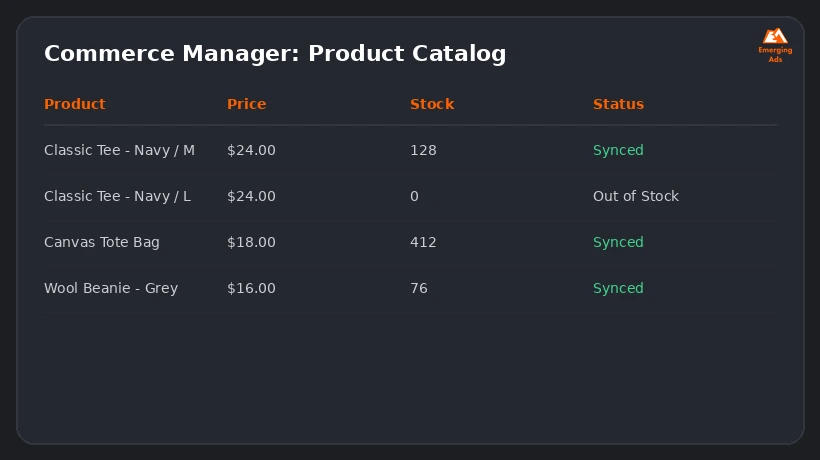
Your catalog is a feed, usually connected through Shopify, a CSV upload, or a direct API integration, that syncs your product data into Meta Commerce Manager. This feed is what powers dynamic product ads, the format that shows a specific user the specific products they viewed or are likely to want.
- Titles should include the attributes people actually search for: brand, size, color, material
- Images need to be clean product shots, Meta’s algorithm and users both respond worse to cluttered lifestyle-only images in the feed
- Availability and price fields must stay in sync in near real time, stale inventory data is one of the most common causes of wasted spend and poor Merchant Center standing
- Product categories (Google Product Category taxonomy) should be filled in accurately, this affects how Meta groups and targets items
Campaign Types and When to Use Each
Advantage+ Shopping Campaigns
This is Meta’s current default recommendation for e-commerce: one campaign, automated audience and placement decisions, optimized toward purchases using your catalog. It works best once you have consistent conversion volume (Meta typically wants at least 50 purchase events a week for the algorithm to optimize well).
Dynamic Retargeting Campaigns
Still worth running as a distinct campaign for cart abandoners and past purchasers, especially if you want tighter control over frequency and messaging than Advantage+ gives you by default.
Prospecting With Broad or Interest Targeting
Useful for newer catalogs that don’t yet have enough purchase volume to feed Advantage+ effectively, or for testing new products before folding them into the automated campaign.
Why the Pixel Alone Isn’t Enough Anymore
Browser-based tracking (the Meta Pixel) has become less reliable due to ad blockers, cookie restrictions, and iOS privacy changes. The Conversions API sends conversion events server-side, directly from your store’s backend to Meta, which recovers a meaningful share of the conversions the pixel alone misses. Running both together, deduplicated properly, gives Meta’s algorithm a more complete picture, which directly improves optimization and effectively lowers cost per purchase.
What Advantage+ Shopping Campaigns Actually Do
Instead of manually building audience segments and placement rules, you feed Advantage+ your catalog, your budget, and creative assets, and Meta’s system tests combinations of audience, placement, and creative in real time, shifting spend toward whatever’s converting. The tradeoff is less granular control and less visibility into exactly why something worked. For most e-commerce accounts with steady conversion volume, the efficiency gain outweighs the loss of control, but it still needs monitoring, particularly around frequency and creative fatigue.
Want us to look at your account?
We’ll audit your setup and tell you exactly where the budget is leaking, free.
Get Your Free Ad AuditFrequently Asked Questions
Do I need a Shopify store to run Meta Ads for e-commerce?
No, Shopify makes catalog setup easier through its native integration, but you can connect a catalog to Meta from WooCommerce, Magento, or a manual CSV feed as well.
How much budget do I need to start Meta Ads for e-commerce?
There’s no universal minimum, but you need enough spend to generate consistent conversion data for the algorithm to optimize against, generally a few hundred dollars a week to start seeing patterns.
What’s the difference between the Meta Pixel and the Conversions API?
The Pixel tracks conversions through the browser and is affected by ad blockers and privacy restrictions. The Conversions API sends the same events server-side, which is more reliable and recovers conversions the Pixel misses.
How long does Advantage+ take to optimize?
Typically one to two weeks once it’s receiving consistent conversion signal, though this varies with your purchase volume and average order value.
Can I run Meta Ads without a product catalog?
Yes, for lead generation or brand campaigns, but dynamic product ads and Advantage+ shopping campaigns both require a connected catalog.
Why do my catalog ads show the wrong price or an out-of-stock item?
This almost always means your feed isn’t syncing frequently enough with your store’s actual inventory and pricing. Check your feed’s update frequency in Commerce Manager.
Should small catalogs (under 50 products) use Advantage+?
It can still work, but with fewer products the algorithm has less to test with. Manual campaign structures sometimes perform comparably for very small catalogs.
How does Meta decide which product to show a specific user?
Based on browsing and purchase behavior on your site (via the pixel/Conversions API), catalog data, and broader signals about what similar users engage with.
What creative formats work best for e-commerce on Meta?
A mix of single product image ads, carousel ads showing multiple products, and short-form video, tested against each other rather than relying on one format.
Is iOS 14+ tracking still a problem for Meta Ads in 2026?
Less than it was initially, since the Conversions API and Meta’s modeled conversions have matured, but attribution is still less precise than it was before Apple’s privacy changes, so treat reported numbers as directionally accurate rather than exact.
Ready to fix what’s costing you conversions?
Book a free, no-pressure audit of your ad account or website.
Get Your Free Ad Audit