Common Mistakes to Avoid With Facebook Ads
Key Takeaways
- Broken or incomplete pixel setup is the single most common reason a Facebook Ads account underperforms, and it’s often invisible until someone specifically audits it
- Launching too many ad sets at once splits the algorithm’s learning phase across too little data per ad set, delaying stable, efficient delivery
- Ad fatigue sets in faster than most advertisers expect, frequency above 3-4 on a cold audience is a common, overlooked cause of rising costs
- Narrow, over-restricted targeting frequently underperforms broader targeting paired with strong creative, Meta’s algorithm needs enough audience size to optimize effectively
- Testing one variable at a time (one new creative, one new audience) produces far more useful, actionable data than changing several elements simultaneously
Why Facebook Ads Mistakes Are Easy to Make and Hard to Spot
Facebook Ads Manager is deceptively easy to use and genuinely difficult to use well. The interface makes it simple to launch a campaign in minutes, but the underlying auction, delivery, and optimization systems are complex enough that small, easy-to-miss setup mistakes routinely go unnoticed for months while quietly inflating costs. Most of the mistakes on this list aren’t exotic, they’re common, and most accounts we’ve audited have at least two or three of them active at once.
What makes these mistakes particularly costly is that Meta’s algorithm is genuinely good at optimizing toward whatever signal you give it, which means a flawed setup doesn’t just underperform, it actively teaches the system to keep optimizing toward the wrong outcome. Fixing the underlying mistake resets that learning in the right direction, but the earlier it’s caught, the less wasted spend accumulates before the correction takes effect.
Mistake 1: A Broken or Incomplete Pixel Setup
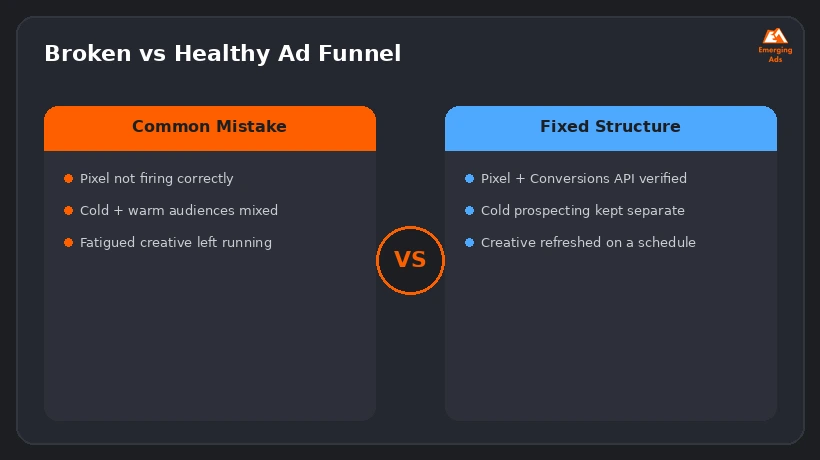
The Meta Pixel (or Conversions API in the current post-iOS 14 environment) is the foundation everything else is built on. A pixel that isn’t firing correctly on every key event, page view, add to cart, purchase, means the algorithm is optimizing with incomplete or inaccurate data, which shows up as campaigns that seem to convert well in Ads Manager but don’t match actual revenue in your store’s own reporting. This mismatch is often the first clue something upstream is broken, long before anyone thinks to check the pixel itself.
- Use Meta’s Events Manager Test Events tool to confirm every key event fires correctly on a live purchase, not just in a sandbox
- Check that Conversions API is set up alongside the browser pixel, not as a replacement, redundancy here improves match quality significantly
- Verify purchase value is passing through correctly, not just the event itself, mismatched values silently distort ROAS reporting
- Re-audit pixel setup after any website platform change or theme update, these frequently break tracking without any obvious symptom
This is worth auditing quarterly even in an account that seems to be performing fine, because a partially broken pixel doesn’t always produce an obvious error, it often just produces steadily declining efficiency that gets attributed to ‘the algorithm’ or ‘the market’ when the real cause is upstream data quality.
Mistake 2: Launching Too Many Ad Sets at Once
Meta’s delivery system needs roughly 50 conversion events per ad set within a 7-day window to exit the learning phase and deliver efficiently. Splitting a modest daily budget across six or eight simultaneous ad sets means none of them individually accumulate enough data to learn properly, keeping the whole campaign stuck in an inefficient, expensive learning phase indefinitely, a pattern that shows up constantly in newer accounts eager to test everything at once.
A more disciplined approach consolidates budget into fewer, better-resourced ad sets, giving each one a realistic shot at reaching the conversion threshold needed to exit learning phase within a reasonable timeframe. For a smaller daily budget, this often means running two or three ad sets rather than six, even if that feels like it’s testing less, because a properly optimized smaller test beats a starved, underpowered broad one.
Mistake 3: Ignoring Ad Fatigue Until Performance Already Dropped
Ad fatigue, the decline in performance as the same audience sees the same creative repeatedly, sets in faster than most advertisers expect, often within 2-3 weeks on a moderately sized cold audience. Frequency climbing above 3-4 on prospecting campaigns is a reliable early warning sign, but most accounts only notice fatigue once CPA has already climbed noticeably, well after the point a proactive creative refresh would have prevented it, and by then the damage to the month’s overall efficiency is largely already done.
| Frequency range | What it typically means | Action |
|---|---|---|
| 1-2 | Healthy, audience still seeing creative for the first or second time | Monitor, no action needed |
| 3-4 | Early fatigue window, worth watching CPA trend closely | Prepare fresh creative variants |
| 5+ | Likely active fatigue, CPA is probably already climbing | Refresh creative or expand audience immediately |
Building a habit of checking frequency weekly, not just when performance visibly drops, catches fatigue early enough to swap in fresh creative before it meaningfully drags down account-level efficiency for the month.
Mistake 4: Over-Narrowing Your Audience Targeting
A carryover habit from older, more granular Facebook Ads targeting is stacking multiple narrow interest and demographic filters into an audience so small the algorithm barely has room to find efficient delivery. Meta’s current advertising system, built around broader optimization and Advantage+ targeting, generally performs better with wider audience pools paired with genuinely strong creative than with a narrowly stacked interest list, a shift that catches many advertisers still working from an older playbook off guard.
- Test broad targeting (age range and geography only, no interest stacking) against a narrower interest-based audience for the same offer
- Let creative and offer do more of the targeting work rather than trying to over-engineer audience definitions
- Reserve tightly defined audiences for retargeting warm traffic, where narrow precision genuinely adds value
- Avoid excessive audience overlap between multiple ad sets targeting the same broad pool, it causes the ad sets to compete against each other in the auction
Mistake 5: Weak or Generic Creative
Targeting and budget structure matter, but creative is consistently the single largest driver of Facebook Ads performance, and it’s the area most accounts under-invest in relative to its impact. Generic stock imagery, copy that reads like every other ad in the category, and a lack of genuine testing volume across creative concepts (not just minor variations of the same concept) are the most common creative-related performance drags, and they’re often the easiest to fix once someone actually looks closely at what’s running.
A practical minimum is testing at least 3-4 genuinely different creative concepts per campaign, not just color or headline variations of the same underlying idea, refreshing whichever concepts show fatigue signals, and treating creative testing as an ongoing monthly discipline rather than a one-time setup task completed at campaign launch and never revisited.
Mistake 6: Changing Too Many Variables at Once
It’s tempting, especially when a campaign is underperforming, to change the audience, the creative, and the bid strategy all in the same session. The problem is that when performance shifts afterward, there’s no way to know which change actually caused it, which means the same mistake, or the same accidental fix, is likely to get repeated or lost going forward.
A more disciplined testing approach changes one meaningful variable at a time, giving each change enough time and data (generally a minimum of 3-5 days and enough spend to reach statistical relevance) before drawing conclusions and moving to the next test. This is slower in the short term but produces a genuinely reliable, cumulative understanding of what actually moves performance in your specific account.
Mistake 7: Ignoring the Learning Phase
Every time a campaign or ad set undergoes a ‘significant edit’, a meaningful budget change, audience change, or bid strategy change, Meta resets it into a fresh learning phase, during which delivery is typically less efficient and less stable. Making frequent small edits, chasing daily performance fluctuations, keeps a campaign perpetually stuck relearning rather than ever reaching stable, optimized delivery.
Resisting the urge to tweak a campaign every day or two, and instead reviewing performance on a weekly cadence with a clear threshold for what actually warrants a change, gives Meta’s system the stability it needs to deliver efficiently, and it’s one of the simplest, most overlooked fixes available to an account that feels perpetually inconsistent.
Mistake 8: No Clear Funnel Structure
Running every campaign purely toward cold, top-of-funnel prospecting, with no dedicated retargeting layer for people who’ve visited the site, viewed a product, or abandoned a cart, leaves significant, relatively cheap conversion volume on the table. Retargeting audiences convert at meaningfully higher rates and lower cost than cold prospecting, simply because they’ve already shown some level of intent.
A Simple Monthly Audit Checklist
- Confirm pixel/Conversions API events are firing correctly and purchase values match actual revenue
- Check frequency across all active ad sets, flag anything above 3-4 for a creative refresh
- Review whether budget is spread across too many ad sets to reach learning phase conversion thresholds
- Audit whether retargeting audiences exist and are appropriately budgeted relative to cold prospecting
- Confirm no more than one meaningful variable was changed per test in the past month, review what was learned
How iOS Privacy Changes Made Some of These Mistakes Worse
Apple’s App Tracking Transparency framework and the broader shift toward browser-level privacy restrictions have made data quality mistakes considerably more costly than they were a few years ago. When a meaningful share of iOS users opt out of tracking, an account already running with a partially broken pixel loses even more visibility into what’s actually driving conversions, compounding an existing problem rather than being a separate, unrelated issue.
This is exactly why Conversions API, server-side tracking that doesn’t rely solely on browser-based signals, has become less of a nice-to-have and more of a baseline requirement for reliable Facebook Ads performance. Accounts still running pixel-only tracking without Conversions API in place are effectively operating with a meaningfully larger blind spot than they may realize, since a portion of real conversions simply never get reported back to the algorithm at all, regardless of how well every other part of the account is set up.
The practical upshot is that several of the mistakes covered above, broken tracking, over-narrow targeting, and premature judgment during the learning phase, all get harder to diagnose and more expensive to leave uncorrected in this environment, because the algorithm simply has less clean data to work with than it did in the pre-privacy-change era, making a disciplined setup and monthly audit habit more valuable now than it was a few years ago, not less.
When These Mistakes Point to a Bigger Structural Problem
If an account audit consistently turns up several of these mistakes at once, it’s often less about any single fix and more about the account never having had a consistent, disciplined management process behind it, campaigns launched reactively, tweaked inconsistently, without a standing weekly or monthly review cadence. Fixing the individual mistakes helps immediately, but building that ongoing discipline is what prevents the same mistakes from quietly creeping back in a few months later, once the initial cleanup effort fades into routine again.
A useful test for whether an account needs more structure than it currently has: could someone else, unfamiliar with the account, pick up the audit checklist above and know exactly what to check and what a passing versus failing result looks like. If the honest answer is no, that’s usually a sign the account has been running on instinct rather than process, which tends to work fine until something changes, a platform update, a new competitor, a tracking break, and there’s no established process to catch it quickly before real budget is wasted.
None of the mistakes covered here are unusual or a sign of a poorly run business, they show up constantly across accounts of every size, including ones with genuinely talented people managing them, simply because Facebook Ads has enough moving parts that something eventually slips without a deliberate, recurring check built into the calendar rather than left to memory, and that recurring check is worth treating as a standing task rather than an occasional one on an otherwise busy team’s already full and growing to-do list.
Want us to look at your account?
We’ll audit your setup and tell you exactly where the budget is leaking, free.
Get Your Free Ad AuditFrequently Asked Questions
How do I know if my Facebook Pixel is broken?
Use Meta’s Events Manager Test Events tool during a live purchase or key action on your site, and compare Ads Manager reported conversions and revenue against your actual store or CRM data for the same period, a meaningful mismatch signals a tracking issue. It is worth repeating this check after any theme update, checkout provider change, or cookie consent banner change, since these are the most common silent causes of a pixel quietly breaking without any obvious error message appearing anywhere in the account.
What frequency is too high for a Facebook ad?
Generally, a frequency above 3-4 on a cold prospecting audience within a rolling 7-day window signals rising fatigue risk. Retargeting audiences can tolerate somewhat higher frequency since the audience is smaller and more engaged by nature.
Should I use broad or narrow targeting on Facebook Ads?
For cold prospecting, broader targeting paired with strong creative generally performs better with Meta’s current algorithm than narrowly stacked interest targeting. Narrow, precise targeting is more valuable for retargeting warm audiences.
How many ad sets should I run at once?
Fewer, better-resourced ad sets that can each realistically reach the roughly 50-conversion learning phase threshold within a week generally outperform many under-resourced ad sets splitting the same budget too thin.
How often should I refresh my ad creative?
As soon as frequency and CPA trends signal fatigue, often every 2-4 weeks for actively running prospecting campaigns, rather than on a fixed calendar schedule disconnected from actual performance signals.
What counts as a ‘significant edit’ that resets learning phase?
Meaningful budget changes (generally over 20%), audience changes, bid strategy changes, and creative changes within an ad set can all trigger a learning phase reset, minor edits like adding a single new ad to an existing ad set typically don’t.
Is Conversions API necessary if I already have the pixel installed?
Yes, running both together significantly improves event match quality in the current tracking environment, since browser-based pixel tracking alone misses a meaningful share of events due to browser privacy restrictions.
How long should I wait before judging a new campaign’s performance?
At minimum through the full learning phase, generally 5-7 days with sufficient spend to reach the conversion threshold, judging performance before then usually reflects learning phase instability rather than the campaign’s true steady-state performance.
Do I need a separate retargeting campaign, or can one campaign handle everything?
A separate, dedicated retargeting campaign or ad set with its own budget is strongly recommended, mixing cold and warm audiences in the same ad set muddies the signal the algorithm uses to optimize delivery for either group.
What’s the single most common mistake you see in Facebook Ads accounts?
Incomplete or degraded pixel/Conversions API tracking, by a wide margin, because it’s invisible without a specific audit and it quietly corrupts every other optimization decision built on top of that data.
Ready to fix what’s costing you conversions?
Book a free, no-pressure audit of your ad account or website.
Get Your Free Ad Audit