What Is CRO and How Does It Work
Key Takeaways
- CRO improves results from traffic you already have, which is usually cheaper than acquiring more traffic to hit the same goal.
- A/B testing without enough traffic volume for statistical significance just produces noise, not insight.
- The biggest conversion barriers are often found in analytics and user recordings, not guesswork or best-practice checklists.
- Form length, page load speed, and trust signals are among the highest-leverage, most commonly overlooked levers.
- CRO is a continuous process, not a one-time project, ongoing testing compounds over time, which is why most businesses eventually bring in dedicated CRO services to keep the testing cadence going.
What CRO Actually Means
Conversion rate optimization is the practice of increasing the percentage of website visitors who complete a desired action, a purchase, a form submission, a signup, without needing to increase traffic. It’s often one of the highest-return marketing investments available, because it improves results from traffic you’re already paying to acquire rather than requiring more ad spend to hit the same goal. This is exactly the gap our CRO services are built to close.
The CRO Process, Step by Step
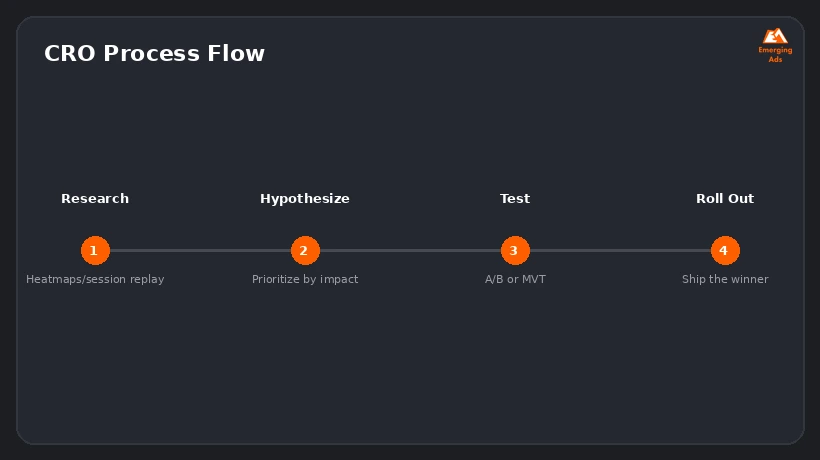
- Research: analyze existing analytics, session recordings, and heatmaps to find where visitors drop off or hesitate
- Hypothesis: form a specific, testable theory about why a particular page or step underperforms
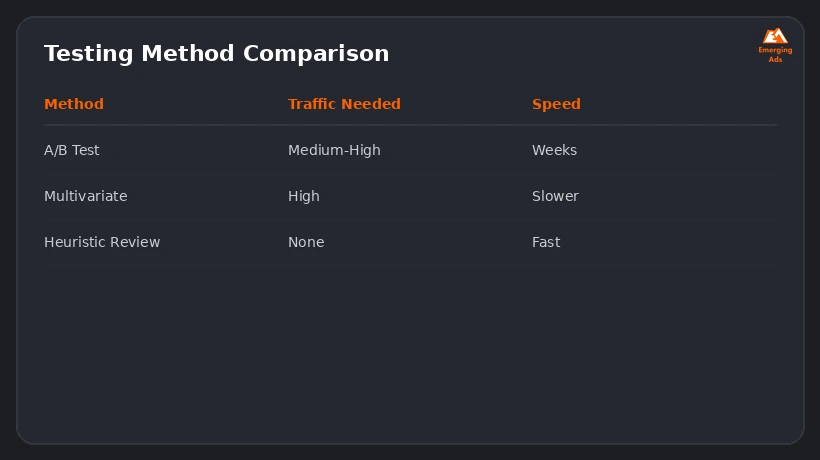
- Test design: build an A/B test isolating the specific variable being tested, not multiple changes at once
- Run the test: let it reach statistical significance before drawing conclusions, ending early on a promising early trend is a common mistake
- Implement and iterate: roll out the winning variant, then move to the next hypothesis
Where to Find Your Biggest Opportunities
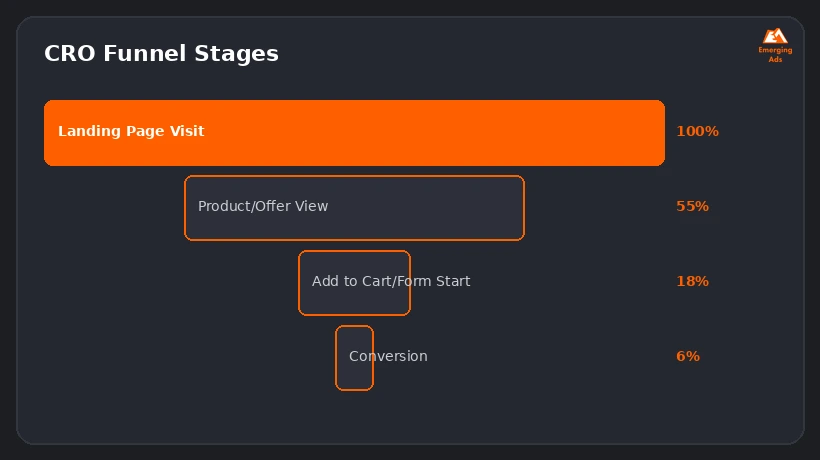
Rather than guessing based on general best practices, look at your own funnel data for the stage with the steepest drop-off, cart abandonment, form abandonment, or checkout exit, and start there. The page with the highest traffic and the lowest conversion rate is usually the highest-leverage place to focus first. Finding that page is typically the first thing we look at when scoping any CRO services engagement.
Common High-Impact Levers
- Form length and field count, shorter almost always converts better, though it can affect lead quality
- Page load speed, even small delays measurably reduce conversion rate, especially on mobile
- Trust signals, reviews, security badges, clear return policies, placed near the decision point
- Call-to-action clarity, one clear primary action per page rather than competing options
- Checkout or form friction, unnecessary steps, required account creation, unclear pricing
Why CRO Is Never Really “Done”
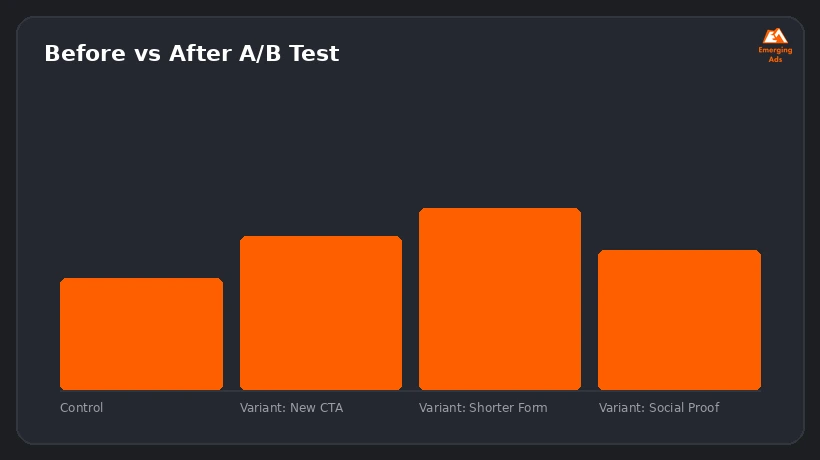
Audience behavior, traffic sources, and competitive context all shift over time, a page optimized a year ago isn’t necessarily still optimized today. Treating CRO as an ongoing testing cadence rather than a one-time project is what compounds results over the long run, and it’s the core reason our CRO services are structured as continuous engagements rather than one-off audits.
Want us to look at your account?
We’ll audit your setup and tell you exactly where the budget is leaking, free.
Get Your Free Ad AuditFrequently Asked Questions
How much traffic do I need to run a valid A/B test?
Enough to reach statistical significance within a reasonable timeframe, low-traffic pages may need several weeks or a larger effect size to produce a reliable result.
What’s a good conversion rate benchmark?
It varies enormously by industry, traffic source, and page type, benchmark against your own historical performance rather than a generic industry average.
Should I test big redesigns or small changes?
Both have a place, small isolated changes are easier to attribute clearly, larger redesigns can produce bigger lifts but make it harder to know exactly which element drove the change.
How long should an A/B test run?
Until it reaches statistical significance and has covered at least one full weekly cycle to account for day-of-week variation, ending early on an apparent trend is a common mistake.
What tools are used for CRO research?
Session recording and heatmap tools, analytics platforms, and dedicated A/B testing software are the common core toolkit, the right combination depends on your traffic volume and platform.
Is CRO only relevant for e-commerce sites?
No, lead generation sites, SaaS signups, and content sites with newsletter or download goals all benefit from the same conversion optimization principles.
What’s the difference between CRO and UX design?
UX design focuses broadly on usability and user experience, CRO specifically focuses on testing and improving the conversion rate for a defined goal, they overlap heavily but aren’t identical.
Can CRO work alongside paid advertising campaigns?
Yes, and it often should, a higher-converting landing page directly improves the return on every dollar spent on paid traffic driving to it.
How do I know which page to optimize first?
Start with the highest-traffic page that has the lowest conversion rate relative to its funnel stage, that’s usually where a lift produces the largest overall impact.
Do I need a dedicated CRO specialist or can my team handle it?
Basic testing can be handled in-house with the right tools, but a dedicated specialist or agency brings testing methodology rigor that often prevents wasted effort on inconclusive tests.
Ready to fix what’s costing you conversions?
Book a free, no-pressure audit of your ad account or website.
Get Your Free Ad Audit