The short answer
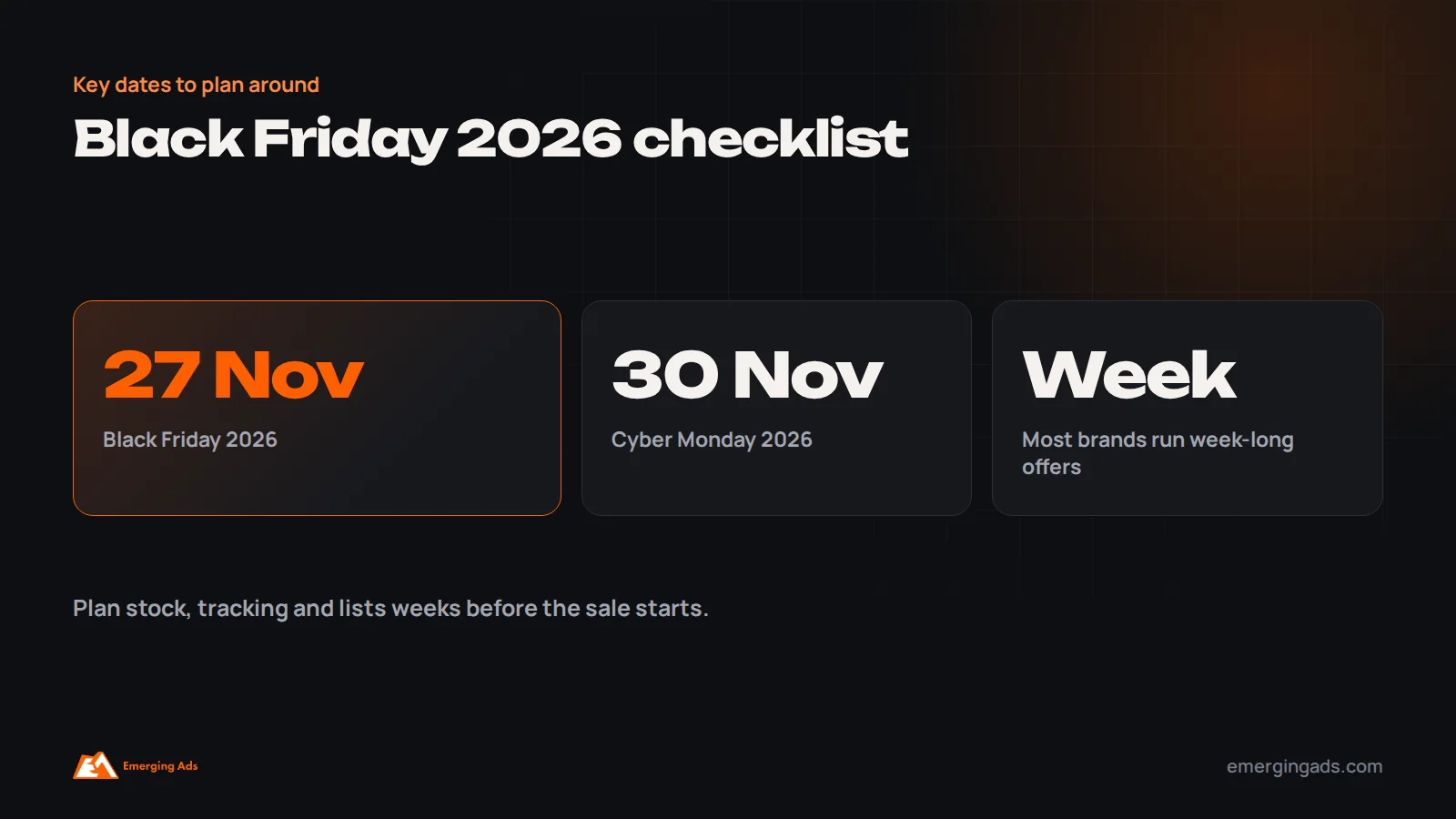
A strong Black Friday marketing strategy for 2026 starts weeks before the day itself: set goals and margins, choose an offer you can afford, check stock and fulfillment, fix tracking and site speed, grow and warm up your email and SMS lists, build audiences and test creative early, then schedule a sequence of emails, ads and on-site messages from early access through Cyber Monday. Black Friday falls on 27 November 2026 and Cyber Monday on 30 November. Plan the follow-up as carefully as the sale, because retaining the customers you win matters as much as winning them.
Black Friday and Cyber Monday are the biggest sales weekend of the year for most online stores, and the most competitive. Advertising costs rise, inboxes overflow, shoppers compare aggressively and every brand is shouting about discounts. The brands that do well are rarely the ones with the biggest discount. They are the ones that prepared earliest, knew their numbers, reached customers who already knew them and made buying easy.
We plan Black Friday campaigns for ecommerce clients across the UK, US, Gulf and India every year. This checklist is the process we follow, organized by timeline, with notes on what changes in 2026. Use it as a working document; tick off each item as you go.

Key dates for 2026
- Black Friday: Friday 27 November 2026.
- Cyber Monday: Monday 30 November 2026.
- Black Friday week: many brands now run offers across the whole week, starting around Monday 23 November or earlier.
- Singles’ Day: 11 November, important in parts of Asia and increasingly used as an early warm-up.
- White Friday: the name many retailers in the Gulf use for the same period.
- Last shipping dates for Christmas: plan messaging for December straight after Cyber Monday.
In India, the festive season around Diwali often brings major sales close to this period too, so plan budgets and stock for both where relevant.
Step 1: Set goals and know your numbers
Before choosing an offer, be clear about what Black Friday needs to achieve. Common goals include revenue, new customers, clearing stock, growing the email list or launching a product. Each leads to different decisions.
Then work out the numbers that keep the event profitable:
- Margin after the discount, including product cost, shipping, payment fees and returns.
- Maximum cost per acquisition you can afford at that margin, and what a new customer is worth over time.
- Expected return rates, which are often higher for discounted purchases.
- Break-even return on ad spend for the sale period.
Many brands lose money on Black Friday without realizing it, because they judge success on revenue rather than profit. Know your break-even before setting budgets.

Step 2: Choose an offer you can afford
The offer is the center of your campaign. Options include:
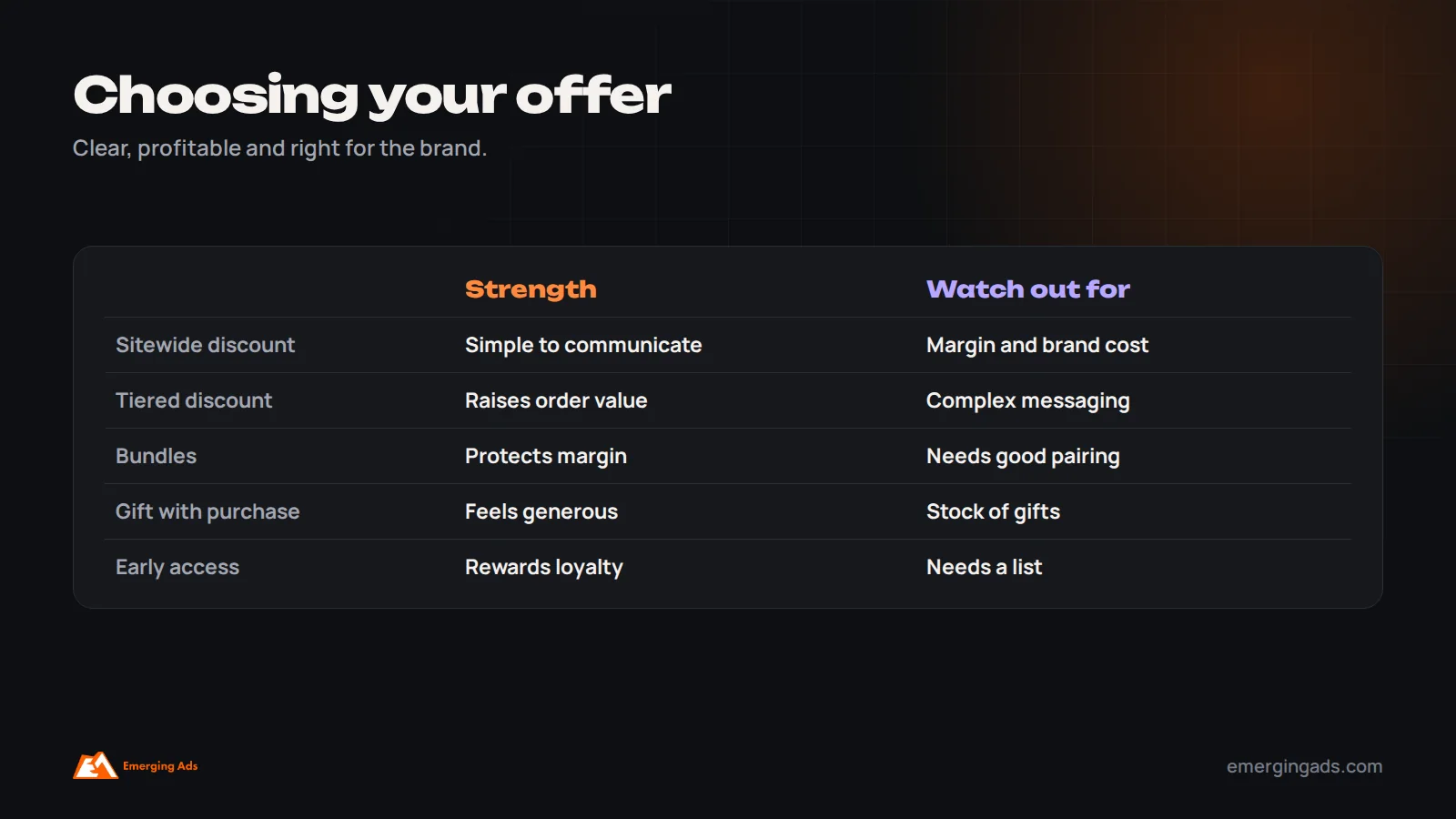
- Sitewide percentage discounts, simple and easy to communicate.
- Tiered discounts, such as larger savings on larger orders, which raise average order value.
- Bundles that combine products at a better price, often protecting margin better than straight discounts.
- Gift with purchase, which can feel generous while costing less than a discount.
- Free shipping or upgraded shipping above a threshold.
- Limited editions or exclusive products available only during the sale.
- Early access for subscribers, customers or loyalty members.
Choose an offer that is clear in one sentence, profitable at your expected volume and consistent with your brand. Premium brands sometimes do better with gifts, bundles or early access than with deep discounts, which can cheapen the brand.
Step 3: Check stock, fulfillment and customer service
- Forecast demand for bestsellers and order stock early, allowing for supplier and shipping delays.
- Decide which products are included and which are excluded.
- Confirm warehouse and courier capacity for peak volume, and set realistic delivery promises.
- Prepare customer service for higher volume: canned replies, extra staff or hours, clear returns information.
- If you sell on Amazon or other marketplaces, check inbound shipment deadlines, which are often earlier before peak.
- Plan what happens when products sell out, including back-in-stock alerts and alternatives.
Step 4: Fix tracking and analytics
Black Friday is the worst time to discover tracking problems. Several weeks before, check that purchases are tracked correctly in Google Ads, Meta, TikTok and other platforms, with server-side tracking such as the Conversions API in place, that GA4 records purchases and revenue accurately, and that email and SMS platforms attribute revenue correctly. Make sure UTM parameters are consistent across campaigns. Our guide on Meta pixel tracking setup covers the essentials.
Step 5: Prepare the website
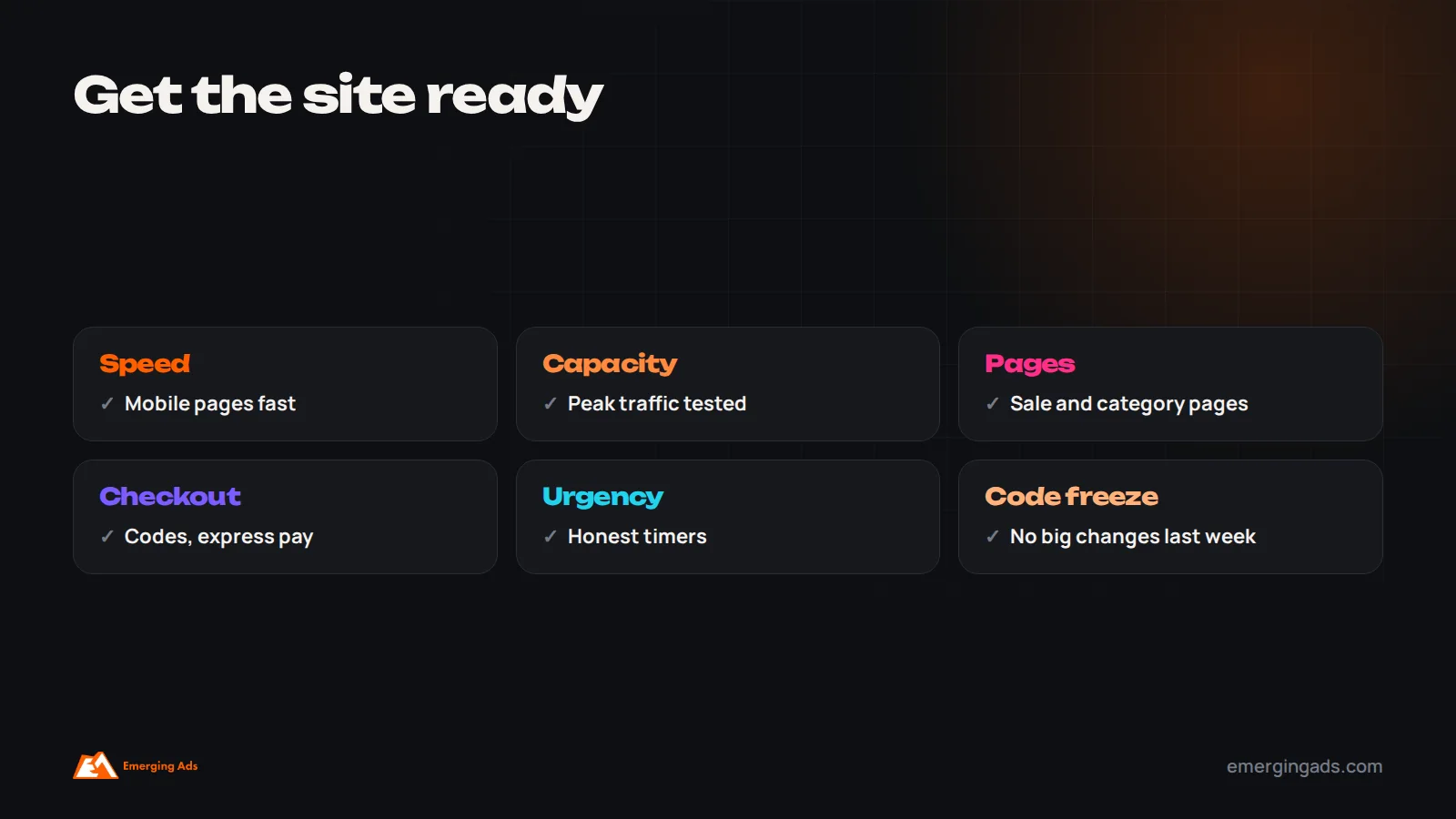
- Speed: test page speed on mobile and fix slow images and scripts.
- Capacity: confirm your hosting or platform can handle peak traffic.
- Landing pages: build a dedicated sale page, and pages for key categories or bundles.
- Navigation: make the sale easy to find from the homepage and menus.
- Checkout: test the full journey, including discount codes, express payments and shipping options.
- Countdown and urgency: use honest timers and stock indicators where appropriate.
- Code freeze: avoid major site changes in the final week before the sale.
Our guide to conversion rate optimization covers how to make sale pages convert.
Step 6: Grow and warm up your email and SMS lists
Your own audience is your most profitable channel during Black Friday, because advertising costs peak while email and SMS cost almost nothing per message. In the weeks before:
- Run a list-growth campaign, such as early access signups, a giveaway or a waitlist for the sale.
- Send regular, valuable emails so subscribers are engaged when the sale starts; inbox providers favor senders with recent engagement.
- Clean the list and suppress long-unengaged subscribers to protect deliverability.
- Check authentication and sending domain setup.
- Collect SMS or WhatsApp opt-ins for high-intent moments.
Our guide on improving ecommerce email results covers deliverability and segmentation.
Step 7: Build audiences and test creative early
Advertising costs rise sharply in late November, so do your learning before then. In October and early November:
- Test creative angles, offers and formats while costs are lower.
- Build retargeting audiences by driving traffic to the site in the weeks before.
- Prepare a full set of sale creative in every format: square, vertical and horizontal, static and video.
- Upload customer lists for exclusions and lookalike audiences.
- Check product feeds for Google Shopping and Meta catalog ads, including sale prices.
- Plan budgets by day, with more budget on the days your data says convert best.
On Google, use seasonality adjustments for short sale periods so Smart Bidding anticipates higher conversion rates. On Meta, avoid launching brand-new campaigns on the busiest days; scale proven ones instead. Our guides to scaling Meta ads and lowering Google Ads CPA cover the mechanics.
Creative that works during Black Friday
During the sale, every brand’s ads say “Black Friday” and “up to 50% off”. Creative that stands out does something more. It shows the product clearly with the price or saving visible, so shoppers understand the offer instantly. It leads with your strongest products rather than a generic sale banner. It uses social proof, such as reviews, customer photos and bestseller badges, to reassure people buying from you for the first time. It shows gift ideas and bundles for people shopping for others. And it looks native to each platform: vertical, fast and sound-on for Reels and TikTok, clean and clear for Shopping and display.
Prepare several variations for each audience: new prospects need a reason to trust you, past visitors need a reminder of the products they viewed, and existing customers need to feel they are getting early or exclusive access. Refresh creative during the week if performance drops, since fatigue sets in quickly when audiences see many ads in a short period.
How to budget across the sale period
Spread budget according to when your customers buy, not evenly across days. Look at last year’s data by day and hour if you have it. Many stores see strong demand on Black Friday itself and Cyber Monday, with meaningful sales throughout the week and early access days. Reserve some budget to move towards whatever performs best in real time.
Plan budgets by channel as well. Email and SMS to your own audience usually deliver the highest return. Retargeting past visitors and cart abandoners is efficient but limited by audience size. Prospecting is the most expensive during peak week, so it works best when it supports proven offers and creative, and when the follow-up flows are ready to convert the new traffic later. Some brands deliberately shift prospecting spend into the weeks before the sale, when costs are lower, to build audiences they can then retarget during the event.
Selling on Amazon and other marketplaces
If you sell on Amazon, Noon, Flipkart or other marketplaces, their deal events often run alongside your own sale. Submit deals before the marketplace deadlines, which can be weeks earlier than you expect, send stock to fulfillment centers early because inbound capacity tightens before peak, and align marketplace pricing with your own site to avoid undercutting yourself. Raise advertising budgets on proven products and watch stock closely, since running out during the event damages rankings for weeks afterwards. Our guide on improving Amazon ROAS covers peak-season preparation.
Agree roles for the sale days
Decide in advance who watches what during the sale: who monitors the site and checkout, who manages ads and budgets, who sends and checks emails, who handles customer service and social comments, and who makes decisions if something goes wrong, such as a product selling out or a payment provider failing. Share a simple contact list and an escalation plan. Small teams that agree roles beforehand handle peak weekend far better than those making decisions on the fly.
Step 8: Plan the campaign sequence
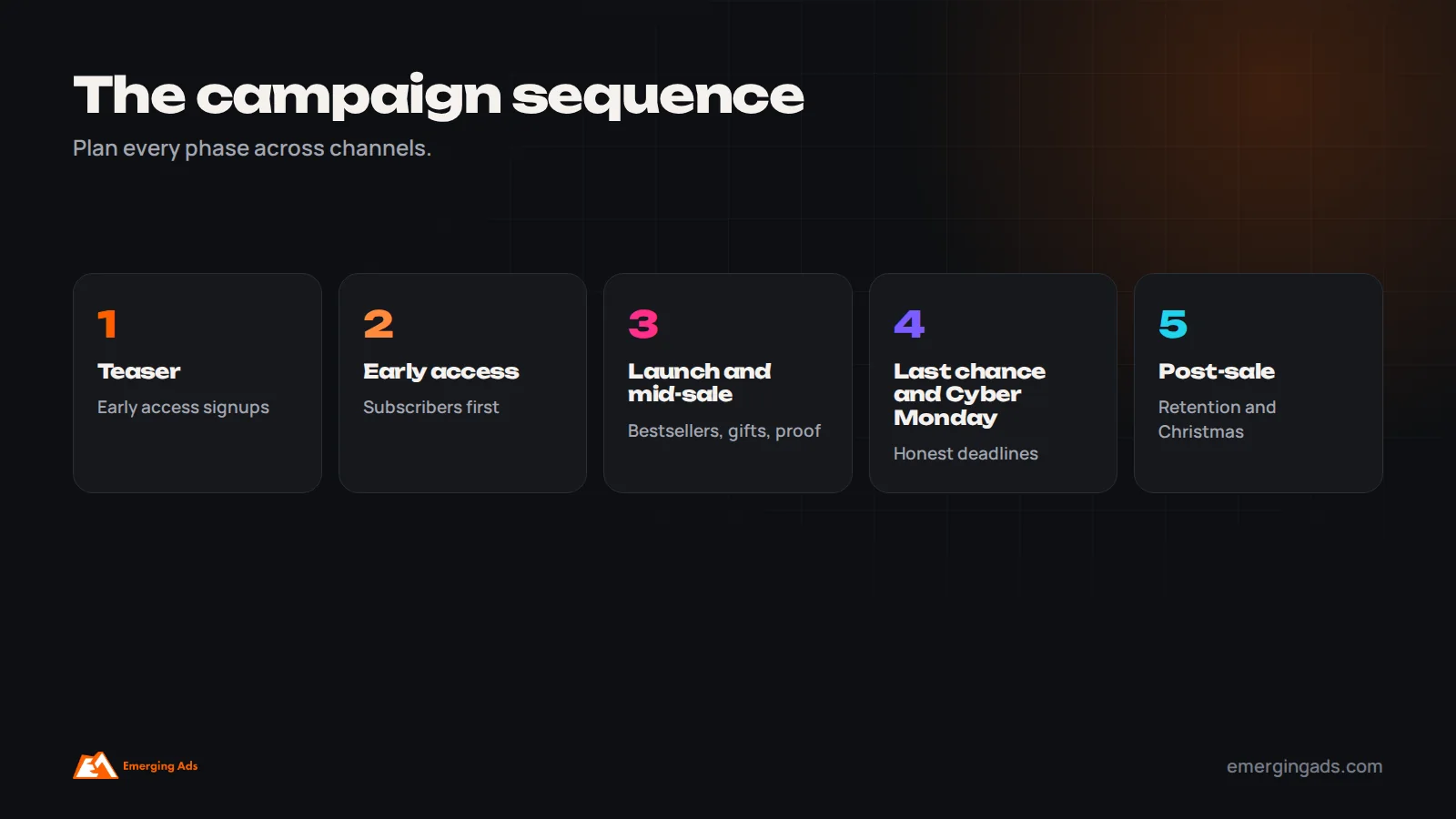
A single “sale is live” email is not a strategy. Plan a sequence across channels:
- Teaser phase: hint at the sale and drive signups for early access.
- Early access: open the sale first to subscribers, customers or loyalty members.
- Launch: announce publicly across email, SMS, social, ads and the website.
- Mid-sale: highlight bestsellers, bundles, gift ideas and social proof.
- Last chance: remind people as the sale ends, with honest deadlines.
- Cyber Monday: a final push or extension, often with a specific online-only angle.
- Post-sale: thank-you messages, shipping updates and the transition to Christmas.
Segment email and SMS so customers, engaged subscribers and less engaged subscribers receive different frequency and messaging.
Step 9: Update automated flows
Abandoned cart, browse abandonment and welcome flows will receive far more traffic than usual. Update them with sale messaging and deadlines, check that discount codes work, and make sure promotional messages do not conflict with sale emails. After the sale, switch them back. Our guide to ecommerce email flows explains each flow.
Reward existing customers first
Existing customers are usually the most profitable buyers during Black Friday, because you do not have to pay to acquire them again. Give them a reason to feel valued: early access a day or two before the public sale, an extra gift or bonus, free shipping regardless of order value, or loyalty points multipliers. Tell them about it in advance, so they plan to buy from you rather than browsing competitors. Customers who feel recognized during the sale are also more likely to come back afterwards, which makes the whole event more profitable.
Make new customers feel safe buying
Many Black Friday shoppers are buying from a brand for the first time, often because of a strong offer. They need reassurance. Make delivery times, shipping costs, returns policy and payment options clear on product pages and in checkout. Show reviews and ratings prominently. Offer familiar payment methods, including express wallets and, where relevant, buy now pay later or cash on delivery. Make customer service easy to reach. Small trust signals often decide whether a hesitant first-time buyer completes the purchase.
Organic social and influencers
Organic social and creator partnerships can extend reach during the sale without matching the rising cost of ads. Plan posts that tease the sale, show bestsellers and gift ideas, and share customer content. Brief creators and influencers early, with clear messaging, links and codes, and schedule their posts to support key moments such as early access and the last day. Creator content often makes strong ad creative too, if usage rights are agreed in advance. Our guide to influencer collaborations for small businesses covers briefs and agreements.
Black Friday for service and B2B businesses
Black Friday is not only for online stores. Service businesses and B2B companies run offers too, such as discounted annual plans, bonus months, free onboarding or limited-time packages. The same principles apply: know your margins, make the offer clear, reach existing leads and customers first, and plan follow-up. For B2B, a Black Friday offer can be a good reason to re-engage leads who went quiet earlier in the year, especially through email and retargeting. Our guide to lead nurture automation covers how to re-engage those leads.
Review the results properly
Within two weeks of the sale, hold a structured review while details are fresh. Look at revenue and profit by day and channel, new versus returning customers, average order value, return on ad spend against break-even, email and SMS revenue per recipient, stock that sold out early or did not move, and customer service issues. Note what worked, what did not and what you would change. Store the notes, creative and results somewhere easy to find, because next year’s preparation should start from this review rather than from scratch.
Keep pricing honest
Shoppers and regulators pay close attention to Black Friday pricing. Discounts should be genuine reductions from prices you actually charged before the sale, not inflated “original” prices created for the event. Several markets, including the UK and EU, have rules on how reference prices and savings can be shown. Be clear about which products are included, when offers start and end, and any conditions, such as minimum spend or exclusions. Honest pricing protects your reputation, reduces complaints and chargebacks, and builds trust with customers you want to keep beyond the sale.
Most sale shopping happens on phones
A large share of Black Friday browsing and buying happens on mobile, often in short moments throughout the day. Test the full journey on a real phone: the ad or email, the landing page, product pages, cart and checkout. Make sure the offer is visible without scrolling, product images load quickly, discount codes apply automatically where possible, and express payment options such as Apple Pay and Google Pay are available. Every extra step or second of loading loses buyers when they are comparing several stores at once.
Plan for gift buyers
Black Friday is also the start of holiday gift shopping. Many shoppers are buying for someone else and need help choosing. Gift guides by recipient and budget, bundles packaged as gifts, gift cards for undecided buyers, gift wrapping and clear delivery dates before holidays all help. Gift buyers often become customers themselves later, so capture their email with their order and follow up thoughtfully after the season.
Check payments and fraud protection
Peak sales attract more fraud attempts as well as more genuine orders. Review fraud filters with your payment provider and ecommerce platform, so suspicious orders are flagged without blocking good customers. Make sure every payment method you offer works on mobile and desktop, including express wallets and local options such as cash on delivery in some Gulf markets or UPI in India. Test refunds and partial refunds too, since returns rise after the sale. A payment failure on Black Friday costs far more than on an ordinary day, so check that you know who to contact at your payment provider if something stops working.
Use last year’s data, if you have it
If you ran a sale last year, last year’s results are the best planning tool you have. Look at which days and hours sold most, which products and offers performed best, which channels returned the most profit, how many new customers came back to buy again, and what went wrong. Use that to set budgets, stock levels and the campaign calendar. If you do not have last year’s data, use this year’s sale to start building it.
Step 10: Monitor and adjust during the sale
- Check site speed, checkout and payment systems regularly.
- Watch stock levels and pause ads on products that sell out.
- Monitor ad spend pacing, cost per acquisition and return on ad spend at least twice a day.
- Shift budget towards campaigns and products performing best.
- Respond quickly to customer questions and comments on ads.
- Keep a log of changes and results for next year’s planning.
Step 11: Plan what happens after the sale
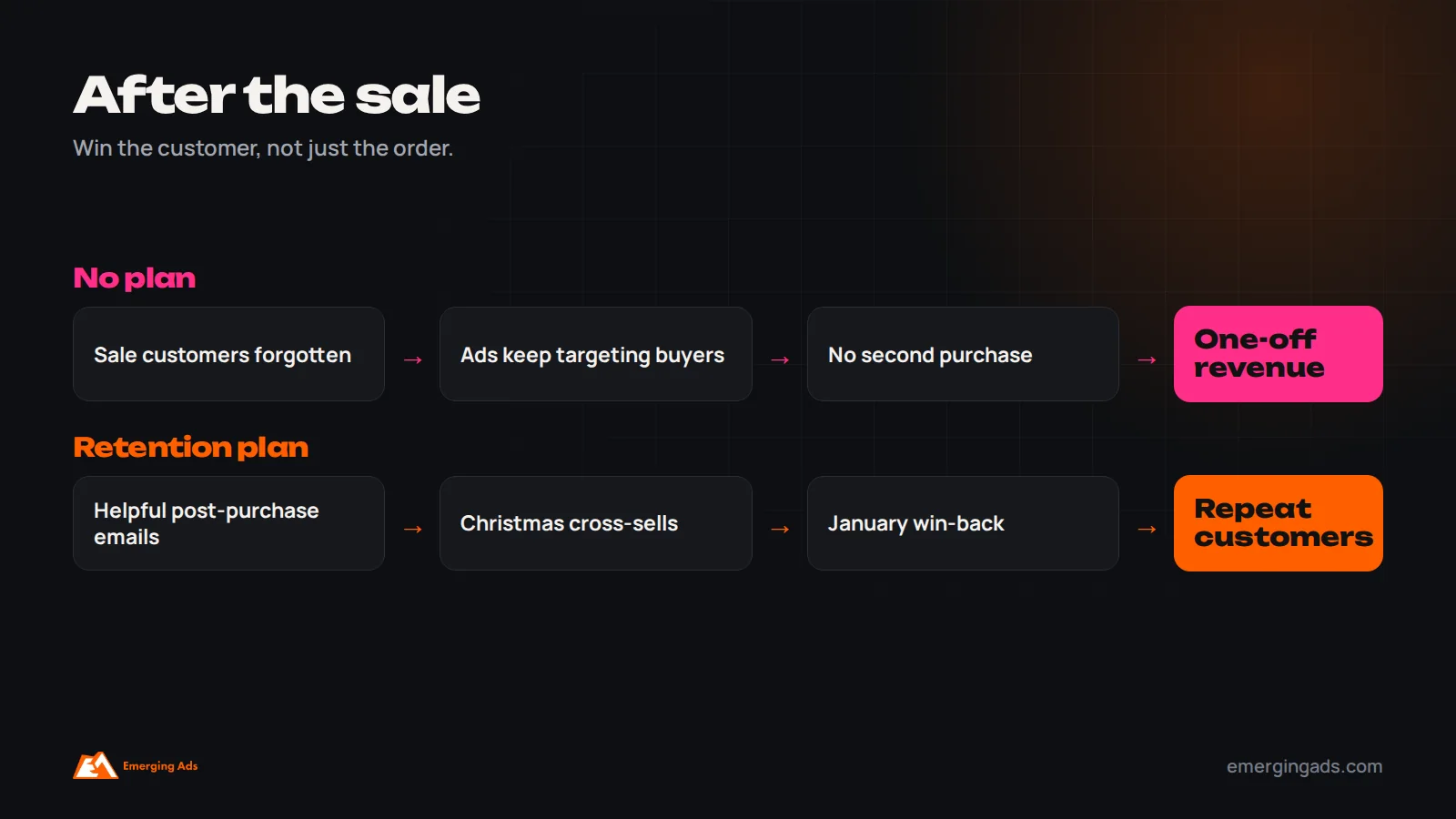
The weeks after Black Friday decide whether the event was worth it. Many new customers bought only because of the discount. Turning some of them into repeat customers is where much of the long-term value lies.
- Send helpful post-purchase emails: shipping updates, how to use the product and review requests.
- Exclude recent purchasers from acquisition ads, and retarget them with complementary products later.
- Move into Christmas campaigns with clear shipping deadlines.
- Plan a January win-back campaign for sale customers.
- Review results by channel, product and customer type, on profit as well as revenue.
If you are starting late
If Black Friday is only a few weeks away and you have not started, focus on what matters most. Decide your offer and check stock today. Fix tracking. Build a simple sale landing page. Email your existing list with a clear sequence of three to five messages. Put most of your paid budget behind campaigns and creative that already work, rather than launching untested ideas during the most expensive week of the year. Prepare customer service. That alone puts you ahead of many competitors.
Regional notes: UK, US, Gulf and India
UK and US: Black Friday and Cyber Monday dominate, with many brands running week-long sales. Competition and ad costs are highest here.
Gulf: White Friday campaigns from major marketplaces drive strong demand. Arabic and English creative, cash on delivery expectations in some markets, and fast delivery promises matter. Our Ramadan marketing guide covers how seasonal shopping differs in the region.
India: Black Friday has grown, but festive season sales around Diwali often matter more. Plan the two together where they fall close, and account for marketplace events.
Common Black Friday mistakes
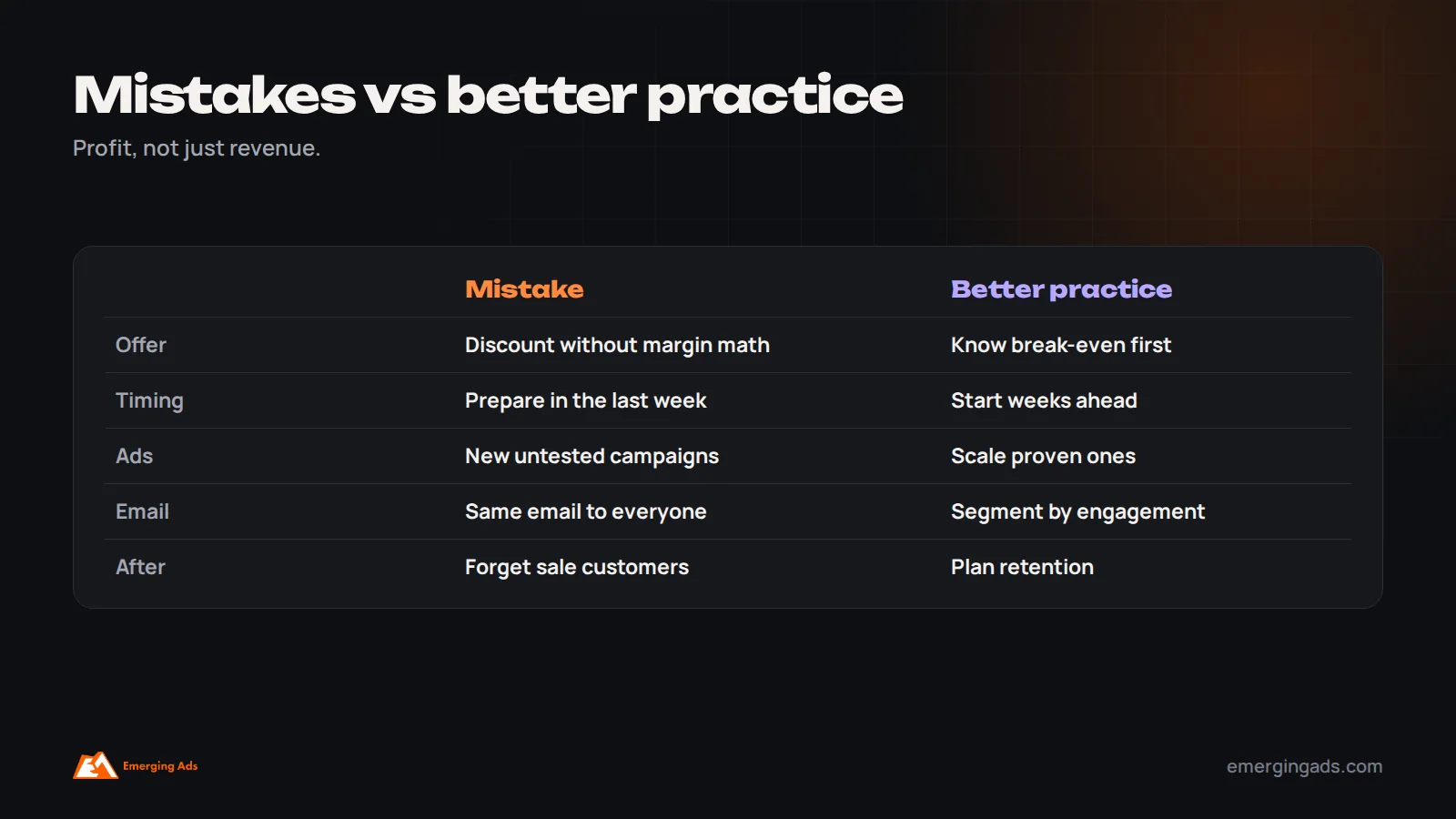
- Discounting without knowing the margin after costs and returns.
- Starting preparation in the final week.
- Launching untested creative and campaigns on the most expensive days.
- Sending the same emails to every subscriber.
- Running out of stock on advertised products.
- Tracking that breaks under peak load or was never checked.
- Ignoring post-sale retention.
- Judging success on revenue instead of profit and new customer value.
The condensed checklist
- Goals, margins and break-even return set.
- Offer chosen and tested for profitability.
- Stock ordered, fulfillment and customer service ready.
- Tracking verified on every platform.
- Site speed, capacity, landing pages and checkout tested.
- Email and SMS lists grown, cleaned and warmed up.
- Creative tested and produced in all formats; audiences built.
- Campaign sequence scheduled from teaser to Cyber Monday.
- Automated flows updated for the sale.
- Monitoring plan and owners agreed for the sale days.
- Post-sale retention and Christmas campaigns planned.
If you would like help planning or running your Black Friday campaigns, our ecommerce marketing, Meta ads and Klaviyo email teams work on peak season every year. You can also start with a free ad audit.
Frequently asked questions
When is Black Friday 2026?
Black Friday is on Friday 27 November 2026, and Cyber Monday is on Monday 30 November 2026. Many brands run offers through the whole week.
When should I start planning Black Friday?
Ideally two to three months ahead for stock, offers and tracking, with list growth and creative testing in October and early November.
What is the best Black Friday offer?
One that is clear, profitable at your expected volume and right for your brand. Bundles, tiered discounts, gifts with purchase and early access can protect margin better than deep sitewide discounts.
How much should I spend on ads for Black Friday?
Set budgets from your break-even return on ad spend and expected margins. Costs rise during the sale, so test early and put most budget behind proven campaigns.
How many emails should I send during Black Friday?
Engaged subscribers can usually receive more emails than normal across the sale period, from teaser and early access through last chance. Send fewer to less engaged subscribers to protect deliverability.
Should premium brands discount on Black Friday?
Not necessarily. Many premium brands use gifts, bundles, limited editions or early access instead of deep discounts to protect brand value.
What should I do after Black Friday?
Focus on retention: post-purchase emails, review requests, complementary product offers, Christmas campaigns and a January win-back plan for sale customers.
Is Black Friday big in the Gulf and India?
Yes. In the Gulf it is often called White Friday. In India, festive season sales around Diwali often matter as much or more, so plan both together.