How to Improve ROAS With Amazon Seller Central Management
Key Takeaways
- ROAS and ACOS are inverse ways of measuring the same underlying efficiency, understanding both helps when comparing Amazon performance against other ad platforms that report differently
- Search term reports are the single highest-leverage, most underused tool in most Amazon accounts, weekly negative keyword additions consistently improve ROAS without touching bids
- Organic ranking and paid ROAS are connected, a listing with weak conversion rate or thin reviews will underperform on ROAS regardless of how well campaigns are structured
- Campaign structure, separating exact, phrase, and broad match into distinct campaigns, gives considerably more precise bid control than blending match types together
- Dayparting and placement bid adjustments are underused levers that can meaningfully improve ROAS once the basics (structure, negatives, listing quality) are already solid
ROAS vs ACOS: Getting the Terminology Straight
Amazon advertising reports primarily in ACOS (Advertising Cost of Sale, ad spend divided by ad-attributed revenue, expressed as a percentage), while ROAS (Return on Ad Spend, the inverse ratio) is more common terminology outside Amazon’s ecosystem. A 25% ACOS equals a 4x ROAS, understanding this conversion matters when comparing Amazon performance against other channels reported in ROAS terms, or when a client or manager asks for numbers in a format different from what Amazon’s dashboard natively shows, a mix-up that causes more unnecessary confusion in seller meetings than almost any other Amazon advertising concept.
Whichever term is used, the underlying goal is the same: generating more ad-attributed revenue per dollar spent. This guide uses ROAS as the primary framing since it’s the more universally recognized metric across marketing channels, but every tactic covered applies identically if your team tracks ACOS or ROAS internally.
Why Listing Quality Sets the Ceiling on Your ROAS
No amount of campaign optimization can fully compensate for a weak product listing. Conversion rate, driven by main image quality, pricing competitiveness, review count and rating, and how well the bullet points and title actually answer a shopper’s real questions, sets the ceiling on what ROAS is achievable no matter how precisely targeted the underlying campaigns are, which is why we always start a new Amazon engagement with a listing audit before touching a single campaign setting.
- Main image should be genuinely competitive against top-ranking competitors in the same category, not just technically compliant with Amazon’s requirements
- A significant gap in review count or rating compared to top competitors is often the single biggest limiting factor on conversion rate
- Pricing that’s noticeably out of step with comparable listings will suppress conversion rate regardless of how well-targeted the traffic is
- Bullet points should address the specific questions and objections real customers have, not just list generic features
Before investing heavily in campaign optimization, it’s worth honestly auditing listing quality against top-performing competitors in the same category, since fixing a weak listing often produces a larger ROAS improvement than any amount of bid or keyword tweaking applied to an underlying page that simply isn’t converting well.
Campaign Structure: The Foundation Everything Else Builds On
Separating exact, phrase, and broad match keywords into distinct campaigns, rather than blending match types within a single campaign, gives considerably more precise control over bids and budget allocation. Exact match keywords, representing your highest-confidence, most proven search terms, generally deserve higher bids and dedicated budget, while broad match serves a genuinely different, more exploratory discovery role earlier in the keyword research process.
A common structural mistake in accounts that started small and grew organically is retaining an early, simpler campaign structure well past the point where the catalog and keyword list have grown enough to justify a more segmented approach, resulting in bid decisions that are effectively guesswork rather than grounded in match-type-specific performance data.
| Campaign type | Purpose | Bid approach |
|---|---|---|
| Exact match | Highest-confidence, proven-converting search terms | Higher bids, tighter budget control |
| Phrase match | Moderate-confidence variations of proven terms | Moderate bids |
| Broad match / Auto | Discovery of new, previously untested search terms | Lower bids, used primarily for research |
This separated structure also makes the search term report (covered next) considerably easier to act on, since it’s immediately clear which campaign type a given search term came from and what that implies about how confident you should be in promoting it to a more tightly controlled exact match campaign.
Search Term Reports: Your Highest-Leverage Weekly Habit
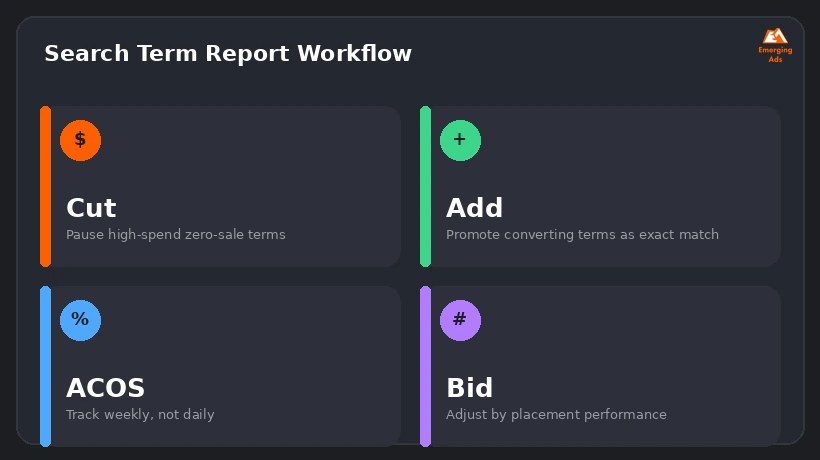
The search term report, showing the actual customer search queries that triggered your ads, is consistently one of the most underused tools in Amazon accounts we audit, despite being one of the highest-leverage habits available for improving ROAS. Reviewing it weekly and adding clearly irrelevant or poor-converting search terms as negative keywords prevents budget from continuing to leak toward searches that were never going to convert.
Beyond negating poor performers, the same report also surfaces genuine winners worth promoting, a broad or auto campaign search term converting well deserves to be pulled into its own dedicated exact match campaign with a correspondingly higher, more confident bid, rather than left to compete passively within the broader, lower-precision campaign it originated from.
Bid Strategy: Dynamic Bids, Placement Adjustments, and Dayparting
Amazon’s dynamic bidding options (down only, up and down) and placement bid adjustments (top of search, product pages, rest of search) offer meaningful control beyond a single flat bid per keyword. Reviewing placement performance specifically, since top-of-search placement often converts at a different rate and cost than product page placement, lets you allocate bid adjustments toward whichever placement is actually delivering the strongest ROAS for a given keyword.
‘Dynamic bids – down only’ is generally the safer default for a newer or less-monitored campaign, since it only reduces bids when a conversion seems less likely rather than actively raising them, while ‘up and down’ can meaningfully increase visibility for high-probability conversions but requires closer monitoring to avoid unexpectedly elevated spend on a keyword that briefly looked more promising than it actually was.
Dayparting, adjusting bids up or down by time of day or day of week based on historical conversion patterns, is a more advanced lever worth exploring once the foundational structure and negative keyword habits are solidly in place, since it requires enough historical data to reliably identify genuine performance patterns rather than reacting to short-term noise.
Sponsored Products vs Sponsored Brands vs Sponsored Display
Each of Amazon’s three main ad types serves a distinct role: Sponsored Products drives the bulk of direct, bottom-funnel conversion volume for most sellers and is usually the priority to optimize first. Sponsored Brands builds broader brand visibility and often supports multi-product consideration through its banner and video formats. Sponsored Display extends reach to both on and off Amazon placements, often used for retargeting shoppers who viewed but didn’t purchase, an audience already familiar with your product and often cheaper to reconvert than a cold prospecting campaign.
For a seller with a multi-product catalog, Sponsored Brands campaigns showcasing several related products together can meaningfully lift overall basket size and cross-sell rate in ways a single-product Sponsored Products campaign structurally can’t, making it worth testing even for a seller primarily focused on Sponsored Products for day-to-day ROAS management.
A common mistake is judging all three ad types against the same ROAS benchmark, when Sponsored Brands and Sponsored Display often serve a more top-of-funnel, brand-building role that naturally carries a different, sometimes lower, ROAS expectation than the highly targeted, bottom-funnel Sponsored Products campaigns driving most direct conversions.
Using Negative Keywords and Negative ASINs Effectively
Beyond standard negative keywords, Amazon also supports negative ASINs, excluding your ads from appearing on specific competitor or irrelevant product pages, useful when a particular competitor listing is generating clicks but consistently no conversions for your product. Building both a standing negative keyword and negative ASIN list, reviewed and expanded weekly, is one of the most consistent, low-risk ways to improve ROAS over time without touching bid amounts at all.
This kind of negative list-building compounds meaningfully over several months, an account with a mature, well-maintained negative list typically shows noticeably tighter, more efficient spend than a comparable account that’s never invested this ongoing attention, even when both are using otherwise similar bid strategies and campaign structures.
Common Mistakes That Quietly Drag Down ROAS
These issues rarely show up as a single dramatic failure, more often they accumulate quietly over months, each individually small but adding up to a meaningfully worse account than the one that would exist with disciplined, consistent attention.
- Blending match types within a single campaign, losing the precise bid control a separated structure provides
- Ignoring the search term report for weeks or months, letting irrelevant clicks quietly accumulate wasted spend
- Judging Sponsored Brands and Sponsored Display against the same ROAS benchmark as bottom-funnel Sponsored Products
- Increasing bids to chase visibility without first confirming the underlying listing converts well enough to justify the spend
- Never reviewing placement-level performance data, missing meaningful differences between top-of-search and product page conversion rates
A Realistic Weekly Optimization Routine
Consistency matters more than intensity here, a modest weekly routine applied reliably over several months consistently outperforms sporadic, intensive optimization sessions separated by long stretches of neglect.
- Review the search term report, adding clear non-converters as negative keywords and promoting strong performers to dedicated exact match campaigns
- Check placement-level performance and adjust bid modifiers for placements showing meaningfully different ROAS
- Review overall account ACOS/ROAS trend against target, flagging any campaign moving meaningfully out of range
- Spot-check listing quality (reviews, main image, pricing) against top competitors for your highest-spend products
How Inventory and Fulfillment Affect Advertising Performance
A frequently overlooked factor in Amazon ROAS is inventory health itself, running low on stock triggers Amazon to automatically reduce ad delivery and visibility for that listing, meaning a genuinely well-optimized campaign can appear to underperform simply because the underlying product is about to go out of stock. Reviewing inventory forecasts alongside advertising performance prevents misdiagnosing a supply chain issue as a targeting or bid problem, a mix-up that leads many sellers to needlessly restructure a perfectly healthy campaign.
Fulfillment method also plays a role, FBA (Fulfilled by Amazon) listings generally see stronger conversion rates than FBM (Fulfilled by Merchant) listings for otherwise comparable products, since Prime eligibility and Amazon’s fulfillment reliability genuinely influence purchase decisions. A seller comparing ROAS across a mixed FBA/FBM catalog should account for this structural difference rather than assuming any gap is purely an advertising execution issue.
Building a simple habit of checking projected days of inventory remaining alongside weekly advertising review catches this issue before it meaningfully impacts a campaign’s data, and it prevents the common mistake of increasing bids in response to declining performance when the real cause is an inventory constraint that increased bids won’t fix.
Attribution Windows and Why They Matter for Judging Performance
Amazon’s standard attribution window credits a sale to an ad click for a set period after that click, commonly 7 days for many product categories, meaning a purchase happening a few days after an ad click still counts as ad-attributed revenue in reporting. Understanding this window matters when judging a campaign’s true performance, since recent campaign changes may look worse than they actually are in the days immediately after a change, before the attribution window has had time to fully reflect the new performance pattern, a nuance that trips up even experienced advertisers new to the platform.
This also means comparing week-over-week performance too literally, without accounting for the attribution lag, can lead to premature conclusions about whether a recent bid or keyword change actually worked. Waiting for at least one full attribution cycle to pass before drawing firm conclusions produces considerably more reliable judgments than reacting to the first day or two of post-change data.
When ROAS Plateaus Despite Doing Everything Right
If campaign structure, negative keywords, and bid strategy are all solid but ROAS still plateaus below target, the underlying issue is frequently the listing itself, conversion rate, review velocity, pricing competitiveness, rather than anything further to optimize on the advertising side. At that point, the highest-leverage next step usually shifts from campaign management to listing optimization or a broader competitive repricing and review-generation strategy.
It’s worth resisting the temptation to keep tweaking campaign settings indefinitely once this plateau is genuinely reached, since further advertising-side changes at that point tend to produce diminishing, sometimes negative, returns compared to redirecting that same effort toward the listing-quality factors actually setting the ceiling on what’s achievable.
Want us to look at your account?
We’ll audit your setup and tell you exactly where the budget is leaking, free.
Get Your Free Ad AuditFrequently Asked Questions
What’s a good ROAS target for Amazon advertising?
This varies significantly by category and margin structure, a reasonable starting benchmark for many categories is a 3-4x ROAS (25-33% ACOS), though a higher-margin category can sustainably support a lower ROAS while a thin-margin category needs a considerably higher one.
How often should I check my Amazon search term report?
Weekly at minimum for an actively managed account, waiting longer risks accumulating meaningful wasted spend on search terms that were never going to convert for your specific product.
Should I separate my Sponsored Products campaigns by match type?
Yes, generally recommended, separating exact, phrase, and broad/auto into distinct campaigns gives considerably more precise bid control than blending match types within a single campaign.
Does organic ranking affect my paid ROAS?
Yes, indirectly but meaningfully, a listing with strong organic ranking and review credibility tends to convert paid traffic at a higher rate too, since shoppers often cross-reference an ad against the product’s overall standing before clicking or buying.
What’s the difference between negative keywords and negative ASINs?
Negative keywords exclude your ads from specific search terms, negative ASINs exclude your ads from appearing on specific product detail pages, both help prevent wasted spend on placements unlikely to convert for your specific product.
Should Sponsored Brands and Sponsored Display have the same ROAS target as Sponsored Products?
Not necessarily, these ad types often serve a more top-of-funnel, brand-building role and can reasonably carry a different ROAS expectation than the highly targeted, bottom-funnel role Sponsored Products typically plays.
How long does it take to see ROAS improve after optimizing a campaign?
Meaningful improvement from search term and negative keyword optimization is often visible within 2-4 weeks, while broader structural or bid strategy changes may take a bit longer to fully reflect in stable, reliable account-level ROAS data.
Is dayparting worth setting up for a smaller Amazon account?
It’s generally more valuable for accounts with enough historical data and traffic volume to identify genuine, reliable time-of-day performance patterns, a newer or lower-volume account may not yet have enough data for dayparting adjustments to be reliably informed.
Can a great advertising campaign compensate for a weak product listing?
Not fully, listing quality (images, reviews, pricing, copy) sets the practical ceiling on achievable conversion rate and therefore ROAS, no amount of campaign optimization can fully overcome a genuinely weak underlying listing.
What’s the single highest-leverage habit for improving Amazon ROAS?
A consistent weekly search term report review, adding clear non-converters as negative keywords and promoting genuine winners to dedicated exact match campaigns, tends to produce the most reliable, compounding ROAS improvement over time relative to the effort involved.
Ready to fix what’s costing you conversions?
Book a free, no-pressure audit of your ad account or website.
Get Your Free Ad Audit