The short answer
To lower cost per click in Google Ads, improve the parts of Ad Rank you control other than the bid: raise Quality Score with tighter ad groups, more relevant ads and better landing pages, add assets such as sitelinks and callouts, cut irrelevant traffic with negative keywords and tighter match types, and move budget towards the hours, locations, devices and long-tail keywords where clicks are cheaper. Then check that a lower CPC is not costing you conversions, because the cheapest click is rarely the cheapest customer.
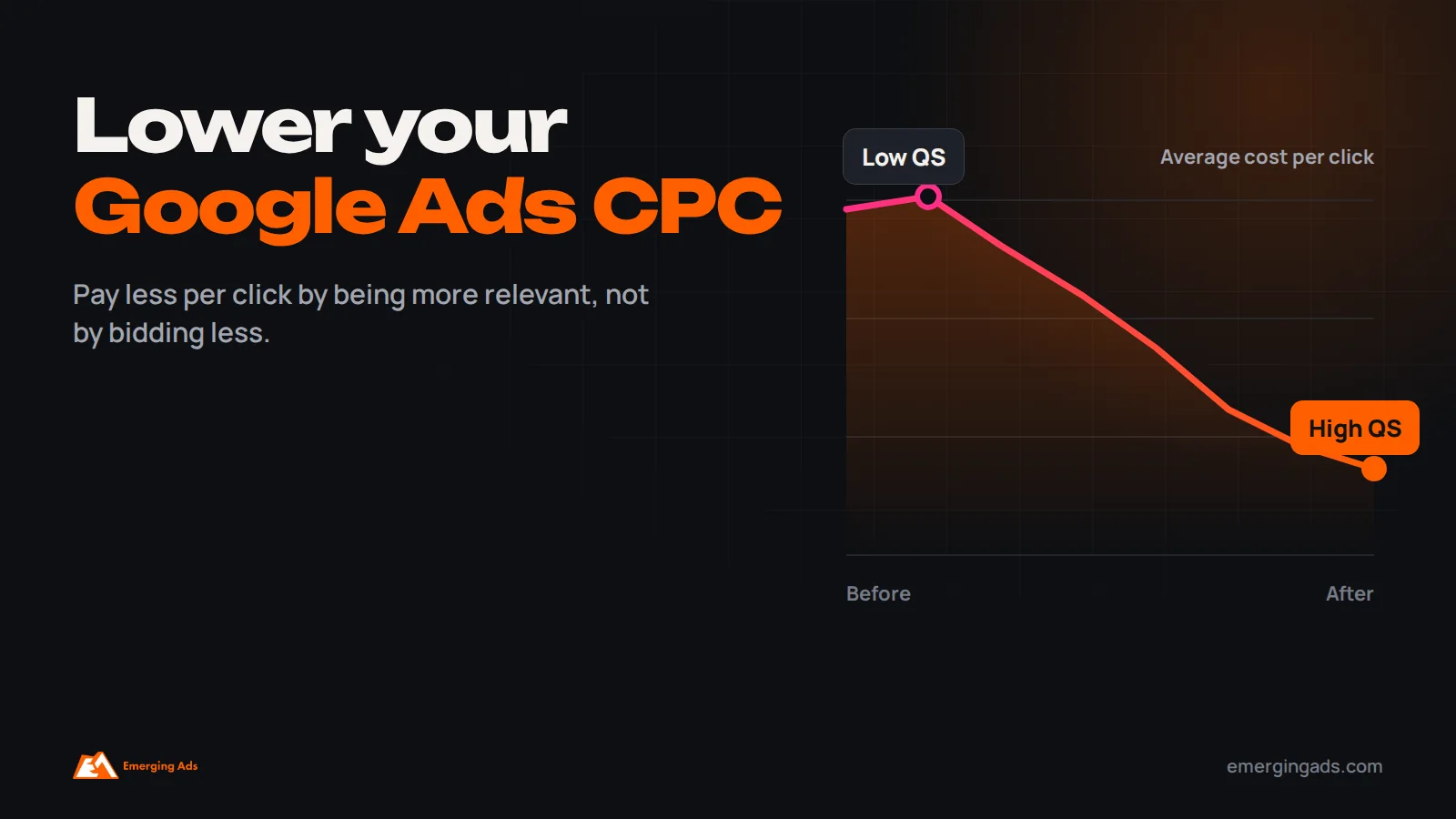
Cost per click is the number most people look at first when Google Ads feels expensive. It is visible, easy to compare and seems simple to fix: bid less, pay less. In practice, cutting bids is usually the least effective way to lower CPC, because it also lowers your position, your click-through rate and often your Quality Score, which pushes CPC back up.
Google does not simply charge the highest bidder. It runs an auction where your bid is only one input. The others, which Google groups under ad quality, relevance and context, are largely in your control, and improving them is how accounts genuinely pay less for the same clicks.
This guide explains how Google decides what you pay, the changes that lower CPC without losing good traffic, a realistic 30-day plan and how to tell when chasing a lower CPC is the wrong goal. If your main concern is cost per acquisition rather than cost per click, our companion guide on lowering Google Ads CPA without cutting budget covers the conversion side.
How Google decides what you pay per click
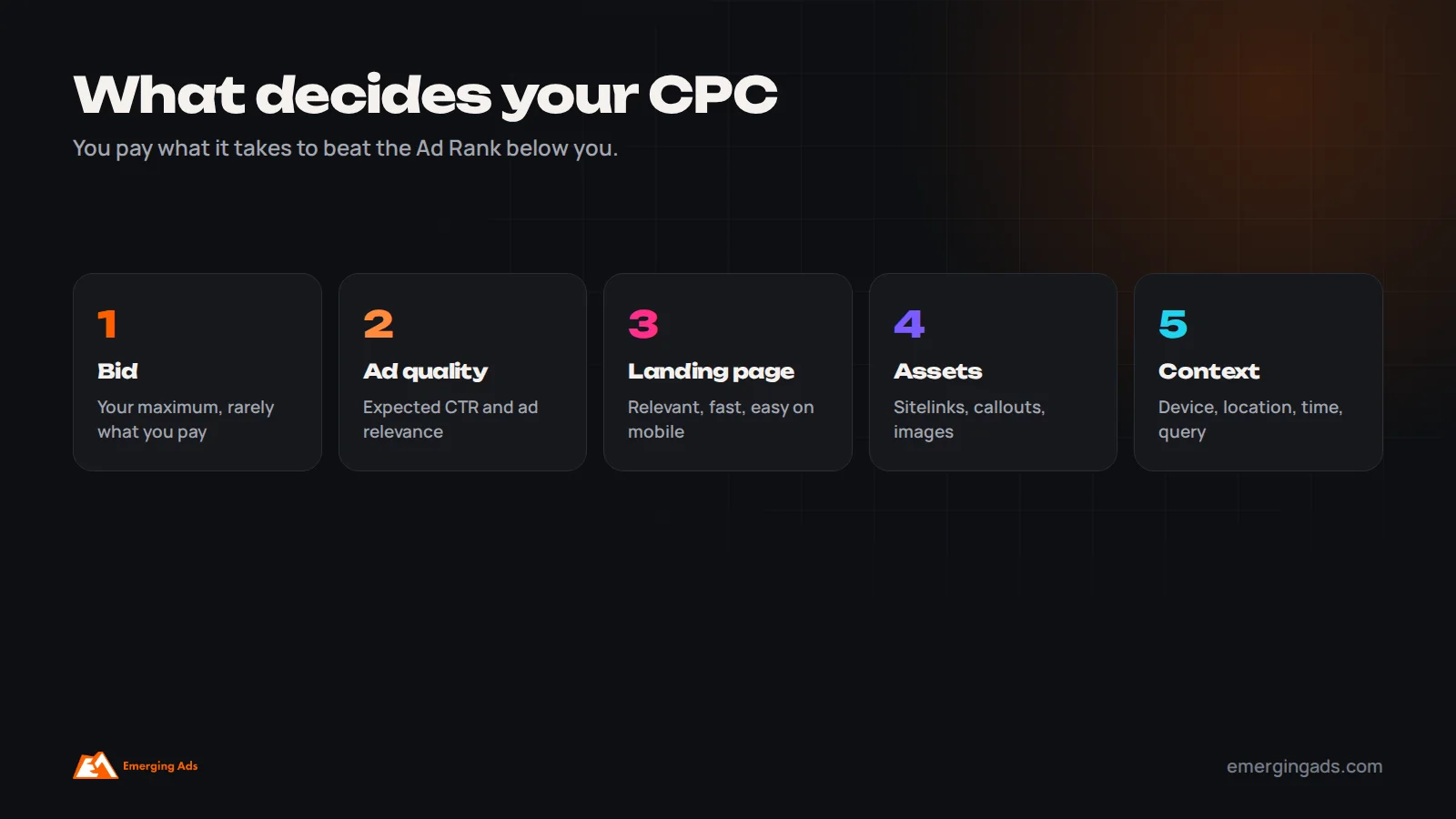
Every time someone searches, Google runs an auction among eligible ads. It calculates an Ad Rank for each one, which decides whether the ad shows and in what position. Ad Rank combines your bid with the quality of your ad and landing page, the expected impact of your assets such as sitelinks, the context of the search, including device, location and time, and Ad Rank thresholds, the minimum quality an ad needs to show in a given position.
What you actually pay is usually less than your maximum bid. Broadly, you pay what is needed to beat the Ad Rank of the advertiser below you. That is the key point: if your ad quality is higher, you need a lower bid to hold the same position, so you pay less per click. Two advertisers in the same position can pay very different amounts for the same click because of quality alone.
This is why “bid less” is a blunt tool. “Be more relevant” is the precise one.
Why CPC alone is the wrong starting point
Before lowering CPC, it is worth being clear on what you are trying to achieve. A campaign with a €0.80 average CPC that converts at 1% costs €80 per customer. A campaign with a €2.50 CPC that converts at 8% costs about €31 per customer. The more expensive click is the cheaper customer by a wide margin.
The goal is not the lowest possible CPC. It is the lowest CPC you can get for clicks that convert. Every tactic below should be judged on that basis: if a change lowers CPC but conversions fall faster, it has made things worse.
Fix Quality Score before touching bids
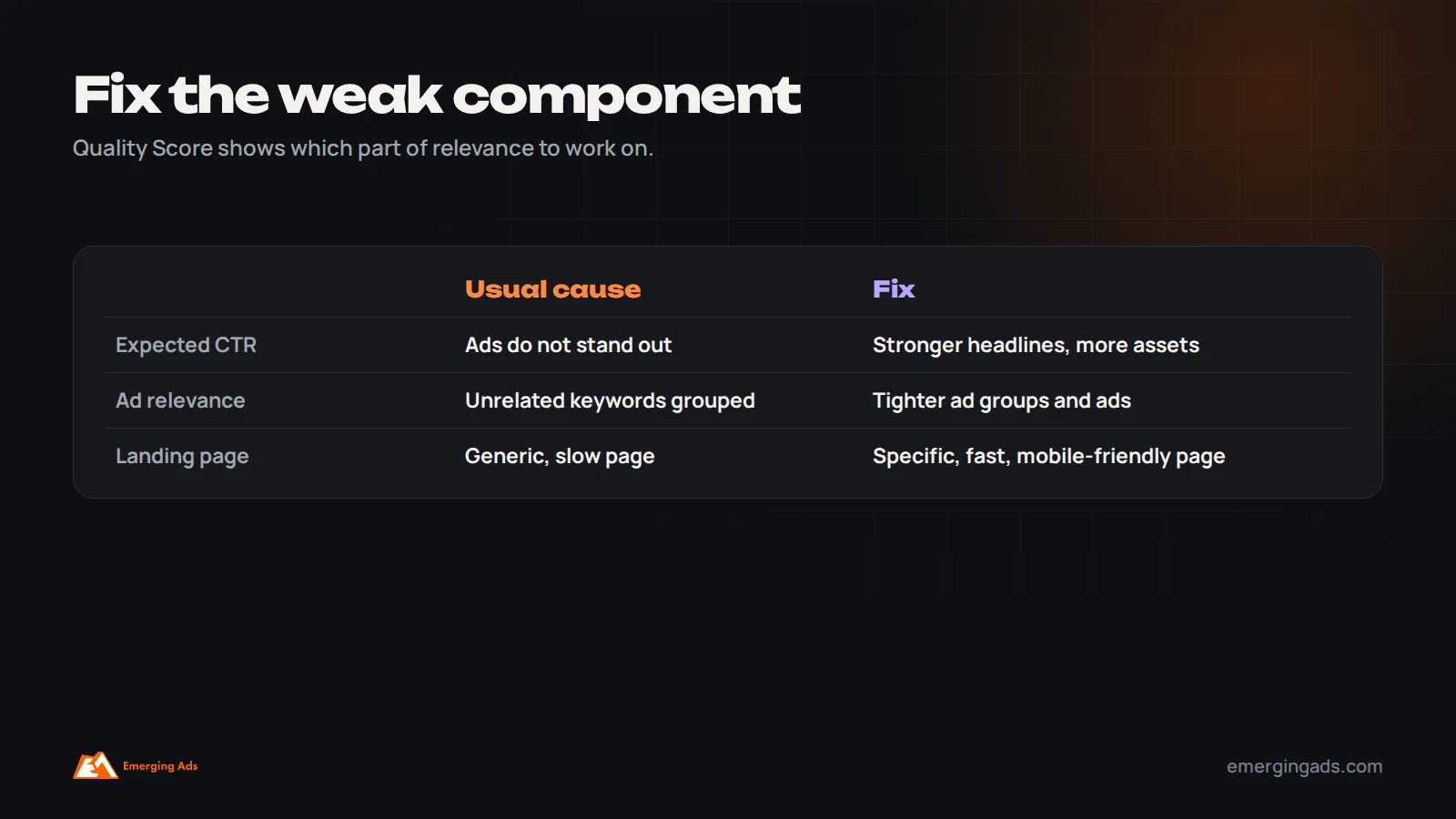
Quality Score is Google’s 1 to 10 diagnostic rating for each keyword. It is not used directly in the auction, but it reflects the same factors that are: expected click-through rate, ad relevance and landing page experience. Keywords with higher Quality Scores generally pay less for the same position.
As a rough guide, 7 or above is strong, 5 to 6 is average with room to improve, and 4 or below usually has a specific, fixable cause. You can see each component in Google Ads by adding the Quality Score, Expected CTR, Ad relevance and Landing page experience columns to the keywords view. Each is rated below average, average or above average.
| Component rated below average | Usual cause | Fix |
|---|---|---|
| Expected CTR | Ads do not stand out or do not match the search | Stronger headlines that repeat the search terms, clearer offers, more assets |
| Ad relevance | Keyword grouped with unrelated keywords | Split into tighter ad groups with ads written for that theme |
| Landing page experience | Page does not match the search, is slow or hard to use on mobile | Send traffic to a specific, fast page that answers the search |
Start with your highest-spending keywords. Raising Quality Score on the ten keywords that take most of your budget usually lowers average CPC far more than tidying up hundreds of small ones.
Tighten ad groups so ads can be specific
A common structural problem is twenty or thirty loosely related keywords in one ad group, served by two or three generic ads. When someone searches “waterproof hiking boots for women” and sees an ad that says “Shop Outdoor Footwear”, relevance and click-through rate both suffer.
The old approach of single keyword ad groups made sense before automated bidding and responsive search ads. Today, we usually build tight thematic groups of closely related keywords that share the same intent, so each group’s ads can use the searcher’s language. “Waterproof hiking boots women” and “women’s waterproof walking boots” belong together. “Hiking boots for kids” does not.
Within each group, use responsive search ads with headlines that include the main keyword theme, the key benefit, proof such as reviews or years in business, and a clear call to action. Pin a keyword-rich headline to the first position only if testing shows it helps, because pinning reduces the combinations Google can test.
Tighten match types and build real negative keyword lists
Broad match can find valuable searches, but without guardrails it also buys clicks on searches that are loosely related at best. Those clicks have low click-through rates and poor conversion rates, which drags down quality signals and wastes budget.
- Review search terms weekly for new accounts and monthly once stable. Sort by cost, and look for repeated words that never convert.
- Add negatives as patterns, such as “free”, “jobs”, “salary”, “course”, “DIY”, “used”, “cheap” if you are premium, or competitor names if you do not target them.
- Use shared negative keyword lists at account level so every campaign benefits.
- Use phrase and exact match for proven keywords, and keep broad match for a separately budgeted discovery campaign once negatives are in place.
Better relevance means higher click-through rate, which feeds expected CTR, which lowers CPC. It also stops paying for clicks that should never have happened.
Use assets to win clicks without paying more
Assets, previously called extensions, add sitelinks, callouts, structured snippets, images, prices, calls and more to your ads. Google factors their expected impact into Ad Rank, and they make ads larger and more useful, which usually raises click-through rate.
At a minimum, every search campaign should have four or more sitelinks to genuinely useful pages, several callouts covering benefits such as free delivery or same-day service, structured snippets listing services or product types, and image assets where eligible. Location and call assets help local businesses. Keep assets accurate and specific to each campaign where it makes sense.
Fix the landing page before blaming the bid
Landing page experience is one of the three Quality Score components, and it also decides how many of the clicks you buy actually convert. Google looks at relevance to the search, transparency and trustworthiness, and ease of navigation, especially on mobile.
Send each ad group to the most specific page available. A search for “emergency boiler repair” should land on an emergency boiler repair page with a phone number at the top, not the homepage. Make sure the page loads quickly on a mid-range phone, the headline repeats the promise of the ad, and the next step is obvious. If your site lacks specific pages, building a few dedicated landing pages for paid traffic often pays back quickly.
Choose the right bidding strategy for your account’s stage
Bidding strategies affect CPC differently, and the right one depends on how much conversion data you have.
- Manual CPC gives direct control over the maximum you pay per click. Useful for new accounts with little data, or for precise control on a few high-value keywords.
- Maximize clicks spends the budget to get as many clicks as possible, and lets you set a maximum CPC limit. It can lower CPC but often buys the cheapest, least valuable clicks. Use it carefully, with a bid cap.
- Maximize conversions and target CPA bid higher for clicks likely to convert and lower for others. Average CPC may rise, but cost per conversion should fall. They need reliable conversion data to work well.
- Target impression share aims for a set visibility level and can push CPC up sharply. Use it mainly for brand campaigns, with a maximum CPC limit.
Conversion-based strategies need enough data, roughly 30 or more conversions in 30 days in our experience, before they optimize reliably. Give them two to three weeks after a change before adjusting targets.
Use schedule, location and device data to cut waste
Clicks cost different amounts at different times, in different places and on different devices, and they convert differently too. Segment your data by hour of day, day of week, location and device, over at least 30 to 90 days.
- If clicks between midnight and 6am cost the same but rarely convert, reduce or pause them.
- If certain cities or regions have high CPC and low conversion rates, lower bids there or exclude them.
- Check the location setting. By default, Google can show ads to people interested in your target area, not only those in it. For local businesses, switching to people in or regularly in your locations often cuts wasted clicks.
- If mobile clicks cost less but convert poorly because the mobile site is weak, fix the site before adjusting bids.
On Smart Bidding, Google already adjusts for many of these signals automatically. Use the data to diagnose problems and set exclusions, rather than layering heavy manual adjustments on top.
Watch the cost of mobile and desktop separately
In many accounts, mobile clicks are cheaper but convert at a lower rate, while desktop clicks cost more and convert better, especially for B2B services and high-ticket products. The blended average CPC hides this. Segment by device and compare cost per conversion, not CPC. If mobile converts poorly because forms are long or pages load slowly, improving the mobile experience is usually worth more than any bid adjustment. If one device genuinely does not convert for your business, a device bid adjustment or exclusion on manual bidding strategies can stop paying for clicks that never turn into customers.
Check your networks and placements
New search campaigns often include the Search Partner network and sometimes the Display network by default. Search partners can be useful, but they sometimes deliver cheaper clicks that convert poorly, which lowers average CPC on paper while hurting results. Display inclusion in search campaigns very often produces low-quality clicks. Segment results by network, and switch off what does not perform. Display campaigns have their own CPC levers, covered in our guide on lowering CPC on Google Display ads.
Lean into long-tail keywords
Short, generic keywords such as “shoes” or “accountant” attract the most competition and the highest CPCs, and their intent is often vague. Longer, more specific searches such as “wide fit leather work shoes men” or “small business accountant for ecommerce” usually have lower CPC, less competition and higher conversion rates because the searcher knows exactly what they want.
Use the search terms report and keyword research tools to find long-tail terms that already convert, then give them their own ad groups with specific ads and landing pages. Our guide to doing keyword research yourself shows how to find them.
How competitors affect your CPC
Your CPC depends partly on what other advertisers do. When a competitor raises bids, enters the market or launches a seasonal push, CPCs for shared keywords rise, even if nothing changed in your account.
The auction insights report shows which competitors appear alongside you, how often they outrank you and how their impression share changes over time. If CPC jumps suddenly, check auction insights before changing anything. A temporary competitor surge may be worth waiting out, while a permanent new competitor may mean shifting budget towards terms where you have a stronger position.
Seasonality matters too. CPCs in many retail categories rise sharply in the weeks around Black Friday and Christmas, and in some markets around Ramadan, Diwali or other major shopping periods. Plan budgets and expectations around these peaks rather than reacting to them.
Brand campaigns deserve special attention. If competitors bid on your brand name, your brand CPCs rise. Strong Quality Scores on your own brand terms, which are usually naturally high, keep those costs manageable.
Separate brand and non-brand campaigns
Brand keywords, searches for your business name, typically have very low CPCs and high conversion rates. Mixing them with non-brand keywords hides what you are really paying to win new customers. Keep brand in its own campaign with its own budget, so you can see the true average CPC and cost per conversion for non-brand traffic, which is where most improvement happens.
Common mistakes that keep CPC high
- Cutting bids across the board, which lowers position and click-through rate, and often Quality Score.
- Large ad groups with generic ads.
- Sending every click to the homepage.
- Few or no assets.
- Broad match without negative keywords.
- Leaving Display or poorly performing search partners switched on.
- Target impression share without a maximum CPC limit.
- Making changes daily, so nothing has time to settle.
A realistic 30-day plan to lower CPC
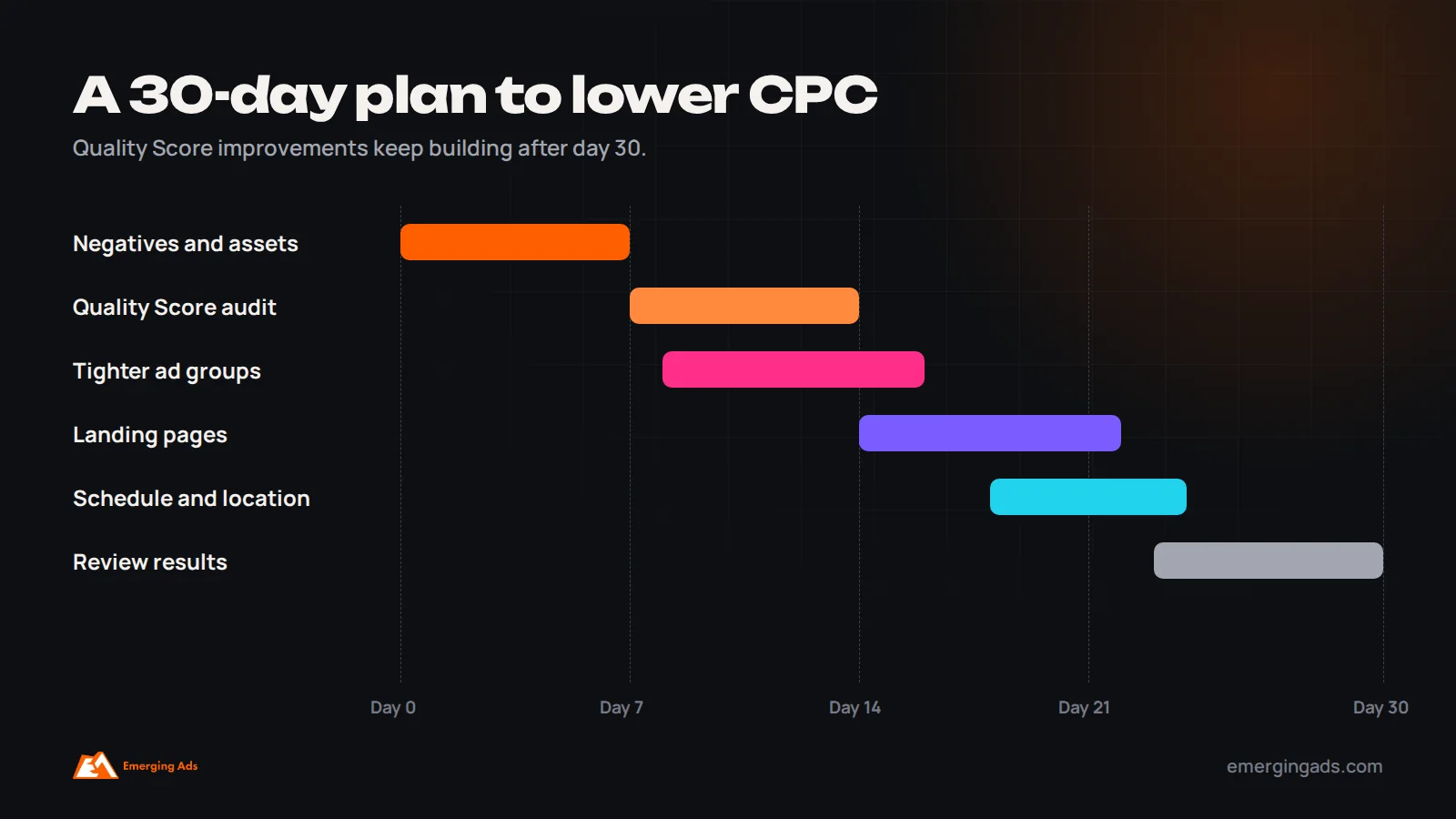
- Week 1: separate brand from non-brand, review search terms and add negative keyword lists, check network settings and location options, and add missing assets.
- Week 2: add Quality Score columns, identify the highest-spending keywords with below-average components, and split their ad groups into tighter themes with specific ads.
- Week 3: point those ad groups at the most specific landing pages, fix mobile speed problems, and review schedule and location data for clear waste.
- Week 4: review results against the starting point, looking at CPC, click-through rate, conversion rate and cost per conversion together. Keep what worked, and plan the next round.
Quality Score components can take a few weeks to update after changes, so expect improvements to build over the following month rather than appear overnight.
What is a good CPC?
It depends heavily on industry, market and competition. Legal, insurance, finance and some B2B services can have CPCs many times higher than ecommerce or local services. Comparing your CPC to a general average tells you little. Compare it to your own history, your conversion rate and what a customer is worth to you. Our breakdown of Google Ads conversion rates by industry gives useful context for the conversion side.
As a real example of how low CPC can go when relevance is high, our NetNutri supplements account runs at an average of $0.46 per click on Shopping and Performance Max, because shoppers search for exact products and the feed matches them closely.
When a lower CPC is not the right goal
Sometimes paying more per click is the right move. If a keyword converts very well and you are losing impression share to competitors, raising bids to win more of those clicks can lower overall cost per customer. If you are launching into a competitive market, accepting a higher CPC for a period may be the price of gathering data. And conversion-based bidding strategies will deliberately pay more for clicks they predict will convert.
Always step back and ask whether cost per conversion and conversion volume are moving in the right direction. CPC is a means, not the goal.
If you would like your account reviewed, our Google Ads audit covers Quality Score, structure, search terms, assets and landing pages, and our search ads management team handles ongoing optimization. You can also start with a free ad audit.
Frequently asked questions
How can I lower my cost per click on Google Ads?
Improve Quality Score with tighter ad groups, more relevant ads and better landing pages, add assets, cut irrelevant traffic with negative keywords and tighter match types, and focus budget on long-tail keywords, locations and times that perform well.
Does Quality Score affect CPC?
Quality Score is a diagnostic, but it reflects the same factors used in the auction: expected click-through rate, ad relevance and landing page experience. Improving those generally lowers what you pay for the same position.
What is a good Quality Score?
7 or above is generally strong, 5 to 6 is average with room to improve, and 4 or below usually points to a specific fixable issue with relevance or the landing page.
Why is my Google Ads CPC so high?
Common reasons are low ad quality and relevance, broad keywords with heavy competition, competitors bidding more, poor landing pages, missing assets and bidding strategies such as target impression share without a bid cap.
Will lowering my bids reduce CPC?
It can, but it also tends to lower your position and click-through rate, which can reduce traffic and quality signals. Improving relevance usually lowers CPC more sustainably.
Which bidding strategy gives the lowest CPC?
Manual CPC or Maximize clicks with a bid cap usually produce the lowest CPC, but not always the lowest cost per conversion. Conversion-based strategies may pay more per click for clicks more likely to convert.
How long does it take to lower CPC?
Negative keywords and network changes take effect within days. Quality Score improvements from ad group and landing page changes usually take a few weeks to show in CPC.
Do ad assets lower CPC?
They can. Google considers the expected impact of assets in Ad Rank, and assets usually raise click-through rate, which supports better quality signals and lower costs.