How to Lower Cost Per Click With Google Display Ads

Key Takeaways
- Placement exclusions usually cut wasted spend faster than any bid adjustment.
- Display CPC is heavily influenced by creative quality, not just targeting.
- Broad automated targeting needs a placement review every single week for the first month.
- Frequency capping protects CPC by preventing the algorithm from over-serving the same few users.
- Video and native ad formats often out-CPC static banners on the same budget.
Why Display CPC Behaves Differently Than Search
On Search, cost per click is mostly a function of keyword competition and Quality Score. On Display, it’s a function of where your ad actually shows up. The Google Display Network spans millions of sites and apps, and a huge share of that inventory is low-quality placements: apps built purely to generate ad clicks, content farms, and sites with almost no real engagement. Until you actively manage where your ads run, you’re paying display-network-average CPC for placements that should never have gotten your budget in the first place.
Placement Exclusions: The Fastest Lever
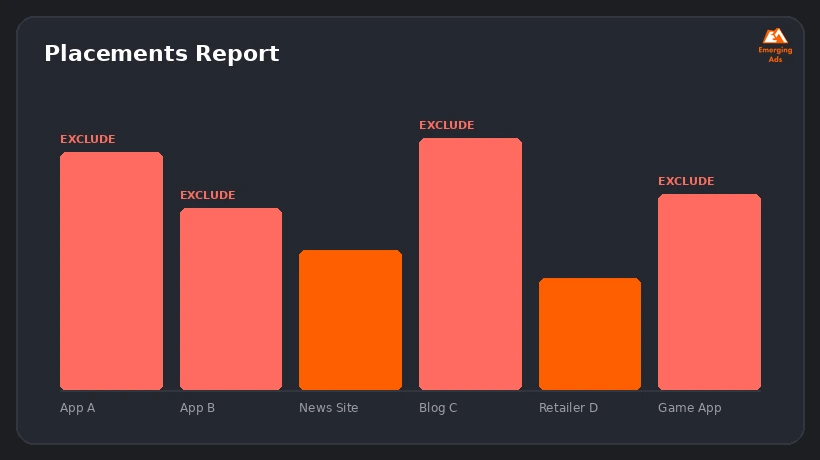
Pull the Placements report under Insights and Reports for any campaign that’s been running more than a week. Sort by clicks and look at conversion rate next to each placement. You’ll almost always find a handful of apps or sites eating a disproportionate share of spend with near-zero conversions.
- Exclude mobile app categories wholesale if your product isn’t app-native (Google lets you exclude entire app categories, not just individual apps)
- Add a placement exclusion list at the account level so every new campaign inherits it
- Review placements weekly for the first month of any new campaign, then monthly once patterns stabilize
- Watch for placements with unusually high click-through rate but no conversions, that’s often accidental-click inventory
Fixing Targeting Before Touching Bids
Narrow Before You Broaden
It’s tempting to let Google’s automated audience expansion run wide to gather data faster, but on Display that usually means paying to reach people with no real signal of interest. Start with first-party remarketing lists and tightly defined in-market or affinity audiences, then expand only once you can see which audience segments are actually converting at an acceptable cost.
Set Frequency Caps Early
Without a frequency cap, the algorithm can serve the same user your ad dozens of times in a week. Each additional impression to a user who isn’t converting still costs money and drags your effective CPC up. A cap of 3-5 impressions per user per week is a reasonable starting point for most campaigns.
Creative Changes That Actually Move CPC
Display CPC responds to ad relevance the same way Search CPC responds to Quality Score, just less visibly. Ads with clear, legible text, a obvious call to action, and creative that matches the audience segment consistently earn lower CPCs than generic banner templates.
- Run at least 3-5 creative variants per ad group so the algorithm can find what resonates
- Use Responsive Display Ads with multiple headline and description combinations rather than a single static banner
- Match creative messaging to the funnel stage of the audience, cold prospecting creative should look different from remarketing creative
- Refresh creative every 4-6 weeks to avoid ad fatigue pushing CPC back up
Bid Strategy Choices That Help or Hurt
Manual CPC gives you the most control but requires constant attention. Target CPA and Maximize Conversions automated strategies can lower effective CPC over time once they have enough conversion data, typically after 30-50 conversions, but they need a realistic target and a clean conversion tracking setup to work well. Switching bid strategies too frequently resets the learning phase and usually makes CPC worse before it gets better, so pick one and give it at least two to three weeks before judging results.
Want us to look at your account?
We’ll audit your setup and tell you exactly where the budget is leaking, free.
Get Your Free Ad AuditFrequently Asked Questions
What’s a good CPC for Google Display Ads?
It varies enormously by industry and audience, but Display CPC is typically a fraction of Search CPC in the same account. Judge performance against your own historical baseline and conversion rate rather than an industry-wide number.
Why is my Display CPC higher than my Search CPC?
This usually points to poor targeting or low-quality placements rather than the network itself. Review your placement report and audience settings before assuming Display is inherently more expensive for your account.
Should I exclude mobile apps from Display campaigns entirely?
For most non-app businesses, yes, excluding low-quality app inventory categories is one of the highest-leverage changes you can make. Test it as a controlled change and watch conversion rate, not just CPC.
How often should I review placement exclusions?
Weekly for the first month of a new campaign, then monthly once your exclusion list has stabilized and spend patterns are consistent.
Does ad size affect CPC on the Display Network?
Indirectly. Certain sizes have more available inventory and lower competition, which can affect the auction dynamics, but relevance and targeting matter more than size alone.
Can Smart Bidding lower my Display CPC automatically?
It can, once it has enough conversion data to optimize against. Give it 30-50 conversions and two to three weeks before adjusting targets.
Is remarketing cheaper than prospecting on Display?
Generally yes, since you’re targeting users who already know your brand, which tends to produce higher click-through and conversion rates at a lower effective CPC.
What’s the minimum budget to see meaningful Display Ads data?
Enough to generate at least a few hundred clicks across your placements within a couple of weeks, otherwise you’re making decisions on too small a sample.
Do frequency caps hurt reach?
They limit how many times the same person sees your ad, which can slightly reduce total impressions, but it protects budget from being wasted on users who’ve already decided not to click.
Should I run Display and Search from the same campaign?
No, keep them separate. They have different auction dynamics, bidding behavior, and reporting needs, combining them makes optimization harder for both.
Ready to fix what’s costing you conversions?
Book a free, no-pressure audit of your ad account or website.
Get Your Free Ad Audit