Best E-Commerce Marketing Agency Singapore

Key Takeaways
- Singapore e-commerce marketing retainers typically run SGD 1,800-SGD 10,000+ a month, with pricing shaped heavily by whether marketplace management (Shopee, Lazada) is included alongside a brand’s own DTC channel
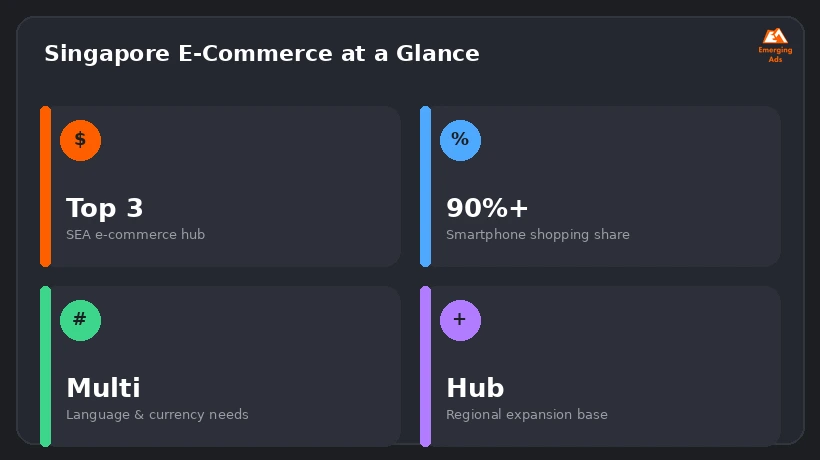
- Singapore functions as a genuine regional hub for Southeast Asia, and the strongest agencies here can speak to expansion into Malaysia, Indonesia, and the broader ASEAN market, not just the domestic Singapore audience
- PDPA (Singapore’s Personal Data Protection Act) governs how customer data can be collected and used in marketing, and compliance should be built into campaign setup from the outset
- Singapore’s multi-ethnic, multilingual population (English, Mandarin, Malay, Tamil widely spoken) means audience segmentation often benefits from language-aware targeting beyond a single English-only campaign
- Marketplace-first selling (Shopee and Lazada dominate much of Singapore’s e-commerce volume) means an agency’s marketplace advertising and optimization expertise matters as much as, or more than, standalone Google/Meta ads skill
Why Singapore Is a Regional E-Commerce Hub, Not Just a Local Market
Singapore punches well above its population size in e-commerce importance, not just because its own domestic market is affluent and digitally sophisticated, but because the city-state functions as a genuine regional headquarters and logistics hub for Southeast Asian e-commerce more broadly. Many brands that start marketing in Singapore are, whether they realize it immediately or not, laying the groundwork for a much larger ASEAN expansion.
This dual role changes what to look for in an agency. A Singapore-only specialist may miss opportunities to build campaign infrastructure that scales naturally into Malaysia, Indonesia, Thailand, and Vietnam, while an agency with only broad Southeast Asia experience and no genuine Singapore-specific depth may miss the nuances, higher digital ad costs, more sophisticated consumer expectations, stronger data privacy enforcement, that make Singapore itself a distinct market from its regional neighbors.
Typical Pricing for Singapore E-Commerce Marketing
| Service | Typical Monthly Range (SGD) |
|---|---|
| PPC management (Google/Meta) | SGD 1,800-SGD 5,000 + ad spend |
| Marketplace management (Shopee/Lazada) | SGD 1,500-SGD 5,000 |
| Full-service (PPC + marketplace + SEO) | SGD 4,000-SGD 10,000+ |
| SEO only | SGD 1,500-SGD 4,000 |
Singapore’s advertising costs (CPCs and CPMs) run higher than most of its regional neighbors, reflecting the market’s affluence and competitiveness, closer to Western metro pricing than to Southeast Asian averages more broadly. Businesses budgeting based on generic Southeast Asia benchmarks often underestimate what’s needed to compete effectively in Singapore specifically.
Marketplace-First Selling: Shopee, Lazada, and Beyond
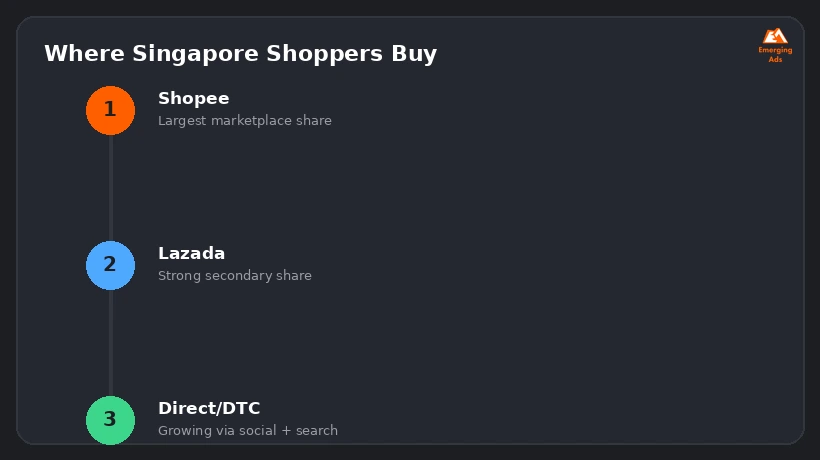
A meaningful share of Singapore’s e-commerce activity happens on marketplaces rather than standalone DTC websites, Shopee and Lazada in particular dominate for many product categories. This means marketplace advertising and store optimization expertise is often as important as, or more important than, traditional Google and Meta ads skill for a Singapore e-commerce brand.
- Shopee and Lazada each have their own internal advertising systems (Shopee Ads, Lazada Sponsored Discovery), distinct from Google and Meta, requiring dedicated platform-specific expertise
- Marketplace algorithm ranking factors (store rating, response time, fulfillment speed) affect organic marketplace visibility separately from paid ads, and a strong agency should address both
- Running a DTC website alongside marketplace presence requires careful thought about pricing consistency and where to direct paid traffic, since marketplaces take a commission that a direct site doesn’t
- Livestream commerce, popular on both Shopee and TikTok in Singapore and the broader region, has become a meaningful sales channel worth discussing with a prospective agency
PDPA Compliance for E-Commerce Marketing
Singapore’s Personal Data Protection Act (PDPA) governs how businesses can collect, use, and disclose personal data, including for marketing purposes. This affects email marketing consent, retargeting audience building, and how customer data collected at checkout or through loyalty programs can be used for future campaigns.
An agency working with Singapore e-commerce brands should be able to speak confidently to PDPA-compliant data handling practices, not treat this as a generic GDPR-adjacent afterthought. While PDPA shares some principles with GDPR, it has its own specific requirements and enforcement body (the Personal Data Protection Commission), and compliance should be built into campaign and CRM setup from the start.
Reaching Singapore’s Multilingual Audience
Singapore’s population is genuinely multilingual and multi-ethnic, with English as the primary business language but Mandarin, Malay, and Tamil all widely spoken and, for meaningful segments of the population, preferred for certain kinds of content and messaging. A campaign running exclusively in English may be missing real engagement opportunities with Mandarin-speaking or Malay-speaking segments of the audience, particularly for certain product categories and older demographics.
- Consider Mandarin-language creative for categories where Chinese Singaporean consumers, a majority of the population, show strong preference for content in that language, especially around festive shopping periods
- Malay-language content can meaningfully improve engagement with the Malay Singaporean community for relevant product categories and cultural moments
- English remains the safe default for broad campaigns, but testing language-specific variants for underperforming segments is a relatively low-cost way to find incremental gains
- Cultural and festive calendar awareness (Chinese New Year, Hari Raya, Deepavali, alongside Western holidays) should shape campaign timing and creative, not just a generic year-round approach
Using Singapore as a Base for ASEAN Expansion
Many brands that succeed in Singapore look to expand into Malaysia, Indonesia, Thailand, Vietnam, and the Philippines, drawn by much larger population bases even where average order values are lower. An agency with genuine regional Southeast Asia experience can help structure this expansion thoughtfully rather than simply copy-pasting the Singapore playbook into markets with very different price sensitivity, payment method preferences, and marketplace dynamics.
| Market | Key Consideration vs. Singapore |
|---|---|
| Malaysia | Similar marketplace dynamics, lower average order values, price sensitivity higher |
| Indonesia | Much larger population, different dominant marketplaces and payment methods (e-wallets) |
| Thailand/Vietnam | Language localization essential, different social platform preferences |
Building Trust With Singapore’s Discerning Shoppers
Singapore consumers are among the most digitally sophisticated shoppers globally, high smartphone penetration, near-universal internet access, and genuine familiarity with comparing options across multiple platforms before buying. This sophistication means marketing that relies on gimmicks or exaggerated claims tends to be quickly identified and discounted, while marketing grounded in clear, verifiable information about product quality, seller reliability, and fulfillment builds trust more durably.
Store and seller ratings on marketplaces carry particular weight here, since Shopee and Lazada both surface rating and review data prominently in search and browsing, meaning marketplace reputation management is functionally a marketing activity, not just a customer service one. A consistently high store rating and fast response time to buyer questions directly influences organic marketplace visibility and conversion, independent of any paid advertising spend.
This is one of the areas where a genuinely local agency team tends to outperform a generalist one managing Singapore as a side market. Understanding the specific cadence of buyer expectations here, how quickly a question typically needs answering, what response tone reads as professional versus overly casual, comes from real, ongoing experience with this specific customer base rather than a generic playbook applied uniformly across several very different Southeast Asian markets at once.
- Actively monitor and respond to marketplace reviews and buyer questions promptly, this affects both trust signals and, on some platforms, organic ranking
- Maintain consistent product information and pricing across your DTC site and marketplace listings, discrepancies erode trust quickly with comparison-savvy shoppers
- Highlight fulfillment speed and reliability prominently where it’s a genuine strength, Singapore consumers weight this heavily in purchase decisions
- Consider third-party verification or certification badges where relevant to your category, these carry real weight with a shopper base that actively researches before buying
Common Mistakes Brands Make in the Singapore Market
A frequent misstep we see is brands entering Singapore with a marketing strategy built entirely around a Western DTC playbook, heavy reliance on a standalone website and Meta/Google ads, while underinvesting in marketplace presence where a substantial share of actual purchase volume happens. This often shows up as strong website traffic but disappointing conversion relative to competitors who’ve built genuine marketplace authority alongside their own site.
The fix isn’t necessarily abandoning the DTC website, which still matters for margin and long-term brand equity, but rebalancing effort and budget so marketplace presence gets the dedicated attention this market’s actual purchase behavior warrants, rather than treating it as a secondary channel bolted onto a website-first strategy imported from elsewhere.
- Underinvesting in marketplace store setup and optimization while over-indexing on a standalone website that Singapore shoppers may never actually purchase from
- Applying a single regional Southeast Asia budget and strategy uniformly, without accounting for Singapore’s higher costs and more sophisticated audience expectations
- Ignoring the multicultural, multilingual nature of the audience and running English-only creative across the board, even where language-specific variants would likely perform better
- Underestimating how much weight marketplace ratings and reviews carry, and treating reputation management as separate from, rather than integral to, the marketing strategy
Livestream Commerce and Social Selling
Livestream commerce has moved from a novelty to a genuine, meaningful sales channel across Singapore and the broader Southeast Asian region, with both Shopee Live and TikTok Shop supporting real-time selling formats where hosts demonstrate products, answer questions, and drive immediate purchases during the stream itself. Categories like beauty, fashion, and home goods have seen particularly strong livestream adoption.
This channel requires a genuinely different content and talent approach than static product photography or pre-recorded video, a comfortable, knowledgeable host who can handle live audience questions and maintain energy over an extended session matters more than production polish. Brands new to livestream commerce often underestimate the operational lift involved, regular scheduling, consistent hosting, and active community management during the stream, rather than treating it as a one-off experiment.
It’s worth budgeting for this channel separately from standard paid media, since the return often comes less from any single session and more from the compounding effect of a recognizable, returning host building a loyal viewer base over weeks and months. Brands that treat their first two or three livestreams as a fair test and abandon the format too early frequently miss the point where the channel starts to genuinely pay off.
- Start with a consistent, modest livestream schedule (weekly, for instance) rather than a single high-production one-off event, consistency builds an audience that returns
- Identify or train a host who’s comfortable improvising and engaging with real-time comments, this matters more than scripted perfection
- Use livestream sessions to showcase products in genuine use, answering the practical questions a static product page can’t anticipate
- Track livestream-specific metrics (concurrent viewers, conversion during stream, repeat viewer rate) separately from broader marketplace analytics to understand this channel’s specific contribution
Questions to Ask a Singapore E-Commerce Agency
- What’s your experience with Shopee and Lazada advertising specifically, not just Google and Meta
- How do you handle PDPA compliance for email marketing and retargeting audience building
- Can you show results for a Singapore-based brand in my specific category and size
- If regional expansion is a goal, what’s your experience running campaigns across multiple Southeast Asian markets
- Do you offer or recommend multilingual creative, and can you produce it in-house or through a vetted partner
What Good Results Look Like in the First Quarter
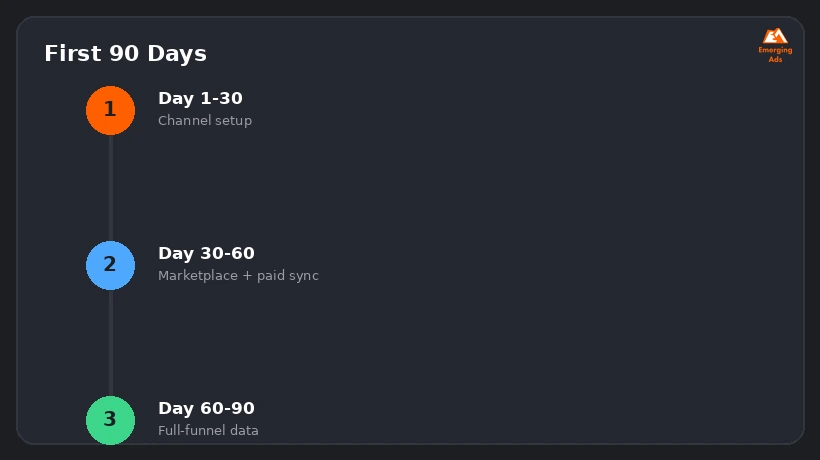
For a Singapore e-commerce brand, the first quarter with a new agency should show a clear, working setup across whichever channels matter most for your category, marketplace store performance and ad efficiency if Shopee/Lazada are in scope, clean PDPA-compliant tracking, and early signal on which of your product lines and messaging approaches are resonating with this affluent, comparison-savvy, digitally sophisticated audience.
Given Singapore’s higher advertising costs relative to much of the region, it’s also worth setting a clear, realistic customer acquisition cost benchmark early, rather than assuming regional Southeast Asia CAC figures will translate directly, so that budget decisions later in the quarter are grounded in Singapore-specific reality rather than a broader regional average that doesn’t actually apply here.
It’s also reasonable to expect a genuinely useful first-quarter debrief to cover not just what happened, but what it implies for the next phase: whether the current channel mix should be doubled down on, whether marketplace and DTC investment need rebalancing against each other, and whether the data so far supports moving toward regional expansion sooner rather than later. An agency that can speak to all three, rather than just reporting last month’s numbers, is one worth keeping.
As with any new market engagement, put a specific 90-day review date on the calendar before work even starts, along with agreed numeric targets for blended ROAS or cost per acquisition, so the conversation at that checkpoint is about real numbers rather than a general impression of whether things feel like they’re moving in the right direction. That single habit, agreeing on what success looks like before the work begins, prevents more strained agency relationships than almost anything else on this list.
Want us to look at your account?
We’ll audit your setup and tell you exactly where the budget is leaking, free.
Get Your Free Ad AuditFrequently Asked Questions
How much does e-commerce marketing cost for a small business in Singapore?
Most Singapore small e-commerce businesses budget between SGD 1,800 and SGD 10,000 a month, depending on whether marketplace management (Shopee, Lazada) is included alongside standard PPC and SEO services.
Do I need a marketplace-specialist agency if I sell on Shopee and Lazada?
It’s worth prioritizing, marketplace advertising systems are distinct from Google and Meta, and an agency without genuine Shopee/Lazada experience may miss significant optimization opportunities specific to those platforms.
What is PDPA and how does it affect e-commerce marketing in Singapore?
PDPA is Singapore’s Personal Data Protection Act, governing how businesses collect, use, and disclose personal data. It affects email marketing consent and retargeting audience building, and should be built into campaign setup from the start.
Should I run marketing campaigns in languages other than English in Singapore?
For certain product categories and demographics, yes. Testing Mandarin or Malay-language creative can improve engagement with specific population segments, particularly around relevant cultural and festive periods.
Is Singapore a good base for expanding into the rest of Southeast Asia?
Yes, many brands use Singapore as a proving ground before expanding into Malaysia, Indonesia, Thailand, and Vietnam, though each of those markets has distinct dynamics that shouldn’t be assumed to mirror Singapore directly.
Are Singapore advertising costs higher than the rest of Southeast Asia?
Generally yes, Singapore’s CPCs and CPMs run closer to Western metro pricing than to broader regional Southeast Asia averages, reflecting the market’s affluence and competitiveness.
Should I sell through marketplaces, my own website, or both in Singapore?
Many successful Singapore e-commerce brands run both, using marketplaces for reach and discovery while building a DTC website for margin and customer relationship ownership, worth discussing the right mix with a prospective agency for your category.
What festive periods should Singapore e-commerce campaigns plan around?
Chinese New Year, Hari Raya, and Deepavali are all significant shopping periods in Singapore’s multicultural calendar, alongside Western holidays like Christmas and Black Friday/Cyber Monday.
How soon should I expect results from a new Singapore e-commerce agency?
A working, properly tracked setup across your priority channels should be in place within the first month, with clearer performance signal on product lines and messaging typically emerging over the first full quarter.
What’s the biggest mistake brands make marketing e-commerce in Singapore?
Treating Singapore’s advertising costs and consumer behavior as interchangeable with the rest of Southeast Asia, leading to underinvestment relative to what’s actually needed to compete effectively in this specific, more expensive and sophisticated market.
Ready to fix what’s costing you conversions?
Book a free, no-pressure audit of your ad account or website.
Get Your Free Ad Audit