The short answer
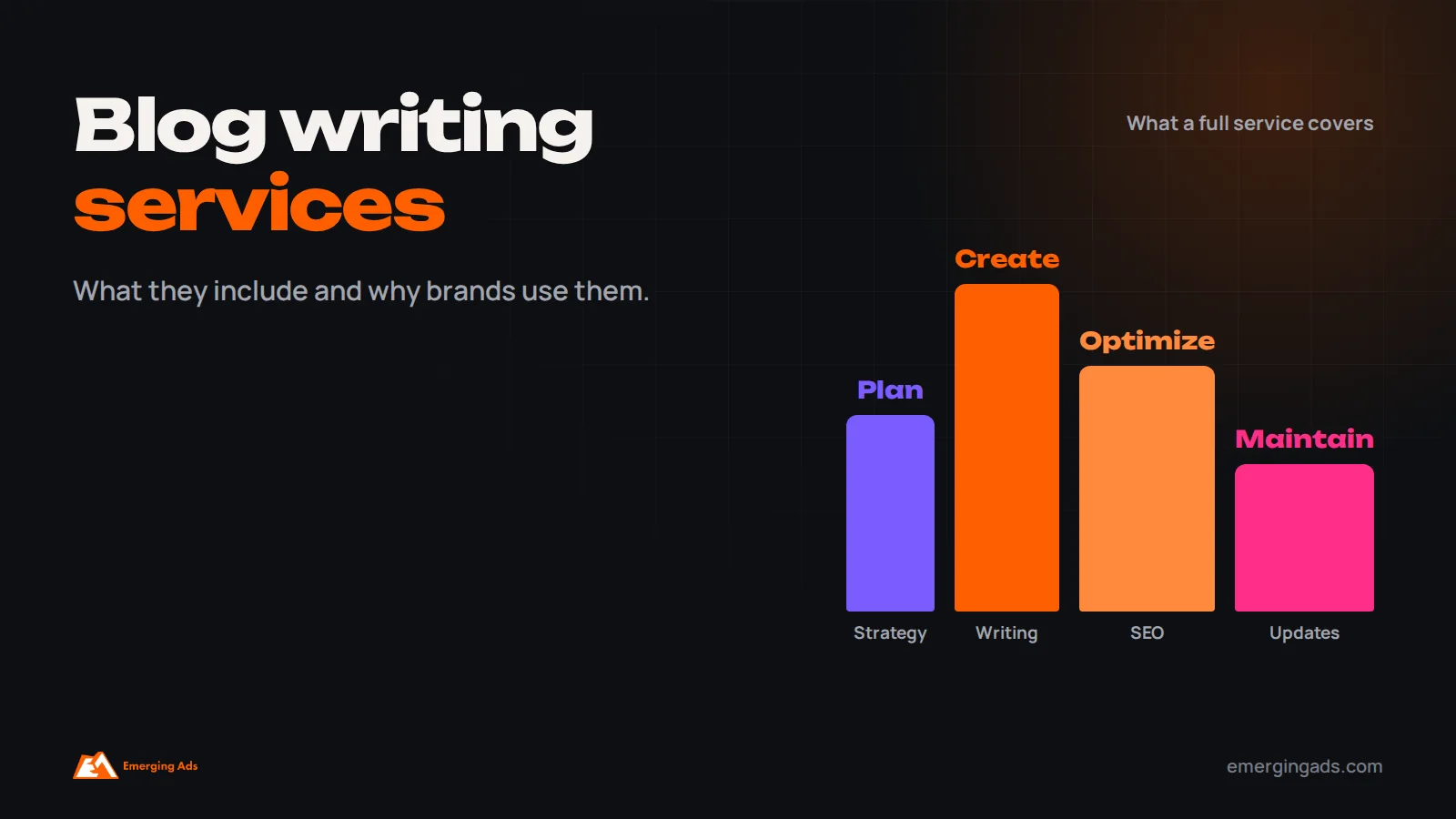
Blog writing services provide researched, written and optimized blog content for businesses, usually including topic and keyword research, writing, editing, SEO optimization, internal linking and publishing support. Brands use them because consistent, expert content builds search visibility, appears in AI answers, supports sales conversations and nurtures leads, but most teams do not have the time or skills to produce it well. The best services combine your expertise with professional writing and SEO, focus on fewer, better articles, and measure success by traffic, leads and sales rather than word counts.
Most businesses know they should be publishing useful content. Fewer manage to do it consistently. The founder is busy, the marketing team has other priorities, and the blog ends up with a burst of posts followed by months of silence. Meanwhile, competitors who publish steadily build search visibility, show up in AI-generated answers and become the brands customers trust before they ever get in touch.
Blog writing services exist to close that gap. Done well, they turn your knowledge into a steady flow of content that earns traffic and leads for years. Done badly, they produce generic articles that nobody reads and that can even hurt how search engines view your site.
This guide explains what blog writing services include, why brands use them, the different types of provider, how to judge quality, what affects cost, how to work with a provider effectively and how to measure results. We write content for clients ourselves, and we are applying the same principles to rewriting this blog, so we know how much the details matter.
What blog writing services usually include
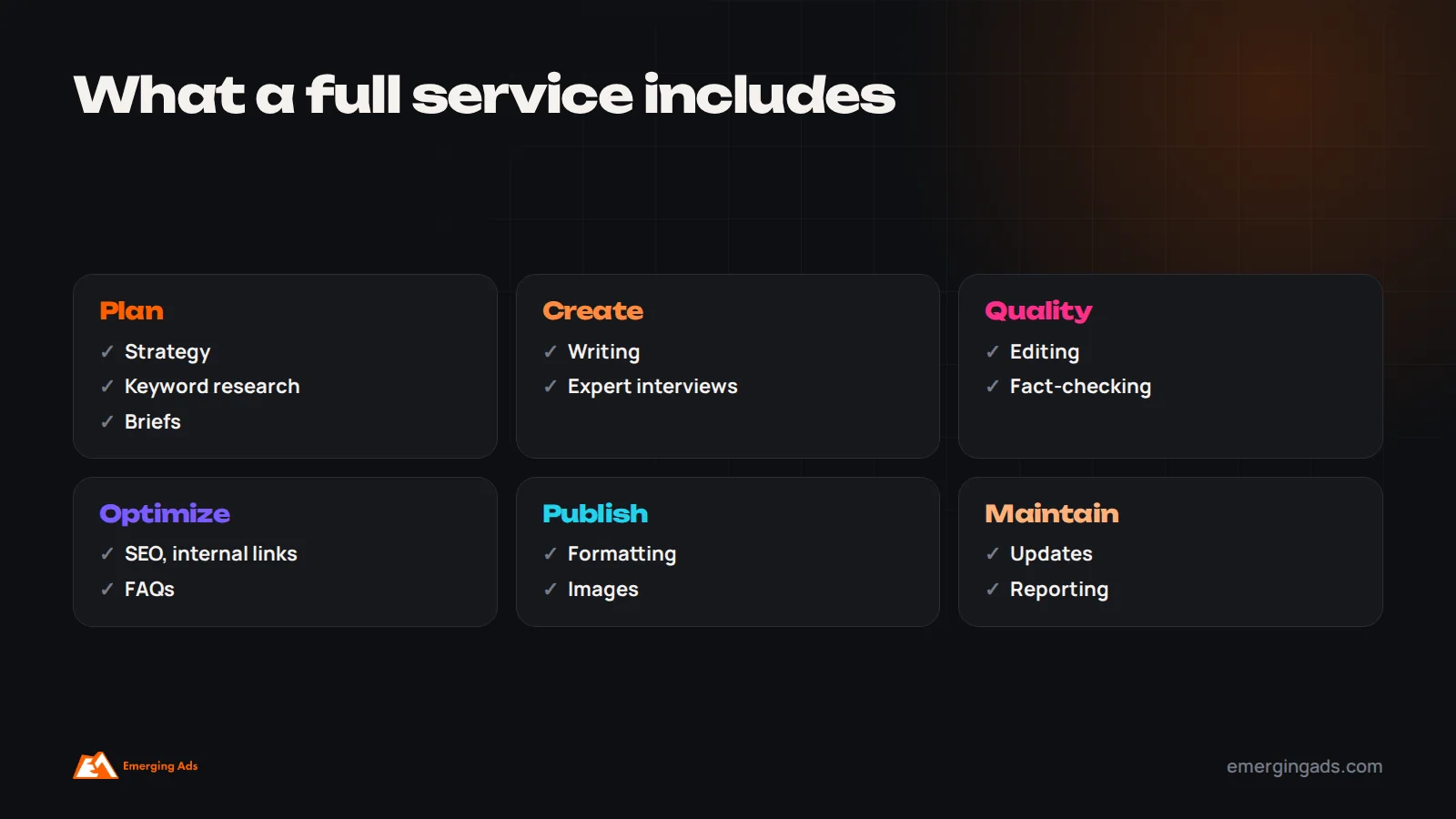
- Content strategy: understanding your audience, goals and competitors, and planning topics.
- Keyword and topic research: finding questions people search for and topics you can realistically rank for.
- Briefing: outlining each article’s purpose, structure, target keywords and key points.
- Writing: drafting articles in your brand voice.
- Expert input: interviewing your team or incorporating your experience and data.
- Editing and fact-checking: clarity, accuracy, tone and grammar.
- SEO optimization: titles, headings, meta descriptions, internal links, structured content and FAQs.
- Images and graphics: sourcing or designing visuals, diagrams and charts.
- Publishing: formatting and uploading to your website.
- Updating: refreshing older articles to keep them accurate and competitive.
- Reporting: tracking performance and refining the plan.
Not every service includes everything. Some provide writing only; others manage the full program. Check exactly what is included before comparing.
Why brands use blog writing services
Consistency
Search visibility and audience trust grow from steady publishing over months and years. A service makes consistency someone’s job rather than an occasional task.
Search visibility
Useful articles that answer real questions are one of the main ways businesses attract organic search traffic, particularly for informational, comparison and how-to searches that paid ads cover expensively.
AI search and citations
AI answer engines such as Google’s AI Overviews and ChatGPT draw on clear, well-structured, authoritative content. Good blog content increases the chance of being cited or recommended. Our guide to generative engine optimization explains why.
Sales enablement and nurture
Articles that answer common questions help sales teams, reduce repetitive explanations and keep leads engaged while they decide. Our guide to lead nurture automation covers how content fits into nurture sequences.
Expertise without the time
Your team has the knowledge; a writing service provides the time, structure and writing skill to turn it into content.
Types of blog writing provider
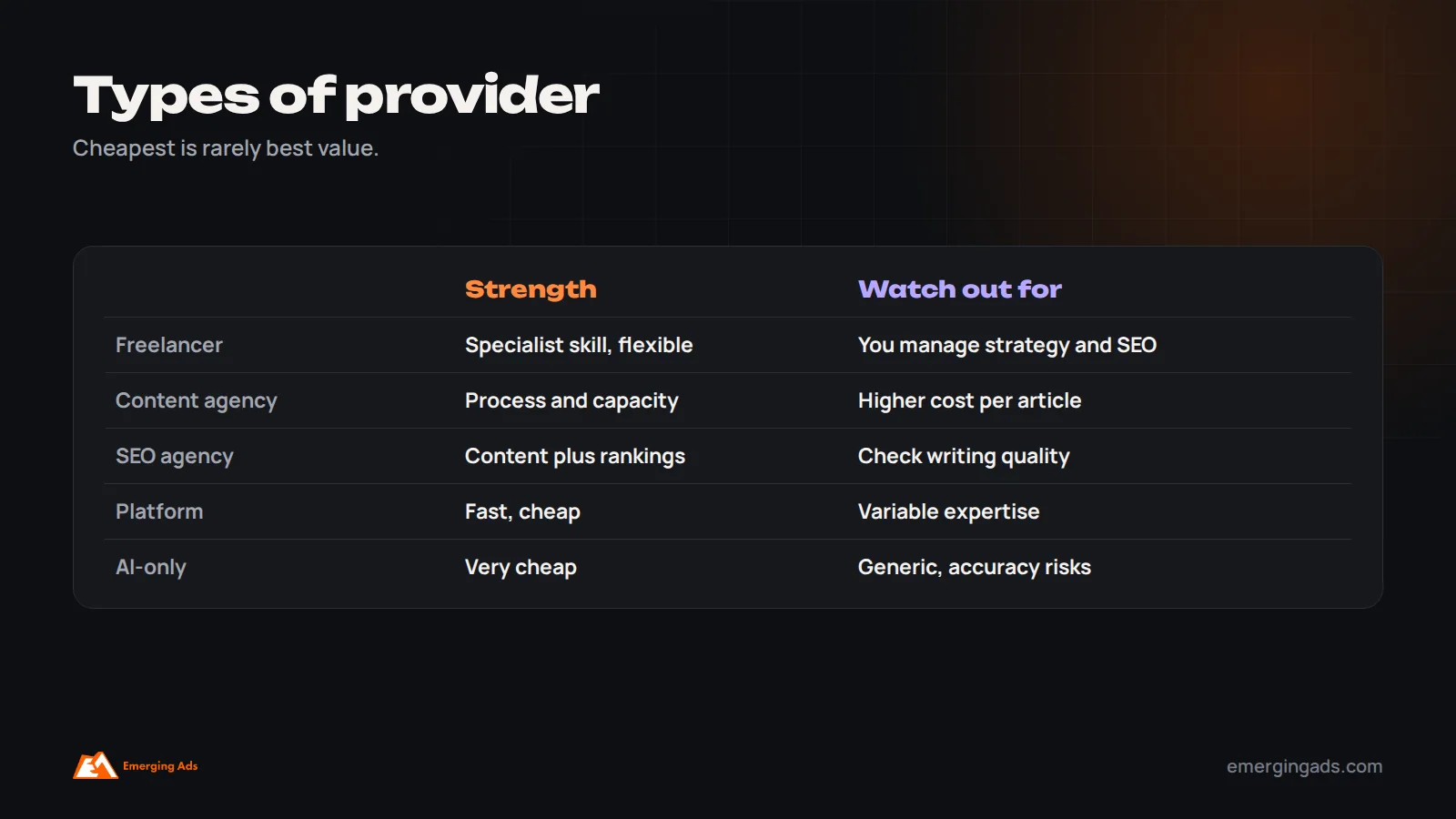
- Freelance writers: flexible and often excellent, especially specialists in your industry. You manage strategy, briefs, SEO and publishing.
- Content agencies: provide strategy, writing, editing and often SEO, with more capacity and process.
- SEO agencies with content services: combine content with technical SEO, internal linking and performance tracking.
- Content platforms and marketplaces: fast and inexpensive, but quality and expertise vary widely.
- AI-only content services: very cheap and fast, but usually generic, with risks to quality, accuracy and credibility.
What good blog content looks like in 2026
- Answers a real question that your customers ask, near the top.
- Shows real expertise: specific examples, numbers, lessons and opinions from people who do the work.
- Is better than what already ranks, not just similar.
- Is structured for scanning: clear headings, short paragraphs, lists, tables and FAQs.
- Is accurate and current, with facts checked and dates visible where relevant.
- Connects to the business: internal links to related services, case studies and next steps.
- Sounds like your brand, not like generic web content.
Search engines focus on whether content is helpful and trustworthy, not on how it was produced. Generic articles that restate what is already available, whether written by people or AI, tend to perform poorly.

The role of AI in blog writing services
AI tools have changed content production. They can speed up research, outlining, drafting and editing. They cannot replace real expertise, original examples, accurate judgment or a distinctive voice. Services that publish large volumes of lightly edited AI content risk producing exactly the kind of unhelpful, unoriginal content that search updates target. Ask any provider how they use AI and how they ensure each article contains genuine expertise and is fact-checked. Our guide on recovering from Google updates explains what happens when sites rely on thin content.
What a good blog writing process looks like
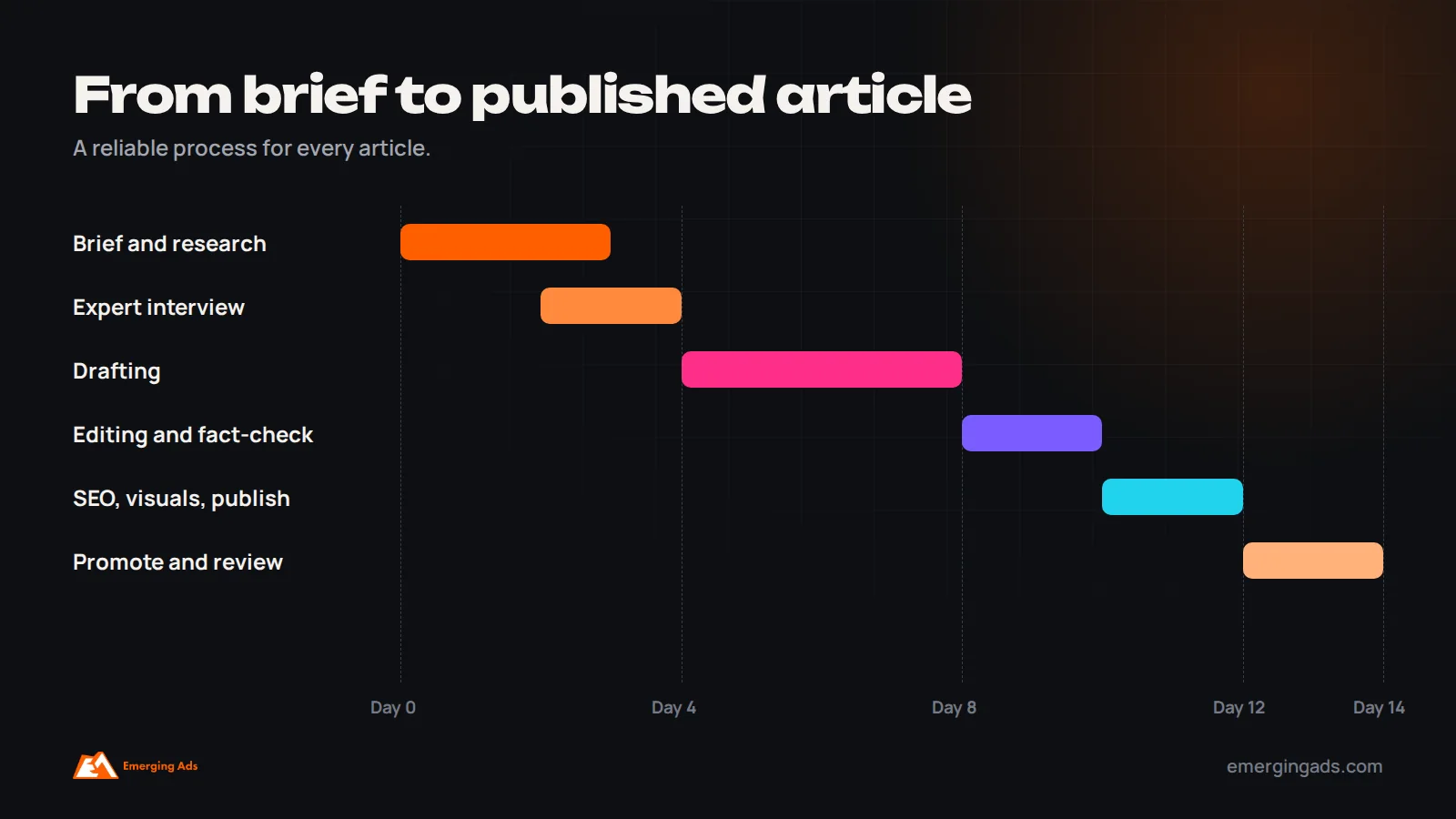
A reliable service follows a clear process for every article. It starts with a brief: the reader, the question being answered, the target keyword cluster, the search intent, the key points to cover, the expert source and the next step for the reader. Then comes research: what currently ranks, what it covers and misses, and what your own experience adds. A short interview or questionnaire with your expert captures examples, numbers and opinions that make the article distinctive. The writer drafts the article with an answer-first introduction, clear headings, specific detail and a natural voice. An editor checks clarity, accuracy, tone and structure, and verifies facts. SEO work adds titles, meta descriptions, internal links, FAQs and structured content. Visuals are added where they explain something better than text. After publishing, the article is promoted and its performance reviewed after a few months.
When comparing providers, ask them to walk you through this process for one of their recent articles. Gaps in the process usually show up as gaps in quality.
Article formats that work
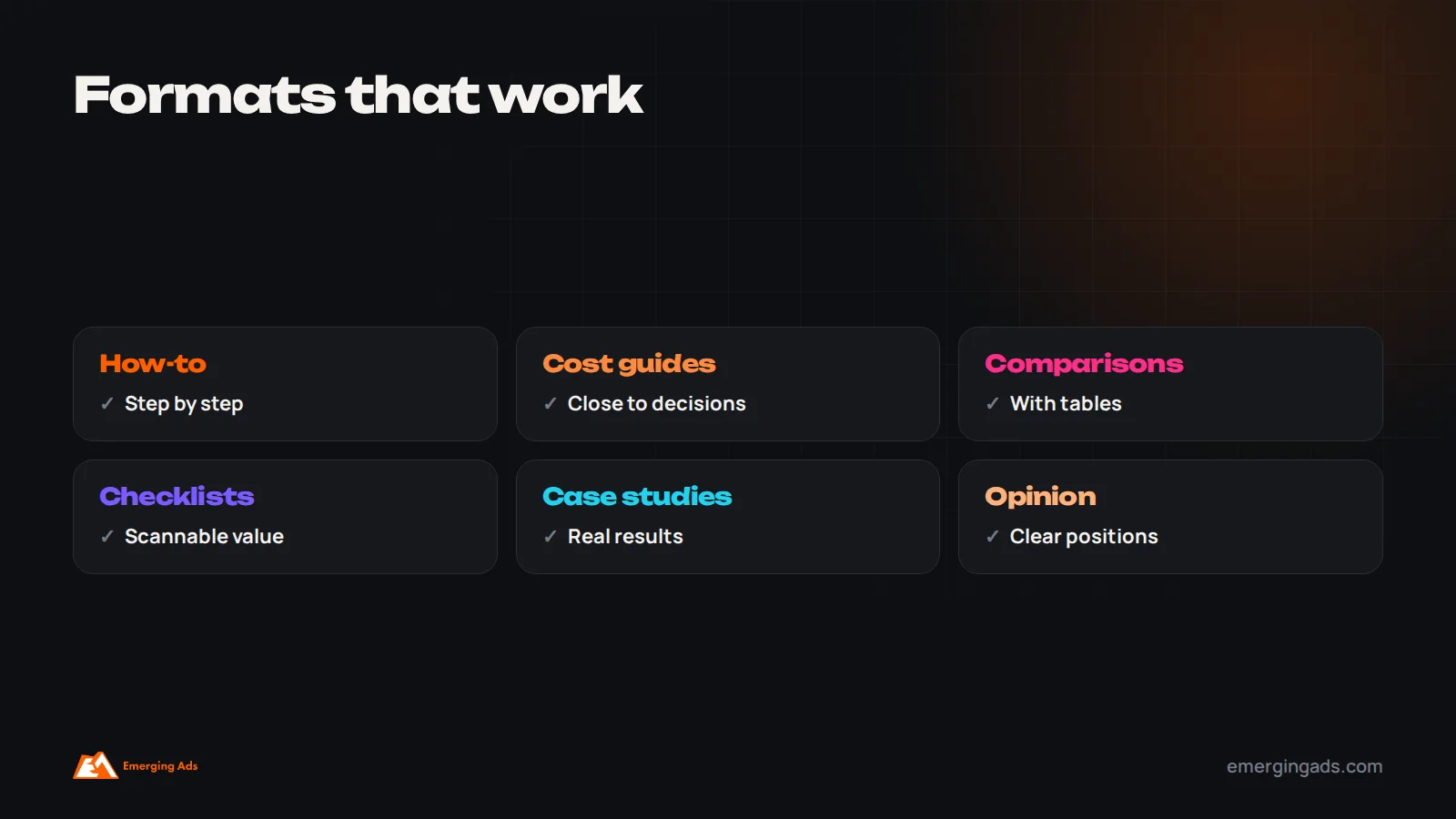
Different topics suit different formats. How-to guides walk readers through a task step by step. Cost and pricing guides explain what drives price and help buyers budget, often attracting people close to a decision. Comparisons help readers choose between options, such as two tools or approaches, and work well with tables. Checklists give practical, scannable value. Explainers define a concept clearly and cover it thoroughly. Case studies show real results and build credibility. Opinion pieces take a clear position on an industry debate, backed by experience. A balanced content plan mixes formats around the questions your customers ask at each stage of buying.
Blog content for different industries
Ecommerce brands benefit from buying guides, comparisons, product education and content that supports category pages, as well as care and usage guides that reduce returns and support email.
Professional services such as legal, financial and healthcare providers need expert-authored, carefully reviewed content that answers common client questions accurately and complies with industry rules.
B2B and SaaS companies need deeper content: problem-focused guides, comparisons and alternatives, implementation advice, original research and case studies that support long sales cycles.
Local businesses get the most from content tied to their services and area, such as answers to common customer questions, local guides and project stories, alongside strong service and location pages.
Why internal linking matters
Every blog article should connect to the rest of your site. Links from articles to related services, case studies and other articles help readers find what they need next, help search engines understand how your content fits together, and pass authority from popular articles to commercial pages. Equally, older articles should link to new ones on related topics. A good writing service plans internal links as part of every brief, rather than adding them as an afterthought. Our own rewritten posts each include several contextual links to related services, case studies and guides for exactly this reason.
Getting your articles seen
Publishing is not the end. New articles on sites with modest authority can take months to attract search traffic, so promotion matters. Share each new article with your email list, post key insights on LinkedIn and other social channels, give sales and customer service teams links to articles that answer common questions, and repurpose articles into shorter social posts, carousels or videos. For important pieces, a small paid promotion budget can bring early readers. Our guide to LinkedIn content strategy covers how to turn articles into social content.
What affects the cost
- Expertise required: technical, medical, legal or financial topics cost more.
- Research depth: original data, interviews and testing add cost and value.
- Length and complexity of each article.
- Scope: strategy, SEO, images, publishing and updates.
- Volume and commitment: ongoing programs often cost less per article than one-off pieces.
- Languages and markets: localized content costs more than translation, and is worth more.
Our guide to content marketing costs explains pricing models and hidden costs in more detail.
In-house writing vs a service
Some businesses write all their content in-house. That works well when someone has the time, writing skill and SEO knowledge, and when the subject requires deep internal expertise. The challenges are consistency, since internal writers are often pulled onto other work, and breadth, since one person rarely covers strategy, writing, editing, SEO and design equally well.
A service adds capacity, process and specialist skills, but needs your expertise to make the content distinctive. Many businesses settle on a hybrid: internal experts supply ideas, examples and review, while a service handles research, writing, editing, SEO and publishing. That combination usually produces the best content at a sustainable pace, because each side does what it does best.
What to include in a content brief
Whether you write in-house or use a service, a good brief makes the difference between a generic article and a useful one. Include the working title and the main question the article answers; the target reader and what they already know; the primary keyword and related terms; the search intent and what currently ranks; the key points, examples and data to include; the expert to interview or quote; the internal links to include, such as related services and case studies; the call to action; and any claims to avoid. A one-page brief takes twenty minutes to write and saves hours of revisions.
Getting your expertise into the content
The most valuable ingredient in blog content is what your business knows that others do not. Getting that knowledge out of busy people is the main challenge. Practical methods include short recorded interviews, where a writer asks an expert ten focused questions; voice notes recorded on the way to meetings; annotated examples from real projects; sales call notes listing common questions and objections; and quick expert reviews of drafts to add detail and correct inaccuracies. A writing service that has a simple, efficient way to capture this expertise will produce far better content than one that relies only on online research.
Blog content in several languages
Businesses serving several markets often need content in more than one language, such as Arabic and English in the Gulf, or English and Hindi in India. Direct translation of articles rarely works well, because search terms, examples, regulations and cultural references differ by market. Localized content, written or adapted by people who understand each market, performs better in search and with readers. When budgets are limited, prioritize localizing the articles most closely tied to buying decisions, such as service, pricing and comparison content, rather than translating everything.
What to expect over the first six months
In the first month, a good service researches your audience, competitors and keywords, agrees a content plan and produces the first articles. Months two and three focus on publishing consistently and updating your best existing content, with early signs in Search Console such as new impressions. By months four to six, articles typically begin ranking for target topics, traffic grows steadily, and the first leads and sales from content appear. Results compound after that, as articles gain authority and internal links strengthen the whole site. Businesses that stop after two or three months often miss the period when results begin to show.
Red flags when hiring a blog writing service
- Very low prices per article with promises of large volumes.
- No questions about your business, customers or expertise.
- Samples that read generically and could apply to any company.
- No clear editing or fact-checking process.
- Guaranteed rankings.
- No internal linking or SEO thinking in the briefs.
- Unclear ownership of the content.
How to choose topics that pay back
Topic selection decides most of a blog’s return. A beautifully written article on a topic nobody searches for, or one that attracts readers who will never buy, is expensive however good it is. Before commissioning any article, ask three questions. Do our customers actually ask this, in sales calls, support tickets, reviews or searches? Is the reader at a stage where we can genuinely help, with a natural next step towards what we sell? And can we answer it better than what currently ranks, using our experience, data or examples?
Topics that pass all three are worth investing in properly. In most businesses, the best early topics are comparisons, cost and pricing guides, how-to guides for problems the product or service solves, and the questions prospects ask just before buying. Broad awareness topics can follow once the content closest to buying decisions is in place. Our guide to doing keyword research yourself explains how to find and prioritize topics.
How long should blog articles be?
There is no ideal word count. Articles should be as long as needed to answer the question thoroughly and better than competing pages, and no longer. Simple questions may need a few hundred words. Complex topics, such as detailed guides, comparisons and cost explanations, often need several thousand words to cover properly, with structure that makes them easy to scan. What matters is that every section earns its place: padding an article to hit a word count makes it worse for readers and does not help rankings. Our own rewritten guides are long because the topics are complex and readers have many related questions, and each one opens with a short answer for people who only need the essentials.
Visuals that make articles more useful
Good visuals explain things that text explains badly. Diagrams show processes and relationships, tables compare options at a glance, charts show data, annotated screenshots show how to do something, and summary graphics give readers the key points quickly. Visuals also make articles more shareable and more likely to be referenced by other sites. Each image should have descriptive alt text, both for accessibility and so search engines understand it. Generic stock photos add little; custom visuals that carry real information add a lot. Each of our rewritten articles includes several custom graphics for this reason.
Keeping content quality consistent over time
Quality often slips as a content program grows: more writers, more topics, tighter deadlines. A few simple controls keep standards high. Maintain a style guide covering tone, terminology, formatting and how to cite sources. Use a standard article template with an answer-first introduction, clear headings, internal links and FAQs. Require expert review for any article making technical, legal, medical or financial claims. Keep a content inventory listing every article, its target topic, last update date and performance, so overlaps and outdated pieces are easy to spot. And review a sample of published articles every quarter against your quality checklist, sharing feedback with writers.
Accuracy, claims and compliance
Blog content represents your business publicly, so accuracy matters. Facts and statistics should come from reliable sources and be checked before publishing. Claims about your products and services should be supportable. Industries such as healthcare, finance and legal services face specific rules about what can be said, and content may need review by qualified professionals. Images need proper licenses. A good writing service builds fact-checking and compliance into its process rather than leaving it to chance, and is clear about who is responsible for final approval.
Advice for small businesses starting out
If you are a small business starting a blog, begin with the content closest to buying decisions: answers to the five questions customers ask most often before buying, a pricing or cost guide, and a comparison relevant to your offer. Publish one excellent article every two to four weeks rather than several weak ones each week. Ask the founder or a senior team member to supply the substance, through a short interview for each article, and use a writer or service to shape it. Link every article to the relevant service page, share it with your email list and on LinkedIn, and review results after three to six months before expanding.
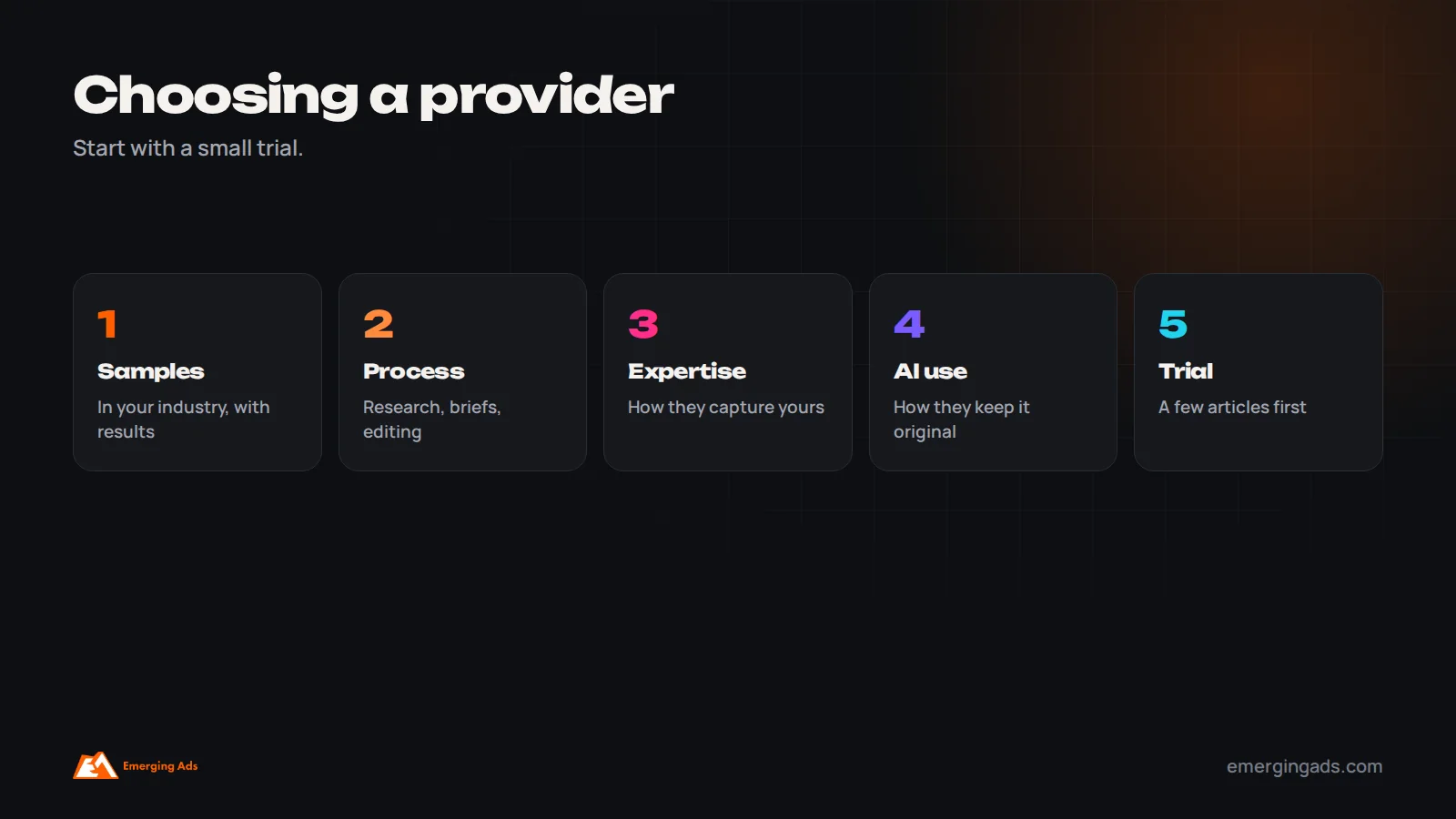
How to choose a blog writing service
- Ask for samples in your industry, ideally with performance results.
- Ask how they research topics and choose keywords.
- Ask how they capture your expertise: interviews, questionnaires or reviews.
- Ask about their editing and fact-checking process.
- Ask how they handle SEO, internal linking and structured content.
- Ask how they use AI, and how they ensure originality and accuracy.
- Ask what they report and how they measure success.
- Agree who owns the content.
- Start with a small trial of a few articles before committing long term.
How to work with a blog writing service effectively
- Share your knowledge: customer questions, sales objections, case studies, data and opinions.
- Make experts available for short interviews.
- Provide a style guide: tone, words to use and avoid, and examples you like.
- Review quickly so the schedule does not stall.
- Agree priorities based on business value, not just search volume.
- Distribute content through email, social media and sales teams.
- Review performance together every month or quarter.
How to measure results
- Organic traffic to blog articles over time.
- Rankings and impressions for target topics in Search Console.
- Engagement: time on page, scroll depth and internal clicks to service pages.
- Leads and sales where articles were the entry point or an assisted touchpoint.
- Email signups from content.
- Citations in AI answers and links from other sites.
Content usually takes several months to rank and build traffic, so judge results over a realistic timeframe.

Do not forget updates
Publishing new articles is only half the job. Older articles lose accuracy and rankings as facts change and competitors publish better content. Updating your best existing articles is often the fastest way to grow traffic, because those pages already have some authority. That is exactly what we are doing with our own blog: rewriting older posts with deeper content, real examples, clear structure and visuals, rather than only publishing new ones.
Common mistakes
These are the patterns that most often stop blog programs from paying off, whoever does the writing.
- Buying volume instead of quality.
- Generic articles with no real expertise.
- No keyword or topic strategy.
- No internal links to services and next steps.
- Publishing and never promoting.
- Never updating older articles.
- Judging results after a few weeks.
If you would like help, our SEO and content teams plan, write, optimize and update blog content, and you can compare providers using our guide to choosing a blog writing agency.
Frequently asked questions
What are blog writing services?
They provide researched, written and optimized blog content, often including topic and keyword research, writing, editing, SEO, internal linking, images, publishing and updates.
Why do brands need blog writing services?
To publish consistent, expert content that builds search visibility, appears in AI answers, supports sales and nurtures leads, without overloading internal teams.
How much do blog writing services cost?
It depends on expertise, research depth, length, scope and volume. Compare providers on what is included, not just the price per article.
Is AI-written blog content bad for SEO?
Search engines focus on quality, not production method. Generic AI content without real expertise tends to perform poorly; AI-assisted content with genuine expertise and editing can perform well.
How many blog posts should I publish a month?
As many as you can make genuinely useful and better than what already ranks. A few excellent articles usually outperform many thin ones.
How long does blog content take to show results?
Usually several months to rank and build traffic, with results compounding over time as articles gain authority.
Should I update old blog posts?
Yes. Updating your best existing articles is often the fastest way to grow traffic, because they already have authority.
Who should own the content?
Your business should own all content produced for it, including images and research, as agreed in writing with the provider.