
The short answer
The best blog writing agency for your business writes content that answers your customers’ real questions with genuine expertise, plans topics around search demand and business value, captures knowledge from your team through interviews, edits and fact-checks carefully, optimizes for search and AI answers, links articles to your services, and reports on traffic, leads and sales. Location matters far less than industry knowledge, writing quality and process. Ask for samples in your sector with performance results, and start with a small trial.
Searching for a blog writing agency “near me” returns hundreds of options, from large content agencies to freelance collectives and AI-driven content mills. Their samples often look similar, their prices vary enormously, and it is hard to tell from a sales call which one will actually produce content that ranks, gets cited and brings in customers.
We write and rewrite blog content for clients and for our own site, including this article, which is part of a project to rewrite every post on our blog to a higher standard. This guide explains how to choose a blog writing agency: what to look for, the questions to ask, how to judge samples, how pricing works, what a good process looks like and the red flags to avoid. For background on what these services include, see our guide to blog writing services.

Does the agency need to be near you?
Blog writing is almost entirely remote work, so location matters much less than expertise. A nearby agency can help if your content needs strong local knowledge, such as local SEO content for a specific city, or if you value in-person interviews and workshops. Language and market knowledge matter more than proximity: a business targeting customers in the UK, the Gulf or India needs writers who understand those audiences, spelling conventions, regulations and search behavior. Arabic content for Saudi or UAE audiences, for example, should be written by native writers who know the market, not translated from English.
What to look for in a blog writing agency
- Industry knowledge: writers or editors who understand your field, or a reliable process for capturing expertise from your team.
- Writing quality: clear, specific, engaging writing in a voice that could fit your brand.
- SEO and AI search skills: topic research, structure, internal linking and content that answers questions directly.
- Editing and fact-checking: a real editorial process, not just a writer and a spell-checker.
- Strategy: topics chosen for business value, not just search volume.
- Reporting: results measured in traffic, leads and sales, not article counts.
- Honest use of AI: clarity about how AI tools are used and how originality and accuracy are ensured.
How to judge writing samples
Samples are the most important evidence you will see, so read them carefully. Ask for samples in your industry or a related one, ideally with performance data such as rankings, traffic or leads. Then ask yourself: does the opening answer the main question quickly? Are there specific examples, numbers and insights, or only generalities you could find anywhere? Is it easy to scan, with clear headings? Does it sound like a knowledgeable person, or like generic web content? Are facts accurate and current? Does it link sensibly to the business’s services? Would your customers find it genuinely useful? Samples that read as interchangeable filler are a warning, however polished they look.

What a good agency process looks like
Ask every agency to walk you through how a single article goes from idea to published page. A clear, repeatable process is one of the best predictors of consistent quality, because it protects accuracy, voice and SEO even when different writers are involved.
- Discovery: understanding your business, customers, competitors, goals and voice.
- Topic strategy: keyword and question research, mapped to business value and buyer stage.
- Briefs: each article’s reader, question, keywords, key points, expert source and internal links.
- Expert input: short interviews or questionnaires with your team to capture real knowledge.
- Writing: answer-first structure, specific detail and natural voice.
- Editing and fact-checking: clarity, accuracy, consistency and brand voice.
- Optimization: titles, meta descriptions, headings, FAQs, internal links and visuals.
- Publishing and promotion support.
- Reporting and updates: reviewing performance and refreshing older articles.
Types of blog writing provider
Full-service content agencies handle strategy, writing, editing, SEO, design and reporting, with teams of writers and editors. They suit businesses that want a complete program and consistent output. SEO agencies with content teams combine writing with technical SEO and link building, which helps when content needs to support wider search goals. Specialist niche agencies focus on one industry, such as healthcare, finance, SaaS or legal, and bring subject knowledge that general agencies lack. Freelance writers and collectives offer flexibility and often excellent value, but you usually manage strategy, briefs and SEO yourself. Content platforms and marketplaces deliver quickly and cheaply, but quality varies widely and expertise is often thin. AI-first content services produce very cheap content at scale, with significant risks to originality, accuracy and performance. The right choice depends on your budget, how much strategy you need, and how specialized your subject is.
How good agencies capture your expertise
The most valuable thing in any article is knowledge only your business has: real examples, numbers, lessons, opinions and stories from client work. Good agencies have an efficient way to get it without consuming your team’s time. Common methods include 20 to 30-minute recorded interviews per article or per batch of articles, short questionnaires for subject experts, access to sales call notes, support tickets and customer reviews, existing case studies and internal documents, and quick expert reviews of drafts. Ask agencies exactly how they do this. Those without a clear method usually fall back on rewriting what competitors have already published.
SEO and AI search: what to expect
A blog writing agency in 2026 should understand both traditional search and AI-generated answers. In practice, that means researching what people search for and what currently ranks, structuring articles so the main answer appears early, using clear headings that match real questions, including FAQs where helpful, adding internal links to related services and articles, writing accurate meta titles and descriptions, and keeping facts specific and current so AI tools can cite them. Our guide to generative engine optimization explains how AI search changes content priorities.
Choosing an agency for specialized industries
Some industries demand more from writers. Healthcare content must be accurate, reviewed by qualified professionals and compliant with advertising rules. Financial and legal content carries regulatory risk and needs careful wording. Technical B2B and SaaS content needs writers who can understand complex products and explain them clearly. For these sectors, prioritize agencies with proven experience in your field, clear expert review processes and a track record of compliant content. The higher cost per article is usually justified by lower risk and better results.
Rewriting and updating existing content
Many businesses already have a blog full of older, thinner articles. Rewriting and updating the best of them is often a faster route to results than publishing new content, because those pages already have some authority and history. A good agency audits existing content, decides what to update, consolidate or remove, and rewrites priority articles with deeper detail, current information, better structure and visuals. That is exactly the approach we are taking with our own blog, where every existing post is being rewritten to a much higher standard.


Questions to ask a blog writing agency
- Can you show samples in our industry, with results?
- Who writes our articles, and what is their background?
- How will you capture our expertise?
- How do you choose topics and keywords?
- What does your editing and fact-checking process involve?
- How do you use AI tools, and how do you keep content original and accurate?
- How do you handle internal linking and SEO?
- What will you report, and how often?
- Who owns the content, images and research?
- Can we start with a trial of a few articles?
How blog writing agencies charge
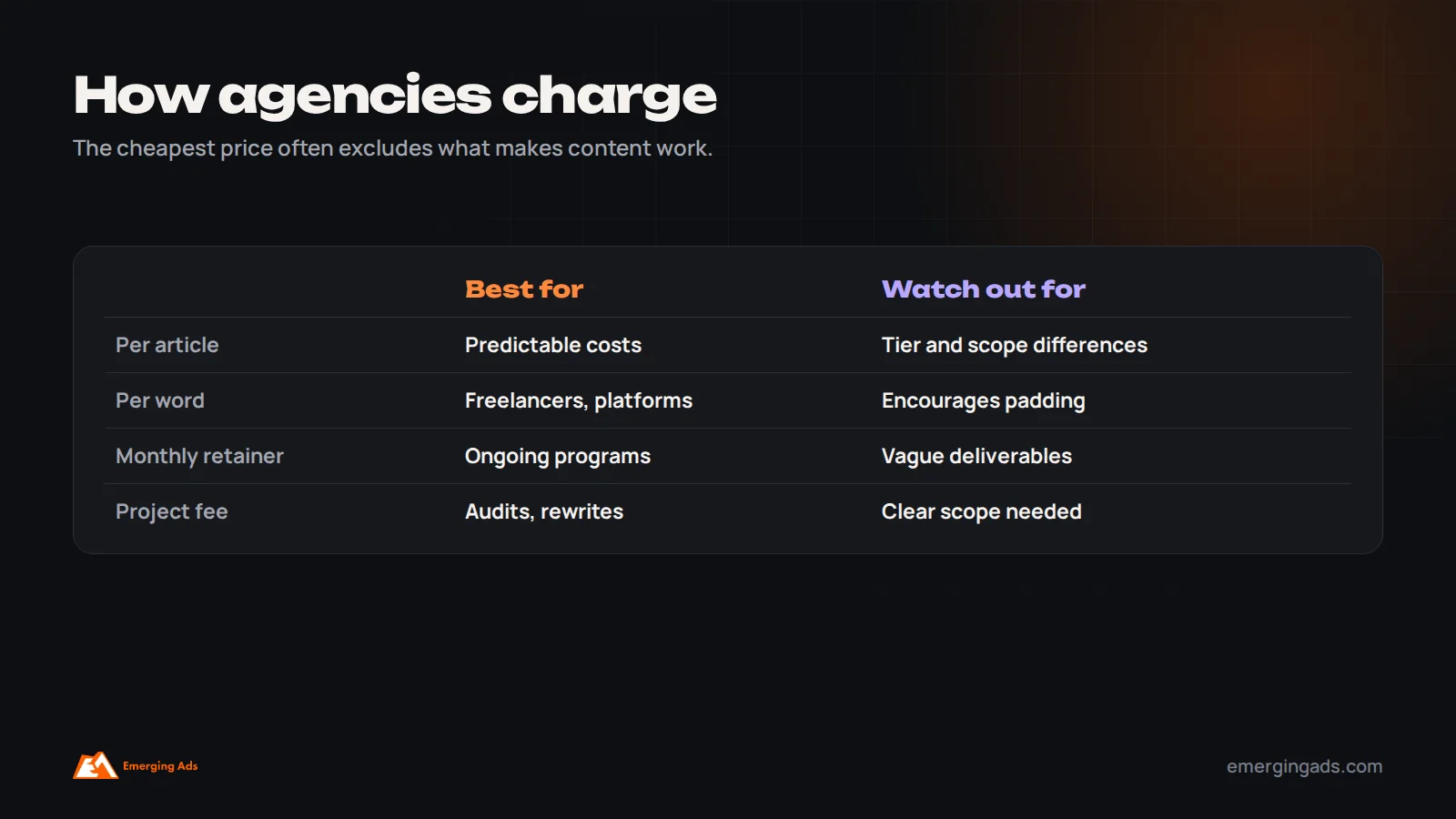
Pricing models vary widely, so make sure you are comparing the same scope of work across every quote you receive.
- Per article: often tiered by length, research depth or expertise required.
- Per word: common with freelancers and content platforms; can encourage padding.
- Monthly retainer: a set number of articles plus strategy, optimization and reporting.
- Project fees: for content audits, strategy or rewriting existing articles.
Compare quotes on what is included: strategy, research, expert interviews, editing, SEO, images, publishing and updates. A cheaper per-article price often excludes the parts that make content perform. Our guide to content marketing costs explains pricing in more detail.

What a good content brief looks like
The brief is where most article quality is decided. A strong agency brief states the working title and the main question the article answers; the target reader, what they already know and what they need to decide; the primary keyword and related questions; the search intent and a short analysis of what currently ranks, including what those pages miss; the key points, examples and data to include; the expert to interview and the questions to ask them; the internal links to services, case studies and related articles; the call to action; and any claims to avoid. Ask to see an example brief before hiring. Agencies that cannot show one often skip this step, and their articles show it.
Good briefs also make your review easier. When you can see the plan before writing starts, you can correct misunderstandings early, add examples only you know, and make sure the article serves a real business purpose. That saves rounds of revisions later and produces articles that feel like they came from inside your business.
Matching your brand voice
Readers notice when a blog sounds different from the rest of your brand. A good agency learns your voice early, from your website, sales materials, emails and the way your team talks, then documents it in a short style guide: tone, words you use and avoid, how formal or casual to be, how to address readers, and examples of sentences that sound right and wrong. Writers then follow the guide, and editors check every article against it. If your brand voice is not yet defined, a good agency will help you define it as part of the onboarding, which also benefits your website, social media and ads. Our guide to brand positioning covers how voice fits into the wider brand.
Will the agency help get articles seen?
Publishing is not the finish line. New articles on sites with modest authority can take months to attract search traffic, so promotion matters. Ask whether the agency helps with distribution: turning articles into email newsletters, LinkedIn posts, short videos or social carousels; suggesting internal links from existing pages; outreach to sites that might reference the content; and recommending which articles deserve paid promotion. Some agencies include this in their retainer; others offer it separately. Even if you handle distribution in-house, an agency that writes with distribution in mind, for example by including quotable insights and shareable visuals, makes it easier. Our guide to LinkedIn content strategy shows how articles can be repurposed for social.
How to measure an agency’s work
Agree measures before the first article is written. In the first few months, look at leading indicators in Google Search Console: impressions, average position and clicks for target topics, and the number of articles indexed. Over six to twelve months, look at organic traffic to articles, conversions such as email signups, enquiries and purchases where articles were the first or an assisted touchpoint, internal clicks from articles to service pages, links earned and citations in AI answers. Compare against a baseline from before the agency started. Ask the agency to report on these monthly, with a short explanation of what is working, what is not and what will change. Article counts and word counts are inputs, not results.
Making the relationship work
The best blog content comes from collaboration. Give the agency access to the people who know your customers and subject, agree a regular interview slot, respond to briefs and drafts within agreed times, and share feedback from customers and sales about which articles are useful. Tell the agency about launches, events, seasonal priorities and changes in your business so the content plan stays relevant. Review results together every quarter and adjust topics, formats and priorities. Agencies do their best work when they are treated as part of the marketing team rather than a supplier receiving occasional orders.
Content in several languages
Businesses serving several markets often need content in more than one language, such as English and Arabic in the Gulf, or English and Hindi in India. Direct translation rarely performs well, because search terms, examples, regulations and cultural references differ. Look for agencies with native writers in each language who understand the target market, and who research keywords separately for each language rather than translating English keyword lists. Prioritize localizing the articles closest to buying decisions, such as service, pricing and comparison content, if budget is limited.
Red flags
Watch for these warning signs during sales conversations and in samples.
- Very low prices for large volumes of articles.
- No questions about your business, customers or expertise.
- Generic samples that could belong to any company.
- Guaranteed rankings.
- No editing or fact-checking process.
- Unclear answers about AI use.
- Articles delivered without internal links, structure or SEO basics.
- Unclear content ownership.
Start with a trial
A short trial is the safest way to find out whether an agency is the right fit for your business.
Before committing to a long contract, commission three to five articles on topics that matter to your business. Judge the trial on the whole experience: how well the agency understood your business, how efficiently they captured your expertise, the quality of drafts, how they handled feedback, deadlines and the final result. Then watch early performance in Search Console over the following months. A trial costs little compared with a year of content that does not perform.
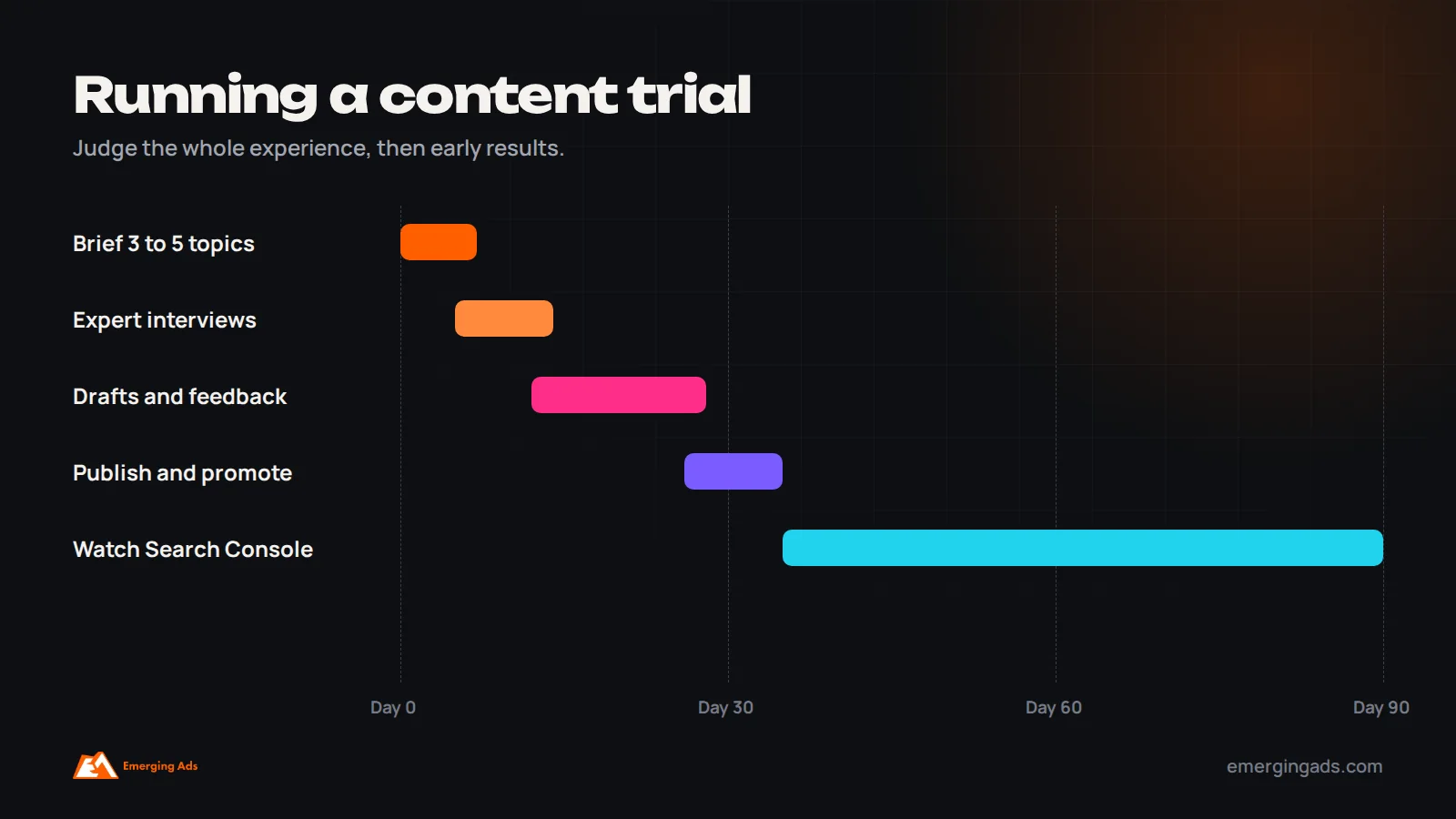
Advice for small businesses
Small businesses usually get the most value from a focused content program rather than a high volume of articles. Start with the content closest to buying decisions: answers to the questions customers ask most often before buying, a pricing or cost guide, comparisons relevant to your offer, and pages that explain your process. One excellent article every two to four weeks, grounded in your expertise and linked to your services, typically outperforms several generic articles a week. Look for an agency or freelancer willing to start small, with a trial, and to grow the program as results appear. Make sure every article links to the relevant service page and has a clear next step for readers.
An example of a strong agency engagement
Consider a mid-sized accounting firm that wants more enquiries from small business owners. The agency begins with discovery: interviews with two partners, a review of common client questions, competitor content and search data. It proposes a plan of twelve articles over six months, prioritizing topics close to buying decisions, such as choosing an accountant for a startup, costs of bookkeeping and common tax mistakes for new businesses. Each article starts with a brief, includes a short recorded interview with a partner, and goes through editing and fact-checking before publication. Articles link to the relevant service pages and include a clear invitation to book a consultation. The agency also rewrites the firm’s five best-performing older posts. After six months, the firm sees steady growth in organic traffic to the new and updated articles, and several consultation bookings where the article was the first touchpoint.
Contract terms to check
Before signing, confirm the number and type of articles per month, what is included in each, such as research, interviews, editing, images and SEO, turnaround times and revision rounds, who owns the content and any images or research, how AI tools may be used, the minimum term and notice period, and what happens to drafts and briefs if you end the contract. Clear terms prevent the most common disagreements between businesses and content agencies.
Making the decision
When you have compared shortlisted agencies, ask yourself which one understood your customers best, whose samples you would be proud to publish under your name, which had the clearest process for capturing your expertise, and which will report on results rather than output. The agency that answers best on those questions is usually the right choice, wherever it is based and whatever its price per article.
How to evaluate an agency’s use of AI
Nearly every content agency now uses AI tools in some way, and that is not a problem in itself. What matters is how. Good agencies use AI to speed up research, outline options, summarize interviews, suggest headlines and check consistency, while humans with subject knowledge decide what to say, add real examples and expertise, write or heavily rewrite drafts, and check every fact. Weak agencies generate full articles with AI, lightly edit them and deliver them at volume. Ask agencies to describe exactly where AI is used in their process, who is accountable for accuracy, how they ensure originality, and whether they will tell you when AI was used heavily. Then read their samples closely: generic phrasing, repeated structures, vague claims and a lack of specific examples are common signs of thin AI content.
Visuals and formatting
Strong articles are easy to read and often include visuals that explain ideas better than text: diagrams, comparison tables, charts, annotated screenshots and summary graphics. Ask whether the agency creates custom visuals or sources stock images, and whether formatting, such as headings, short paragraphs, lists, tables and FAQs, is part of the service. Well-formatted articles with useful visuals keep readers on the page longer, are more likely to earn links and shares, and help search engines and AI tools understand the content. Each article in our own blog rewrite includes several custom graphics for this reason.
Realistic timelines
Expect the first month to focus on discovery, strategy, briefs and the first articles. From the second month, publishing usually settles into a regular rhythm. Search results typically take several months to appear for new articles, and longer for competitive topics, while updates to existing articles can show improvements sooner. Agencies that promise rankings within weeks are overselling; agencies that explain this timeline honestly, and show early indicators along the way, are usually more reliable partners.
A quick checklist for your shortlist
Before choosing, check each agency against these points. Have you read samples in your industry and found them genuinely useful? Do they have a clear method for capturing your team’s expertise? Can they show an example brief? Is there a real editing and fact-checking step? Do they research topics by business value as well as search volume? Are they honest and specific about AI use? Will articles include internal links, structure and SEO basics? Will they report on traffic, leads and sales? Will you own all content? Can you start with a trial? An agency that meets all of these is worth serious consideration; one that misses several is likely to produce content that looks fine and performs poorly.
Common mistakes when hiring a blog agency
- Choosing on price per article alone.
- Buying volume instead of usefulness.
- Not making your experts available for input.
- No topic strategy, so articles target random keywords.
- Judging results after a few weeks rather than months.
- Ignoring updates to existing articles.
Frequently asked questions
How do I choose a blog writing agency?
Look for industry knowledge, strong samples with results, a clear process for capturing your expertise, editing and fact-checking, SEO skills, honest AI use, outcome-based reporting and a trial before committing.
Does a blog writing agency need to be local?
Not usually. Industry, language and market knowledge matter more than location, though local knowledge helps for local SEO content.
How much do blog writing agencies charge?
They charge per article, per word, through monthly retainers or project fees. Compare what is included, such as strategy, interviews, editing, SEO and updates.
How can I tell if an agency’s writing is good?
Read samples in your industry: look for direct answers, specific detail, clear structure, accuracy and a knowledgeable voice, and ask for performance results.
Is AI-written content acceptable?
Search engines focus on quality, not how content was produced. AI-assisted content can work when grounded in real expertise and careful editing; generic AI content usually does not.
How many articles should I buy each month?
As many as can be genuinely useful and better than what already ranks. A few strong articles usually outperform many thin ones.
How long before blog content shows results?
Usually several months to rank and attract traffic, with results growing as articles gain authority.
Who should own the content?
Your business should own all content, images and research produced for it, agreed in writing.