The short answer
App install campaigns cost whatever you pay per install or per in-app action, multiplied by the volume you need, plus creative, tracking tools and management. Cost per install varies widely by platform (Google, Apple, Meta, TikTok, Snapchat), country, operating system, app category and what you optimize for: cheap installs from people who never open the app are easy to buy, while installs from users who register, subscribe or purchase cost more and are worth far more. The useful question is not “what is a normal cost per install?” but “what can I afford to pay for a user who stays and pays?”
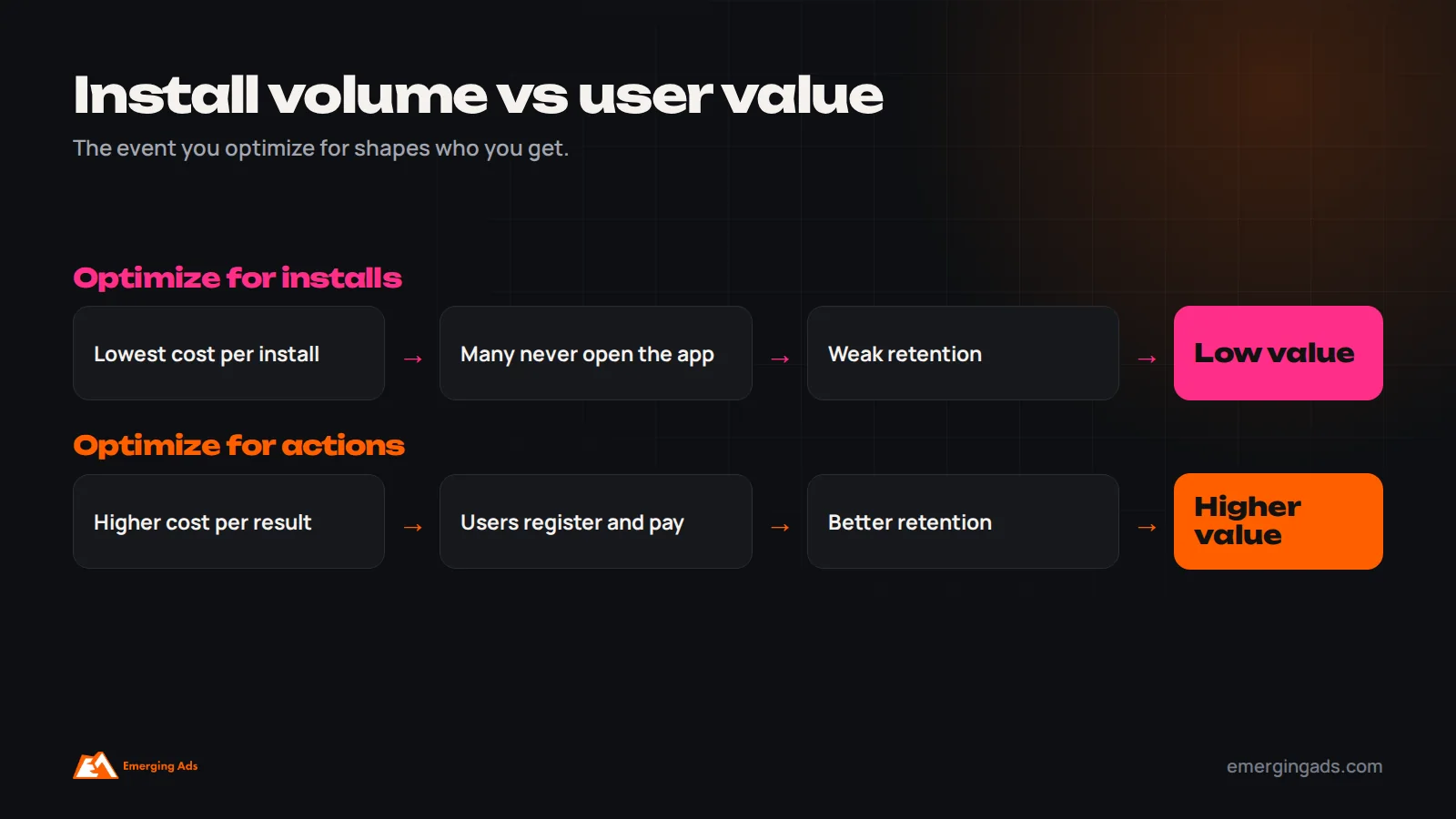
App marketers face a familiar trap. Campaigns optimized for installs can deliver impressive volumes at low cost, but many of those users open the app once and never return. Meanwhile, the users who actually register, subscribe or buy cost more to acquire and are harder to measure, especially on iOS after Apple’s privacy changes.
We run app install campaigns across Google, Meta, Apple, TikTok and Snapchat through our app marketing service. This guide explains how app campaign costs work, what drives them on each platform, the tracking and creative costs on top of media, how to set budgets and targets, and how to judge whether campaigns are profitable. It deliberately avoids quoting universal cost-per-install figures, because they vary so much by market and category that averages are more misleading than useful.
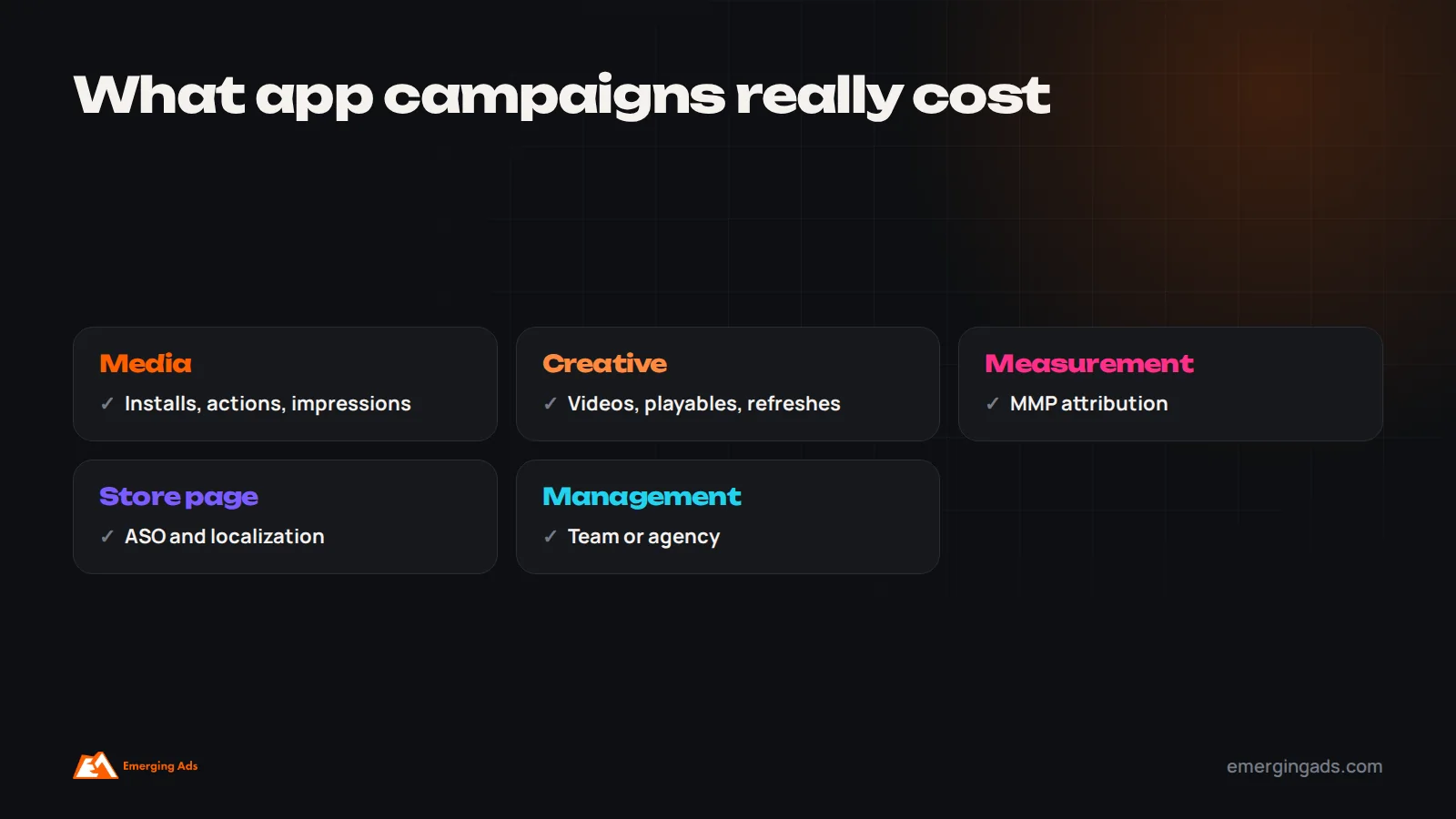
What app install campaigns really cost
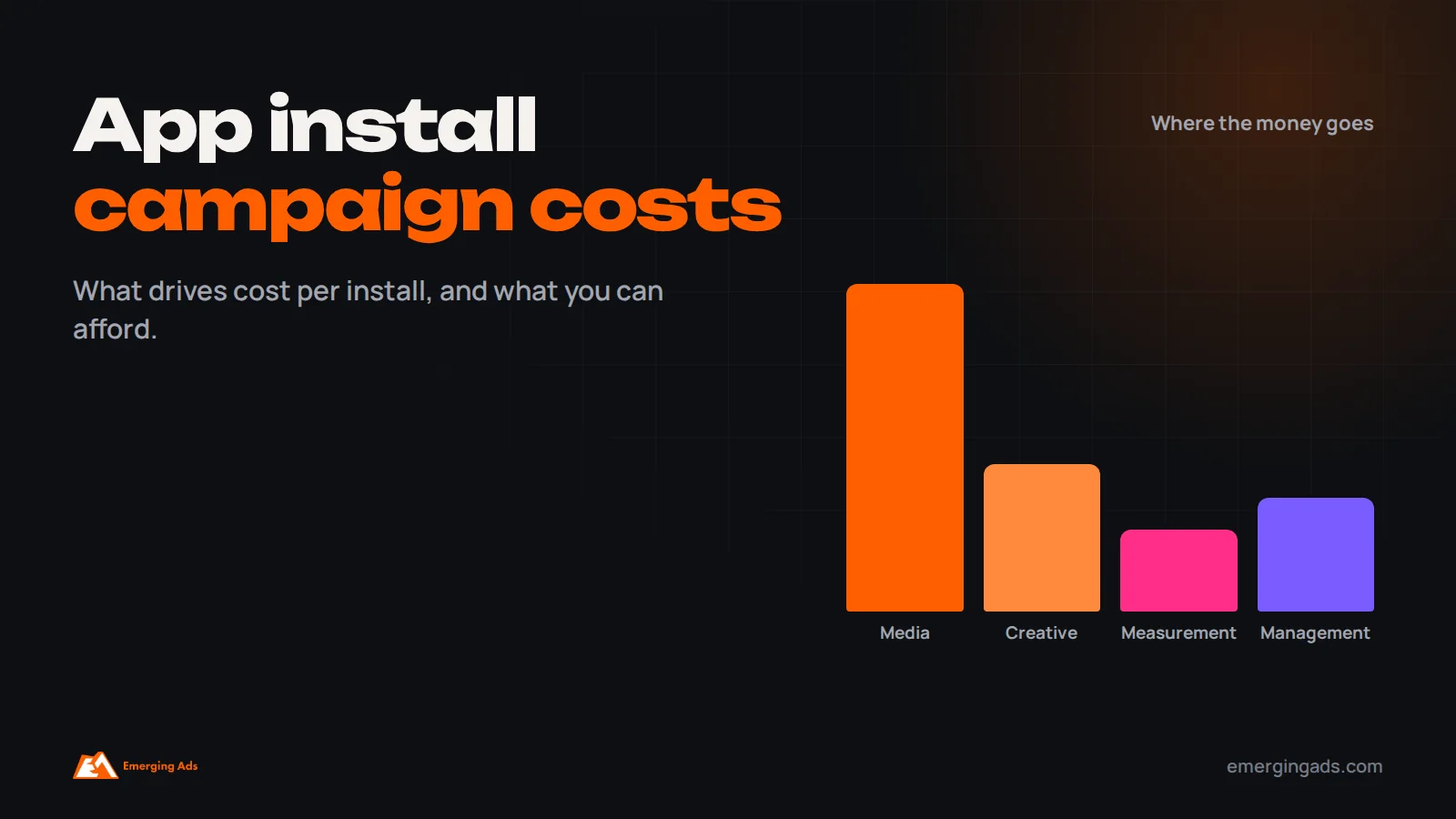
The total cost of an app acquisition program includes:
- Media spend: what you pay the ad platforms for installs, actions or impressions.
- Creative production: videos, playables, screenshots and ad variations, refreshed often.
- Measurement tools: a mobile measurement partner (MMP) for attribution across networks, often priced by attributed installs or as a subscription.
- App store optimization: improving store listings so more people who see ads install.
- Management: in-house time or agency fees.
Media is usually the largest share, but weak creative or poor store pages can make media far more expensive than it needs to be.
How platforms charge
Most app campaigns are bought on an auction basis with automated bidding. You set a goal and, often, a target:
- Target cost per install (CPI): optimize for as many installs as possible near a target cost.
- Target cost per action (CPA): optimize for in-app events such as registration, tutorial completion, first purchase or subscription start.
- Target return on ad spend (ROAS): optimize for purchase value, for apps with in-app revenue.
- Cost per thousand impressions or clicks: used for some awareness and retargeting campaigns.
The deeper the event you optimize for, the higher the cost per result, and usually the higher the quality of users.
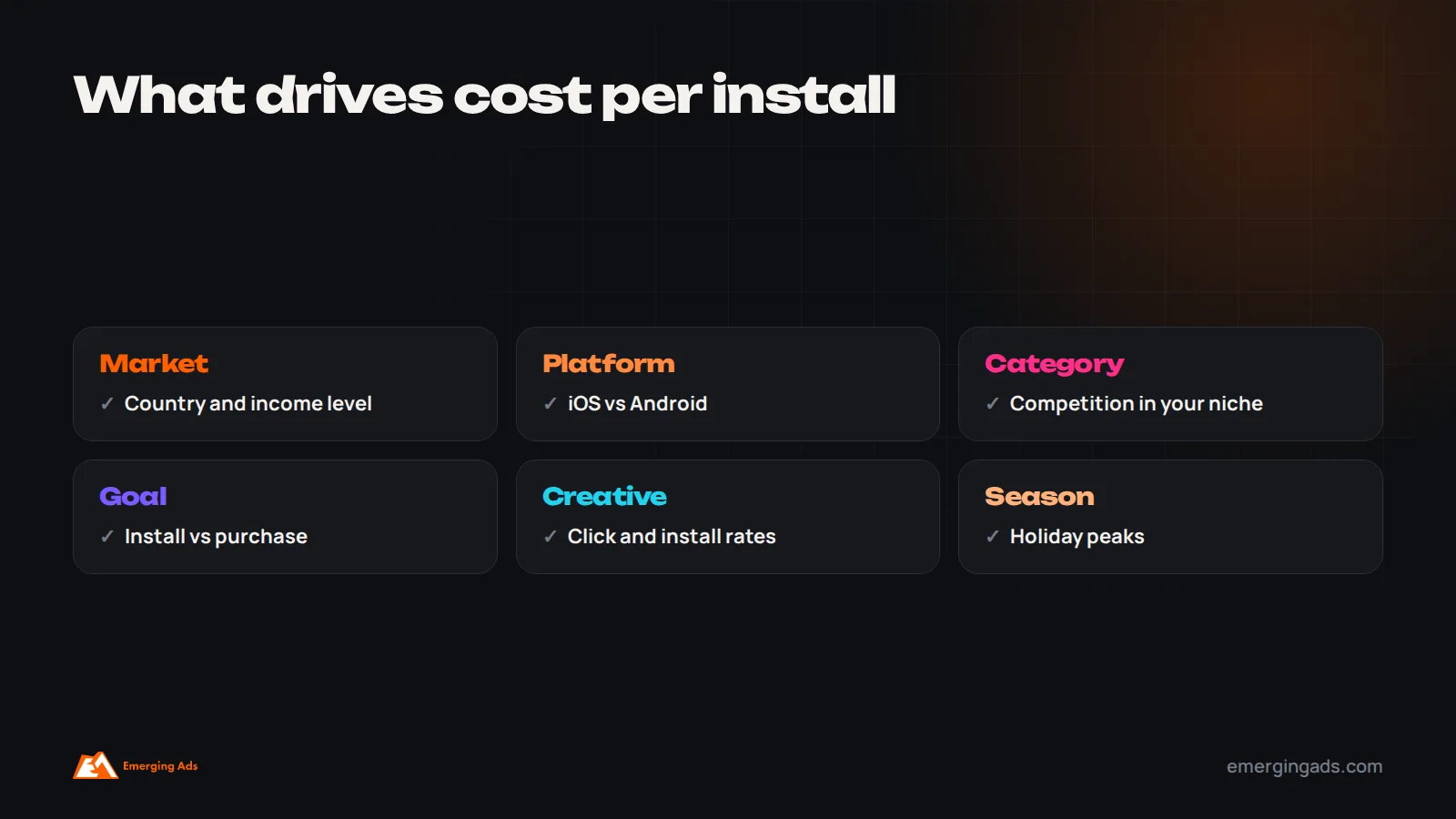
What drives cost per install
Cost per install is the result of many factors working together. Understanding them helps you decide which you can influence and which you simply need to budget for.
- Country: users in high-income markets such as the US, UK, Western Europe and the Gulf usually cost more than users in emerging markets.
- Operating system: iOS users often cost more than Android users in the same market, and are often more valuable.
- App category: finance, insurance and other high-value categories face intense competition; casual games may see low CPIs but need huge volumes.
- Optimization event: installs are cheapest; registrations, subscriptions and purchases cost more per result.
- Creative quality: strong creative lowers costs by earning more clicks and installs per impression.
- Store listing conversion: a better store page turns more clicks into installs.
- Seasonality: costs rise in competitive periods such as the year-end holidays and major shopping events.
- Audience and targeting: narrow targeting usually raises costs.
Platform by platform
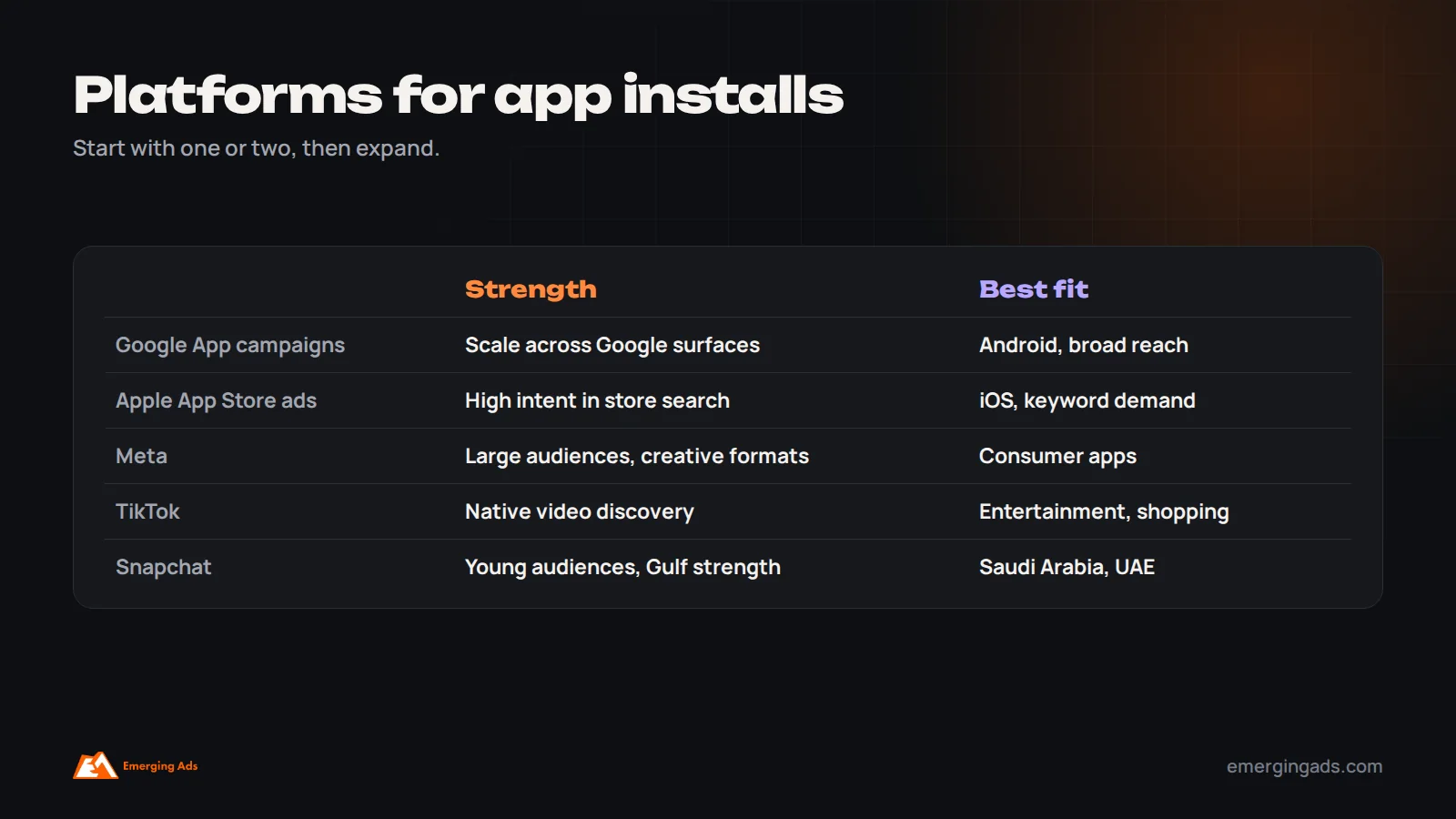
Each platform reaches users at a different moment and charges in its own way. Most apps start with one or two that best match their audience and expand once they know what a valuable user costs.
Google App campaigns run across Search, Google Play, YouTube, Discover and the Display Network from one campaign, using your assets and automated bidding. They are often the largest source of Android installs. Google recommends daily budgets large enough for learning, commonly guided as a multiple of your target cost per install or action, so very small budgets learn slowly.
Apple’s App Store ads (formerly known as Apple Search Ads) place your app at the top of App Store search results and in other App Store placements. Intent is high, since people are already searching in the store, and costs depend heavily on keyword competition.
Meta (Facebook and Instagram) reaches large audiences with strong creative formats, and supports install, event and value optimization. It suits apps with broad consumer appeal.
TikTok works well for entertainment, gaming, social, shopping and lifestyle apps with native video creative, in markets where it is available.
Snapchat reaches younger audiences and is particularly strong in Saudi Arabia, the UAE and other Gulf markets. Our guide to Snapchat Story Ads covers creative that works there.
Ad networks and programmatic sources, such as in-app networks, can add scale, especially for games, but require careful fraud monitoring.
iOS privacy and measurement
Since Apple introduced App Tracking Transparency, many iOS users opt out of tracking, which limits user-level attribution. Apple’s privacy-preserving attribution frameworks provide aggregated, delayed conversion data instead. In practice, this makes iOS campaign optimization harder and reporting less precise. Advertisers respond by carefully configuring conversion values to capture the most important early user actions, using an MMP to combine data, relying more on modeled and incrementality-based measurement, and comparing platform results with actual app revenue. Expect iOS results in ad platforms to be less complete than Android.
Do you need a mobile measurement partner?
If you advertise on more than one network, a mobile measurement partner helps attribute installs and in-app events to the right source, deduplicate claims from different platforms, handle iOS privacy frameworks, detect fraud and send post-install events back to networks for optimization. MMP pricing varies; for small apps, some offer free or low-cost tiers. Advertisers on a single platform sometimes start with the platform’s own SDK and add an MMP as they scale.
Work out what you can afford
The most important number is not your cost per install but what a user is worth. A simple approach:
- Estimate lifetime value per user from your data, such as average revenue per user over 90 or 180 days, adjusted for retention.
- Estimate the share of installs that become paying or active users.
- Decide the payback period you can accept, such as recovering acquisition cost within three or six months.
- Work back to the maximum cost per install or per action you can afford.
For example, if 5% of installs become subscribers worth a certain amount over six months, the maximum you can pay per install is 5% of that value, minus margin and other costs. Apps without revenue data yet should use proxy events, such as registrations or day-7 retention, and treat early campaigns as learning.

Metrics that matter
Judge campaigns on what users do after installing, measured by cohort over time.
- Cost per install, as a starting point only.
- Cost per key action: registration, trial, first purchase or subscription.
- Retention: day 1, day 7 and day 30 retention by campaign and source.
- Return on ad spend at day 7, day 30 and longer windows.
- Lifetime value by cohort and source.
- Payback period: how long until a cohort repays its acquisition cost.
- Store listing conversion rate: page views to installs.

Creative: the biggest controllable lever
On automated platforms, creative often matters more than targeting. Show the app in use within the first seconds, lead with the main benefit, use real people and real screens rather than abstract animation, test several concepts in parallel and refresh frequently as performance fatigues. For games, playable ads and gameplay footage work well; for utility, finance and shopping apps, clear before-and-after or problem-solution stories help. Produce vertical, square and horizontal formats for every platform.
App store optimization lowers paid costs
Every paid campaign ends on an app store page. Improving that page, through a clear icon, compelling screenshots and preview video, a strong first line of description, ratings and reviews, and localized listings for each market, raises the share of visitors who install. A higher store conversion rate lowers cost per install across every paid channel and also boosts organic installs.
Setting a starting budget
Budget size decides how quickly platforms can learn which users are valuable.
Start with enough budget per campaign for the platform to learn, focus on one or two platforms and markets, optimize for a meaningful in-app event as soon as you have enough volume, and run for at least two to four weeks before judging. Splitting a small budget across many platforms usually means none of them learns. Scale gradually once cohorts show acceptable retention and payback.
How costs differ by app category
Games: casual games can see relatively low install costs but depend on very large volumes and strong monetization through ads or in-app purchases. Mid-core and strategy games often pay more per install for players who spend. Creative refresh rates are high, and playable ads are common.
Shopping and ecommerce apps: optimize for first purchase and repeat purchase rather than installs. Costs rise sharply around peak shopping periods such as Black Friday, White Friday and Ramadan, so plan budgets and creative ahead.
Finance, insurance and fintech: among the most competitive categories, with high costs per completed registration or verified account. Compliance rules on advertising financial products also shape creative and targeting.
Subscription apps: fitness, education, productivity and streaming apps optimize for trial starts and paid conversions, and judge campaigns on subscriber lifetime value and churn.
On-demand and marketplace apps: food delivery, ride-hailing and services apps balance acquisition of customers with supply, and often target specific cities. First-order offers and referral programs play a big role.
Social and community apps: depend on network effects and retention; campaigns often target specific communities or regions to build density.
Regional considerations
App marketing costs and channel mix vary by region. In the US, UK and Western Europe, costs per user are generally higher, iOS share is significant and competition is intense. In the Gulf, including Saudi Arabia and the UAE, users are highly valuable for many categories, iOS share is substantial, Snapchat and TikTok are important, and Arabic creative and store listings make a large difference. In India, Android dominates, costs per install are generally lower, TikTok is not available, and regional language creative can expand reach. Localize store listings, creative and offers for each market rather than running one global campaign.
Re-engagement campaigns
Acquiring users is only half the job. Many users install, open the app once or twice and lapse. Re-engagement campaigns, run on Google, Meta and other networks, target existing users with deep links that bring them back to specific content, offers or abandoned carts inside the app. They are often cheaper per active user than acquiring new ones, and work especially well for shopping, travel, food delivery and subscription apps. Combine them with push notifications, in-app messages, email and, where appropriate, WhatsApp, coordinated so users are not overwhelmed.
Web-to-app and search
Some apps acquire users more cheaply through the web first: a landing page or web experience that captures interest, collects an email or phone number, or lets users try a feature before installing. Search ads, SEO and content can bring high-intent visitors to these pages. This approach can also help on iOS, where web conversion tracking is more reliable than app attribution. It works particularly well for subscription, finance and B2B apps where users want to understand the product before installing.
Install fraud and how to avoid it
Mobile ad fraud, such as fake installs from device farms, click spamming and attribution hijacking, can waste significant budget, especially on less reputable ad networks. Signs include very high install volumes with almost no in-app activity, unusual time between click and install, installs concentrated in unexpected locations or devices, and sudden spikes from a single source. Use an MMP with fraud protection, work with reputable networks, judge sources on downstream events rather than installs alone, and cut sources that deliver low-quality users.
A practical testing plan
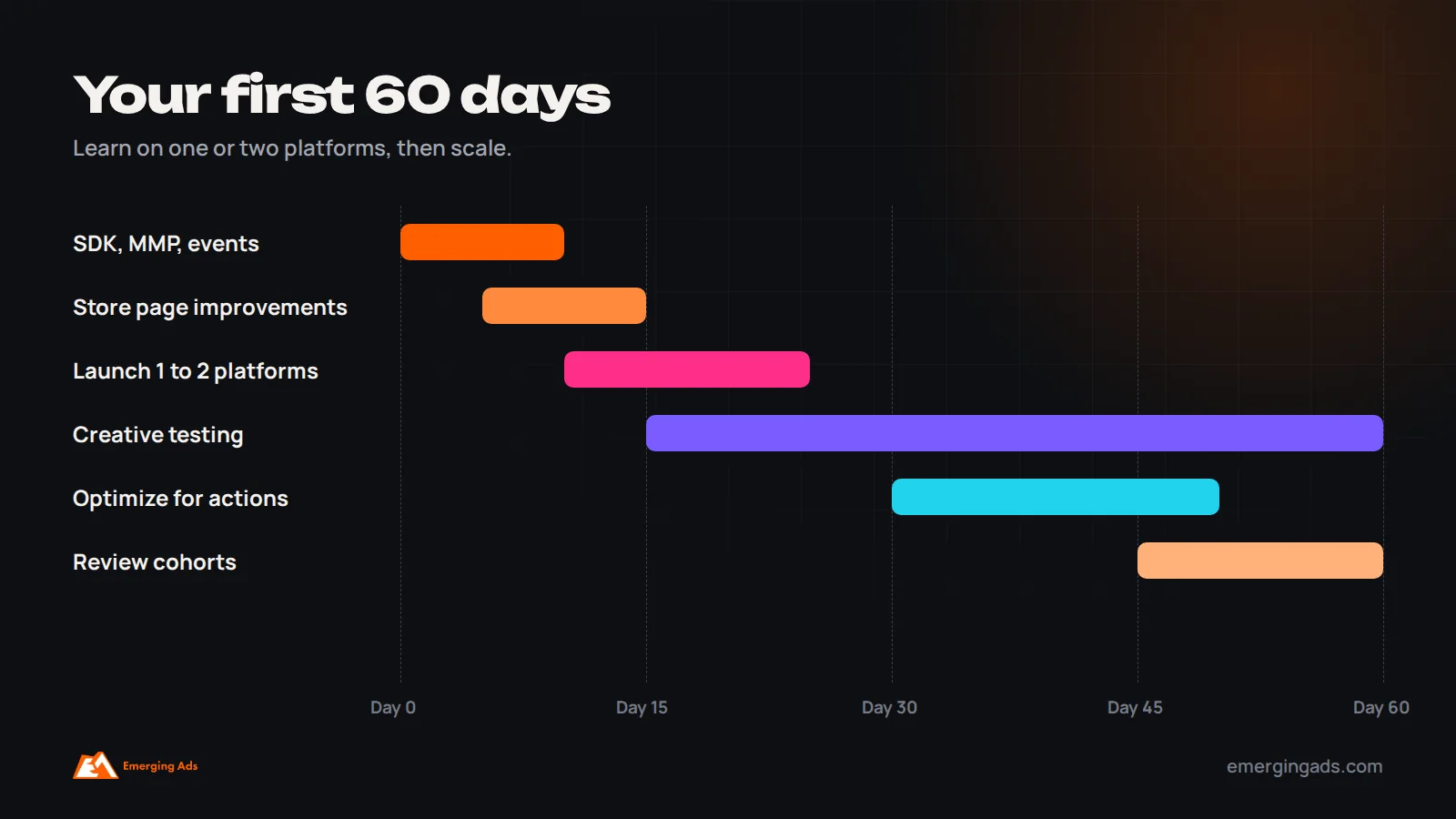
Start with tracking: integrate the SDK and MMP, define the key in-app events, configure iOS conversion values and verify data. Improve the store listing. Launch on one or two platforms that best fit your audience, with several creative concepts and a budget large enough to learn. After two to four weeks, review cohorts by retention and early revenue rather than installs. Shift budget to the sources and creatives producing valuable users, move optimization to deeper events once volume allows, and add new platforms one at a time. Review lifetime value and payback monthly as cohorts mature.
Agency or in-house?
App user acquisition requires skills across platforms, creative production, measurement and analytics. Small app teams often benefit from an agency or specialist for setup, creative testing and platform management, while keeping product analytics in-house. Larger apps with significant budgets usually build in-house user acquisition teams and use agencies for creative or specific channels. Whichever you choose, insist on access to your ad accounts and MMP data, and on reporting by cohort value rather than installs alone.
Choosing the right in-app events
The events you send to ad platforms shape who they find. Choose events that happen early enough and often enough for platforms to learn, and that predict long-term value. For a subscription app, a trial start may be better than a paid subscription if paid conversions are too rare for the algorithm to optimize. For a shopping app, a first purchase or add to cart may work. For a game, reaching a certain level or making a first purchase may be the right signal. Analyze your data to find which early actions best predict retained, paying users, then use those as optimization goals. Revisit the choice as volumes grow.
Configuring iOS conversion values
On iOS, privacy-preserving attribution sends limited, delayed information about what users did after installing. How you configure conversion values decides what ad platforms learn. Most apps map the most important actions in the first day or two, such as registration, trial start, first purchase or revenue ranges, into the available values, prioritizing the signals that best predict lifetime value. Poor configuration leaves platforms optimizing almost blind. An MMP can help set up and manage these values, and they should be reviewed whenever your app or monetization changes.
Measuring true incremental impact
Ad platforms and MMPs attribute installs to campaigns, but some of those users would have installed anyway, for example through organic search or word of mouth. Incrementality testing, such as geographic holdout tests or pausing a channel in some markets, shows how many additional users campaigns actually create. For apps spending meaningful budgets, occasional incrementality tests help decide which channels genuinely grow the user base and which mostly claim credit for organic installs. Our guide on attribution modeling covers these approaches.
Budgeting for an app launch
New apps face a cold start: no data on which users are valuable, no ratings and reviews, and ad platforms with nothing to learn from. Launch budgets should account for a learning period with higher costs. Many apps start with a soft launch in one or two smaller markets to test retention, monetization, creative and store pages before spending heavily in their main markets. Gather early reviews from real users, refine onboarding to improve retention, and only scale paid acquisition once cohorts show the app keeps and monetizes users.
Retention changes everything
Acquisition costs only make sense relative to retention. An app that keeps a higher share of users after 30 days can afford to pay far more per install than one that loses most users in the first week. Before scaling spend, improve onboarding, first-session experience, notifications and core value delivery. Small retention improvements often raise the affordable cost per install more than any bidding change, and make every acquisition channel more efficient.
A worked budgeting example
Consider a subscription fitness app launching in Saudi Arabia and the UAE. From a soft launch, the team knows that a meaningful share of installs start a free trial, a share of trial users convert to paid, and paying users stay for several months on average. Multiplying these together gives the expected subscription revenue per install. The team decides it wants to recover acquisition costs within four months, which sets a maximum affordable cost per install and, more usefully, a maximum cost per trial start.
It launches Google App campaigns for Android and Apple’s App Store ads for iOS, plus Snapchat and Meta with Arabic creative filmed locally, optimizing for trial starts. After four weeks, it compares cohorts by source: one platform delivers cheap installs with poor trial conversion, another delivers fewer installs with strong trial and paid conversion. Budget shifts toward the sources and creatives with the best cost per paying user, not the lowest cost per install.
Producing enough creative
App campaigns on automated platforms consume creative quickly, and performance often drops after a few weeks as audiences see the same ads. Plan a regular production rhythm: several new concepts each month, with variations of the best performers in different lengths, formats and languages. Mix formats such as screen recordings, user-generated style testimonials, problem-solution stories and feature highlights. User-generated content from creators often performs well for consumer apps. Track performance by concept rather than individual ad, so you learn which ideas work and can brief new ones based on evidence.
What a good monthly report looks like
A useful app marketing report shows spend, installs and cost per install by platform and market, but focuses on what happens after the install: cost per key action, retention by cohort, revenue or return on ad spend at several windows, payback progress for earlier cohorts, store conversion rate, creative performance by concept, and planned changes. Reports that stop at installs make it impossible to tell whether campaigns are building a valuable user base.
Seasonality and timing
App advertising costs follow the wider advertising market. They usually rise in the final months of the year as retailers and brands compete for attention, peak around major shopping events, and ease in January. Regional events matter too: Ramadan and Eid change user behavior and competition in the Gulf, and festive seasons such as Diwali do the same in India. Some categories have their own peaks, such as fitness apps in January, education apps around school terms and travel apps before holidays. Plan budgets and creative around these patterns, and judge performance against the same period last year rather than the previous month.
Common mistakes
These are the patterns we see most often in app campaigns that spend a lot and grow little.
- Optimizing only for cheap installs.
- Judging campaigns on cost per install without retention or revenue data.
- Spreading small budgets across too many networks.
- Weak creative refreshed too rarely.
- Ignoring the app store page.
- Poorly configured iOS conversion values.
- No fraud monitoring on network traffic.
If you would like help, our app marketing team plans and runs campaigns across Google, Apple, Meta, TikTok and Snapchat, and our guide to choosing an app install agency covers what to look for.
Frequently asked questions
How much do app install campaigns cost?
Cost per install varies widely by platform, country, operating system, category and optimization goal. Total cost also includes creative, measurement tools and management. Work out what you can afford from user lifetime value.
What is a good cost per install?
One that is below what an installing user is worth, after retention and conversion. Averages vary too much by market and category to be a reliable benchmark.
Why are iOS installs more expensive?
iOS users in many markets are more valuable and competitive to reach, and privacy changes make optimization harder, which can raise costs.
Should I optimize for installs or in-app actions?
Start with installs only if you need volume to learn. Move to meaningful in-app actions or value as soon as you have enough data, since those users are worth more.
Which platform is best for app installs?
It depends on your audience and market. Google App campaigns and Apple’s App Store ads capture intent, Meta and TikTok reach large audiences, and Snapchat is strong in the Gulf.
Do I need a mobile measurement partner?
If you advertise on several networks, yes. An MMP attributes installs and events across sources, handles iOS privacy frameworks and helps detect fraud.
How much budget do app campaigns need?
Enough per campaign for the platform to learn, often guided as a multiple of your target cost per install or action. Focus budget on one or two platforms first.
How does app store optimization affect paid costs?
A better store page converts more visitors into installs, lowering cost per install across all paid channels.