The short answer
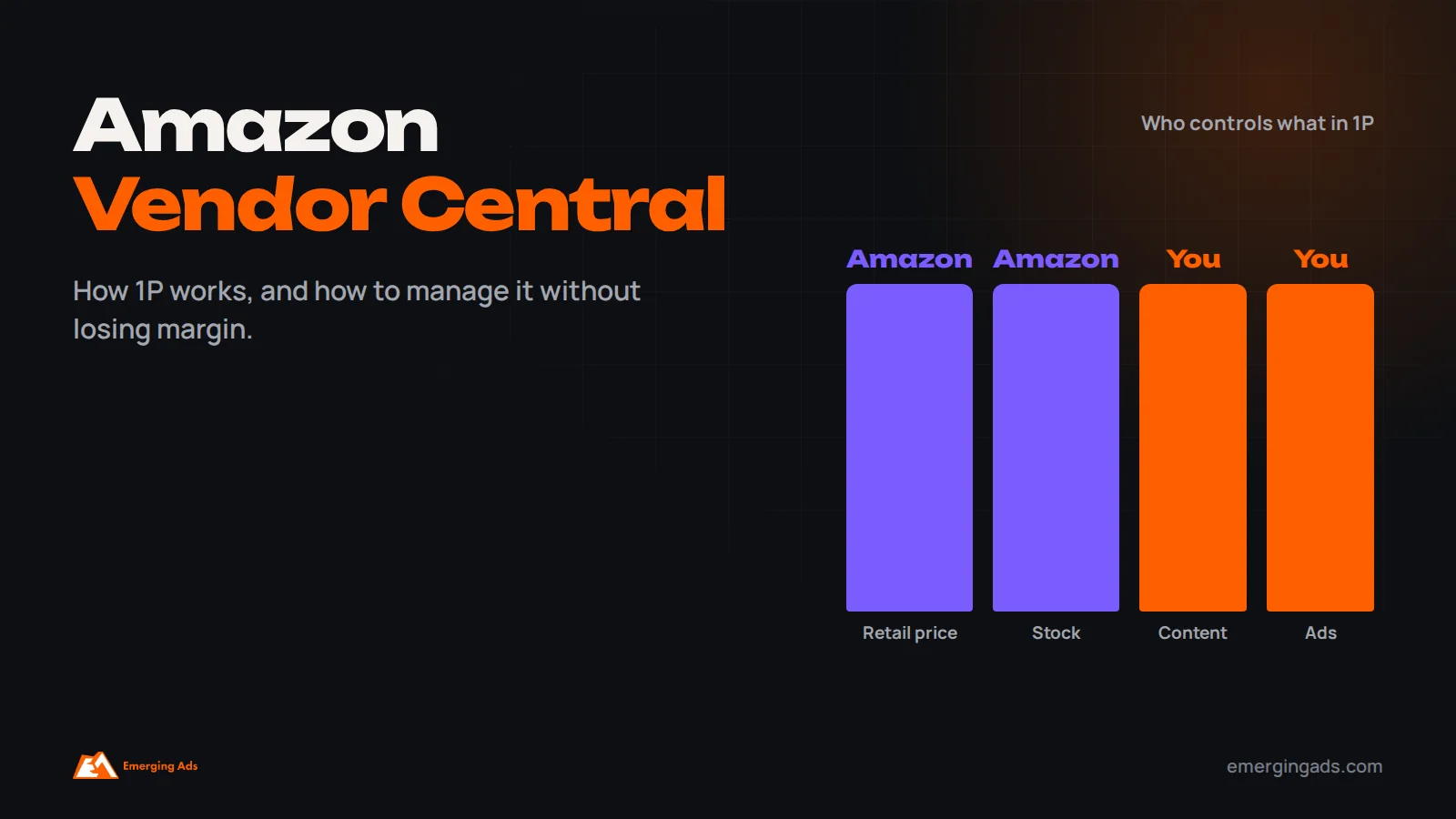
Amazon Vendor Central is the invitation-only portal brands use to sell wholesale to Amazon, which then sets the retail price, holds the stock and sells to customers. Vendor Central management covers everything that relationship involves: confirming purchase orders, meeting shipping and labeling rules to avoid chargebacks, negotiating annual terms, managing listings and A+ Content, analyzing retail data, protecting margins on low-profit products and running advertising. Done well, it turns Amazon into a large, steady wholesale customer. Done poorly, deductions and price pressure quietly erode the margin.
Most brands on Amazon sell through Seller Central, listing products themselves and selling directly to shoppers. A smaller group sells through Vendor Central instead, as a supplier to Amazon. In that model, Amazon is your customer. It sends you purchase orders, buys your products at a wholesale price and resells them as “Ships from and sold by Amazon”.
Being invited to Vendor Central can feel like a milestone. It often is. But it also changes almost everything about how you run Amazon: who controls price, how you get paid, what goes wrong and how you advertise. Brands that treat it like Seller Central with a different login are often surprised by chargebacks, shrinking margins and products Amazon stops ordering.
This guide explains how Vendor Central works, what managing it involves day to day, where the hidden costs are, how advertising differs for vendors and how to decide whether it is right for your brand.
Vendor Central vs Seller Central: the core difference
In Seller Central, the third-party or 3P model, you are the seller. You set prices, own the inventory until it sells, choose whether to fulfill orders yourself or through Fulfillment by Amazon, and pay Amazon referral and fulfillment fees on each sale. Amazon is the marketplace.
In Vendor Central, the first-party or 1P model, you are a supplier. Amazon issues purchase orders, you ship stock to Amazon’s warehouses, Amazon pays you a wholesale cost under agreed payment terms, and Amazon decides the retail price and sells to the customer. Amazon is the retailer.
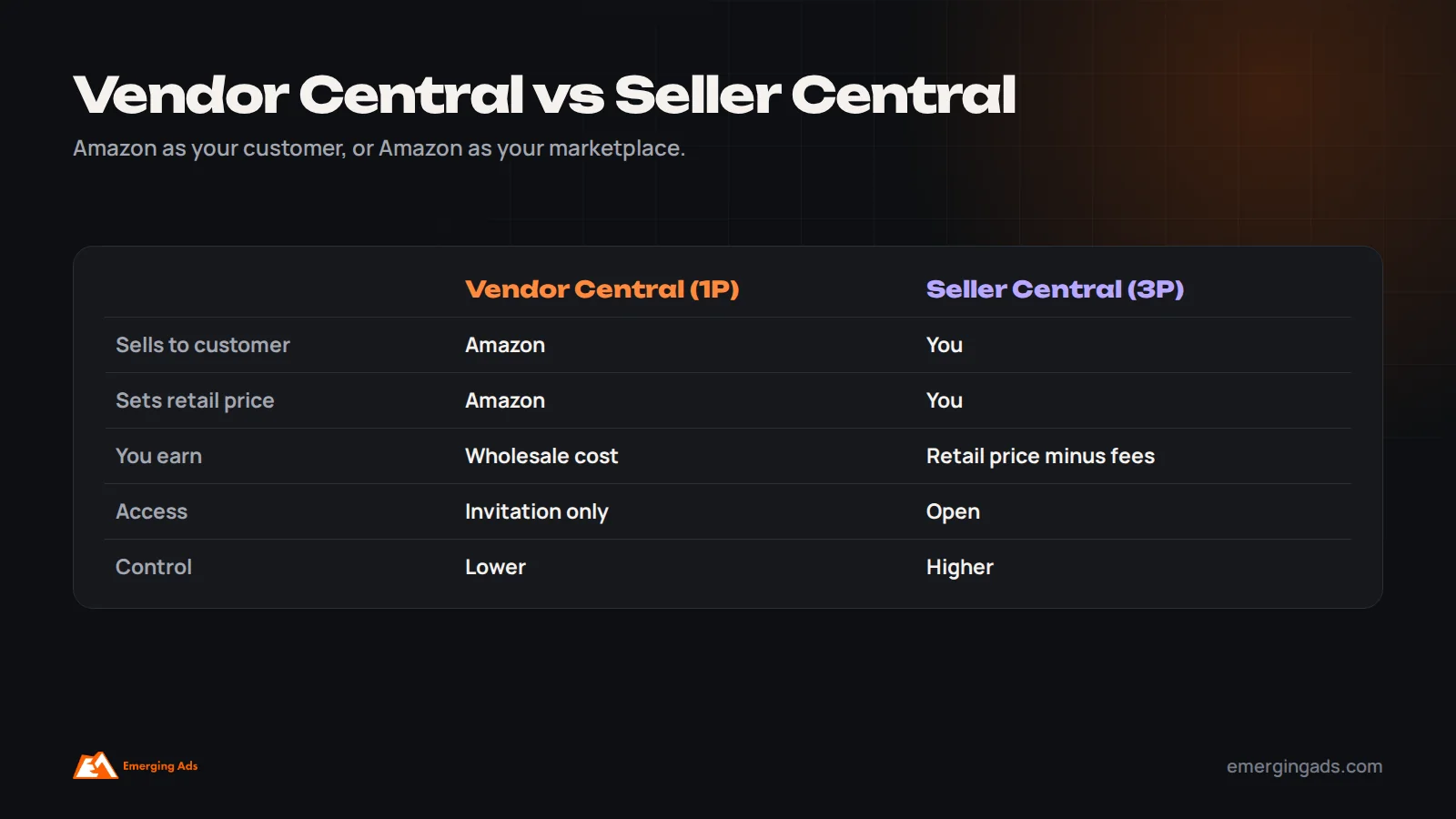
| Area | Vendor Central (1P) | Seller Central (3P) |
|---|---|---|
| Who sells to the customer | Amazon | You |
| Who sets the retail price | Amazon | You |
| How you earn | Wholesale cost from Amazon’s purchase orders | Retail price minus Amazon fees |
| Access | By invitation | Open to registered sellers |
| Main costs | Negotiated allowances, chargebacks, co-op and advertising | Referral, fulfillment, storage fees and advertising |
| Control | Lower over price, stock and listing details | Higher |
| Customer trust signal | “Sold by Amazon” | Depends on brand and reviews |
Some brands run a hybrid: core products through Vendor Central and others, such as new launches, bulky items or slow sellers, through Seller Central. That gives more control, but it requires careful coordination so the two channels do not compete on the same products.
How Vendor Central works, step by step
- Invitation and terms. Amazon invites a brand, usually based on sales elsewhere or demand on Amazon, and proposes terms: wholesale costs, payment terms and various allowances and fees.
- Product setup. Products are set up with cost prices, identifiers, packaging details and listing content.
- Purchase orders. Amazon’s systems forecast demand and send purchase orders. You confirm, partially confirm or reject each line based on stock.
- Shipping. You prepare shipments to Amazon’s specifications, send advance shipment notifications and book deliveries to the warehouses Amazon specifies.
- Invoicing and payment. Invoices are matched against purchase orders and received quantities. Amazon pays according to the agreed terms, minus any deductions.
- Selling. Amazon lists the product, sets the price and sells it. You support sales through content, advertising and promotions.
- Annual negotiation. Terms are typically reviewed each year, when Amazon often asks for improved margins or allowances.
Forecasting and inventory planning
Amazon’s purchase orders are driven by its own demand forecasts, and those forecasts are not always right. Orders can spike before peak seasons and drop suddenly afterwards, and new or seasonal products are especially hard for Amazon’s systems to predict. Vendors who plan only from incoming purchase orders often end up either short of stock when orders spike or holding inventory Amazon never orders.
Use the demand and inventory forecasts in retail analytics alongside your own sales history and planned promotions. Share planned launches, seasonal ranges and marketing pushes with your vendor manager in advance where you have one. Keep safety stock for top sellers, because running out on Amazon damages both sales and the product’s organic rank for weeks afterwards. And track Amazon’s on-hand inventory and open purchase orders weekly, so you can see a problem coming rather than reacting to an empty shelf.
Direct Fulfillment: an alternative to shipping in bulk
Some vendors are offered Direct Fulfillment, a drop-shipping model where Amazon owns the sale but the vendor ships each order directly to the customer from its own warehouse. It suits bulky, heavy or slow-moving products that are expensive for Amazon to stock, and long-tail ranges where holding inventory in Amazon’s network would not make sense.
Direct Fulfillment brings its own standards, for order acknowledgment, shipping speed, tracking and cancellations, and its own penalties when they are missed. It works best for vendors with reliable warehouse systems that can integrate with Amazon’s order feeds.
What day-to-day Vendor Central management involves
Purchase order management
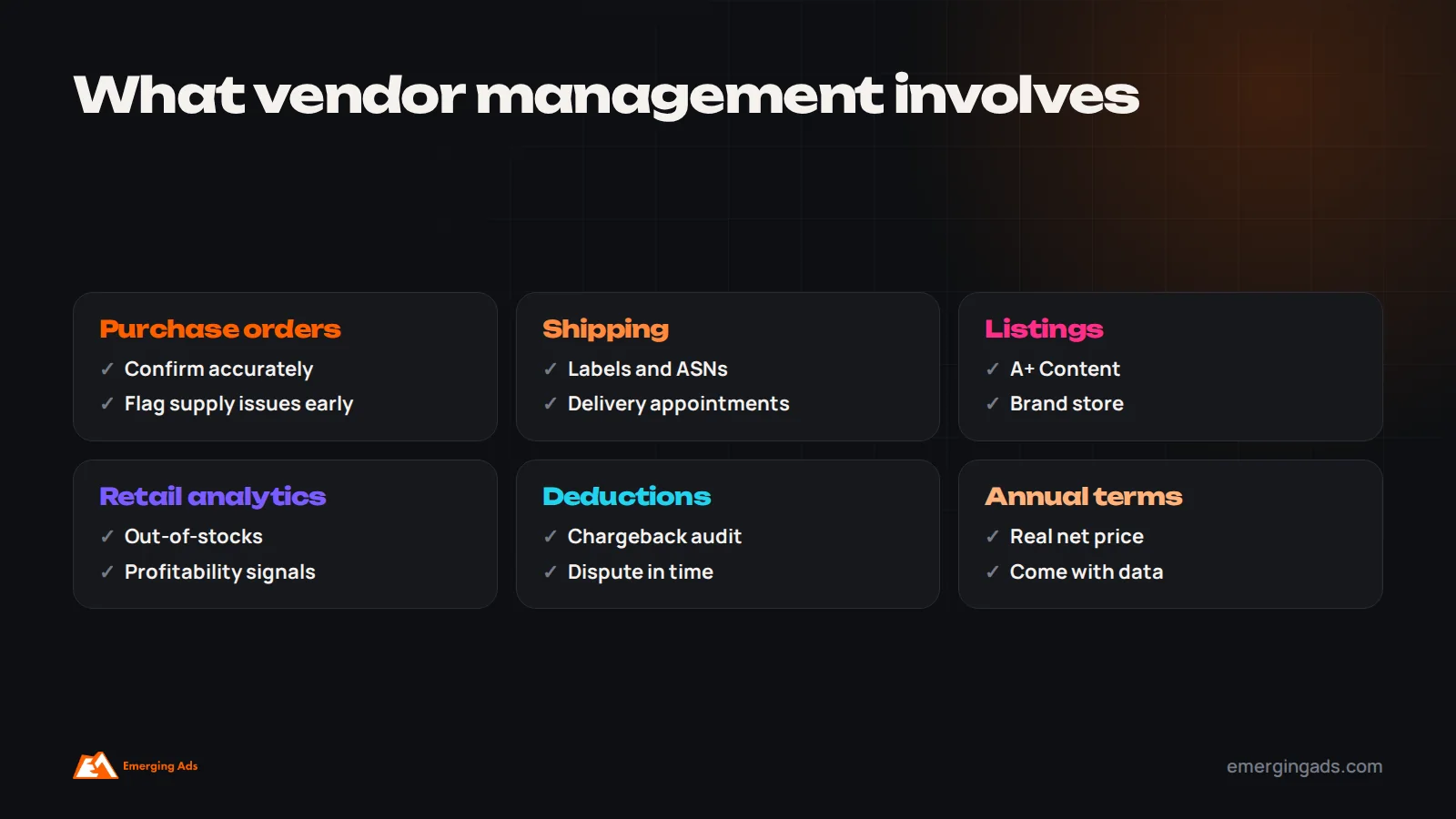
Confirming purchase orders accurately is more important than it sounds. Confirming quantities you cannot ship leads to shortages and penalties. Rejecting too much can reduce future orders, because Amazon’s systems treat unreliable supply as a risk. Good management means checking stock before confirming, responding within the required timeframes and communicating supply problems early.
Shipping and compliance
Amazon has detailed requirements for carton labels, pallet configuration, packaging, advance shipment notices and delivery appointments. Mistakes trigger operational chargebacks. Most deductions we see come from a small number of repeated errors that can be fixed at the warehouse.
Listings and content
Vendors control product content through Vendor Central, though Amazon can override some details. Titles, bullet points, images, A+ Content and brand store pages all affect conversion rate. Because Amazon controls price, content is one of the main levers a vendor has to improve sales.
Retail analytics
Vendor Central gives access to Amazon’s retail analytics: sales, traffic, inventory, forecasts, net profitability and more. Reviewing these regularly helps catch problems early, such as rising out-of-stocks, falling traffic or products slipping into low profitability.
Payments and deductions
Remittances often include deductions for chargebacks, allowances, co-op and shortages. Reconciling them, and disputing incorrect ones within the allowed window, is a recurring task that many brands neglect. Unchallenged incorrect deductions add up quickly.
Chargebacks: the part nobody warns you about
Operational chargebacks are fees Amazon charges when shipments do not meet its requirements. Common triggers include incorrect or missing carton labels, inaccurate advance shipment notices, shipping more or less than confirmed, missed delivery windows, packaging that does not meet standards, and pallet or carton configurations outside the specifications.
Individually, chargebacks look small. Across hundreds of cartons and many shipments, they can take a meaningful share of margin. Amazon also deducts for shortages, where Amazon’s received quantity is lower than what you invoiced, which may or may not reflect what you actually shipped.
Managing chargebacks well involves three habits:
- Fix root causes. Review chargeback reports monthly, find the most common reasons, and fix them at the warehouse or with your logistics provider.
- Keep proof. Proof of delivery, packing lists and photos make disputes winnable.
- Dispute within the deadline. Incorrect chargebacks and shortage claims can be disputed, but only within a set period.
Understanding your terms and allowances
Vendor agreements usually include several types of allowances and fees beyond the wholesale cost, such as marketing or co-op funds, damage allowances, freight allowances and payment term discounts. Together, they reduce what you actually receive per unit. When evaluating Vendor Central, calculate your real net price after every allowance, not the headline wholesale cost.
It also helps to model scenarios before signing: what happens to net margin if Amazon lowers the retail price, if chargebacks run higher than expected, or if a key product loses the buy box to a reseller. A product that only works under perfect conditions is a risk in 1P.
Annual negotiations are where these terms change. Amazon will often ask for better margins. Come prepared with data on your sales growth, advertising investment, content improvements and operational performance, and understand your own minimum acceptable net margin before the conversation starts.
Price control and low-profit products
Because Amazon sets the retail price, it may lower it to match other retailers, including your own website or other marketplaces. Your wholesale cost stays the same, so Amazon’s margin on that product shrinks. When a product becomes unprofitable for Amazon, it may stop advertising it, reduce orders or stop ordering it altogether. Sellers informally call these products “CRaP”, short for “can’t realize a profit”.
Protecting products from this means keeping prices consistent across channels, watching Amazon’s profitability signals in retail analytics, adjusting pack sizes or bundles for low-priced items, and moving products that cannot work in 1P to Seller Central. Price consistency also matters for your brand: if Amazon sells below your own site, customers notice.
Content: the lever vendors control most
With price set by Amazon, the quality of the product page is one of the few levers fully in your hands. Strong listings combine a clear title that leads with brand and product type, bullet points that answer the questions shoppers actually ask, a full set of images including lifestyle and scale shots, a product video where possible, and A+ Content that explains benefits, comparisons and the brand story. A brand store gives shoppers somewhere to browse the full range rather than one product.
Review content for the top-selling products at least quarterly, checking reviews and customer questions for recurring concerns that the listing should answer. Watch for Amazon or other contributors changing details, and use Brand Registry to protect your content.
Promotions and deals for vendors
Vendors cannot simply lower the price, but they can fund promotions through Vendor Central, such as deals, price discounts and coupons, typically paid for through promotional funding from the vendor. Major events such as Prime Day and Black Friday are where these matter most. Plan deals well ahead of event deadlines, make sure Amazon has enough stock to support them, and align advertising budgets with the promotion periods so the extra traffic lands on a discounted, in-stock product. Measure promotions on incremental units and net margin after funding, not just on the sales spike.
Advertising options for vendors
Advertising and organic performance are closely connected on Amazon, so the same efficiency principles we use for sellers, covered in our performance marketing guide, apply to vendors too.
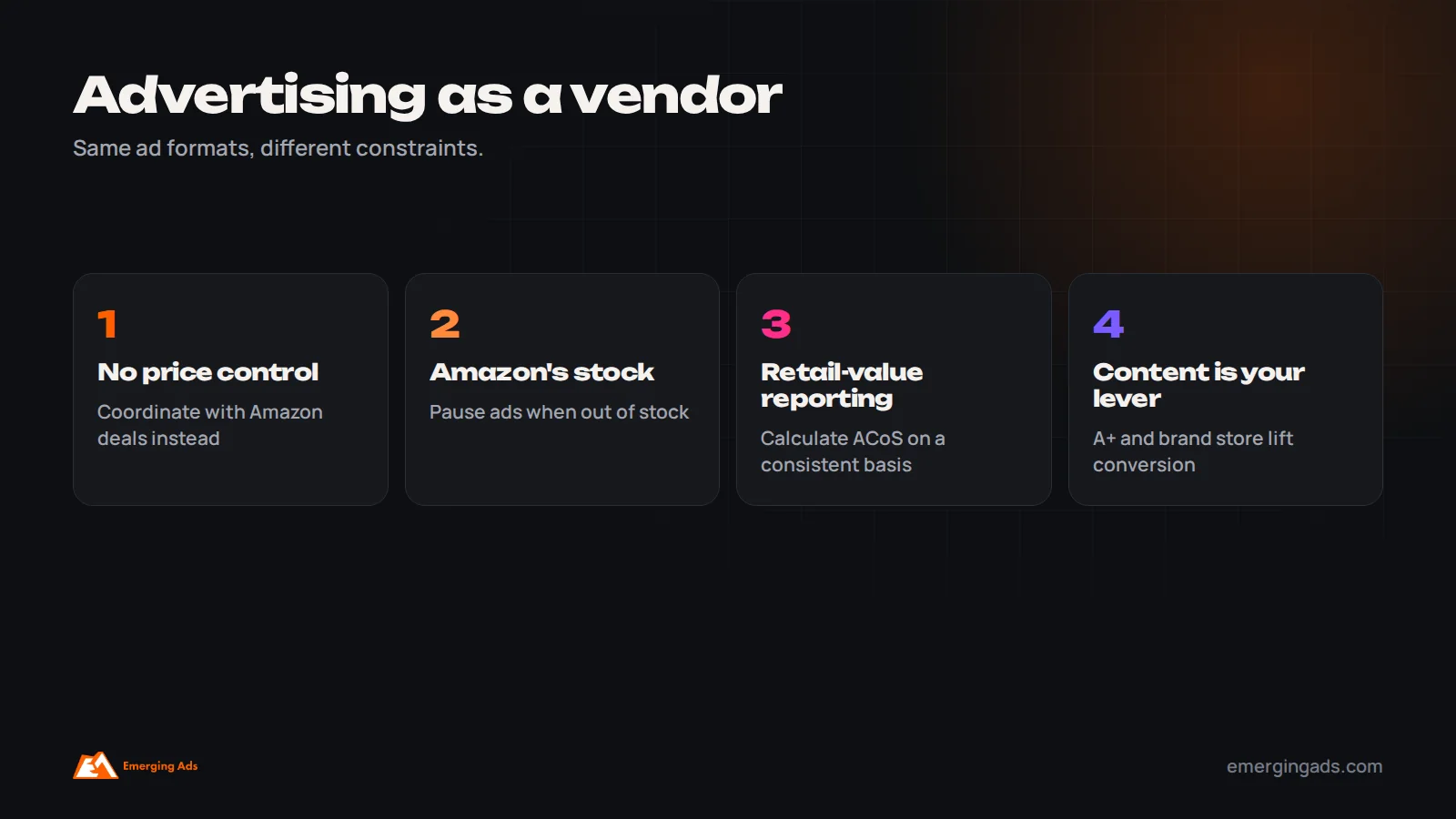
Vendors have access to the main Amazon Ads formats: Sponsored Products, Sponsored Brands, Sponsored Display, Amazon DSP for programmatic display and video, and store and posts features for brands. The mechanics are similar to Seller Central, but a few things differ in practice.
- You cannot control price, so you cannot pair advertising with your own price promotions in the same way. Coordinate with Amazon’s promotions and deals instead.
- Stock is Amazon’s. If Amazon runs low, ads can drive traffic to an out-of-stock listing. Monitor availability and pause ads when needed.
- Measurement is at retail value. Ad sales are reported at Amazon’s retail price, while your revenue is wholesale. When calculating ACoS and TACoS, use a consistent basis. Our guide on ACoS vs TACoS explains how to calculate them properly.
- Advertising supports negotiations. Consistent ad investment is part of the case you make to Amazon about growing the business together.
Content quality, such as A+ Content and the brand store, has an outsized effect for 1P listings, because it directly affects conversion rate on the paid traffic you send. For the advertising side, see our Amazon PPC management service.
Is Vendor Central right for your brand?
Vendor Central tends to suit brands that:
- Have strong, steady demand and can supply reliably in volume.
- Have operations that can meet strict shipping and labeling standards.
- Value the trust and buy box strength of “sold by Amazon”.
- Prefer wholesale-style relationships over managing each sale.
- Have margins that can absorb allowances, deductions and potential price pressure.
It tends to be harder for brands that need tight control over retail price, launch new products frequently, have thin margins, sell bulky or low-priced items, or lack operational capacity to manage compliance. For many of those brands, Seller Central, or a hybrid, is the better fit. Our guide to improving ROAS with Seller Central management covers the 3P side.
Running a hybrid model
A hybrid setup lets you keep core, high-volume products in Vendor Central while using Seller Central for products where you need control or where 1P margins do not work. It requires clear rules about which products go where, consistent pricing across channels to avoid undercutting Amazon’s retail price, and coordination so you are not competing with Amazon for the buy box on the same ASIN. Brand Registry protects your listings and content in both.
Who should manage Vendor Central?
Vendor Central sits across several teams. Operations owns purchase orders, shipping and compliance. Finance owns invoicing, remittances and deduction disputes. Marketing or ecommerce owns content, promotions and advertising. Commercial leadership owns terms and the annual negotiation. Problems usually appear in the gaps between them: a promotion planned without enough stock, or a chargeback nobody disputes because each team assumes another will.
Whoever manages it, make one person accountable for the overall relationship and a weekly review that brings the key numbers together: open purchase orders, fill rate, deductions, top-product availability, sales trend and advertising performance. Many brands use a specialist agency or consultant for parts of this, especially advertising and content, while keeping operations in-house.
The metrics that matter for vendors
- Shipped revenue and units, from retail analytics.
- Purchase order fill rate, how much of what Amazon orders you actually supply.
- Chargeback and shortage rates, as a share of invoiced value.
- Net received margin, after allowances and deductions.
- Out-of-stock rate on key products.
- Conversion rate and glance views on product pages.
- Advertising ACoS and TACoS, calculated on a consistent basis.
- Net profitability signals for Amazon, to spot products at risk.
Common Vendor Central mistakes
- Accepting terms without calculating the real net price after allowances.
- Confirming purchase orders for stock you do not have.
- Treating chargebacks as unavoidable rather than fixing causes.
- Not disputing incorrect deductions within the deadline.
- Pricing lower on your own site or other marketplaces than Amazon’s retail price.
- Neglecting A+ Content and listings because Amazon “handles the selling”.
- Advertising products that are out of stock or unprofitable for Amazon.
A 90-day plan to take control of Vendor Central
- Days 1 to 30: map every allowance and fee in your terms to calculate real net price per product, audit the last six months of chargebacks and shortages, and dispute anything still within the deadline.
- Days 30 to 60: fix the top three chargeback causes with your warehouse, set up a weekly purchase order and inventory review, and improve content for your top 20 products.
- Days 60 to 90: review profitability signals for every product, decide which low-profit products to reprice, rebundle or move to Seller Central, and align advertising budgets with stock levels and planned promotions.
After 90 days, most vendors have a clearer picture of real margin, fewer deductions and a stronger base for the next annual negotiation.
Getting started, or getting control back
If you are new to Vendor Central, start by mapping every allowance in your terms, setting up a weekly purchase order and shipment routine, and reviewing chargeback requirements with your warehouse before the first shipment. If you already sell as a vendor and margins have been slipping, the quickest wins usually come from a chargeback and deduction audit, a review of low-profitability products, and better content on top sellers.
We help brands with the advertising and content side of Amazon through our Amazon advertising service, alongside wider ecommerce marketing. If you want to see where your current Amazon spend is going, start with a free ad audit.
Frequently asked questions
What is Amazon Vendor Central?
Vendor Central is Amazon’s invitation-only platform for suppliers who sell wholesale to Amazon. Amazon issues purchase orders, buys the stock, sets the retail price and sells to customers.
What is the difference between Vendor Central and Seller Central?
In Vendor Central you sell to Amazon as a supplier and Amazon sells to the customer. In Seller Central you sell directly to customers on Amazon’s marketplace, set your own prices and pay fees.
How do I get invited to Vendor Central?
Invitations come from Amazon, typically to brands with strong sales or demand, either on Amazon through Seller Central or through other retail channels. There is no open application process.
What are Amazon chargebacks?
Chargebacks are fees Amazon deducts when shipments do not meet its requirements, such as incorrect labels, inaccurate shipment notices or missed delivery windows. Many can be avoided by fixing operational causes, and incorrect ones can be disputed within a deadline.
Can vendors control their prices on Amazon?
No. Amazon sets the retail price for 1P products. Vendors influence it indirectly through wholesale cost, promotions and keeping prices consistent across channels.
Can vendors run Amazon ads?
Yes. Vendors can use Sponsored Products, Sponsored Brands, Sponsored Display and Amazon DSP. Ad sales are reported at retail value, so calculate ACoS and TACoS on a consistent basis.
Is Vendor Central better than Seller Central?
Neither is better in general. Vendor Central suits brands with strong demand, reliable operations and margins that absorb allowances. Seller Central suits brands that want control over price, inventory and customer data. Some use both.
Why did Amazon stop ordering my product?
Common reasons include low profitability for Amazon at the current retail price, poor fill rates or compliance issues, and falling demand. Retail analytics and your vendor manager can help identify which applies.