

The short answer
The best medical practice SEO strategy in 2026 combines a complete, active Google Business Profile for every location, a steady flow of genuine patient reviews, fast and accessible service and condition pages written or reviewed by qualified clinicians, clear practitioner profiles with credentials, accurate business details across directories, technical SEO that keeps pages crawlable and fast, and content that answers patients’ real questions accurately. Health content is held to high standards of expertise and trust, so accuracy, authorship and compliance matter as much as keywords. Measure success in booked appointments, not traffic alone.
When people need a doctor, dentist, physiotherapist, dermatologist or specialist, most start with a search: a symptom, a treatment, a specialist near them, or the name of a practice they have heard of. The practices that appear at the top of those searches, with strong reviews and clear information, get the calls and bookings.
Medical SEO has its own rules. Search engines treat health topics as areas where inaccurate information can cause real harm, so they look for clear signs of expertise, authoritativeness and trust. Advertising and patient privacy rules also shape what practices can say and how they handle data. And most patients choose locally, which makes maps, reviews and location pages central.
We help healthcare practices with SEO and patient acquisition through our healthcare marketing and local SEO services. This guide sets out a practical SEO strategy for medical practices in 2026.

Local SEO: where most patients find you
For most practices, local search is the single most important source of new patients, and the place to start.
Most patients choose a practice near home or work. When they search for a dentist, GP, physiotherapist or specialist nearby, Google shows a map with a small number of practices. Winning a place there depends on relevance, distance and prominence, and practices can influence relevance and prominence directly.
- Complete Google Business Profile for each location: correct primary and secondary categories, services, accurate opening hours including holidays, photos of the practice and team, appointment links and regular updates.
- Consistent details across healthcare directories, insurers’ listings and general directories.
- Location pages on the website for each clinic, with address, map, parking, accessibility, services, practitioners and reviews.
- Reviews, collected steadily and answered professionally.
Patient reviews, handled properly
Reviews are often the deciding factor when patients compare nearby practices, so they deserve a deliberate process.
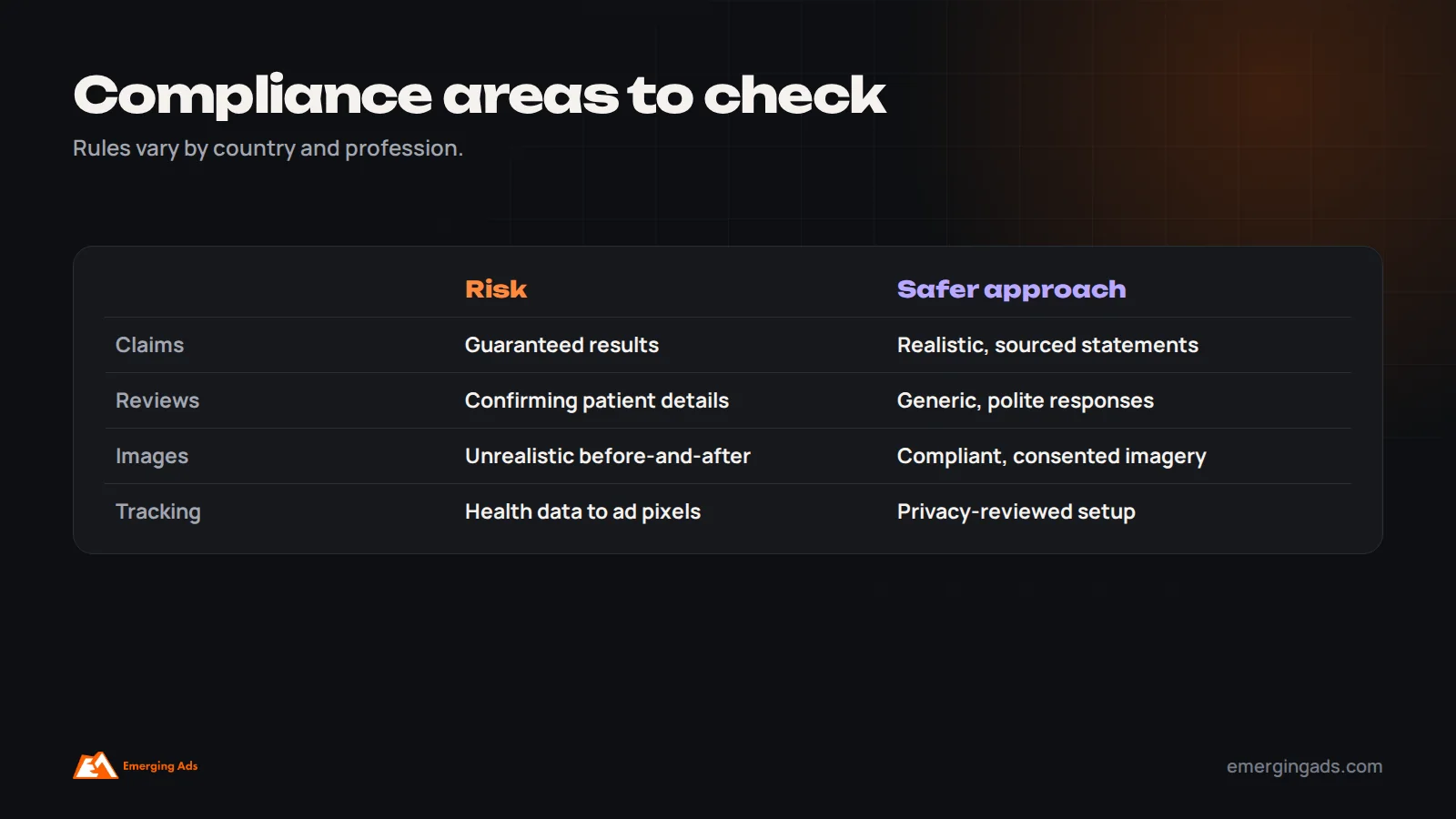
Reviews influence both rankings and patient choice. Ask satisfied patients for reviews through a simple, consistent process, such as a message after an appointment with a direct link. Respond to every review, thanking positive reviewers and addressing concerns politely, without confirming that the reviewer is a patient or discussing any clinical details, which could breach patient confidentiality. Never offer incentives for positive reviews or write reviews on patients’ behalf, which breaches platform rules and, in many places, professional standards.
Service and condition pages
Each main service and condition you treat deserves its own page. A strong page explains the condition or treatment in plain language, who it is for, what happens during treatment, recovery and results expectations stated responsibly, risks where relevant, cost or insurance information where possible, the practitioners who provide it, and how to book. Pages should be written or reviewed by qualified clinicians, show the reviewer’s name and credentials, and display a last-reviewed date. Patients and search engines both reward pages that answer questions completely and honestly.

Practitioner profiles that build trust
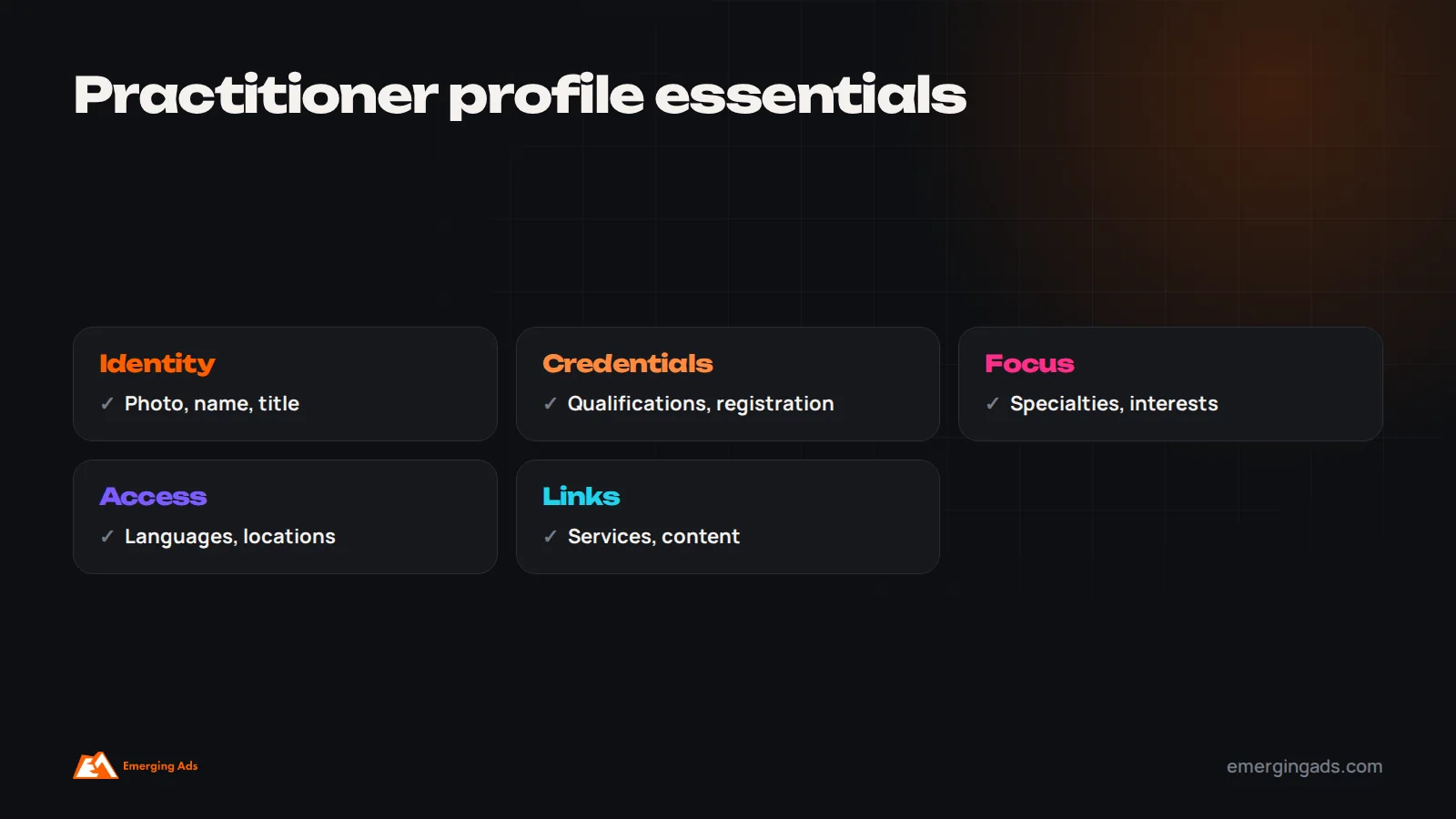
Patients often choose a practice because of a specific clinician, and search engines look for clear evidence of who provides care. Every practitioner should have a dedicated profile page with a professional photo, full name and title, qualifications and registration details, specialties and areas of interest, languages spoken, the locations where they practice, a short personal introduction, and links to the services they provide and content they have written or reviewed. Many patients search for practitioners by name before booking, so these pages also capture valuable branded searches. Keep profiles updated as clinicians join, leave or change roles, and make sure the same details appear on directory listings and professional registers.
SEO for multi-location practices
Practice groups with several clinics need a scalable approach. Each location should have its own Google Business Profile, a unique location page with genuinely local details rather than duplicated text, its own reviews, and accurate listings in directories. Central service pages can link to the locations that offer each service, and location pages can list the services and practitioners available there. Managing reviews, hours and posts across many profiles benefits from a clear process and, for larger groups, dedicated tools. Avoid creating thin pages for areas where you have no clinic; they rarely rank and can undermine trust.
How priorities differ by specialty
Dental practices compete heavily on local search for general dentistry and on treatment searches such as implants, aligners and whitening, where detailed pages, before-and-after content where permitted and clear pricing information help. GP and primary care practices focus on local visibility, registration information, opening hours and services. Physiotherapy and sports medicine clinics benefit from condition pages for common injuries and educational content. Dermatology and aesthetics face strict rules on claims and imagery, so compliance review is essential. Specialist consultants rely on practitioner profiles, referral relationships and condition-specific content. Mental health services need especially careful, compassionate content and strong privacy practices.

Experience, expertise and trust
Google’s quality guidelines give special weight to experience, expertise, authoritativeness and trust for health topics. For practices, that means named authors and reviewers with credentials; detailed practitioner profiles with qualifications, registrations, specialties and experience; clear information about the practice, its ownership and how to contact it; accurate, well-sourced medical information; transparent policies; and a strong reputation in reviews and mentions. These signals also reassure patients, who want to know who will treat them.
How patients search for care
Patient searches fall into a few patterns, and a strong strategy covers each one. Symptom and condition searches, such as knee pain when running or recurring headaches, come from people trying to understand a problem; helpful condition pages and articles can introduce your practice at this early stage. Treatment searches, such as dental implants or physiotherapy for back pain, show stronger intent; detailed service pages answer them. Local provider searches, such as dentist near me or dermatologist in a particular city, show the highest intent; maps, reviews and location pages win them. Practitioner and practice name searches come from people who have been referred or already know you; strong profiles and consistent branding capture them. Practical searches, such as opening hours, parking, insurance accepted and costs, often decide whether a patient books with you or someone else. Mapping your priority services against these patterns shows where content and optimization are missing.
Cost, insurance and practical information
Patients often hesitate because they do not know what treatment will cost, whether their insurance is accepted or how long they will wait. Practices that answer these questions clearly on their website tend to convert more visitors into appointments and rank for valuable practical searches. Where exact prices are not possible, give ranges, explain what affects cost, list accepted insurers and payment options, and describe typical waiting times. Keep this information current; outdated prices or insurer lists frustrate patients and generate complaints.
Video and visual content
Short videos of clinicians explaining common conditions, what happens during a treatment, or what to expect at a first visit help nervous patients feel comfortable and build trust in your team. Videos can be embedded on service pages, shared on YouTube and social media, and used in your Google Business Profile. Photos of the practice, waiting areas, equipment and staff also make profiles and pages more welcoming. Always obtain consent before featuring patients, and follow professional rules on clinical imagery.
Referrals, partnerships and local authority
Links and mentions from reputable local and healthcare sources strengthen a practice’s authority. Good opportunities include professional association directories, hospital and referral partner pages, local community organizations, sports clubs a physiotherapy clinic supports, health charities, local news coverage of practice events and expert commentary, and university or training affiliations. These relationships often produce patient referrals directly as well as improving search visibility. Avoid buying links or joining low-quality directories, which add little value and can create risk.
Keeping information accurate
Medical information and practice details change. Review service and condition pages at least once a year, or whenever clinical guidance changes, updating the reviewed date and reviewer. Update practitioner profiles when staff change. Check Google Business Profile hours before every public holiday. Remove services you no longer offer. Accuracy protects patients, maintains trust and supports rankings, since search engines favor current, reliable health information.
Structured data for medical practices
Structured data is code that helps search engines understand what a page contains. For medical practices, useful types include markup identifying the organization or medical business, each location with address, opening hours and contact details, physicians and other practitioners, and frequently asked questions where appropriate. Structured data does not guarantee special search features, but it makes information clearer and more consistent for search engines and AI tools. Keep it accurate and matched to visible content on the page, and validate it with Google’s testing tools after changes.
SEO for a new practice or new location
A new practice or location starts with no reviews, no history and no rankings. Speed up visibility by creating and verifying the Google Business Profile as early as allowed, building a detailed location page before opening, listing the practice in key healthcare and local directories, announcing the opening through local media and community partners, collecting reviews from the first patients through a consistent process, and supporting the launch with local search ads until organic visibility builds. Expect it to take several months to compete with established practices in competitive areas.
An example strategy for a dental practice
Consider a two-location dental practice wanting more implant and orthodontic patients. The first month fixes both Google Business Profiles, adding services, photos and accurate hours, and sets up review requests after appointments. Location pages are rebuilt with parking, accessibility and team details. Next, detailed service pages for implants, clear aligners and whitening are written with the lead dentist, covering suitability, process, recovery, cost ranges and financing, with before-and-after images used only where permitted and consented. Practitioner profiles are expanded. Booking is simplified on mobile. Over the following months, articles answering common questions about implants and aligners are published and linked to service pages. The practice tracks map calls, booking clicks and new patients by treatment, and sees steady growth in high-value treatment enquiries.
Choosing a medical SEO partner
If you work with an agency, choose one with healthcare experience, a clear understanding of medical advertising rules and patient privacy, a process for clinician review of content, and reporting focused on appointments and new patients. Be cautious of agencies promising guaranteed rankings, using generic content across many practices, or installing tracking without considering privacy. Our guide on choosing a marketing agency covers the wider selection process.
Mobile experience and accessibility
Most patients search for care on their phones, often while unwell, worried or in a hurry. A practice website that loads slowly, has tiny buttons or hides the phone number loses patients before they book. Make the phone number and booking button visible on every page, keep pages fast by compressing images and limiting scripts, use readable font sizes and strong contrast, and test the full booking journey on a real phone. Accessibility is especially important in healthcare, since many patients have visual, motor or cognitive needs. Clear headings, descriptive links, alt text for images, keyboard navigation and simple language make the site usable for more people, and accessible sites tend to perform better in search as well.
Serving patients in several languages
In diverse cities, many patients prefer to find and discuss care in their own language. If your practitioners or staff speak other languages, say so clearly on practitioner profiles, location pages and your Google Business Profile. Where demand justifies it, create key pages in the languages your patients use, written or reviewed by fluent speakers with medical knowledge rather than machine-translated. In the Gulf, Arabic and English pages are often both essential; in other markets, languages spoken by local communities can be a strong differentiator in local search.
What good reporting looks like
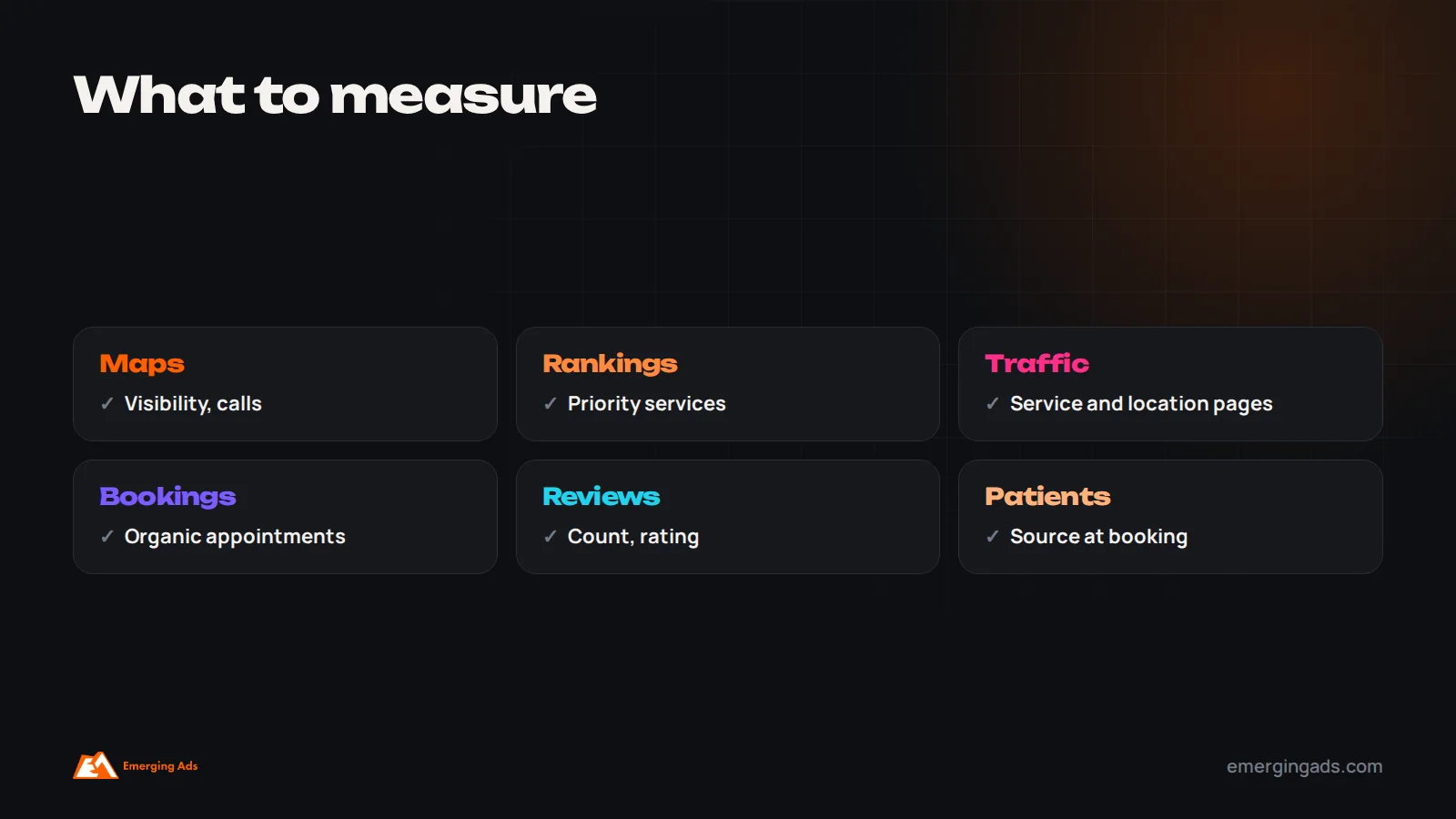
Monthly SEO reports for practices should be short and practical. They should show map visibility and Google Business Profile actions such as calls, direction requests and booking clicks for each location; rankings for priority services and locations; organic traffic to service and location pages; appointment requests from organic search; review growth and rating; technical issues found and fixed; and planned work for the next month. Practices that also record how new patients found them at booking can connect SEO work directly to new patient numbers.
SEO for telehealth and online consultations
Many practices now offer online consultations alongside in-person care. Telehealth services can reach patients beyond the immediate area, but licensing and regulations usually limit where clinicians can treat patients, so pages should state clearly which regions or patients you can serve. Create dedicated pages explaining how online consultations work, which conditions are suitable, technology requirements, costs and how to book. These pages can rank for broader searches than location-based pages, while location pages continue to capture local demand for in-person visits.
Learning from competitors
Look at the practices that consistently appear in the map pack and top results for your priority searches. Compare their Google Business Profiles, number and recency of reviews, service page depth, practitioner profiles, site speed and content. You will usually find specific gaps you can close, such as missing service pages, fewer recent reviews or incomplete profile categories. Focus on outperforming them on usefulness and trust rather than copying their content.
Realistic timelines
Google Business Profile improvements and a steady review process can improve map visibility within weeks to a few months. New or rewritten service pages typically take several months to rank for competitive treatments, and longer in crowded urban markets. Content and authority build over a year or more. Measure progress monthly, but judge the strategy over at least six months, and keep improving pages based on what patients ask and what the data shows.
A quick medical SEO checklist
Check that every location has a complete, verified Google Business Profile with correct categories and current hours; that details match across directories; that each location has its own page; that each main service and condition has a dedicated, clinician-reviewed page with a reviewer name and date; that every practitioner has a detailed profile; that a compliant review process is running; that the site is fast, accessible and easy to book on mobile; that structured data is in place; that tracking respects patient privacy; and that you record new patients by source. Most practices find several quick wins in this list.
Technical SEO for medical websites
Many practice websites are slow, hard to use on mobile or built on templates that bury important pages. Make sure pages load quickly on phones, every important page is indexable and linked from navigation, location and service pages have clean URLs, structured data identifies the practice, locations and practitioners, and booking works smoothly on mobile. Accessibility matters especially in healthcare: readable fonts, good contrast, keyboard navigation and descriptive alt text. Our technical SEO checklist covers the essentials.
Content that answers patients’ questions
Helpful content brings patients to your practice earlier in their journey, often before they are ready to book, and builds the trust that makes them choose you later. It also supports your service pages and gives AI tools accurate information to reference.
Patients search for symptoms, treatments, costs, recovery times, preparation and what to expect. Content that answers these questions accurately builds visibility and trust. Good topics come from questions patients ask at the front desk and in consultations. Keep content factual and responsible, avoid diagnosing readers, encourage them to seek professional advice, and update pages when guidance changes. Content should support service pages and link to booking, rather than compete with them.
AI search and health questions
Patients increasingly ask AI assistants and see AI Overviews for health questions and provider recommendations. These tools tend to draw on authoritative, clear and current sources, along with reviews and business listings for local recommendations. Practices that publish clinician-reviewed content, keep business details consistent and maintain strong reviews improve their chances of being referenced. Our guide to generative engine optimization explains the approach.
Compliance and patient privacy
Healthcare marketing must follow advertising rules and professional standards on claims, testimonials, before-and-after images and promotions, which vary by country and profession. Patient data must be protected under health privacy and data protection laws. Be cautious with tracking tools on pages and forms that may collect health information; in some jurisdictions, sharing such data with advertising platforms through pixels has led to regulatory action. Work with your agency and compliance advisers to configure analytics and forms appropriately.
Making booking easy
SEO brings patients to your website, but booking turns visits into appointments. Make it easy: a clear booking button on every page, online booking where possible, click-to-call on mobile, short contact forms, and information about what to bring, insurance and costs. Check that booking works on phones and that confirmation messages are sent promptly. Track booking clicks and completed bookings as conversions in analytics, using approaches that respect patient privacy. Many practices find that improving booking flow raises appointments as much as improving rankings. Our guide to conversion rate optimization covers how to find and fix friction.
How SEO works with paid advertising
SEO builds lasting visibility, while paid search can fill gaps immediately, for example for a new location, a new service or competitive treatments where organic rankings take time. Search ads for healthcare are subject to platform policies on medical services, and some treatments and claims are restricted. Paid search data also shows which treatment searches produce bookings, which helps prioritize SEO content. Many practices run both, shifting budget toward organic as rankings grow. Our guide to lowering Google Ads CPA explains how to run search ads efficiently.
A 90-day medical SEO plan
- Weeks 1 to 3: audit Google Business Profiles, directory listings, website technical health, tracking and privacy setup; fix profile categories, hours and details.
- Weeks 3 to 6: set up a review request process, build or improve location pages and practitioner profiles, and fix the most important technical issues.
- Weeks 6 to 10: create or rewrite priority service and condition pages with clinician review, add structured data and improve booking flow.
- Weeks 10 to 13: publish patient-question content, review rankings, map visibility and appointment data, and plan the next quarter.
Measuring medical SEO
Judge SEO on new patients and appointments, measured consistently every month across all locations.
- Map visibility and Google Business Profile calls, direction requests and booking clicks.
- Rankings and impressions for priority services and locations.
- Organic traffic to service, condition and location pages.
- Appointment requests and bookings from organic search.
- Review count, rating and response rate.
- New patients by source, recorded at booking.

Common mistakes
These are the issues we find most often when auditing medical practice websites and profiles.
- Incomplete or inaccurate Google Business Profiles.
- One generic services page instead of dedicated pages.
- Content without named clinical authors or reviewers.
- Slow mobile pages and difficult booking.
- Ignoring reviews or responding in ways that breach confidentiality.
- Tracking setups that expose health data.
- Measuring traffic instead of appointments.
Frequently asked questions
What is the best SEO strategy for a medical practice?
Strong local SEO with complete Google Business Profiles and reviews, clinician-reviewed service and condition pages, detailed practitioner profiles, solid technical SEO and helpful patient content, measured in appointments.
How do medical practices rank in Google Maps?
Through complete and accurate Google Business Profiles, relevant categories, consistent details across directories, location pages and a steady flow of genuine reviews.
Why does expertise matter so much for health content?
Search engines hold health topics to high standards because inaccurate information can cause harm, so named clinical authors, credentials and accuracy matter.
How should practices respond to reviews?
Politely and professionally, without confirming the reviewer is a patient or discussing clinical details, to protect confidentiality.
Can tracking pixels cause privacy problems for practices?
Yes. Pixels on pages or forms that collect health information can breach privacy rules in some jurisdictions, so configure tracking carefully.
How long does medical SEO take?
Local profile and review improvements can show results within weeks to a few months; competitive service rankings usually take several months.
Should each treatment have its own page?
Yes. Dedicated pages answer patients’ questions better and rank for specific searches.
How should medical SEO be measured?
By map visibility, profile actions, rankings for priority services, organic appointment requests and new patients by source.