
The short answer
To choose a digital marketing agency in 2026, start by defining the business outcome you need and the channels that matter most, then shortlist three to five agencies with proven results for businesses like yours. Judge them on evidence (named case studies with real numbers), the people who will actually do the work, how they would approach your account, how they report and what contract terms they offer. Prefer a defined first phase of around 90 days over a long lock-in, and make sure you own every account and asset.
There are more digital marketing agencies than ever, and from the outside they look remarkably similar. Every website promises growth, every proposal mentions data-driven strategy, and every case study shows a line going up. Choosing well is hard, and choosing badly is expensive: months of fees, wasted ad spend and lost momentum before you realize it is not working.
We are an agency, so we have a stake in this question. This guide is our honest view of how to choose, written so you can use it to judge any agency, including us. It covers what to decide before you start looking, the types of agency available, how to build a shortlist, how to evaluate proposals, red flags, contract terms and how to make the relationship work once you choose.

Decide what you need before you start looking
Agencies are easiest to compare when you know exactly what you are buying. Before contacting anyone, write down:
- The business outcome: more online sales, more qualified leads, lower cost per acquisition, a successful launch, better organic visibility.
- Where you are now: current revenue or lead volume from marketing, current spend, what has worked and what has not.
- The channels likely to matter: search, paid social, Amazon, SEO, email, automation, content.
- Your budget: for agency fees and, separately, for ad spend.
- Your resources: who internally will work with the agency, approve work and supply information.
- Timeline: when you need results, and what would count as success in three, six and twelve months.
This brief makes conversations faster and proposals comparable. It also exposes a common problem early: wanting results across six channels on a budget that can only fund one or two properly.
Types of agency, and which suits you
Full-service agencies
Cover strategy, paid media, SEO, content, creative, email, web and sometimes PR under one roof. They suit businesses that want one partner coordinating several channels. The risk is that some services may be stronger than others, and smaller clients can receive less senior attention.
Specialist agencies
Focus on one channel or discipline, such as Google Ads, Amazon, SEO or email. They usually have deep expertise and strong processes in that area. They suit businesses with one dominant channel or that want the best possible execution in a specific discipline. You may need several specialists for several channels, which adds coordination work.
Industry-focused agencies
Specialize in a sector, such as ecommerce, healthcare, real estate, SaaS or hospitality. Their advantage is knowledge of your customers, regulations and competitors. Check that sector experience is matched by strong channel skills.
Boutique agencies and freelancer networks
Small teams or networks of senior freelancers, often offering direct access to experienced people at lower overhead. They suit businesses that value senior attention and flexibility. Capacity and continuity are the main risks.

Building a shortlist
Aim for three to five agencies. Good sources include recommendations from businesses similar to yours, agencies whose content you have found genuinely useful, review platforms such as Clutch, Google reviews and industry directories, platform partner directories for Google, Meta, Amazon, Klaviyo and others, and case studies that match your industry and size.
Filter quickly using public evidence: do they show named case studies with real numbers? Do they work with businesses of your size and type? Do they publish useful, specific content that shows they understand your channels? Do they operate in your market and language? Do reviews describe results and communication, not just pleasantness?
Judge evidence, not promises
The most important thing to evaluate is proof. Strong agencies can show:
- Named case studies with specific numbers, such as cost per acquisition before and after, revenue growth, return on ad spend or lead volume, ideally from businesses like yours.
- Context: what the problem was, what they changed and how long it took.
- References you can speak to, from current or recent clients.
- Consistency: several results in your area, not one outlier.
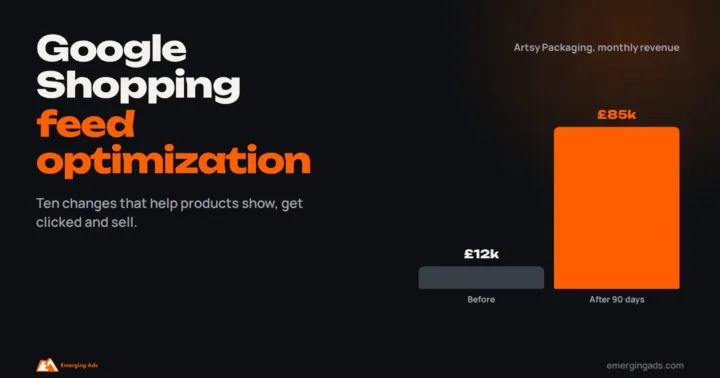
As an example of what useful evidence looks like, our Artsy Packaging case study shows a 71% lower cost per acquisition on the same budget within 90 days, with the specific changes made, and our Simple Seed Baby case study shows 22,606 purchases at 5.30x return on Meta. Ask every agency for this level of detail.
Meet the people who will do the work
The salesperson or founder you meet in the pitch is often not the person who manages your account day to day. Ask to meet the account lead and the specialists who will work on your channels. Ask about their experience, how many accounts they handle, and how continuity is managed when people leave or go on holiday. The quality of those people determines most of what you will get.
Ask how they would approach your business
A good agency will have looked at your website, ads or search presence before the meeting and will have specific observations. Ask:
- What would you look at first, and why?
- What do you think is holding results back today?
- What would the first 90 days look like?
- What do you need from us to succeed?
- How would you measure progress before final results appear?
- What would make you recommend we spend less, or stop a channel?
Specific, thoughtful answers are a strong signal. Generic answers, or a pitch focused on the agency’s awards rather than your business, are not.

Ask how they handle tracking and measurement
Tracking is the foundation of performance marketing, and agencies that take it seriously tend to deliver better results. Ask how they will audit conversion tracking, how they deal with differences between platform reports and real sales, how they measure blended results across channels, and whether they send CRM outcomes back to ad platforms. Our guide to attribution modeling explains why these questions matter.
Look at how they report
Ask to see a sample report. Good reports are short, focused on business outcomes such as revenue, leads, cost per acquisition and return on ad spend, explain what changed and why, and state what will happen next. Reports full of impressions, clicks and screenshots with no business context make it hard to know whether you are getting value.
Compare pricing on scope, not headline fee
Agency pricing varies widely, and comparing headline fees alone is misleading. Compare what each proposal includes: channels, deliverables, seniority of staff, reporting, creative, tools and setup. Our guide on how much to pay a digital marketing agency covers pricing models and hidden costs in detail.
A simple scoring system for proposals
Score each agency from 1 to 5 on the factors that matter most to you, and weight them. A typical set:
- Relevant proof and results.
- Quality and seniority of the team.
- Understanding of your business and quality of their approach.
- Tracking and measurement rigor.
- Reporting and communication.
- Value for money, based on scope.
- Contract flexibility and ownership terms.
- Cultural fit and responsiveness.
The scores matter less than the conversation they force: they make you articulate why one agency feels stronger than another, and they reduce the influence of the most polished pitch.

What a good first call feels like
The first conversation with an agency tells you a lot. Strong agencies spend most of the call asking questions: about your customers, margins, sales process, past results, what has been tried and why it did or did not work. They are curious about the business, not just the ad accounts. They are honest about what they do not know yet and what they would need to find out. They talk about tradeoffs, such as which channel to prioritize with a limited budget, rather than promising everything at once. And they are willing to say that something you are doing is fine and does not need changing.
Weaker agencies spend most of the call presenting: their awards, their client logos, their process slides. They answer questions with general claims rather than specifics, and they recommend the same set of services they recommend to everyone. If you leave the call having learned nothing new about your own business, that is a useful signal.

How to get the most from reference calls
References are only useful if you ask the right questions. Ask how long they have worked with the agency, what results changed and over what period, how the agency handled a problem or a bad month, how responsive and proactive the team is, whether the people they started with are still on the account, and whether they would hire the agency again. Ask what the agency is not good at. Every agency has weaknesses, and a reference who can name one honestly is usually more trustworthy than one who praises everything.
Using one agency or several
Some businesses use one agency for everything; others use specialists for each channel. One agency simplifies coordination, reporting and accountability, and makes cross-channel decisions easier. Several specialists can bring deeper expertise in each channel but create overlap and gaps, especially around tracking, landing pages and attribution. If you use several, appoint one internal owner to coordinate them, agree shared measurement, and make one party clearly responsible for tracking and conversion data across all channels.
Agency, in-house or both?
An agency is not always the answer. If one or two channels drive most of your results and there is enough work for a full-time person, an in-house hire may offer better value and deeper product knowledge. If you need several specialisms, want to move quickly or cannot keep specialists fully occupied, an agency usually makes more sense. Many growing businesses combine both: an in-house marketing lead who owns strategy, budget and internal coordination, and an agency for specialist execution. That structure often gets the best from each, because the in-house lead can brief the agency well and judge its work with business context.
What size of agency suits you?
Large agencies offer breadth, resources and processes, but smaller clients may receive less senior attention. Small agencies often give direct access to experienced people, but have less capacity and fewer specialists. As a rough guide, choose an agency for which your account is meaningful: large enough that it matters to them, small enough that you are not their only client and they have proven processes. Ask directly how your account size compares with their typical client.
What onboarding should look like
The first weeks after signing set the tone for the relationship. A strong agency requests access to ad accounts, analytics, CRM and store data straight away, checks tracking before changing campaigns, asks about margins, customer value and sales processes, reviews past performance and explains what it sees, agrees communication and approval processes, and delivers a written plan for the first 90 days. If onboarding is rushed or generic, raise it early, because the problems rarely fix themselves later.
What to look for by type of business
Ecommerce brands should look for agencies with proven results in paid social, Google Shopping and Performance Max, email and retention, and conversion rate optimization, ideally on the same store platform. Ask how they handle creative production, product feeds and tracking through the pixel and Conversions API, and how they judge results on blended revenue rather than platform-reported return alone.
Lead generation businesses, such as local services, clinics, education and real estate, need agencies that understand lead quality, landing pages and follow-up, not just cost per lead. Ask how they connect leads to your CRM, how quickly leads are followed up, and whether they send qualified lead and sale outcomes back to ad platforms. Our article on CRM automation mistakes shows why this matters.
B2B and SaaS companies need agencies experienced in search, LinkedIn, content and nurture, with patience for long sales cycles and reporting focused on pipeline rather than raw leads.
Local businesses benefit from agencies strong in local SEO, Google Business Profile, local search ads and reviews, with an understanding of the specific area and competitors.
Make sure your budget fits the plan
A frequent cause of disappointment is a mismatch between ambition and budget. An agency proposing five channels on a budget that can only fund one or two properly is setting the engagement up to fail, however good its people are. Ask each agency how it would prioritize your budget, which channel it would start with and why, and what it would not do yet. The best agencies will often recommend doing less, better, at first, then expanding once a channel proves itself. Our performance marketing guide covers realistic budgets by channel.
Making the final decision
When you have scored the shortlist, step back from the numbers and ask a few simple questions. Which team understood our business best? Which one would we trust to tell us bad news early? Whose evidence was most relevant to us? Whose terms let us leave if it does not work? The agency that scores well on those questions is usually the right choice, even if it is not the cheapest or the most impressive presenter.
Set expectations together from the start
Many agency relationships fail not because the work is poor but because expectations were never agreed. Before the engagement starts, agree in writing what success looks like at 30, 90 and 180 days, which metrics will be used to judge it, how often you will meet and who attends, how quickly each side responds to questions and approvals, and what happens if results fall short. Include leading indicators, such as fixed tracking, launched campaigns, improved click-through rates or rising impressions, so progress is visible before final results arrive.
Revisit these expectations at the end of the first phase. If the business has changed, such as a new product, a new market or a different budget, update the goals rather than holding the agency to targets that no longer fit. A good partnership adjusts as the business does.
Insist on transparency
Transparency is one of the clearest differences between agencies worth hiring and those to avoid. You should be able to see your ad accounts at any time, understand where every unit of ad spend goes, see the changes made each month and why, and get straight answers about what is and is not working. Agencies that resist giving access, hide fees inside media costs or report only selected metrics make it impossible to judge value. Ask about transparency directly before signing, and treat any hesitation as a warning.
Red flags
These warning signs come up again and again when businesses tell us about agency relationships that went wrong. Any one of them is worth questioning; two or three together are usually a reason to walk away.
- Guaranteed results, such as guaranteed rankings or a guaranteed return on ad spend.
- Case studies without names, numbers or context.
- Refusal to let you own ad accounts, analytics or content.
- Long contracts without break clauses, signed before any results.
- Vague deliverables, such as “ongoing optimization” with no detail.
- Undisclosed markups on ad spend.
- A pitch team you will never see again.
- Pressure to decide quickly.

Contract terms that protect you
Read the contract as carefully as the proposal. These terms protect you if the relationship does not work out, and a confident agency will accept them without much negotiation.
- An initial phase of around 90 days with defined deliverables and a review point.
- A reasonable notice period after that, commonly around 30 days.
- Ownership of ad accounts, analytics, pixels, domains, content and creative by your business.
- Ad spend billed directly to you by platforms where possible.
- A clear scope and a process for changing it.
- Data protection and confidentiality terms suitable for your business and markets.
What changes in 2026
Agency work has changed with automation and AI. Platforms such as Google’s Performance Max and Meta’s Advantage+ now handle much of the targeting and bidding, so the value an agency adds has shifted towards strategy, tracking, creative, landing pages and testing. AI search, including Google’s AI Overviews and ChatGPT, is changing SEO and content. And AI tools have made basic production cheaper, which means generic work is worth less while genuine expertise is worth more.
When choosing an agency in 2026, ask how they use automation without losing control, how they produce enough creative for social platforms, how they approach AI search and generative engine optimization, and how they use AI in their own work while keeping quality high. Agencies still running 2019 playbooks will struggle.
Choosing an agency in your market
Local market knowledge matters for some channels more than others. For local SEO, local social media and markets with distinct languages and platforms, such as Arabic and English campaigns in the Gulf or regional languages in India, an agency with real experience in that market is a strong advantage. For performance channels such as Google Ads and Meta, strong skills can travel across markets, provided the agency understands local customers, competitors, holidays and regulations. Check time zone overlap and communication expectations if the agency is in another country.
Start with a defined first phase
Rather than committing for a year, agree a first phase of around 90 days with clear deliverables: an audit, tracking fixes, an account rebuild or launch, a set number of tests and a review meeting with results against the starting point. A good agency will welcome this, because it gives them a fair chance to prove value. At the end, both sides decide whether to continue, change scope or part ways.

Making the relationship work
The client side matters as much as the agency. Share real business data, such as margins, customer value, stock and sales outcomes. Approve work quickly. Tell the agency about promotions, launches and problems in advance. Give honest feedback early. Make sure leads are followed up fast, because even the best campaigns cannot fix slow sales responses. And treat the agency as an extension of the team rather than a supplier you check on once a month.
When to switch agencies
Consider switching when results have been flat or falling for two or more quarters without a credible plan, reports avoid business outcomes, recommendations are never followed through, communication has deteriorated, or the people working on your account keep changing. Before switching, hold a frank review; sometimes a change of scope or team fixes the problem. If you do switch, make sure you keep access to every account and asset, and plan a handover so campaigns are not disrupted.
If you would like us to be one of the agencies you compare, our Google Ads, Meta ads, SEO and automation teams can review your situation, and our free ad audit shows exactly what we would change before you commit to anything.
Frequently asked questions
How do I choose a digital marketing agency?
Define your goals and budget, shortlist three to five agencies with proven results for similar businesses, meet the people who will do the work, compare proposals on scope and evidence, and start with a defined first phase.
Should I choose a full-service or specialist agency?
A full-service agency suits businesses wanting one partner across several channels. A specialist suits businesses with one dominant channel or needing deep expertise in a specific discipline.
What questions should I ask a marketing agency?
Ask what they would look at first, what is holding results back, what the first 90 days look like, who will do the work, how they handle tracking, how they report and who owns the accounts.
What are red flags when hiring an agency?
Guaranteed results, vague case studies, agency-owned accounts, long lock-in contracts, vague deliverables, hidden ad spend markups and pressure to sign quickly.
How long should an agency contract be?
A first phase of around 90 days with a review point, then a rolling arrangement with a reasonable notice period, is usually safer than a long lock-in.
Does a local agency matter?
It matters most for local SEO, local social and markets with distinct languages or platforms. For channels like Google Ads and Meta, skills and market understanding matter more than physical location.
How long before I see results from an agency?
Paid media often shows meaningful changes within the first one to three months. SEO and content usually take several months. A good agency sets out what to expect before you start.
When should I change agencies?
When results have been flat or falling for two or more quarters without a credible plan, reporting avoids business outcomes, or communication and follow-through have broken down.