
The short answer
For most growing ecommerce stores, Klaviyo is the stronger choice: it connects more deeply to store data, makes behavior-based flows and segmentation easier, and adds SMS, predictive analytics and reviews in one place. Mailchimp is simpler and often cheaper for very small lists, and suits businesses whose email needs are mainly newsletters and basic automations. The deciding factors are how much revenue you expect from email, how much you rely on segmentation, and how your costs scale as the list grows.
Klaviyo and Mailchimp are the two names that come up most when ecommerce brands choose an email platform. Both send email well. Both have automations, templates and integrations with the main store platforms. On a feature checklist, they can look surprisingly similar.
The differences show up in daily use: how easily you can build a flow triggered by a specific product being viewed, how precisely you can segment customers by what they bought and when, how the pricing behaves as your list grows, and how much revenue the platform can realistically help you generate.
A disclosure before we start. We build most of our clients’ ecommerce email on Klaviyo, because for the stores we work with it usually wins. We have also worked with Mailchimp extensively and recommend it in some situations. We have tried to be fair below, and we explain when Mailchimp is the better call.

What each platform is actually built for
Klaviyo was built for ecommerce from the start. Its core idea is that every customer profile holds everything the store knows about that person: what they browsed, what they bought, how much they spent, when they last ordered, which emails and texts they engaged with. Flows, segments and reports are built on that data. Over time it has added SMS, a reviews product, customer service tools and predictive analytics, positioning itself as a customer data and marketing platform for online brands.
Mailchimp, owned by Intuit since 2021, began as a newsletter tool for small businesses of all kinds, and has grown into a broader marketing platform with email, automations, landing pages, basic CRM features and ecommerce integrations. It is designed to be approachable for people who are not email specialists, and it serves restaurants, consultants, nonprofits and creators as well as online stores.
That difference in origin explains most of what follows. Klaviyo goes deeper on ecommerce. Mailchimp goes broader and simpler.
Feature-by-feature comparison
| Area | Klaviyo | Mailchimp |
|---|---|---|
| Store data integration | Deep, near real-time sync with Shopify and other major platforms, including browsing, cart, order and product data | Store integrations for orders and products; less granular behavioral data in most setups |
| Flows and automations | Flexible flows triggered by events, segments, dates or properties, with conditional splits | Pre-built and custom automations; ecommerce automations available on paid plans |
| Segmentation | Very granular, combining behavior, purchase history, predicted values and engagement | Good for common needs; complex conditions are more limited |
| Predictive analytics | Predicted lifetime value, churn risk and expected next order date, once enough data exists | Some predictive features on higher plans |
| SMS | Built in, sharing profiles, flows and reporting with email | Available in some markets as an add-on |
| Ease of use | Powerful, with a steeper learning curve | Generally easier for beginners |
| Reporting | Revenue attribution by flow, campaign and message, with benchmarks | Clear campaign reporting; ecommerce revenue reporting varies by plan |
| Best fit | Ecommerce brands treating email and SMS as a core revenue channel | Small businesses and stores with simpler email needs |
Both platforms change features and plans regularly, so check current details on each provider’s site before committing.
Why store data depth matters so much
The most valuable ecommerce emails are the ones triggered by what a specific shopper just did. Viewed a product but did not add it. Added to cart but did not check out. Bought a moisturizer 45 days ago and is probably running low. Has ordered three times and spent over a certain amount.
Building those emails requires the email platform to know, quickly and accurately, what each shopper did on the store. This is where Klaviyo’s design shows. Product views, cart activity, orders, refunds and product details flow into each profile, and any of them can trigger a flow or define a segment with little setup.
Mailchimp can handle the core ecommerce automations, such as abandoned cart and post-purchase, once the store is connected. Where it tends to fall behind is in the next layer: combining several behaviors and purchase details into precise segments and conditional flows. For a store sending a weekly newsletter and a few basic automations, that may never matter. For a store expecting email to drive a large share of revenue, it matters a great deal.
Pricing: what the headline numbers do not show
Both platforms price mainly by the size of your audience, with tiers for sends and features. Both offer free plans for very small lists, and both have changed their pricing structures in recent years, so treat any specific number you read, including on this page, as something to verify on their sites.
A few things matter more than the headline price:
- Who counts towards your limit. Klaviyo now bills based on active profiles, meaning people you can actually market to. Mailchimp has historically counted contacts in your audience, including unsubscribed ones, towards plan limits. Check how each currently counts contacts and clean your list regularly either way.
- How pricing scales. At small list sizes Mailchimp is often cheaper. As lists grow into the tens of thousands, the gap narrows and the comparison depends heavily on plan and features needed.
- What is included. SMS, predictive features, advanced segmentation, multiple users and support levels may sit on different tiers.
- Revenue, not just cost. If one platform helps email generate meaningfully more revenue through better flows and segmentation, a higher monthly fee can be the cheaper choice.

A practical way to compare total cost
Estimate your list size today and in twelve months. Price both platforms at both sizes, including the features you will actually use. Then estimate what share of store revenue email currently drives and what it could drive with better flows. For a store with $1M in annual online revenue, the difference between email driving 15% and 25% of revenue is $100,000 a year, which dwarfs the difference in subscription costs.
What the difference looks like in practice
On our Fit Kit Bodycare account, a UK bodycare brand, rebuilding the Klaviyo flows lifted revenue from flows by 29%, with an average flow open rate of 41%. For The Simple Seed Baby, Klaviyo flows running alongside Meta ads helped lift the returning customer rate from 21.62% to 34.81% and average order value from $70.38 to $82.82.
We want to be careful not to credit the platform alone. Those results came from strategy, copy and testing as much as software. But both relied on behavioral triggers and segments, such as purchase history, product categories and time since last order, that Klaviyo makes straightforward to build and maintain.
Templates, design and ease of building emails
Both platforms have drag-and-drop editors and libraries of templates. Mailchimp’s editor is widely considered among the most approachable, and its templates suit a broad range of businesses. Klaviyo’s editor has caught up a long way and adds ecommerce-specific blocks, such as dynamic product recommendations, abandoned cart contents and items related to what a customer bought, which are tedious or impossible to recreate manually.
For most stores, design is not the deciding factor. Simple, clean emails often outperform heavily designed ones, especially in flows. What matters more is how easily you can insert the right product, for the right person, at the right moment, and that is where Klaviyo’s product blocks earn their place.
Signup forms and list growth
An email platform is only as valuable as the list it reaches. Both offer embedded forms and popups. Klaviyo’s forms include targeting rules, such as showing different forms to new visitors, returning visitors or people from specific traffic sources, plus multi-step forms that collect an email first and a phone number second, and A/B testing built in. Mailchimp’s forms are simpler but cover the basics, and many stores using Mailchimp add a separate popup tool.
Whichever you use, the offer matters more than the form. A clear reason to subscribe, such as early access, a useful guide, a quiz result or a first-order incentive, makes far more difference than the popup design.
Reporting and revenue attribution
Klaviyo reports revenue by flow, by individual message and by campaign, using an attribution window you can adjust, and it shows how your results compare with similar businesses. That makes it easy to see which flows earn their keep. Mailchimp’s campaign reporting is clear and its ecommerce revenue reporting has improved, though detail depends on plan and integration.
On both platforms, attributed revenue is generous: a purchase within a few days of opening or clicking an email is usually credited to email, even if the customer was going to buy anyway. Compare platform-reported email revenue with total store revenue over time, and treat attribution as a tool for comparing emails with each other rather than as an exact measure of email’s total contribution.
Integrations beyond the store
Both platforms connect to a large number of other tools. Klaviyo’s ecosystem leans towards ecommerce: reviews, loyalty programs, subscriptions, helpdesks, quizzes and customer data tools. Mailchimp’s leans broader, including accounting, CRM and general small business tools, which suits businesses where ecommerce is one part of what they do. Before choosing, list the tools you already use or plan to use, such as reviews, loyalty or subscriptions, and confirm each integrates natively with the platform you are considering.
Which one fits your store?
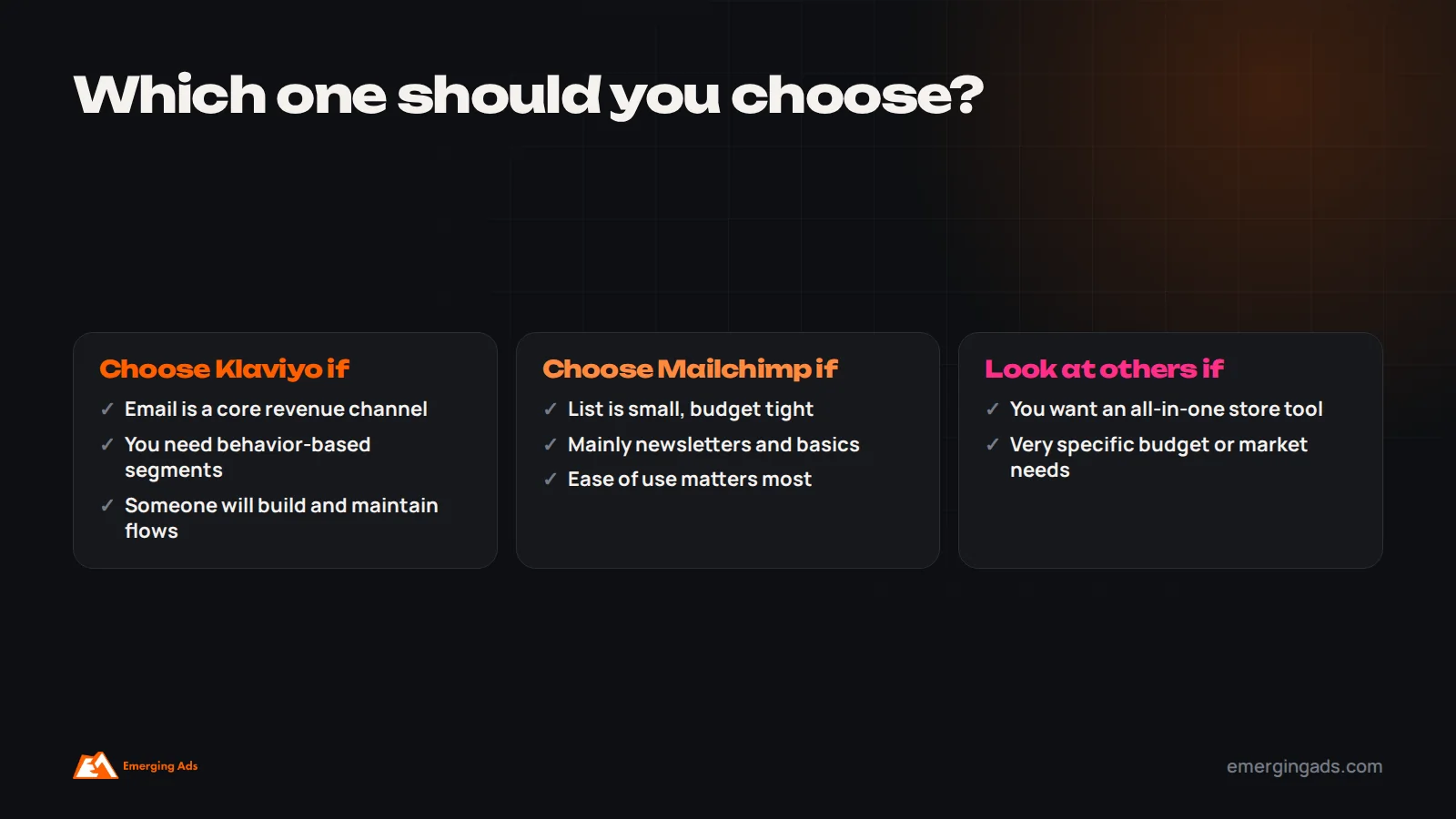
Choose Klaviyo if
- You run on Shopify or another major ecommerce platform and want deep, real-time store data in your email platform.
- You expect email, and possibly SMS, to be a major revenue channel.
- You want flows and segments based on browsing behavior, purchase history and predicted customer value.
- You are scaling paid acquisition and need strong retention to make the economics work.
- You have someone, in-house or an agency, who will build and maintain flows properly.
Choose Mailchimp if
- Your list is small and budget is tight, and you mainly need a newsletter plus basic automations.
- Email is a secondary channel for your business rather than a core revenue driver.
- Ease of use matters more than depth, and nobody on the team will spend time on advanced segmentation.
- You already use Mailchimp or Intuit tools across a business that is not primarily ecommerce.
When neither is the obvious answer
Other platforms such as Omnisend, Brevo and Shopify’s own email tools are worth a look for specific needs, such as very tight budgets or a preference for an all-in-one store tool. The principles in this comparison apply to them too: depth of store data, flow flexibility, segmentation, pricing structure and realistic revenue impact.
How the right answer changes as a store grows
The best choice often depends on stage more than anything else.
Just launched, under a few thousand subscribers. Either works. Mailchimp may be cheaper and easier. If you expect to grow quickly and plan to invest in paid ads, starting on Klaviyo avoids a migration later, and its free tier lets you build the core flows early.
Growing, with paid acquisition and a list in the tens of thousands. This is where Klaviyo’s depth usually starts paying for itself. Retention becomes a big part of profitability, and better segmentation turns into measurable revenue. It is also the stage where most of the migrations we handle happen.
Established, with a large list and a dedicated team. The question becomes less about the platform and more about how well it is used: testing, segmentation strategy, SMS coordination and how email data connects with the rest of the business. At this stage, most ecommerce brands we see are on Klaviyo or a comparable ecommerce-focused platform.
Deliverability: does the platform matter?
Both Klaviyo and Mailchimp have good infrastructure and support the authentication that Gmail and Yahoo have required of bulk senders since 2024: SPF, DKIM, DMARC and easy one-click unsubscribe. In practice, deliverability depends far more on how you use the platform than on which one you choose.
Send to engaged subscribers more often and disengaged ones less, sunset people who have not engaged for a long time, never import bought lists, and set up a dedicated sending domain. Klaviyo’s engagement-based segments make that easier to automate, but either platform can deliver well with good habits.
Switching from Mailchimp to Klaviyo (or back)
Migrations are common as stores grow, most often from Mailchimp to Klaviyo. A clean migration usually takes a few weeks rather than a few days, because the work is more than moving a contact list.
- Audit what exists. List every automation, form, segment and integration in the current platform, and note which are actually performing.
- Export contacts with consent status. Keep subscribed, unsubscribed and suppressed contacts clearly separated. Never re-subscribe people who unsubscribed.
- Connect the store first. Let the new platform sync historical orders and products so segments and flows have data from day one.
- Set up authentication and a sending domain. Then warm up sending gradually, starting with your most engaged subscribers.
- Rebuild the core flows, improving them rather than copying, starting with abandoned checkout, welcome and post-purchase. Our guide to the five essential ecommerce email flows is a good blueprint.
- Replace signup forms on the site, and update any other tools sending data to the old platform.
- Run both briefly, then switch off the old flows so nobody receives duplicate emails.
Plan the switch for a quieter trading period, not the weeks before a major sale such as Black Friday, so any teething problems do not land on your busiest days. Our Black Friday marketing checklist covers what else needs to be ready ahead of peak season.
The most common migration mistake is rushing the warm-up and sending a full-list campaign from the new platform on day one, which can damage sender reputation before the new setup has proven itself.
What about SMS?
SMS can add meaningful revenue for ecommerce, especially for abandoned checkout, launches and time-sensitive offers, but it is more intrusive and more expensive per message than email. Klaviyo’s advantage here is that SMS shares the same profiles, flows and reporting as email, so you can coordinate them, for example sending a text only to people who did not open the email. Mailchimp offers SMS in some markets but with a less integrated approach.
In some markets, particularly the Gulf, India and much of Asia, WhatsApp is more natural for customers than SMS. If that applies to you, consider whether your email platform connects well with a WhatsApp tool. Our WhatsApp marketing team often runs WhatsApp alongside Klaviyo email for stores in those markets.
The skills question nobody asks
The most powerful email platform is worth very little if nobody uses its features. Before choosing, be honest about who will run email. A founder spending an hour a week will get more from a simple, well-set-up Mailchimp account than from a half-configured Klaviyo account. A dedicated marketer or an agency will get far more from Klaviyo’s depth.
If you choose Klaviyo but do not have the time to build it out, it is worth getting help with the initial setup: flows, segments, forms and reporting. After that, ongoing campaigns are much easier to manage in-house. Our explainer on how Klaviyo email marketing works covers the setup in more detail.
Our verdict
For an ecommerce store that sees email as a serious revenue channel, Klaviyo is usually worth its higher cost at scale, because the depth of store data and segmentation translates into more relevant emails and more revenue. For a small store or a business where email is mainly a newsletter, Mailchimp is a perfectly sensible, simpler and often cheaper choice.
Whichever you choose, it is worth revisiting the decision once a year as your list, revenue and team change. The right platform at launch is not always the right platform at scale, and migrations are much easier when they are planned rather than forced by a pricing change or a missing feature.
The worst choice is picking either one and leaving it half set up. If you would like help deciding or building it properly, our Klaviyo email marketing and wider email marketing teams work on both platforms. For ideas that apply whichever you choose, read how to improve results with ecommerce email marketing.
Frequently asked questions
Is Klaviyo better than Mailchimp for ecommerce?
For most growing online stores, yes. Klaviyo integrates more deeply with store data and makes behavior-based flows and segmentation easier. Mailchimp is simpler and often cheaper for small lists with basic needs.
Is Klaviyo more expensive than Mailchimp?
Often at small list sizes, though the comparison depends on plan, features and how each counts contacts. Compare total cost at your expected list size and weigh it against the revenue email can generate.
Does Mailchimp work with Shopify?
Yes, Mailchimp connects to Shopify through an app that syncs customers, orders and products, and supports core ecommerce automations such as abandoned cart on paid plans.
Can I switch from Mailchimp to Klaviyo without losing subscribers?
Yes. Export contacts with their consent status, connect your store to Klaviyo, authenticate your sending domain, warm up sending gradually and rebuild your key flows. Keep unsubscribed contacts suppressed.
Which platform has better deliverability?
Both have strong infrastructure. Deliverability depends mostly on authentication, list hygiene and sending to engaged subscribers, which you control on either platform.
Does Klaviyo include SMS?
Yes, Klaviyo includes SMS, sharing the same profiles, flows and reporting as email. Availability and pricing vary by country.
Is Mailchimp good for small online stores?
Yes, especially for stores with small lists and simple needs such as a newsletter, welcome email and abandoned cart. It is easy to learn and affordable at small sizes.
What are alternatives to Klaviyo and Mailchimp?
Omnisend, Brevo and Shopify’s own email tools are common alternatives. Compare them on store data depth, flow flexibility, segmentation, pricing structure and support.